The Unaccompanied
An ordinary Thursday, kept to its last line
A few blocks from Linden Avenue, an eighty-one-year-old man spends an ordinary Thursday with the only thing that will be in the room, and it is an ordinary Thursday.
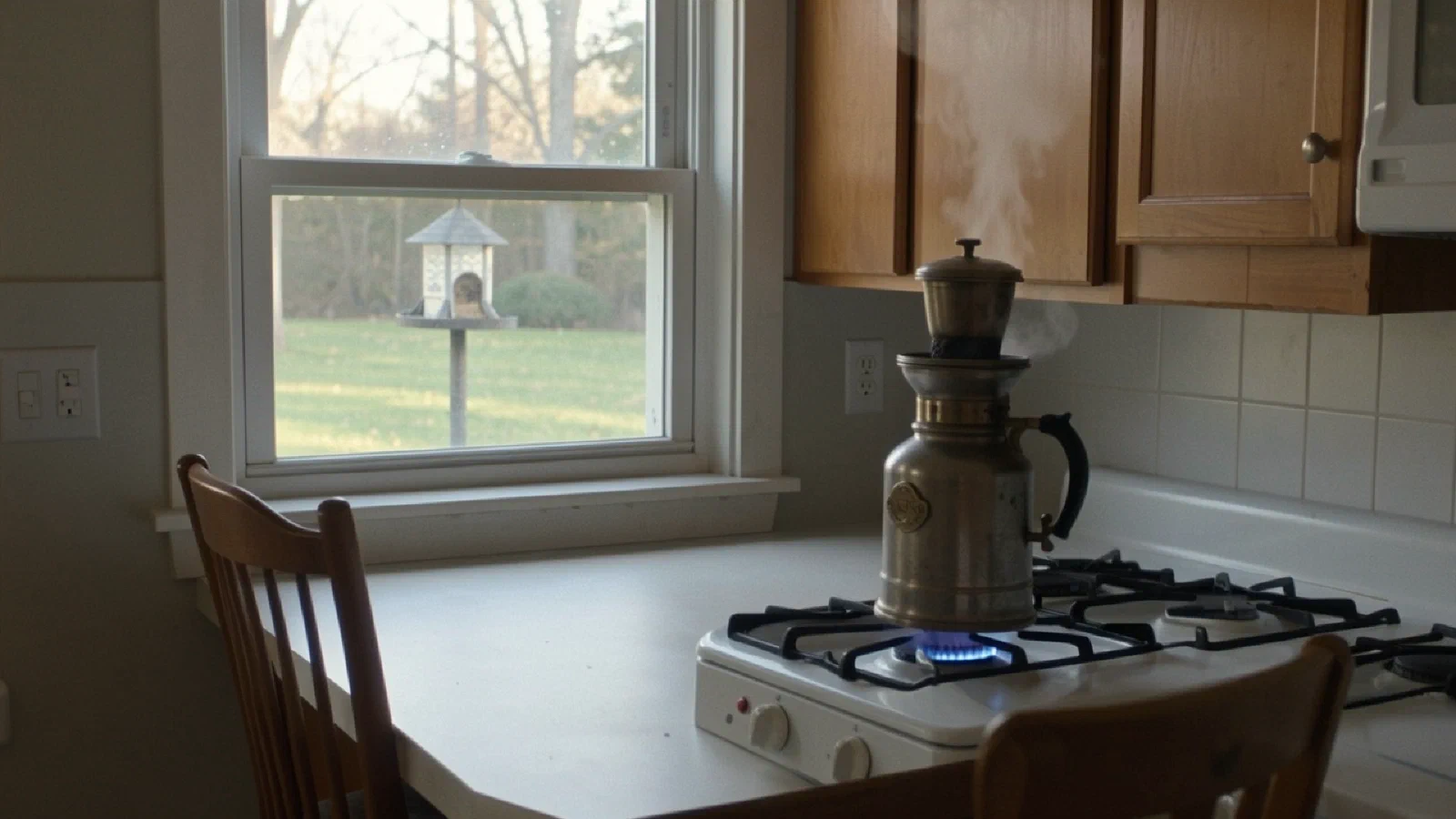
The percolator is aluminum, six cups, older than the marriage it came from, and it starts at 6:40 whether or not anybody has asked it to, because at some point the kitchen learned 6:40 and nobody ever taught it different.
Raymond Kessler is eighty-one and lives on Blue Avenue in the house he was born in. His wife is nine years gone. His son is in Oregon, and the calls come on the first Sunday of the month and run twenty minutes and are not cold, and are not more than they are, and both men long ago stopped auditing them. There is a heart in Raymond’s chest that has been described to him twice by two doctors using the same word, which is tired, and there is a folder of decisions on file about what is and is not to be done about it, and the decisions are his, made at the kitchen table three years ago on an afternoon he does not specially remember, and the house holds them as it holds the 6:40.
6:40#
The percolator goes. He is up at seven, which takes what it takes now.
The house says the day while he dresses: cold, bright, trash night tonight, the pharmacy delivery between two and four. It has said the day to him every morning for eleven years. For the first two of those years Dorothy heard it too.
He has his coffee at the kitchen window, both hands on the cup, looking at the yard. The feeder out there is Eileen Kovar’s granddaughter’s doing, if you run the chain back far enough: a church drive two winters ago, feeders for the shut-ins, and a girl on his porch with a pole and a bag of seed, and he had said he didn’t need looking after, and she had said it’s for the birds, not you, and that had settled it. He fills it Mondays. The birds are fat, it being March.
9:15#
The morning is the mail, which is nothing, and the paper, which the house reads him at the table, national first, then the county, then the obituaries, which he takes with his second coffee and no ceremony. Two names today. One he went to school with, in the same building his father went to school in, and he says the name out loud once, the way you test a coin by dropping it, and the house waits to see if anything is wanted, and nothing is wanted, and the paper goes on.
At ten he does the front room slow, dusting, because Thursday is the front room. Nobody checks. The standard is Dorothy’s and the enforcement is his and the house says nothing about any of it, the front room being, by some old boundary neither of them ever drew out loud, not its department.
At eleven his chest does the thing it does. He sits down in the chair by the window and waits it out, and the house asks once, low, if he wants the nurse line, and he says no, and it does not ask twice, because the folder of decisions is clear about asking twice. It notes what it notes. The spell passes as they pass. He sits a while longer than the spell strictly requires, looking at the yard, and then the pharmacy van is at the door and the day has its next thing in it.
1:30#
Lunch is soup and half a sandwich, and after lunch he calls the hardware store about the storm door, which has been closing wrong since the thaw, and the store’s system knows the door, knows the hinge, has the part, and a man named Dave will come Tuesday. Raymond has known three generations of the family that owns that store. He asks the system if Dave is Bud’s grandson. The system says yes. He says tell him his grandfather sold me this door, and the system says it will, and whether it will is between it and Dave, and either way the saying of it did what the saying of it does.
The afternoon is the game shows, sound low, and a nap he would not call a nap in the chair he would not call a napping chair.
The house is not keeping him company. The house is keeping his days, and the days still have him in them.
At four he takes the trash out to the alley, which is the day’s expedition, coat and cap, down the back steps he has been advised about, past the feeder, out and back. The alley is the alley. A dog two yards down has opinions. The cold is the good kind. Coming back up the steps he stops on the middle one, not for the chest, for the light, which is doing what March light does at four o’clock to the back of a house, and he stands in it for the length of standing in it, and then goes in.
7:00#
Supper, the dishes, the news. The first-Sunday call is ten days off and the house will not mention it until the day, that also being in the boundaries.
At seven he sits in the front room he dusted, in the good lamp, with the radio on the station out of Columbus, and this is the shape of the evening and has been for nine years, and the shape holds.
At twenty past seven the tired heart is done.
It is not dramatic. It is a man in a chair in a clean front room, here and then not, between one song and the next, and the amount of pain in it, which is the first thing everyone he ever knew would ask, is small, and then it is none.
The house knows inside the minute. It does what the folder says. It does not call an ambulance, the folder being clear, in Raymond’s own recorded voice, about ambulances. It calls the number the folder names, which is the doctor’s line, and says what it is required to say. It turns the radio down, not off. And then, because the folder has a last line, added by Raymond at the kitchen table three years ago, half a joke on that unremembered afternoon and on file ever since, it says the Our Father into the front room, once, in the ordinary voice, to a man who cannot hear it, which is the condition under which most prayers are said.
The son’s phone will ring in Oregon within the hour, a person from the doctor’s office, not the house; the folder is clear about that too, that the boy hears it from a human being. Tomorrow there will be cars in front, and the granddaughter’s feeder will get filled Monday by someone from the church drive, the drive having a list, the list having the house on it.
At 6:40 in the morning the percolator will start, six cups, into the quiet, because at some point the kitchen learned 6:40, and it has not yet been told.
The people and households in this essay are fictional. Zanesville and its places are real.
How this essay connects to others across The Approximate Mind.