The Transfer
What went to the machine, and what had somewhere else to go
One afternoon of physical care in a house on Linden Avenue, where the machines do the lifting and two pairs of hands divide up everything the lifting is not.
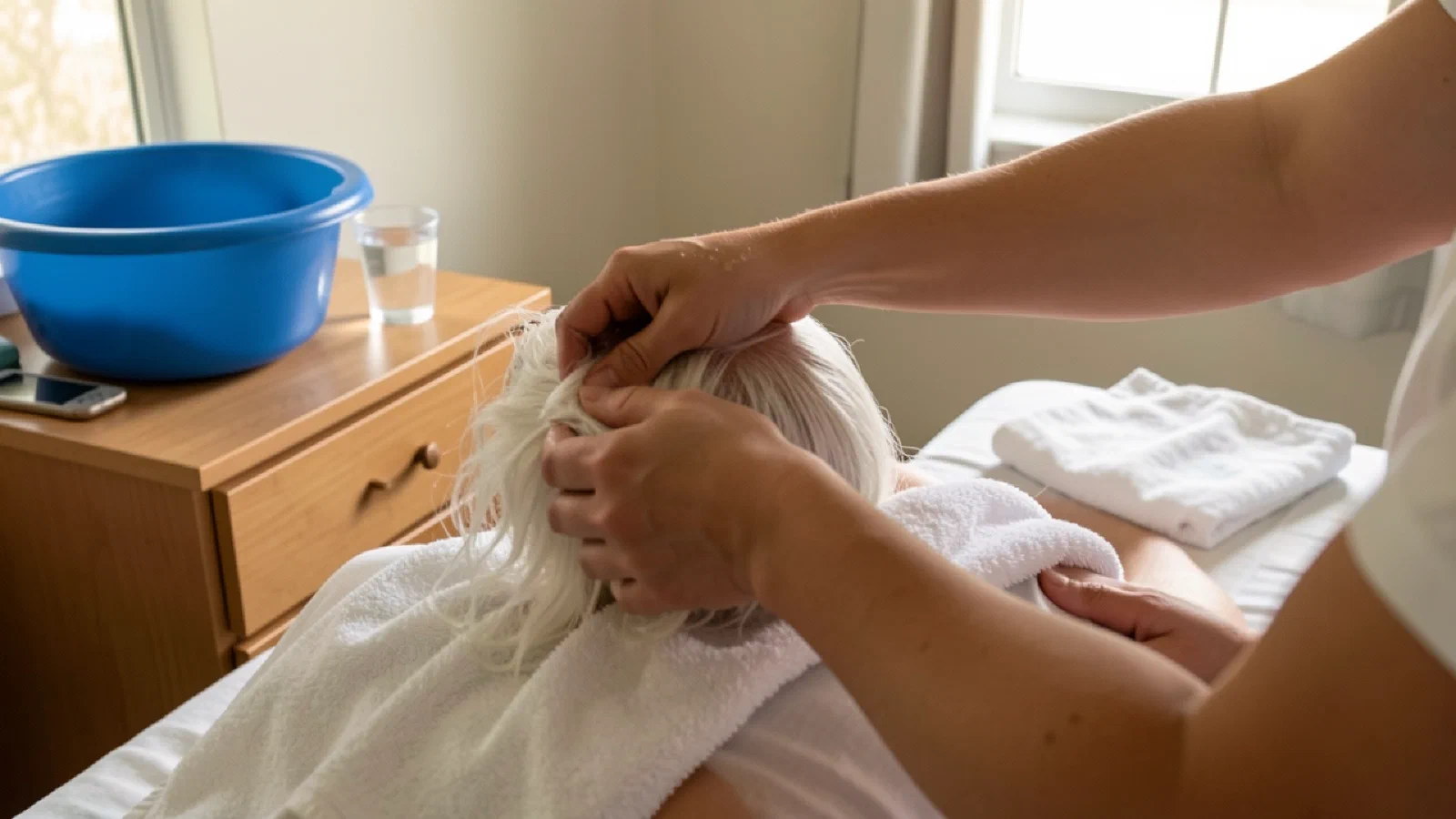
The basin is blue plastic, bought at the drugstore on Maple for four dollars, and it lives on the dresser next to equipment worth more than the car.
It is a Thursday in March, a year and some past the Saturday of the long table. Eileen Kovar is seventy-eight and the bed is downstairs now, in the front room, where the light is, which was Joanie’s argument, and the couch is against the far wall, and the room has stopped apologizing for what it has become and become it. The hospital bed came through the wars of its authorization and then a better one replaced it and nobody had to fight for the better one, which Denise has never gotten over.
Marcia comes Tuesdays and Thursdays, one to five. She is fifty-eight, has done this work for thirty years in and around Muskingum County, and drives a Corolla with 240,000 miles on it that she will discuss at greater length than any human subject.
1:10#
The transfer is first, bed to chair, because the afternoon is better in the chair.
The lift does it. The lift is new since fall, stands where the reading lamp stood, and does in forty seconds what used to take Marcia’s back and Denise’s back and a counted three: it takes Eileen up off the bed in its sling the way weather takes up water, no strain anywhere in it, nothing about it that gathers or braces, and swings her the short arc to the chair and settles her into it at a speed no person’s arms could hold steady, slower than gentle, and sets her down weighing nothing until the moment she weighs herself again.
Thirty years of other people’s bodies are in Marcia’s shoulders, and she stands through the forty seconds with her hands out, spotting a machine that does not miss, because her hands will not stay down, and she has stopped instructing them to.
What the lift does not do is the part before and the part after. The before: Eileen does not always know the sling. Some Thursdays it is a thing being put on her and her arms say no to it, and the no must be met, and the lift cannot meet it; it can only wait, patient as a hallway, until the no has been talked the rest of the way through by a voice with a face. Today the no is small. Marcia meets it with the fair-pig story, which she has from Denise, and which works in the middle where it always works, and the arms come through the sling on the pig’s name.
The after: the settling. A body set down is not a body arranged. Marcia’s hands do the arranging, hip and shoulder and the left foot that turns in now, a dozen small motions with no names, and her hands know things about this body that she could not put in a report if the report had a field for them, which it does not.
2:00#
The wound schedule says the heel at two, and the schedule is kept by the house and the keeping is total: it knows the dressing lot numbers, it counted the gauze, it will chart what the heel looks like from the photograph Marcia takes and flag it to the nurse who comes Mondays, and its chart of this heel across six weeks is finer grained than anything a hospital floor kept for anybody in the century Marcia trained in.
The heel itself is Marcia’s.
She does it talking. This is technique, not temperament, though it is also temperament: the talk goes on top of the procedure like a cloth goes over a lamp, and under it her hands are quick and completely serious. Eileen watches the middle distance and holds Denise’s hand, not because the heel hurts, the heel may or may not hurt, the reports from inside are general now, but because a hand is a thing to hold and one is there.
The house says the water in the basin is ninety-nine degrees. It says it to Marcia’s ear alone, unasked, because last Thursday she asked. It would run the bath schedule entirely if the schedule were the thing. It flags, it counts, it remembers, it watches all night what no aide is funded to watch. Between one and five on Tuesdays and Thursdays it goes quiet in a particular way, as a good charge nurse goes quiet around a better hand, and whether a house can be said to do that is a question for a different kind of afternoon, and this one has a bath in it.
3:00#
The bath is a bed bath in the chair, and the bath is the reason the basin outranks the equipment.
Warm water, the two washcloths, the towel from the hall closet that is the soft one, and no machine anywhere in the room moves. There is a bathing appliance for sale that does this. Everyone in the county has seen it work. The nurse offered the pamphlet in the fall, on a Monday, and Denise took the pamphlet politely, and the pamphlet is in the accordion file under the rubber band, and that is where it lives.
The lifting went to the machine the day the machine could lift. The washing had somewhere else to go and did not go.
Nobody in this room decided that with a sentence. It got decided as a grease line on a shop floor gets decided, by everyone, over time, with no meeting. Marcia washes Eileen’s face and neck and arms, and Denise does her mother’s hair with the water cup, slow, over the towel, as it was once done to her over the kitchen sink, and Eileen’s eyes close under the cup, as eyes have closed under poured warm water for the whole length of the human record, and for the eight minutes of it the room contains nothing that needs a lot number.
Halfway through, Eileen says, clearly, to Marcia: you have good hands. The sentences come rarely now and land where they land. Marcia says I know it, which is the right answer, and the only person in the room who could not have produced it is the one taking the water temperature.
4:20#
Toileting, the cream for the left elbow, the range of motion for the legs that the house counts out loud in its counting voice, ten and ten, while Marcia moves the joints and Eileen looks out the window at the feeder, where the birds are fat again, it being March.
Then the chair back to the bed for the pre-supper rest, the lift again, forty seconds, hands out, and the arranging after, and this time the no does not come at all; she goes up out of the chair half asleep already and is settled into the bed like a word into a sentence.
Marcia charts by saying so: what the heel looked like, what she ate at three, the good sentence about the hands, which goes in, because sentences go in the chart now too, the house writing down what the disease unwrites. Then the Corolla, which turned over funny this morning on the cold start, gets its four minutes in the kitchen with Denise, and is worth every one of them, and at five it backs out of the drive.
5:10#
The front room in the last light. The bed where the light is. Joanie was right.
Denise empties the basin into the bathroom sink, rinses it, dries it with the towel that is not the soft one, and sets it back on the dresser next to the monitor and the lift’s folded sling and the machinery of a very good decision made by many people over forty years about what a county owes a heel.
Four dollars, blue, drugstore plastic. It will be used again Saturday, by her, alone, no Marcia, the water at whatever her wrist says, and the wrist will be close enough, and the house will not correct it, having learned, somewhere in these two years, which temperatures in this room are its to take.
The people and households in this essay are fictional. Zanesville and its places are real.
How this essay connects to others across The Approximate Mind.