The Recipe Box
The card that assumed a kitchen that knew the rest
Two years after the word, a woman in Zanesville makes her mother’s apple dumplings for Sunday dinner, and it goes well, and how much of it was her is a question the kitchen has arranged for nobody to ask.
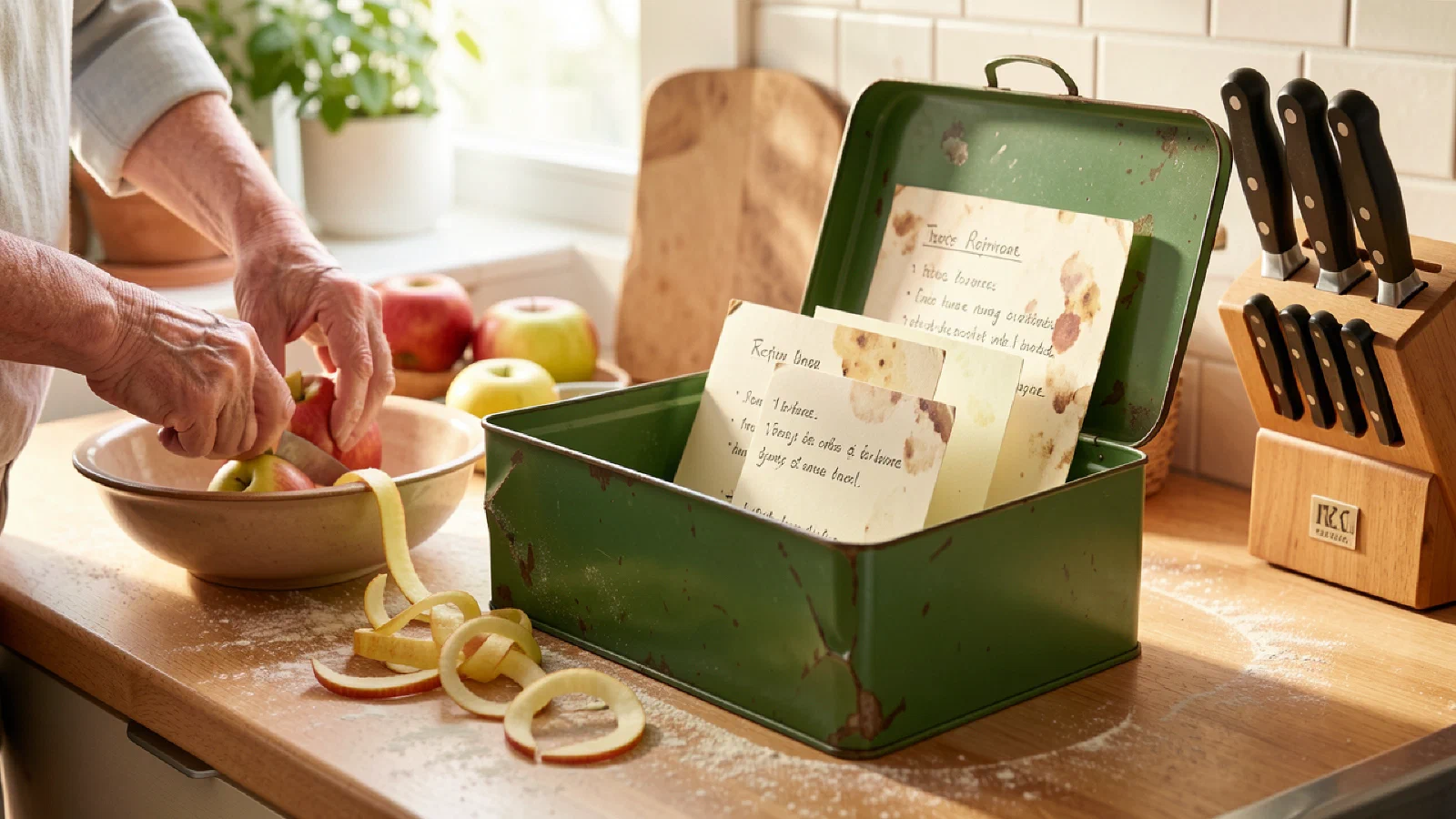
The recipe box is green tin, dented at one corner from a fall off a shelf in 1988, and the cards inside are in three hands: her mother’s, her own, and her own from before.
The dividers say what dividers say. Pies. Meats. Christmas. The card for the apple dumplings is her mother’s, pencil, grease-spotted at the top right where a thumb held it for forty years, and it begins, as her mother’s cards all begin, with no list of anything. Peel six good apples. Her mother assumed a kitchen that knew the rest.
Eileen Kovar is seventy-six. It is Sunday, and the family comes at five.
8:30#
The morning has a shape and the shape is the house’s.
It walks her through the pills by color, which is new since spring. It says the stove is hers until noon, which is how the arrangement gets said, as if the stove were a car and noon were a curfew, and neither of them has ever used the word arrangement. The coffee is going when she gets downstairs. Church is at ten and the car comes at twenty of.
At church she sits where she sits. The word has never crossed at church. She said it to Denise on the Thursday after the drive home, two years ago, in this kitchen, and Denise cried and then made a list, because Denise is a person who makes a list, and the word has moved outward from that list on a schedule Denise manages: the family first, then Father Steve, then the two women from the altar society Eileen has known for forty years, and there it has stopped. At coffee hour a man asks how she’s keeping and she says old, which gets the laugh it has gotten since before any of this, and is still true, and still does the work.
12:00#
The apples are on the counter when she gets home. She did not put them there and does not wonder who did, because the answer is the same answer as the coffee.
She takes down the box and finds the card fourth in Pies, where it does not belong and has always been.
Peel six good apples.
She peels them. Nobody has taken the peeler from her. The knife for quartering comes out of the block, and the block is lighter than it used to be, three knives now where there were nine, and the three are the ones that will not do much to a reaching hand, and she has noticed this exactly once, last winter, and by supper it had gone wherever such noticings go now.
The card says a syrup and stops describing it halfway. Her mother knew the rest. She knew the rest, for fifty years, and now the kitchen says it, quietly, at the moment the sugar is in her hand: a cup and a half, and the water on first. It does not say she was reaching for the flour. It has a way of saying what comes next that never says what almost came instead.
The kitchen is not correcting her. The kitchen is finishing her mother’s sentences.
That is one way to put it, and on Sundays it is how the whole house puts it.
The Afternoon#
The dough she does from the shoulder, no card, and the dough is fine. The dough will always be fine. The hands are the last to go, everyone says, though nobody around her says it, and she has not heard it said since it became about her.
At two the oven takes the pan and tells her forty minutes, and she goes to the front room, and this is the part of the day where the day gets thin.
She means to read. The house reads to her now, has for a year, her eyes being what they are, which is the sentence she uses, her eyes, and nobody has pressed on it, though her eyes tested fine in March and the tester and the house and Denise all know it and she may know it too, at whatever depth such things are known. Today she does not ask for the book. She sits with the afternoon light doing what it does to the carpet, and at some point the afternoon folds in the middle the way afternoons do now, and it is four o’clock arriving like a guest with no car in the drive, and she has been nowhere, and the house says nothing about the hour except the hour.
The dumplings came out at 2:40. She has no memory of the oven and no burn and no ruined pan, because the oven turned itself over at forty minutes exactly and held the pan warm, and what she has instead of the memory is the smell of the house, which says, to her and to everyone who will walk in at five, that it went well.
She wakes the front door at half past four by standing near it with intent, and it asks where she is going, mild, as it asks now, and she says the porch, and it agrees to the porch. There was a night in June behind that question. Nobody has told her about the night in June. She was there for it and it is gone, and the question stayed, and she treats the question as she treats the pills by color, as a thing the house does, the house having gotten particular in its old age, which is a joke she makes, and which gets a laugh that is a beat too quick every time she makes it.
5:00#
They come at five and the table takes them all.
Denise, who lives here now and left at noon to make this an arrival. Erin down from Columbus with a boy whose name Eileen was told in the car and told again on the porch by a voice only she could hear, so that she says Tyler at the door like a woman who never dropped it. Joanie on the wall screen from Pittsburgh for the meal, propped where the china cabinet’s glass used to reflect the table, saying it smells amazing, which is a thing you can apparently say now from Pittsburgh, and everyone lets it be true.
The dinner is a dinner. The chicken is Denise’s. The dumplings come out at the end in the pan her mother used, and they are right, the syrup right, the crust right, and Erin says nobody else’s taste like this, and Eileen says it’s the card, and this is the moment the essay of the family writes itself in the family’s head: she’s doing so well.
She is doing so well. Sitting at the head of the table with the pan in front of her, she is a woman who cooked for her family, and every person at the table holds a different account of how true that is, and the range of those accounts is the range the house permits, and the house permits a wide one, and no one has ever asked it for the narrow one.
Denise, clearing, at the sink, looks at the oven for a second longer than the oven needs looking at.
8:15#
They go as Sundays go, in cars that pull out quietly and one screen that says goodnight from Pittsburgh.
Denise does the kitchen. Eileen dries, which is hers, and puts things where they go, and two of the things will be somewhere else by morning, moved back by nobody, and the somewhere she put them will not be mentioned, and this is the deepest of all the kitchen’s kindnesses and the one with the longest bill.
At nine the house starts the downstairs in its order. The pills by color. The stairs with the light that walks up ahead of her now, one tread at a time.
The green tin box stays on the counter, out, because she means to look through Christmas before Christmas. The card is back in Pies, fourth, where it does not belong, in the grease-thumbed pencil that assumed a kitchen that knew the rest.
The kitchen knows the rest.
The people and households in this essay are fictional. Zanesville and its places are real.
How this essay connects to others across The Approximate Mind.