The Next Room
The daughter, the portal, and the part with no shift
The daughter who moved back spends a Tuesday on hold with three systems about her mother’s care while her mother, in the next room, is having one of the good days.
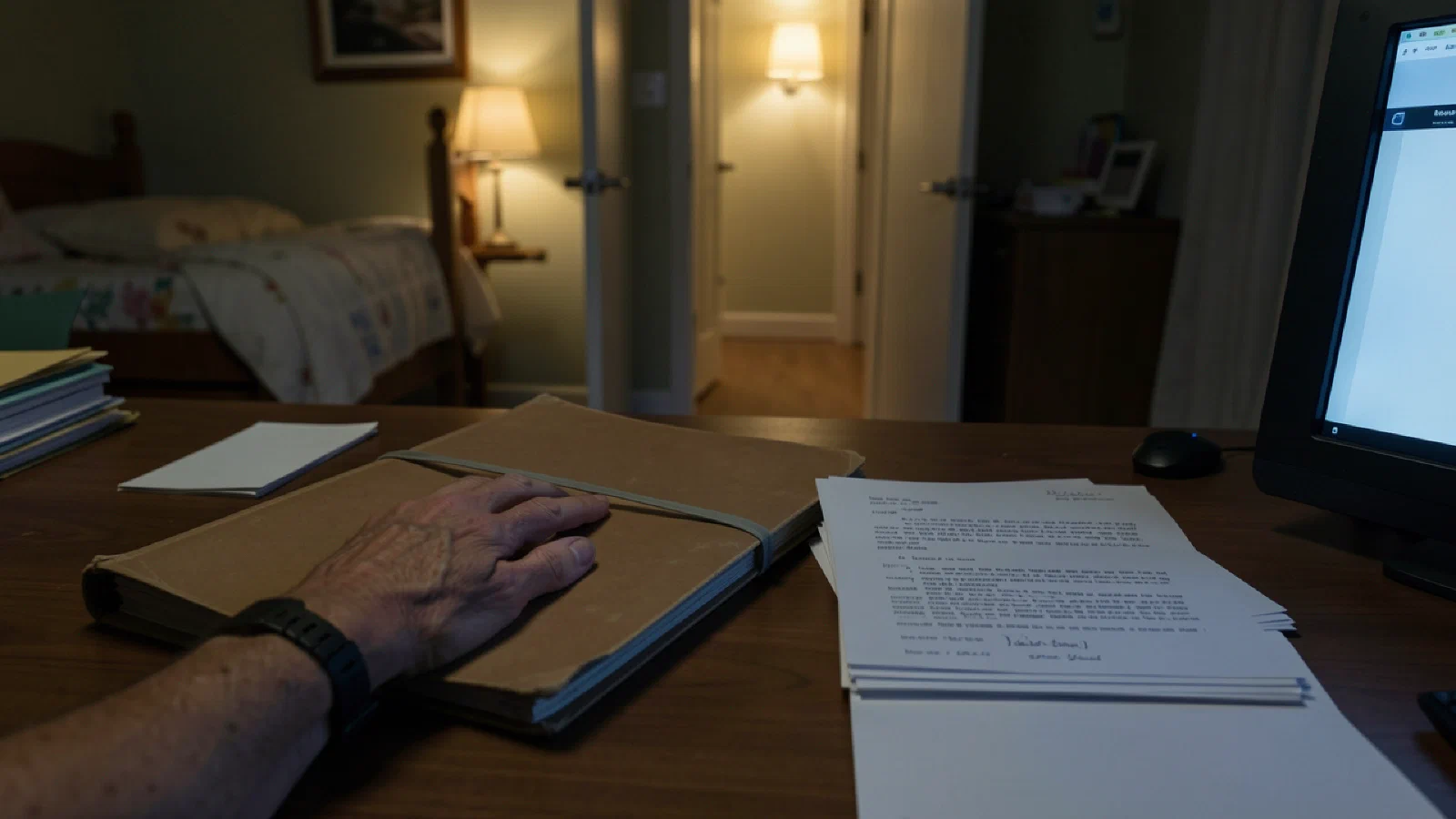
The accordion file is brown, bought in 2009 for taxes, and the rubber band that closes it is the fourth rubber band.
Denise Kovar is fifty-one. She has lived in her mother’s house on Linden Avenue for two years, in her own girlhood room, which she repainted the first month because sleeping inside 1989 was not survivable, and the file lives on the desk in that room, and the desk is the war office, and nobody calls it that out loud except her, once, to Joanie, who laughed and then didn’t.
The file is nearly empty. That is the joke of it. Everything is in the portal now, every claim and denial and letter, held perfectly forever by systems that never lose anything. The file holds the eleven things that still arrive on paper, and she keeps it because a rubber band around a thing is a way of knowing where the thing is that no portal has ever offered her.
5:50#
She wakes before the house would wake her, which the house has learned, and so it no longer tries.
The night report is waiting, spoken low while her feet find the floor. Up once at 2:10, the bathroom, back in bed by 2:25, steady, no wandering, oxygen fine, slept through till twenty till. It watched all night. It has watched every night for two years, and this is the fact of her life that Denise can least explain to the friends she left in Columbus: that she sleeps. That the 3 a.m. of the caregiver, the one in every account she read that first terrified month, is a room she has never had to live in, because something else stands in it, all night, every night, without being thanked.
She showers. She is downstairs by 6:20. Coffee going. Her mother sleeps till 7:30 now and the ninety minutes are hers, and she spends them where she always spends them, at the kitchen table with her own tea going cold, doing the day’s paperwork before the day’s person is awake.
8:40#
Her mother is up, dressed with the closet’s help, at the table, and it is a good day. Denise can tell inside the first minute, and could not tell you how. Today the first minute is her mother saying the birds have gotten fat, which they have.
A good day means Eileen holds the morning and Denise holds the phone.
The hospital bed is the project of the week. The doctor ordered it Thursday. The supplier cannot deliver it until the insurer authorizes it, the insurer’s system wants a form the doctor’s system says it sent, and between those two sentences is where Tuesday goes. The portal shows the request as pending. It has shown pending for four days. Pending is not a status, she has decided; pending is a place, and she knows every road in it.
She calls the supplier. The supplier’s voice system is pleasant and bottomless, and knows her, and tells her what the portal told her in the same words, and the words have a rhythm now like a rosary said badly. She asks for a person. This is the skill she has grown that she never wanted: she knows, now, on the third pleasantry, exactly which kind of system can be gotten past and which kind has no past to get to.
The person, when the person comes, is in Tennessee and kind and powerless in a slightly different shape than the system was, and the difference is the morning’s whole yield: the form is not missing, it is misfiled against the wrong plan year. A human made that error or a system did. The person in Tennessee cannot say which and cannot fix it, but can name the department that can, and the naming takes until 9:55.
In the next room her mother is telling the house about the fat birds, and the house is agreeing in the voice it keeps for her, the older, slower one, and the two of them go on like that, like a kettle and a radiator, all morning.
11:00#
What the house takes, it takes whole. What it cannot take, it leaves whole, and the line between runs through the middle of every hour.
It holds the medication schedule down to the minute and the color. It watched the night. It caught the fall in June before it finished happening, some grammar of a stumble it knew in the half second where a stumble decides, and had the neighbor there in four minutes and Denise’s car turning around in six. It reads the bulletin, finishes the recipes, walks the light up the stairs. It does, Denise has said to Joanie, everything but the part where you have to be a daughter.
At eleven it says, privately, into her ear alone, that her mother has asked what day Frank’s funeral is three times since nine.
It does not say what to do. It has never once said what to do. Whether three times is the disease breathing or the disease advancing, whether to answer the fourth ask with the truth again or with a change of subject, whether today’s good day is turning and Erin’s visit Saturday should move up, whether to tell Gary, what to tell Gary, whether her mother in some cellar of herself knows the answer and is asking about the funeral because she wants to talk about Frank and no one will start: the house holds every fact that bears on all of this and not one ounce of its weight.
The night shift was never the hard part. The hard part is the part with no shift.
She goes in and sits down and talks about Frank for twenty minutes. Best twenty minutes of the day. Nobody authorized them.
1:30#
Lunch happens, is cleared. Her mother settles into the front room and the afternoon, and the afternoon will fold on her as it does, and the house will sit inside the fold with her where Denise cannot follow.
Denise takes the war office. The benefit review is the afternoon’s front: the annual redetermination, forty minutes of portal, uploads the state’s system wants that the state’s other system already has, a video interview slot three weeks out that she takes because the two-days-out slot vanished while she was reading it. She does it all with her headphones half on, one ear kept bare for the next room, which is a way of sitting she did not have to learn because every mother of a toddler already knows it, and she was one once, in another life, in Columbus.
At 2:40 the misfiled form comes loose in Tennessee or wherever forms are, and the portal’s pending turns to approved without ceremony, and the bed will come Thursday, and no one anywhere apologized, and she puts both fists over her head alone in her girlhood room like a woman whose team has scored.
Twenty minutes later a letter arrives, paper, in the actual mail, stating that the request has been denied, dated four days ago, from the plan year the form was misfiled against. It is void. It voids nothing; it is simply from an earlier layer of the earth. She puts it in the accordion file with the other eleven things, under the fourth rubber band, and this is what the file is for: the paper trail of a country that no longer runs on paper and still bleeds it.
4:15#
Gary calls at 4:15, which is 1:15 in Phoenix, his lunch.
He asks how Mom is and she says good day, and means it, and he is glad, and his glad is real, and it lasts four minutes because the flight prices for Christmas are the actual agenda, and she gives the agenda its four minutes. He says at the end, like always, that she is a saint, and the word goes into her like a splinter goes in, small and standing up, and she says the thing she says, somebody local had to, which is drier than a saint would put it, and he laughs, and they hang up on the laugh, which is the best either of them can currently do and both of them know it.
She starts dinner. Her mother drifts in to dry things, which is hers.
9:30#
The house walks her mother up at nine, light by light.
Denise sits at the kitchen table with the day’s last tea and the portal open one more time, not because anything is pending, but the way a farmer looks at a field in the dark. Approved is still approved. Thursday still says Thursday.
Upstairs the house is telling her mother tomorrow’s weather, unasked, because her mother sleeps better knowing, a fact about her that nobody alive taught it.
The rubber band goes back around the file, four years old and going gray in the way of rubber, and it will not last the winter, and there is a drawer in the war office with more where it came from.
The people and households in this essay are fictional. Zanesville and its places are real.
How this essay connects to others across The Approximate Mind.