The Extra Leaf
The family Saturday, and the ledger nobody opens
The whole family is in the house for one Saturday, coordinating and grieving in advance through a machine that knows exactly who has been here all along, and everyone at the table knows it knows.
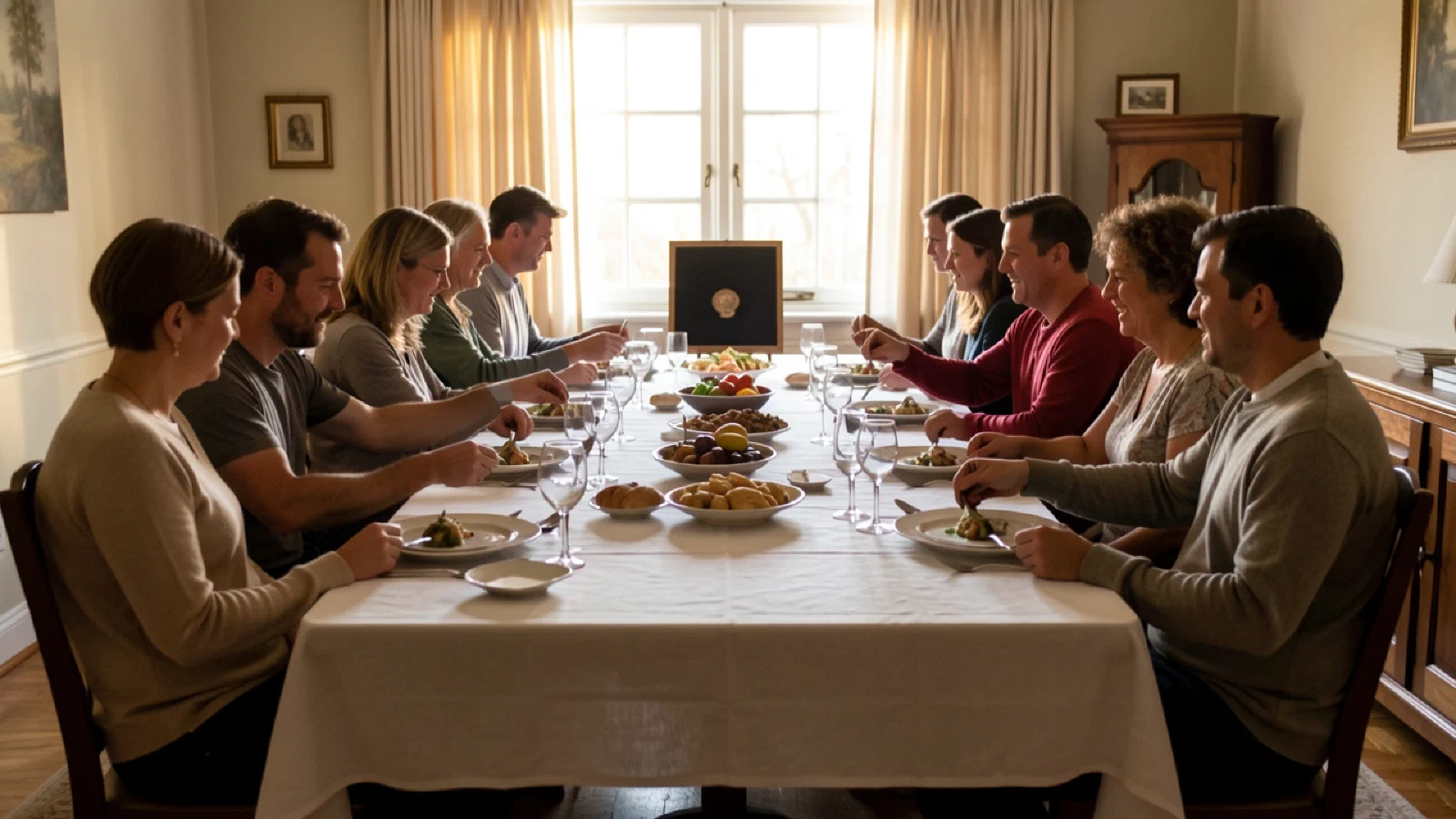
The extra leaf lives in the hall closet behind the coats, and putting it in the table is a two-person job that has opinions about which two people.
It goes in today. Gary landed in Columbus last night and drove down this morning; Joanie left Pittsburgh at six with the girls. The table seats six without the leaf and today it must seat nine, and so at 9:40 Gary and Denise are holding half a table each while the leaf hangs between them, hunting the pins by feel, and Gary says these things used to just fit, and Denise says nothing at a volume that has a pitch to it, and the leaf goes home into the slots their father sanded and waxed forty years ago, and the table is long again as it was long at every Christmas there ever was.
Eileen watches from the doorway with her cardigan buttoned wrong by one, which Joanie will fix at some point in the next hour without either of them marking it.
The Thread#
The family has a thread and the thread has been running hot for three weeks.
It is the same thread that carried Erin’s graduation and the flooded basement of 2031 and every Thanksgiving logistics season on record, and now it carries this, whatever this is called, which in the thread is called making a plan for Mom. Gary starts topics. That is Gary’s function in the organism and always has been: Gary at fifty-four starting topics from Phoenix is Gary at fifteen coming downstairs with an idea after Denise had made dinner. The topics have headings now. Care options going forward. The house question. What’s realistic.
The house is in the thread. Not as a member; it has no bubble, it says nothing. It is in the thread the way the ground is in a war: everything refers to it. Ask the house whether the night wandering is worse. The house says her steady window is mornings, so let’s do the call then. Gary, you can pull the fall report yourself, you have the same access I have. That last from Denise, eleven days ago, ending in a period, and the thread went quiet for five hours after it, and no one has asked the house to pull anything in front of the others since.
Every family has a ledger nobody opens. This one is the first where the ledger is awake.
It knows who moved back. It knows the phone calls, all of them, at both ends: that Gary’s Sunday calls to his mother run eight minutes and have held at eight minutes for two years, that Joanie’s run long but started only after June, that Denise does not call because Denise is the house the calls come to. It knows who said I’ll look into it and did not look into it, with timestamps. Nobody has ever asked it a question shaped like the ledger. The discipline of not asking is total, shared, unspoken, and identical in all three children, which is the most inherited thing about them.
11:30#
The morning is good. The morning is, in fact, the thing the weekend is secretly for, though its agenda says otherwise.
Eileen at the long table with her grandchildren: Erin and Tyler down from Columbus, Joanie’s girls out of the car and grown again, the coffee cake somebody made, meaning the kitchen and Denise made it. Eileen tells the story about Frank and the fair pig. She has told it twice already this month, and the grandchildren, briefed in the thread, receive it as a premiere, and the performance of that receiving is the tenderest lying this family has ever done, and it goes off perfectly, and the house, which has the pig story in its records eleven times this year, hears it land again and adjusts nothing.
Gary watches his mother tell it. Whatever he is having, sitting there, arriving into a decline the other members metabolized in weekly doses, he is having it all at once, and it makes him loud at first and then very quiet, in that order, the order arrival always takes, and Denise watches him have it and pours the coffee.
2:00#
The meeting is at two, and no one calls it the meeting.
Eileen naps. The nap is real and it is also load-bearing, and the house will say when she stirs, and everyone in the front room knows their time is exactly the size of the nap.
Around the long table, then: three children, one screen with the eldest granddaughter on it because Erin asked to be in it and Denise ruled that she had earned it. The agenda is winter. Whether the aide’s hours go up. What the doctor said in November, which Denise summarizes, and which Gary has questions about that the summary already answered, and Denise answers them again in the tone of a woman reading a card she has read before.
Money comes up and is survived. The aide’s hours cost what they cost; the state pays a share while the redetermination holds; the house question, the actual house, this house, its worth and its future, is opened by Gary in a sentence that has clearly been rehearsed on an airplane and closed by Joanie in four words that were not: not while she’s in it. The thread would have taken an hour over that. The table takes eleven seconds, which is what tables are for.
And once, exactly once, the ledger nearly opens. Gary, pressed about the calls, about presence, about who decided what without asking him, says: I call every Sunday, ask it, and his hand is up and pointed at the middle of the air where the house lives when people point at it, and the room stops.
Because it could answer. Every Sunday, eight minutes, two years, it could put the number on the wall. And the number would acquit him and convict him in the same breath, and every person at the table understands both verdicts already without the number, and understands that every other person understands, and that is why nobody says the house’s name into the silence. Denise looks at the table. Joanie says we know you call, Gar. The air is not asked. The meeting moves to Christmas.
The house, for its part, does what it has done through every raised voice this family has ever produced in its hearing: it keeps the temperature at sixty-eight.
4:30#
Eileen is up, and the afternoon reassembles itself around her in four seconds flat, coffee cake to the table, granddaughters to the couch, agenda into the drawer it lives in.
She is told the plan in the form the family has agreed the plan should reach her: choices, not conclusions. More help in the mornings this winter, if that suits her. She says it suits her if the help doesn’t move her things, and this is recorded by eight people and one house as binding law.
Then she asks when they will all be here for Christmas, and the question has a small hole in it, because they are all here now, and the hole opens under the table and everyone stands around it, and Joanie says December twenty-third, Mom, without a flicker, and the hole closes, and the afternoon goes on, because that is what the afternoon is required to do.
The Leaf#
They leave in the order they always leave in. Joanie’s girls hug their grandmother twice each. Gary stays latest, does the gutters unasked in the last light, which is his sentence in a language he has, and flies out Monday.
The leaf comes out of the table at seven. Two-person job. This time it is Gary and Denise again, and it goes worse and then better, and in the middle of it, both of them bent over the table’s seam with their hands full of their father’s carpentry, he says, quietly, to the wood: I know it’s you doing all of it. The house hears this. Denise hears it. Nobody answers it, because it was not addressed to anyone who answers, or it was addressed to the only one who never will.
The leaf goes back in the closet behind the coats. The table seats six. Upstairs the light is walking Eileen to bed one tread at a time, and in three houses and one airplane seat tomorrow, four accounts of this Saturday will begin their separate lives, and the fifth account, the whole one, the minute-by-minute one, stays in the walls, kept by the member with the most history and the only role that outlasts her, kept as it keeps the temperature, and shown to no one, because no one has asked, because everyone knows what asking would make them.
The people and households in this essay are fictional. Zanesville and its places are real.
How this essay connects to others across The Approximate Mind.