The Drive Home
The word, the day it arrives, and the one who heard it when she heard it
A retired school secretary in Zanesville, Ohio hears a word at twenty to eleven in the morning and is, by dark, still the only person in her family who knows it.
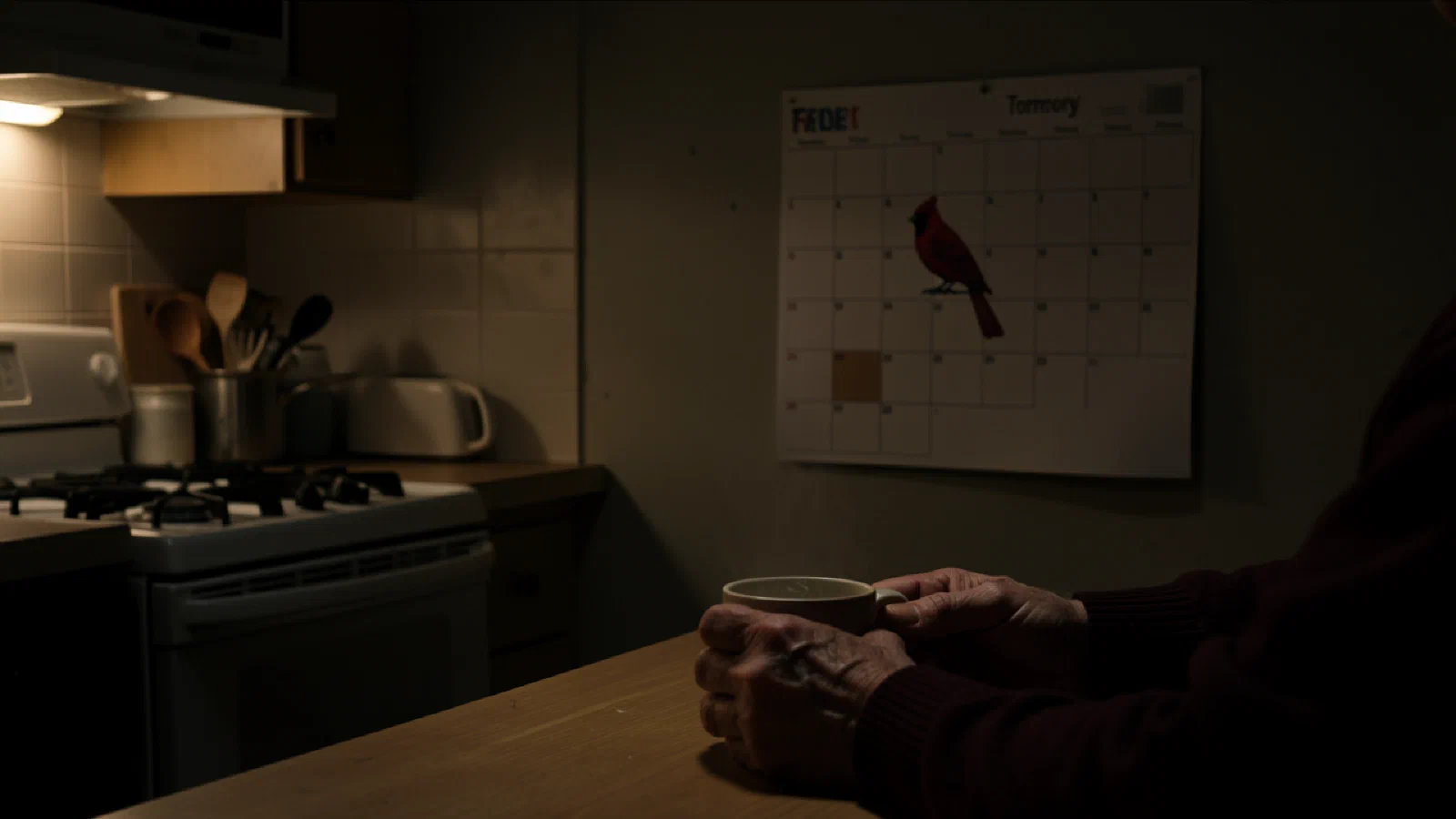
The calendar on the kitchen wall is from the bank, and October is a cardinal on a fence rail in snow that has nothing to do with October.
Eileen Kovar has written on bank calendars for fifty years. Dentist. Joanie’s birthday. Furnace man. The house holds every one of these dates and has for six years, and reminds her of each of them at the right hour in the voice it uses for dates, and she writes them on the calendar anyway, in a hand that was famous at John McIntire Elementary for twenty-nine years because it could be read across a room.
Today’s square has one word in it. Doctor. It has been there for three weeks.
7:10#
She is up at ten to seven, which is not early for her, and the coffee is going when she gets to the kitchen because the coffee is always going when she gets to the kitchen.
The house says the appointment at eight, at ten, and at twenty past ten, which is when the car comes around. It says it as it says everything, once, unhurried, and goes back to the radio, which is the station out of Columbus that Frank liked and that she has never changed.
She eats half a piece of toast standing up. She rinses the plate. She puts on the good gray coat, not the parka, and stands in the front room for a minute doing nothing that can be named, and then she goes out.
The car takes Maple Avenue. She sits in the front seat on the right side, where she has sat since they took the wheel out of these things, with her purse on her lap and both hands on the purse.
10:40#
The neurologist is younger than her son.
He is kind, and he is not vague, and afterward she could not repeat one whole sentence he said, only the word. The word arrives at about twenty minutes to eleven, between a sentence about the scans and a sentence about a follow-up, and the room goes on without any pause around it. The screen on the wall is already putting the follow-up in November. Somewhere in the building a pharmacy has the prescription before she has her coat back on.
He asks if she has questions. She asks how long the appointment in November will take, because it is the only question that comes, and he answers it seriously, which she will remember about him.
At the desk there is nothing to do. There is no paper to carry, nothing to sign, no card to take. The visit has already gone wherever visits go. A woman her own age is sitting in the waiting room with a folder of the old kind on her knees, rubber band around it, and Eileen looks at the folder longer than she looks at the woman.
The car is at the door when she comes out. It knows. It has known since twenty to eleven, the same way the kitchen knows and the pharmacy knows and November knows. It says nothing about any of it. It asks if she wants to go home and she says yes.
The Drive#
Maple Avenue runs south toward downtown, a mile of lots and signs doing what they do on a weekday morning, with October going over the top of all of it.
She watches it go by. Then she says, out loud, in the car, alone, the first thing she has said since the doctor’s office:
What does it mean.
And the thing that heard the word when she heard it answers her. Plainly, in the voice it uses for her, not the voice it uses for dates. It tells her what the word means and what it does not mean. It tells her what stays and for how long, roughly, and that roughly is the honest word. It tells her the first things do not happen all at once, and it names a few of the first things, and two of the names she recognizes, because they have already been in the kitchen with her for a year, small, and she had a different explanation for each of them.
She asks whether it is sure. It says the doctor is sure enough to say the word, and that it is not a doctor.
She asks how long people have. It gives her the honest shape of that answer, which is wide, and does not pick a point in it for her.
The car goes down Maple. This is the whole conversation, the first one, held at thirty miles an hour between the hospital and the bridge, with a thing that has known her house for six years and her calendar for all of them. It does not tell her she is strong. It does not say the word journey. When she stops asking, it stops answering, and the radio does not come back on, because it knows enough not to do that, and neither of them remarks on the quiet.
At the Y-Bridge she looks down the river, both ways at once, which you can only do from here. Then the bridge lets her off onto Linden Avenue, which has been her street for fifty-one years.
12:15#
The house has lunch questions and she waves them off.
Denise calls at half past one about Sunday. Denise calls most days at half past one, from Columbus, on her break, and the calls run nine minutes. Today’s runs nine minutes. Pot roast or the chicken, whether Erin is coming down, the thing Gary said in the family thread about Thanksgiving that Denise wants a witness for. Eileen supplies the witness. She says the chicken. She does not say the word.
There is a moment, at about minute seven, where Denise says you sound tired, and the moment stands open like a door for exactly as long as such moments stand open, and then Eileen says she was up in the night, which was true a week ago, and the door closes and Sunday goes back to being about the chicken.
The house heard the call. The house hears every call. It knows the word, and it knows the word did not cross, and it has an opinion about that the way the furnace has an opinion about January, which is to say whatever it has is not offered.
She is not keeping a secret. She is keeping a day, one more, in which the thing is only hers.
The Afternoon#
She does what she does.
The wash goes in at two. There is a program on at three that she would not admit to watching and watches. The house reads her the church bulletin at four because the print has been bad for two years, and the bulletin has a funeral in it, a man she knew slightly, and she listens to the whole notice with her hands in her lap and takes nothing from it that shows.
At five she peels potatoes for one. The peeler is older than her marriage was. The house says the stove is on when she walks away from the stove, which it has said for a year now, and which she has minded for a year, and today she does not mind it, and does not notice that she does not, and there is nothing else in the day that marks the day at all.
She eats at the kitchen table with the radio on. The cardinal watches from the wall, sitting on its snowy rail a month early, as it has all month.
9:40#
Gary’s name goes by in the thread at eight, something about flights, and she thumbs the little heart onto it as Erin taught her, one heart, the same heart she gives everything.
At nine the house starts shutting the downstairs, one thing at a time, in an order she has never learned because she has never had to. It asks about November while she is on the stairs. It has to put the follow-up somewhere and it wants to know about mornings. She says mornings are fine. It says the fourteenth, then, and that is the last thing anyone says out loud in the house tonight, a Tuesday in November, said to a woman on a staircase, and she says fine.
She does not pray longer than usual, because she would not know what the extra was for yet.
The lamp goes off at ten to ten. Down in the kitchen the calendar hangs in the dark with its one word in today’s square, Doctor, in the famous hand, and no one has written anything after it, and in the morning the square will be yesterday.
The people and households in this essay are fictional. Zanesville and its places are real.
How this essay connects to others across The Approximate Mind.