Window 4
The democracy of the line
TAM-WTR.05 · The Waiting Room · The Approximate Mind
Margaret’s license photo from the 2018 renewal is, she believes, the best photo anyone has ever taken of her. She does not know why. Something about the light in that room, or having a good day, or the way the woman behind the camera said “look here” in a tone that was not bored but was also not performing interest, a professional neutrality that somehow relaxed Margaret’s face into something she recognized as herself.
She has told her daughter this. Her daughter laughed and said it was a DMV photo, and Margaret said she knew that, and something in the way she said it made her daughter stop laughing and look at it again and say, actually, yes, you do look good in that one.
The license is expired now. She renewed online last year. Three minutes. No line. No Window 4. Her new license arrived in the mail with a photo that is her passport photo from 2015, which she has always hated, because the passport office had fluorescent light and she had not slept well and her face in the photo is the face of someone who is enduring the process rather than participating in it.
She keeps the old license in her wallet anyway, behind the library card.
Number 47#
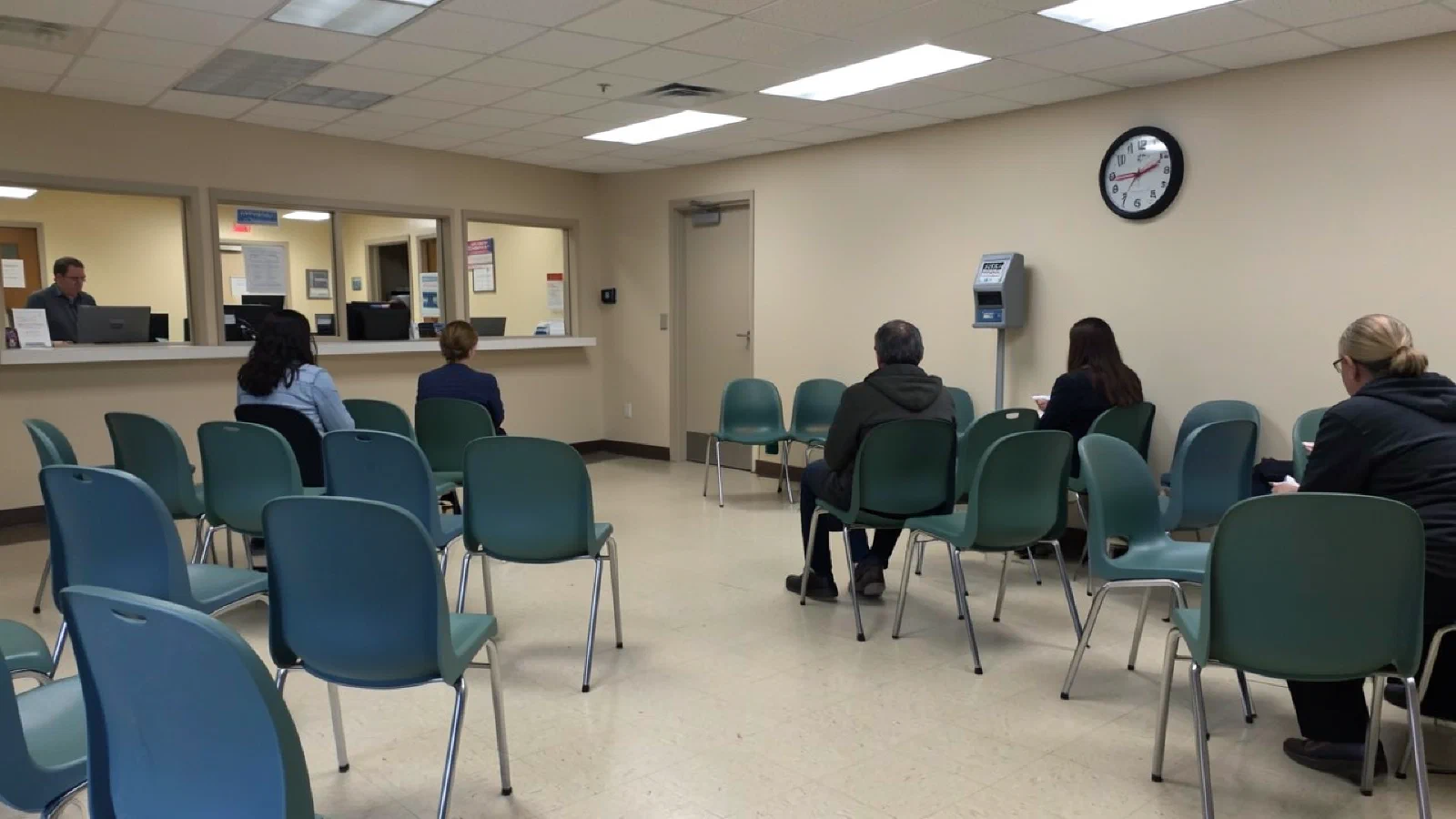
In 2018, Margaret took a number. Forty-seven. The room was full. The plastic chairs were arranged in rows, the kind of chairs that exist only in government buildings and have a specific color that is not quite blue and not quite green and has no name in any paint catalog Margaret has ever seen. The floor was linoleum. The clock on the wall was the kind with the red second hand that moves in small, visible ticks, and Margaret watched it for a while because there was nothing else to do.
She waited forty minutes. In those forty minutes she sat next to a young man who was getting his first license, whose mother was with him, whose mother was more nervous than he was. On her other side, an older woman who had just moved to town and needed to transfer her registration and who asked Margaret whether the town was a good place to live, and Margaret said yes without thinking about it, which was the truth, and said it in a way that made the woman smile and say thank you in a way that meant it.
Window 4 was called. The woman behind the counter had worked there for eleven years. Margaret knows this because she said so while processing the license, unprompted, the way people do when they have been in the same place long enough to feel it is worth mentioning. Eleven years behind the same counter, processing the same forms, taking the same photos. She had developed a rhythm with the camera that produced, on this particular Thursday in 2018, the best photo anyone had ever taken of Margaret.
The Democracy Nobody Named#
The DMV was sorted by nothing. Rich and poor, old and young, every neighborhood, every occupation, every level of education, in the same plastic chairs doing the same thing. The line did not care who you were. The number did not know your income. The wait was the same for the person in the suit and the person in the work boots and Margaret in the cardigan she has worn to errands since 2004.
Nobody experienced this as democracy. Nobody sat in those plastic chairs and thought, this is civic solidarity. They thought, this line is long, and this chair is uncomfortable, and the clock’s second hand is moving slowly. The inconvenience was what they noticed. The democracy was the thing they could not see because they were inside it.
What the DMV provided, without intending to, without anyone designing it, without anyone measuring it, was the one institutional experience that selected for nothing except citizenship. You were there because you lived here. Everyone else was there for the same reason. The waiting was democratizing in the literal sense: it produced a cross-section of the community that no other institution in town could produce, because every other institution sorted by something. The church sorted by belief. The school sorted by age and neighborhood. The grocery store sorted by income and preference. The DMV sorted by nothing at all.
The accidental cross-section produced accidental encounters. The young man’s mother talked to Margaret about the town. The woman transferring her registration asked for a recommendation and received one. These encounters were not meaningful in any individual sense. They were small, forgettable, the kind of conversation that evaporates by the time you reach the parking lot.
But they were encounters with people Margaret would not otherwise have met, in a room whose composition she would not otherwise have experienced, in a posture of shared inconvenience that produced, without anyone noticing, a kind of civic knowledge: this is who lives here. These are my neighbors. We are all waiting for the same thing.
The Online Renewal#
Margaret renewed online last year. Three minutes. She confirmed her address, her vision status, her organ donor preference. She paid the fee. The confirmation arrived by email. The license arrived by mail.
Nobody misses the line. This is important to say clearly, because the argument that follows sounds like nostalgia for a thing nobody enjoyed, and it is not. The DMV line was uncomfortable, time-consuming, sometimes humiliating. The chairs were bad. The wait was unpredictable. The experience of being number 47 in a room of sixty people with a clock whose second hand ticked visibly was not pleasant. Nobody is arguing for the return of the line.
What is gone is not the line. What is gone is the room.
The room was the only place in town where you waited alongside a genuine cross-section of your community for a shared civic purpose, and nobody has noticed its absence because nobody noticed its presence.
The app that replaced the room is better by every measure the room was designed to meet. Faster. More convenient. No parking required. No chairs. No wait. The app is the correct solution to the problem the DMV was designed to solve: processing license renewals efficiently.
The app is not a solution to the problem the room solved by accident: the experience of shared inconvenience across demographic lines, which was a form of civic solidarity that nobody called civic solidarity because it just felt like waiting.
I wonder whether the cross-sectional encounter, the accidental democracy of shared inconvenience, can be rebuilt intentionally, or whether it only exists as a byproduct of friction, and whether removing the friction removed the only condition under which it was possible.
The Wallet#
The new license arrived in an envelope. Margaret put it in her wallet, in the slot where the license goes, in front of the library card. The photo is the passport photo from 2015. She looked at it once and put it away.
The old license, the one from 2018, the one with the good photo, is still in the wallet. She moved it to the back, behind the insurance card, behind the library card, behind everything. It is not a valid form of identification. It is not useful for anything.
She keeps it because the photo is the best photo anyone has ever taken of her, and it was taken by a woman who had worked at Window 4 for eleven years and who had a rhythm with the camera that produced, on that particular Thursday, something that Margaret recognized as her own face looking back at her as if the face approved of who it saw.
The DMV is now a website. The chairs are in a storage facility somewhere, or in a landfill, or in another government building where they are continuing their long, uncomfortable service. The clock with the red second hand is keeping time in a room Margaret will never sit in again.
The photo is in the wallet. The wallet is in the purse. The purse is on the hook by the door where it has hung since Harold installed the hook in 1993.
References#
Putnam, Robert D. Bowling Alone: The Collapse and Revival of American Community. Simon & Schuster, 2000.
Klinenberg, Eric. Palaces for the People: How Social Infrastructure Can Help Fight Inequality, Polarization, and the Decline of Civic Life. Crown, 2018.
Anderson, Elijah. “The Cosmopolitan Canopy.” The Annals of the American Academy of Political and Social Science, vol. 595, no. 1, 2004, pp. 14–31.
Oldenburg, Ray. The Great Good Place: Cafés, Coffee Shops, Community Centers, Beauty Parlors, General Stores, Bars, Hangouts, and How They Get You Through the Day. Paragon House, 1989.
de Tocqueville, Alexis. Democracy in America. Translated by Harvey C. Mansfield and Delba Winthrop, University of Chicago Press, 2000.
How this essay connects to others across The Approximate Mind.
- Putnam, Robert D. Bowling Alone: The Collapse and Revival of American Community. Simon & Schuster, 2000.
- Klinenberg, Eric. Palaces for the People: How Social Infrastructure Can Help Fight Inequality, Polarization, and the Decline of Civic Life. Crown, 2018.
- Anderson, Elijah. “The Cosmopolitan Canopy.” The Annals of the American Academy of Political and Social Science, vol. 595, no. 1, 2004, pp. 14–31.
- Oldenburg, Ray. The Great Good Place: Cafés, Coffee Shops, Community Centers, Beauty Parlors, General Stores, Bars, Hangouts, and How They Get You Through the Day. Paragon House, 1989.
- de Tocqueville, Alexis. Democracy in America. Translated by Harvey C. Mansfield and Delba Winthrop, University of Chicago Press, 2000.