The Public Living Room
The institution that survived by abandoning its original purpose
TAM-WTR.04 · The Waiting Room · The Approximate Mind
Margaret has had a library card since 1971. Same number. She has never lost it. It lives in the same slot in her wallet where it has always lived, behind the driver’s license and in front of the insurance card, in the order she arranged them when the wallet was new, which was 1998, which was the last time she bought a wallet.
The card is worn soft at the corners. The lamination has separated on one edge. The number is still legible. She has renewed it, she thinks, six times. Each renewal produced a new card with the same number, and each time she considered whether to throw away the old one, and each time she did not, and the old ones are in a small envelope in the filing cabinet next to the mortgage document in its manila folder. She does not know why she keeps them. She keeps them.
On Thursday afternoons Margaret goes to the library. She goes for the large-print books, which she reads one per week, sometimes two, mostly mysteries, sometimes the historical novels her daughter recommends. She could order the books online. She could read them on a tablet, which her daughter also offered to set up, which Margaret declined without explaining why, because the explanation would have required saying something about the weight of a book in her hands that she did not want to have to defend.
She stays because the chairs are good and the light is good and there is no reason she has to leave.
The Unsorted Room#
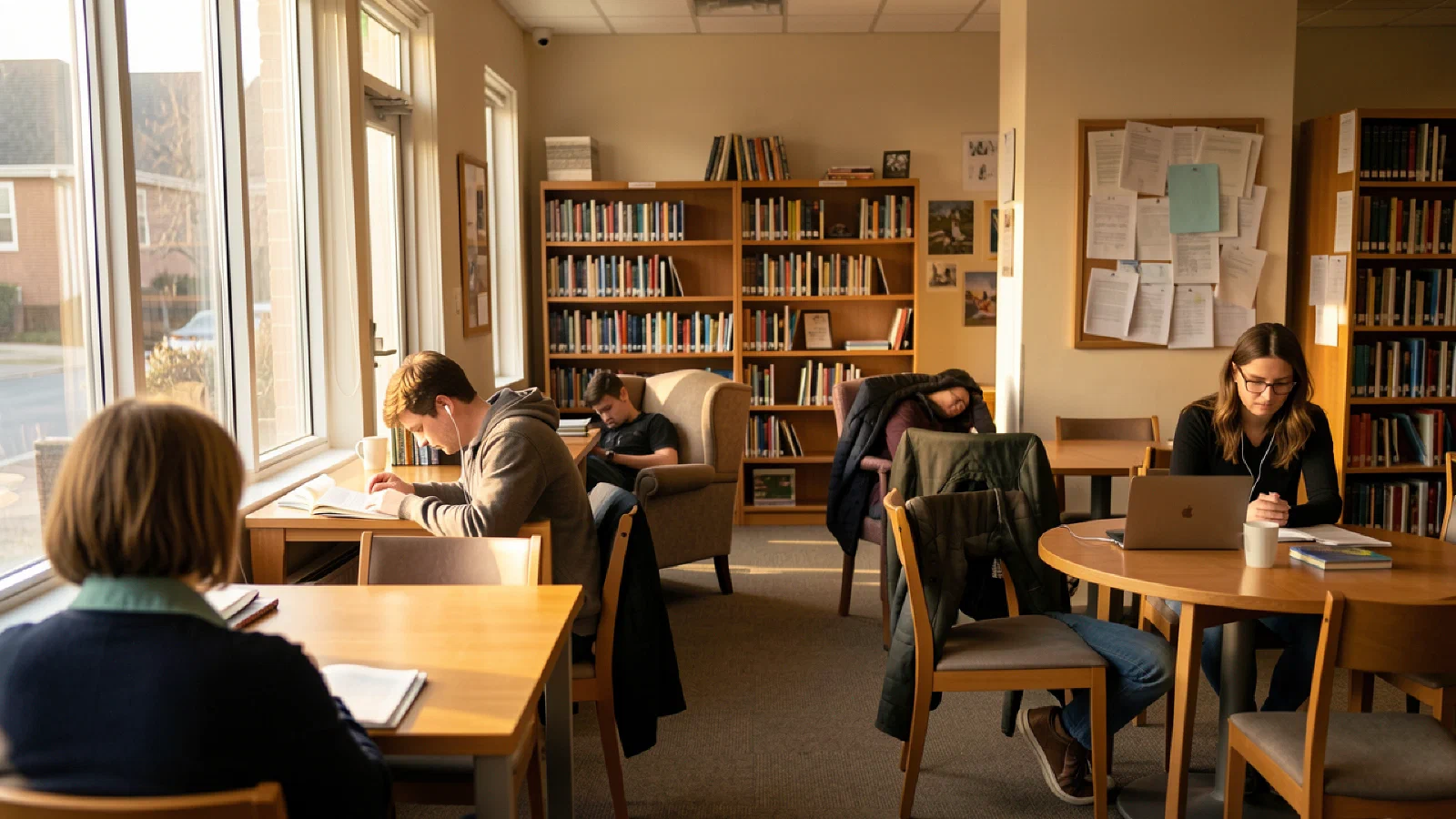
At the table near the window: a teenager doing homework, earbuds in, pencil moving, a textbook open to a chapter she will probably not finish today. In the armchair by the biography section: a man Margaret does not know, sleeping with his coat pulled up to his chin, a backpack on the floor beside him. At the round table near the children’s area, which is empty of children at 2 PM on a Thursday: a woman speaking quietly in another language on her phone, a laptop open in front of her, a coffee from the gas station on the corner balanced on a stack of books she is not reading.
None of them are here for the same reason. The teenager needs a quiet place her apartment does not provide. The man needs a warm place. The woman needs somewhere to work between the obligations that bracket her afternoon. Margaret needs the large-print mysteries and the chair near the window and the particular quality of a room that does not require her to explain why she is in it.
The library cannot win on information. It cannot compete with the internet on access, on speed, on breadth, on cost. The catalog is a fraction of what is available online. The books Margaret reads are available for free as digital downloads through the same library system, delivered to a device she does not own and does not want.
What the library has, and what nothing else in Margaret’s town has, is the quality of being free, open, warm, and unsorted. No membership tier. No cover charge. No minimum purchase. No reason required to be there. The man sleeping in the armchair and the teenager doing homework and Margaret reading the first chapter of a mystery she may or may not finish are in the same room for different reasons, and the institution holds them all without asking which one belongs.
This is not a function the library advertises. The mission statement says something about lifelong learning and community access to information and bridging the digital divide. These are real things the library does. They are not why Margaret comes on Thursdays.
What Survived#
The library has outlived its information monopoly by decades. The card catalog gave way to the computer terminal, which gave way to the website, which gave way to the app. Each transition reduced the library’s claim on its original purpose: the organized repository of knowledge that a community could access in no other way.
The knowledge is everywhere now. The organized repository is Google. The community access is a phone. By the logic that justified libraries as information infrastructure, the library should have contracted to a server room and a delivery service.
What happened instead is that the library survived by becoming something it had always been but never named: the public living room. The room where anyone can be, for any reason, for free, in the company of strangers who are also there for their own reasons, without the commercial transaction that every other shared space in the town requires.
The coffee shop requires a purchase. The church requires, if not belief, at least comfort with the context. The community center requires a program, a class, a scheduled reason. The library requires nothing. You walk in. You sit down. You leave when you are done.
The library’s deepest function was never information. It was unconditional interior space. The books were the reason. The room was the point. And the room works precisely because it is organized around a reason, the books, the programs, the quiet study tables, that gives everyone permission to be there without having to explain that the real reason is the room itself.
The Measurement Problem#
The library reports to its board and its funders on circulation numbers, program attendance, computer usage, digital downloads. These are the metrics that justify the budget. They are the things that can be counted.
What cannot be counted: the man in the armchair who has spent four hours in a warm room on a day when the temperature is eighteen degrees and his other options are a bus shelter and the McDonalds where they will eventually ask him to buy something. The teenager whose homework is slightly better because the library is quieter than her apartment. Margaret’s Thursday afternoon, which has a shape and a destination because the library is there, and which would be formless without it.
The library knows these things. The librarians know. They talk about it among themselves, the way professionals talk about the parts of their work that the institution has no mechanism to value. The man in the armchair is not a circulated item. The teenager’s homework is not a program attendee. Margaret’s structured Thursday is not a digital download.
The funding model measures what the library was built to do. The library’s survival depends on what it has become. And what it has become is the one institution in town that holds space for people whose presence generates no revenue, no data, and no metrics, and treats that holding as its purpose.
I wonder whether this function, the unsorted public room, can survive inside a funding model that still measures success by circulation numbers, or whether the library’s deepest value is precisely the thing that defies measurement.
The Bulletin Board#
Margaret checks out two large-print books she may or may not read. One is a mystery set in Scotland. The other is the historical novel her daughter mentioned, which Margaret suspects she will abandon after sixty pages but feels she should try because her daughter’s recommendations are a form of connection she does not want to refuse.
On the way out she passes the bulletin board near the exit. The bulletin board has been there as long as Margaret can remember. It is covered in flyers: a yoga class at the community center, a lost cat named Simon, a church rummage sale on Saturday, a high school band concert.
Someone has posted a notice about a grief support group meeting here on Wednesdays. The notice is printed on pale blue paper, simple, a time and a room number and a name to call. No photo. No logo. Just the information.
Margaret takes a photo of it with her phone. She does not know if she will go. She has taken photos of things on this bulletin board before and not followed up. The yoga class. The community garden sign-up. The water aerobics at the Y.
She does not know if she will go. She knows the room will be there.
The library card is in her wallet, behind the license, in front of the insurance card. It has been there since 1971. The number is the same. The lamination is separating. She will renew it when they ask, and she will keep the old one, and it will go into the envelope in the filing cabinet, and she does not know why she keeps them, but she keeps them.
References#
Klinenberg, Eric. Palaces for the People: How Social Infrastructure Can Help Fight Inequality, Polarization, and the Decline of Civic Life. Crown, 2018.
Oldenburg, Ray. The Great Good Place: Cafés, Coffee Shops, Community Centers, Beauty Parlors, General Stores, Bars, Hangouts, and How They Get You Through the Day. Paragon House, 1989.
Pew Research Center. “Libraries at the Crossroads.” Pew Research Center, September 2015.
Leckie, Gloria J., and Jeffrey Hopkins. “The Public Place of Central Libraries: Findings from Toronto and Vancouver.” The Library Quarterly, vol. 72, no. 3, 2002, pp. 326–372.
Scott, Rachel. “The Role of Public Libraries in Community Building.” Public Library Quarterly, vol. 30, no. 3, 2011, pp. 191–227.
How this essay connects to others across The Approximate Mind.
- Klinenberg, Eric. Palaces for the People: How Social Infrastructure Can Help Fight Inequality, Polarization, and the Decline of Civic Life. Crown, 2018.
- Oldenburg, Ray. The Great Good Place: Cafés, Coffee Shops, Community Centers, Beauty Parlors, General Stores, Bars, Hangouts, and How They Get You Through the Day. Paragon House, 1989.
- Pew Research Center. “Libraries at the Crossroads.” Pew Research Center, September 2015.
- Leckie, Gloria J., and Jeffrey Hopkins. “The Public Place of Central Libraries: Findings from Toronto and Vancouver.” The Library Quarterly, vol. 72, no. 3, 2002, pp. 326–372.
- Scott, Rachel. “The Role of Public Libraries in Community Building.” Public Library Quarterly, vol. 30, no. 3, 2011, pp. 191–227.