The Pharmacist Who Stayed
One Institution That Chose Differently
TAM-WTR.11 · The Waiting Room · The Approximate Mind
Linda arrives at 8:40, twenty minutes before the pharmacy opens, and starts with the whiteboard.
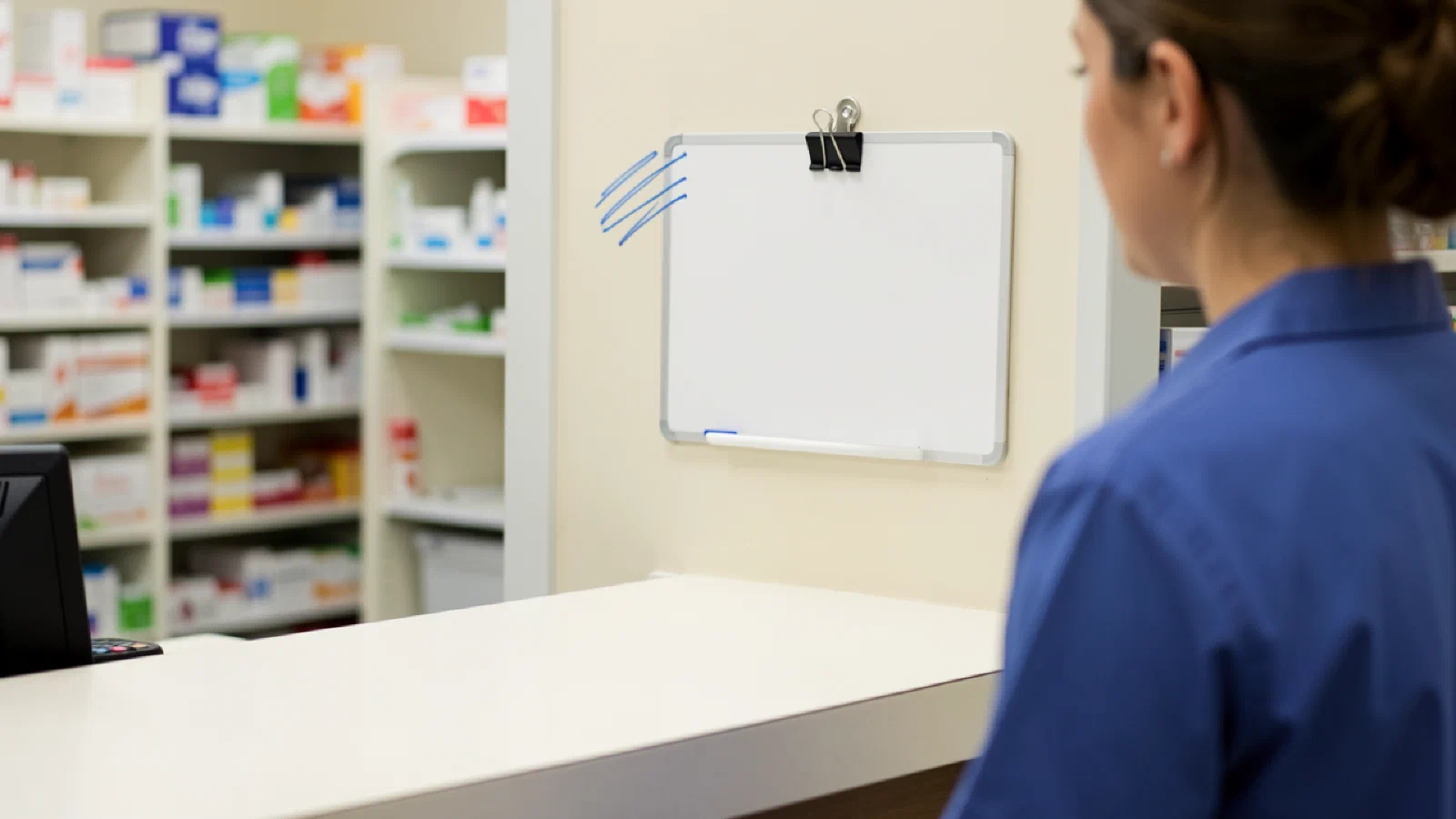
The whiteboard is small, maybe eighteen inches across, mounted behind the dispensing counter where customers cannot see it. It is not part of any system. It is not connected to the software that manages inventory, generates refill alerts, tracks insurance authorizations, or flags interactions. It is a whiteboard, with a blue dry-erase marker clipped to the frame by a binder clip because the magnetic cap holder fell off three years ago and Linda replaced it with what she had.
She writes four names. Not because the system flagged them. Because she has been thinking about them.
The first is a man whose wife died in February. His refill pattern has not changed, which means nothing clinical has shifted, which means the system has no reason to notice him. Linda has a reason. The reason is that grief does not show up in refill data, and she saw him last week and he looked like he had stopped bothering with breakfast.
The second is a teenager on a new antidepressant. Two weeks in. The dosage is low and the protocol is standard and the follow-up is the prescriber’s responsibility. Linda wants to see her face when she picks it up. Not to evaluate. To see.
The third is Margaret.
The fourth is a name Linda writes and then pauses over, because she cannot remember exactly why she wrote it, only that something about his last visit left a residue of concern she cannot locate in any specific observation. She leaves the name. The inability to articulate the reason is not, in her experience, evidence that the reason does not exist.
The Choice#
The pharmacy is independently owned. This fact requires explanation because it has become unusual enough to be remarkable, like saying the house has a landline or the car has a manual transmission. The chains closed their counters or reduced their hours or replaced pharmacists with pharmacy technicians supervised remotely. The economics were clear. The counter pharmacist is expensive. The automated dispensing system is not.
Carl, the owner, made a different choice. Not a sentimental choice, though the sentimentality is part of the story people tell about it. An economic choice with a different set of variables than the ones the chains were optimizing for.
Carl kept Linda because he understood that what Linda does at the counter is not what the counter was designed for, and that the undesigned function is the reason people still come in.
This costs something specific. Linda’s salary, plus benefits, plus the margin differential between what the pharmacy charges and what a mail-order operation charges, minus the volume that walks in the door because Linda is there. Carl has done this math. The math does not work if you measure only prescriptions filled. The math works if you measure the pharmacy as an institution that a town needs, the way it needs a post office or a school, not because the service cannot be delivered otherwise but because the place where the service is delivered is doing something beyond the service.
Carl would not describe it this way. Carl would say Linda is good for business, which is true in the way that a simplification can be true: it captures the conclusion and skips the architecture. Linda is good for business because Linda makes the pharmacy a place, and a place holds customers in a way that a delivery service does not. But the reason she makes it a place is not business. The reason she makes it a place is that she writes four names on a whiteboard every morning and then wipes them off at the end of the day and writes new ones, and no one told her to do this, and no one pays her to do this, and no system would ever generate the instruction to do this, because the logic that produces the names is not algorithmic. It is attentional.
What the Counter Does#
The automated dispensing system fills prescriptions faster than Linda ever could. It checks interactions across a database that no human pharmacist can hold in working memory. It tracks insurance authorizations, flags prior authorization requirements, calculates copays, and prints labels with accuracy rates that approach the asymptotic. It does not make errors of fatigue or distraction. It does not have bad days.
Linda does not compete with the system. Linda does what the system cannot, which is stand in a room with a person and notice things that do not have data fields.
What Linda notices is not clinical, exactly. It is pre-clinical. It is the thing that might become clinical if no one catches it, and the catching requires presence, and presence requires a body in a room, and a body in a room requires an institution willing to pay for the body and the room.
The teenager comes in at 11:00. Linda watches her approach the counter. The walk is fine. The face is fine. Fine is not a clinical assessment. Fine is what fourteen years of watching people approach a counter teaches you fine looks like, and this girl looks fine in the way that means something other than fine, a kind of effortful normalcy that Linda has learned to read the way a sailor reads weather.
She hands over the medication. She does not pause dramatically. She does not ask a probing question. She says, “How’s it going with these so far?” in the tone of voice that means the question is real and the answer can be real if the girl wants it to be.
The girl says, “Fine.”
Linda says, “Good. If anything feels off, you can always call us.” She writes the pharmacy number on the bag, which the girl already has, which is printed on the label, which is available on the website. She writes it anyway. The writing is not the information. The writing is the gesture that says: this number connects to a person, and the person is me, and I will pick up.
The Scaling Question#
There are four thousand independent pharmacies left in the state. There were eleven thousand twenty years ago. The attrition is not mysterious. The chain model, the mail-order model, and the pharmacy benefit manager model all optimize for the same variable: cost per prescription filled. An independent pharmacy competing on cost per prescription filled is competing on the variable where it is weakest. It is like a restaurant competing on calories per dollar. The metric is real, but the metric is not why people come.
The question of whether Linda scales is the wrong question, and knowing it is the wrong question does not make it go away, because the systems that decide which pharmacies survive are asking it.
One Linda in one town is an exception. Exceptions do not drive policy. Exceptions do not attract investment. Exceptions do not appear in the models that health systems use to project workforce needs. Linda is, from the perspective of the system that is replacing her everywhere else, an anomaly maintained by an owner who has not yet done the math correctly, or who has done different math that the system does not recognize as math.
But Linda is also evidence. Not evidence of a scalable model. Evidence of a possible choice. The pharmacy could keep the counter. The counter could keep the pharmacist. The pharmacist could keep the whiteboard. The whiteboard could keep the names. Each link in this chain is a decision, and each decision costs something, and the cumulative cost is real and quantifiable and lands on Carl’s books every quarter when he reviews the margin and decides, again, to keep it.
The argument against Linda is efficiency. The argument for Linda is that efficiency is a measurement, and measurements require a decision about what to count, and the decision about what to count is where the values live, underneath the math, prior to the algorithm, in the place where someone decides that a pharmacist who writes names on a whiteboard is a cost or a function.
The Fourth Name#
At 2:30, the man whose wife died in February comes in. He is picking up a refill he could have had mailed. He came in because coming in is what he has always done, and the continuity of always is holding weight right now that he probably cannot articulate and Linda certainly will not ask him to.
She asks about his shoulder, which he mentioned hurting three weeks ago. He says it is better. He does not look like he has stopped bothering with breakfast. He looks like a man who is managing, which is a word that means something different depending on who says it and how much weight the managing is carrying.
The third name, Margaret, came in at 1:15. She did not need anything filled. She came in to ask Linda about a supplement her daughter recommended. Linda looked it up, checked it against Margaret’s current medications, found no interactions, and said it was probably fine but she would not expect miracles. The conversation took four minutes. The four minutes were not billable. The four minutes were what Margaret came for, though what she said she came for was the supplement question.
I wonder whether the existence of one pharmacist who stayed, in one pharmacy that chose differently, is enough to constitute evidence that the choice is possible, or whether evidence requires frequency, and frequency requires a model, and a model requires the very optimization logic that eliminated the pharmacists in the first place.
At 4:00, Linda checks the whiteboard. Three of the four names have come in or called. The fourth, the one she could not articulate a reason for, she will try tomorrow. Maybe she will remember why. Maybe the why does not matter and the attention does.
She wipes the names off with the side of her hand. The ink smears slightly on the lower left corner where the surface is scratched. She picks up the blue marker and writes two names for tomorrow. One is a new patient she met this week whose hands were shaking. One is Margaret, again, because Margaret is always on the list, not because anything is wrong but because Margaret is seventy-four and alone and comes to the pharmacy the way some people go to church: not because they need saving but because they need to be somewhere where someone knows their name.
The counter is clean. The counter is open. Tomorrow Linda will arrive at 8:40, twenty minutes before the pharmacy opens, and start with the whiteboard, and the whiteboard will have names, and the names will be people, and the people will come in or they won’t, and Linda will be there either way, in the room, behind the counter, in the pharmacy that chose to keep the thing that no one could bill for but everyone needed.
References#
Guadamuz, Lorenzo, et al. “Community Pharmacy Closures in the United States.” JAMA Internal Medicine, vol. 183, no. 12, 2023, pp. 1355-1362.
Schommer, Jon C., et al. “Pharmacist Contributions to the US Health Care System.” Innovations in Pharmacy, vol. 11, no. 1, 2020, pp. 1-16.
Berenbrok, Lucas A., et al. “Access to Community Pharmacy Services in the United States.” JAMA Health Forum, vol. 3, no. 6, 2022, e221517.
Arya, Vikas, et al. “Pharmacy Deserts and Health Equity.” American Journal of Public Health, vol. 112, no. S7, 2022, pp. S638-S641.
Chisholm-Burns, Marie A., et al. “US Pharmacists’ Effect as Team Members on Patient Care.” Medical Care, vol. 48, no. 10, 2010, pp. 923-933.
How this essay connects to others across The Approximate Mind.
- Guadamuz, Lorenzo, et al. “Community Pharmacy Closures in the United States.” JAMA Internal Medicine, vol. 183, no. 12, 2023, pp. 1355-1362.
- Schommer, Jon C., et al. “Pharmacist Contributions to the US Health Care System.” Innovations in Pharmacy, vol. 11, no. 1, 2020, pp. 1-16.
- Berenbrok, Lucas A., et al. “Access to Community Pharmacy Services in the United States.” JAMA Health Forum, vol. 3, no. 6, 2022, e221517.
- Arya, Vikas, et al. “Pharmacy Deserts and Health Equity.” American Journal of Public Health, vol. 112, no. S7, 2022, pp. S638-S641.
- Chisholm-Burns, Marie A., et al. “US Pharmacists’ Effect as Team Members on Patient Care.” Medical Care, vol. 48, no. 10, 2010, pp. 923-933.