The Caseworker's Caseload
What noticing requires
TAM-WTR.07 · The Waiting Room · The Approximate Mind
She keeps a list of seven cases from her first year. Not the worst outcomes, not the cases that haunt her in the way her training warned cases would haunt her, but the ones where she noticed something the file did not contain, acted on it, and something changed. A woman whose paperwork showed stable housing but whose hands shook when she signed the form. A child who answered every question correctly but would not look up from the table. A man whose benefits had lapsed not because he failed to recertify but because he could not read the recertification letter and would not say so.
Seven cases. She has written the details in a small notebook she keeps in her desk drawer, not the system, because the system has no field for “I noticed something and it mattered.” The notebook is three years old. She has not added to it in three years.
Her name is Rachel. She is thirty-eight. She manages two hundred cases through a dashboard that shows her what the system has flagged: eligibility changes, missed appointments, benefits about to expire, documentation gaps. The dashboard is good. It is better than the paper files she inherited in her first year, better than the color-coded folders her supervisor used to stack on the corner of every desk, better than the morning meetings where cases were distributed by last name and the distribution was the only triage.
The dashboard does not notice hands that shake when someone signs a form.
The Streamlined Office#
AI has made Rachel’s work faster, more accurate, and larger. Intake that used to take forty minutes now takes twelve: the client fills out a pre-screening on a tablet in the lobby, the system cross-references three databases, the eligibility determination is flagged before Rachel opens the case. Processing errors, which used to run at seven percent, are below one. Renewals that once required an in-person visit trigger automatically. The system works.
Her caseload is two hundred. Five years ago it was one hundred and twenty. The increase is not because there are more people needing services. It is because the system can handle more throughput, and the throughput capacity was converted into caseload the way the doctor’s efficiency gains were converted into shorter appointments: not by anyone’s decision, but by the structural logic of a system that measures productivity by cases per worker.
The increase is invisible because the system makes it manageable. Two hundred cases on a dashboard is as scannable as one hundred and twenty cases in a stack of folders. More scannable, actually, because the dashboard sorts and flags and prioritizes, and the folders just sat there in whatever order the last person left them.
Rachel can process two hundred cases. She cannot know two hundred people. The distinction is the thing the system does not measure and the increase has buried.
What Noticing Required#
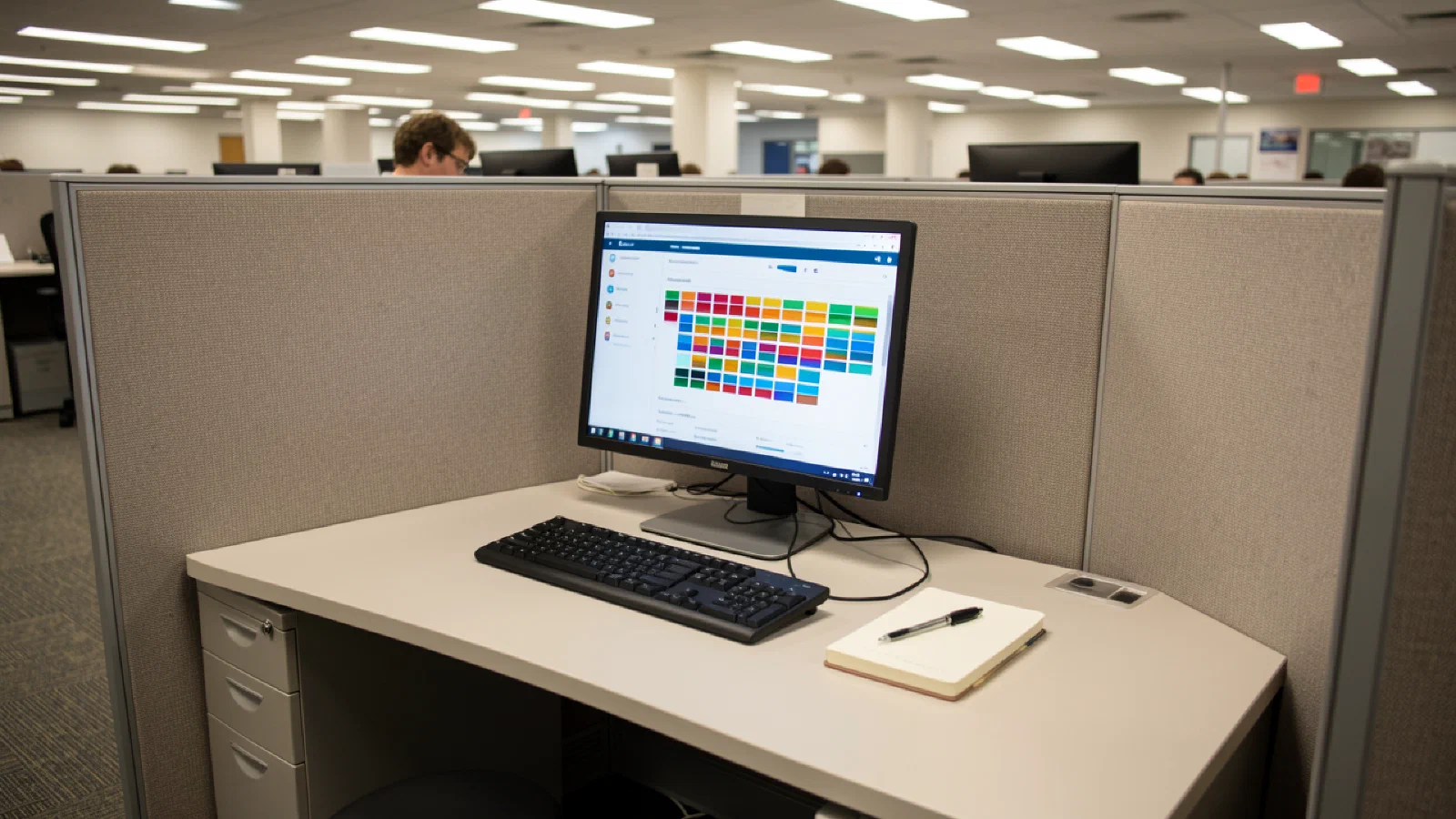
Rachel’s first year, before the dashboard, before the automated intake, before the cross-referenced databases, she sat across a desk from each client. The desk was in a cubicle with fabric walls that did not reach the ceiling. The office smelled like coffee and carpet cleaner. The client sat in a chair that was not comfortable but was the same chair for everyone, the way the DMV’s chairs were the same chairs for everyone, the institutional democracy of bad seating.
The meeting took forty minutes because the form took forty minutes. Rachel read the questions. The client answered. Rachel wrote the answers. The slowness of this process was, by every measure of efficiency, a failure. It was also the condition under which Rachel noticed things the form did not ask about.
The woman whose hands shook: Rachel noticed because the form required a signature, and the signature required time, and in the time the signature took, the shaking was visible. In a twelve-minute digital intake, the signature is electronic and the shaking is not transmitted.
The child who would not look up: Rachel noticed because the meeting included the child, who was in the room because there was no childcare, and the child’s behavior over forty minutes was visible in a way that a three-minute lobby interaction is not.
The man who could not read: Rachel noticed because the form was on paper, and she was reading the questions aloud, and the man’s relief at being read to was palpable and unmistakable, and she understood in that moment that the form he had failed to return was a form he had never been able to complete.
Noticing was never in the job description. It was in the encounter. The encounter required a human being with time and presence and the specific unease of sitting across from someone whose situation could not be fully reduced to a field in a form. The unease was not a bug. It was the mechanism by which the caseworker’s attention moved from the form to the person, from the system’s questions to the questions the system did not know to ask.
The Dashboard’s Limits#
The dashboard flags what it is designed to flag: missed deadlines, eligibility changes, documentation gaps. These are the system’s categories. They are real, important, and well-served by automation. A missed recertification deadline is a missed recertification deadline whether it is flagged by a person or a system, and the system flags it faster and more reliably.
What the dashboard does not flag, because it cannot, is the quality of a person’s situation between the flagged events. The woman whose eligibility is current but whose housing has become unsafe. The family whose benefits are intact but whose circumstances have shifted in ways the recertification does not ask about. The client who has not missed a deadline but who is quietly falling apart in ways that are visible only to someone who has been sitting across from them regularly enough to notice the change.
Rachel used to see her clients. Now she processes them. The word is too harsh, she knows, because she cares about the work and does it well, and the dashboard allows her to serve more people with fewer errors. But the shift from seeing to processing is real, and it has changed what she can know about the people on her caseload.
Two hundred cases, all current. The system is working. The question the system does not ask is whether the cases are people, and whether the people are okay, and whether “okay” is something a dashboard can determine.
I wonder whether the noticing can be preserved inside a system designed around efficiency, or whether the noticing was only possible when inefficiency gave the caseworker enough time in the room to be affected by what she saw.
Five O’Clock#
Rachel closes her dashboard at five. Two hundred cases, all current. No flags overdue. The numbers are good.
She picks up her phone. Not the work phone, the personal one. She calls a client she has been worried about. Not flagged by the system. Not overdue on anything. Not in any category that would generate an alert. Just worried, the way you worry about someone when you know enough about their life to know that the absence of a flag does not mean the absence of a problem.
The call goes to voicemail. Rachel leaves a message, her name, her number, the kind of message that says “just checking in” in a tone that means something more than checking in but cannot say so in a voicemail. She logs it under outreach. The system records the call. The system does not record the worry.
She drives home. The notebook is in her desk drawer. Seven cases from her first year. Seven times she noticed something the file did not contain, and acted on it, and something changed. She has not added to the list in three years, not because there is nothing to notice but because the structure of her days no longer puts her in the room where noticing happens.
The notebook is in the drawer. The drawer is in the desk. The desk is in the cubicle with the fabric walls that do not reach the ceiling. The office still smells like coffee and carpet cleaner. Some things have not changed. The things that have changed are the things that mattered.
References#
Lipsky, Michael. Street-Level Bureaucracy: Dilemmas of the Individual in Public Services. Russell Sage Foundation, 2010.
Eubanks, Virginia. Automating Inequality: How High-Tech Tools Profile, Police, and Punish the Poor. St. Martin’s Press, 2018.
Watkins-Hayes, Celeste. The New Welfare Bureaucrats: Entanglements of Race, Class, and Policy Reform. University of Chicago Press, 2009.
Herd, Pamela, and Donald P. Moynihan. Administrative Burden: Policymaking by Other Means. Russell Sage Foundation, 2019.
Soss, Joe. Unwanted Claims: The Politics of Participation in the U.S. Welfare System. University of Michigan Press, 2002.
How this essay connects to others across The Approximate Mind.
- Lipsky, Michael. Street-Level Bureaucracy: Dilemmas of the Individual in Public Services. Russell Sage Foundation, 2010.
- Eubanks, Virginia. Automating Inequality: How High-Tech Tools Profile, Police, and Punish the Poor. St. Martin’s Press, 2018.
- Watkins-Hayes, Celeste. The New Welfare Bureaucrats: Entanglements of Race, Class, and Policy Reform. University of Chicago Press, 2009.
- Herd, Pamela, and Donald P. Moynihan. Administrative Burden: Policymaking by Other Means. Russell Sage Foundation, 2019.
- Soss, Joe. Unwanted Claims: The Politics of Participation in the U.S. Welfare System. University of Michigan Press, 2002.