The Branch
What judgment looks like when it has a face
TAM-WTR.02 · The Waiting Room · The Approximate Mind
Margaret still has the original mortgage document in a manila folder in the filing cabinet in the spare room. She has not opened the filing cabinet in years. She knows the folder is there the way she knows the water heater is in the basement: a fact about the house that requires no attention but whose absence would mean something had gone wrong. The folder is there. The house is hers. The document proves it, though no one has asked for proof since 1994.
In 1987, she and Harold sat across from a loan officer named Robert. She remembers his mustache. She remembers the desk, which was real wood and had a brass nameplate. She does not remember a single number from the meeting. Not the interest rate, not the monthly payment, not the term. She remembers that Robert listened to them for forty minutes and then said yes.
Forty minutes is a long time to listen to two people who are buying their first house. Harold explained what he did for a living. Margaret explained what she did. They talked about the neighborhood, which Robert knew because he had grown up two towns over and his sister lived on the next street. They talked about the furnace, which the inspector had flagged, and Robert said that furnace would outlast them all, and he was wrong about that but right about everything else.
The decision Robert made was a judgment. Not a calculation, though calculation was part of it. He looked at two people, listened to them describe their lives, assessed something that the numbers alone did not capture, and decided they were good for it. The something he assessed was not legible to the system he worked inside. It was legible to him because he had been making this judgment for nineteen years and the accumulation of those years had produced a capacity that no one had taught him and that he could not have described if asked.
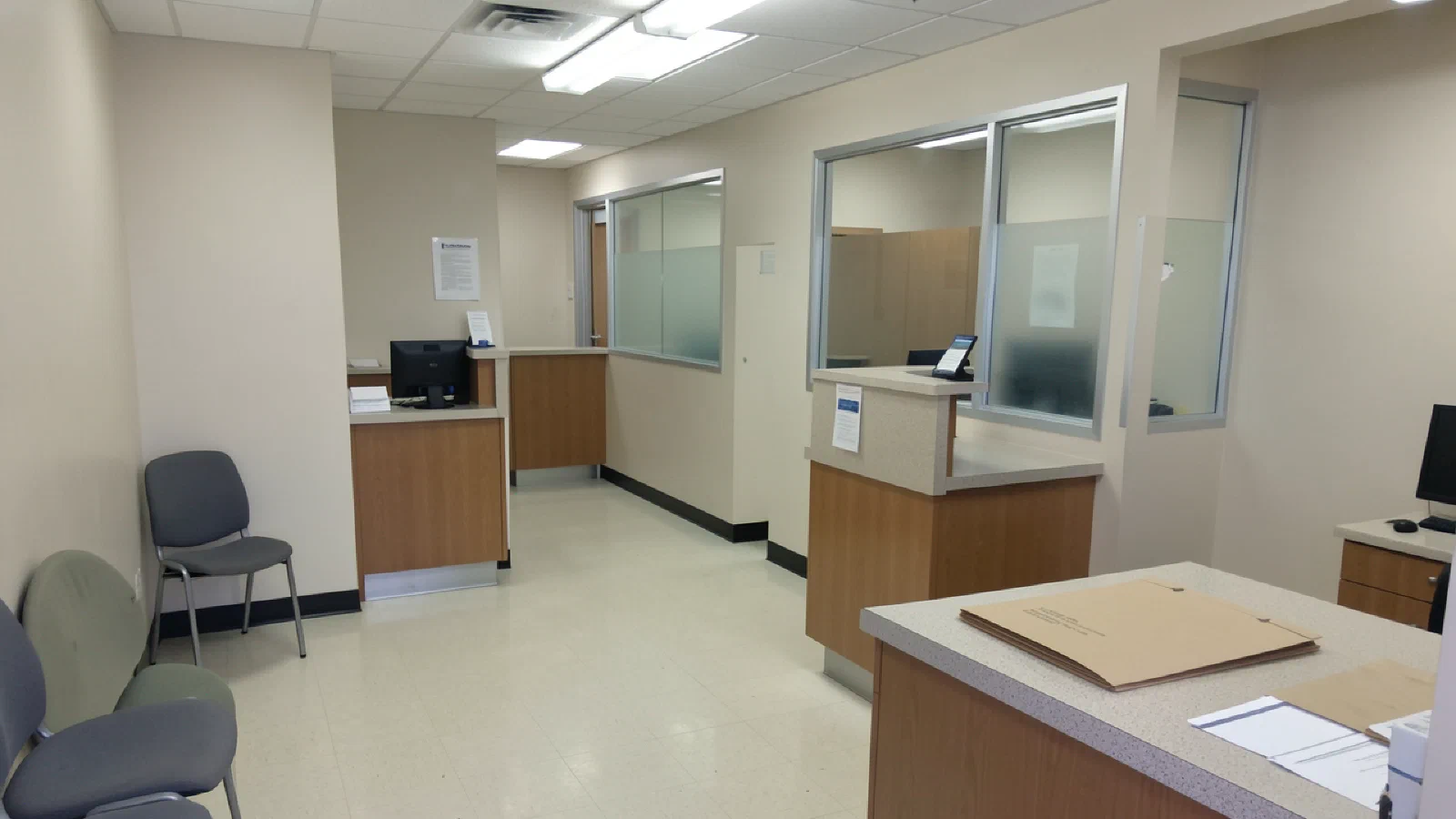
The desk is now an open space with a tablet on a stand.
The Teller Who Knew#
The branch is still open. Two teller windows instead of six. The lobby that used to fill on Friday afternoons is quiet most days. The app handles deposits, transfers, bill payments, balance checks. The app is faster, available at midnight, does not require parking.
Margaret uses the app. It works. She learned it from her daughter, who set it up on her phone during a visit and walked her through the screens twice, and now Margaret checks her balance on Sunday evenings the way she used to balance the checkbook, which she no longer does because the app does it automatically.
What the app cannot do is what happened in November two years ago when the furnace failed.
The repair was $2,800. Margaret’s fixed income covers her expenses with a margin that absorbs a bad month but not a $2,800 surprise. The payment to the repair company would have overdrafted her checking account, which would have triggered a fee, which would have caused the automatic mortgage payment to bounce, which would have triggered another fee, which would have cascaded into a sequence of consequences that would have taken weeks to resolve and cost more than the original repair.
The teller who processed Margaret’s transactions three or four times a month noticed the pattern before it became a problem. She did not run an algorithm. She saw the deposit, saw the pending check to the repair company, knew Margaret’s income from years of handling her deposits, and flagged it. Not in the system. To her manager, in a conversation at the end of the day. The manager called Margaret and arranged a temporary overdraft protection that absorbed the shock.
The flag was not a feature of the system. It was a relationship expressing itself through an institution.
The teller knew Margaret’s income the way Linda knew her prescriptions: not from a file but from presence, from the accumulation of ordinary transactions over years, from standing on the other side of the counter often enough that the pattern became visible without being analyzed. The system had the data. The teller had the context. The difference between the two was the difference between seeing a number and understanding what the number meant for a specific person whose furnace had just failed in November.
The App’s Version#
The banking app has overdraft alerts. It can be configured to notify Margaret when her balance drops below a threshold. It can, in sophisticated implementations, predict cash flow and flag upcoming shortfalls before they arrive. These features exist. Some of them are free. Some cost $12.99 a month.
The app would have caught the furnace problem. Probably. If the alert threshold had been set correctly, if Margaret had understood the notification when it arrived, if she had known what to do about it. The app provides the information. It does not provide what the teller provided, which was not information but intervention: a person who saw the problem, understood its implications for this specific customer, and acted before Margaret knew she was in trouble.
The distinction matters because the app assumes a user who is already managing. The alert assumes someone who can interpret it, who knows what overdraft protection is, who can work through the options and make the right call in time. The teller assumed nothing. She saw the situation and handled it the way a neighbor handles a neighbor’s problem: by doing something, not by sending a notification that the problem exists.
The app provides information to the capable. The teller provided judgment to the specific. These are not the same service wearing different clothes. They are different relationships to the person being served.
What Forty Minutes Bought#
Robert’s forty-minute conversation in 1987 was not efficient. A modern mortgage application takes less time, requires less human judgment, and produces more consistent outcomes. The algorithm that evaluates Margaret’s creditworthiness in 2024 considers more variables, applies them more uniformly, and eliminates the biases that Robert inevitably carried: the comfort of shared geography, the warmth toward a couple who reminded him of his own early marriage, the assessment of character that was really an assessment of familiarity.
The algorithm is fairer. This is not a small thing. Robert’s judgment, however warm, was also a gate that opened more easily for people who looked like him, talked like him, lived in the neighborhoods he knew. The couples who did not remind Robert of his own early marriage may have sat through a different forty minutes. The consistency of the algorithm corrects for this, and the correction matters.
But the algorithm also does something Robert did not do. It makes the decision without a face. Margaret does not know who decided she could buy the house. The decision arrives as an approval notification. The approval is correct, fair, well-calibrated. It is also an event that happened to her rather than a conversation she participated in.
I wonder whether the bank’s obligation to its customers is served by making their transactions faster and more accurate, or whether the obligation is larger than that, and the efficiency argument has been allowed to stand in for the whole thing.
Robert’s forty minutes bought something that no one at the bank would have called a product. It bought Margaret’s sense that a person had looked at her life and found it sufficient. That someone with authority had listened and decided she was worth the risk. The manila folder in the filing cabinet is not just proof of ownership. It is proof that a person said yes, in a room, across a real desk, with a brass nameplate. That is not nostalgia. That is a record of being seen.
The Corner#
Margaret uses the app. It works. The branch is still there on the corner, smaller now, the hours reduced, the lobby open only on weekdays until four. She passes it on the way to the library. The parking lot is empty at 11 AM on a Tuesday.
She has not been inside in over a year. The teller who knew her income was transferred to another branch in March. The new teller is perfectly pleasant. Margaret does not know her name.
The manila folder is in the filing cabinet. The house is hers. Robert’s mustache is thirty-seven years ago, and Margaret remembers it the way she remembers things that felt important at the time: vividly and without knowing exactly why.
References#
Baradaran, Mehrsa. How the Other Half Banks: Exclusion, Exploitation, and the Threat to Democracy. Harvard University Press, 2015.
Fligstein, Neil, and Adam Goldstein. The Banks Did It: An Anatomy of the Financial Crisis. Harvard University Press, 2022.
Oldenburg, Ray. The Great Good Place: Cafés, Coffee Shops, Community Centers, Beauty Parlors, General Stores, Bars, Hangouts, and How They Get You Through the Day. Paragon House, 1989.
Servon, Lisa J. The Unbanking of America: How the New Middle Class Survives. Houghton Mifflin Harcourt, 2017.
Putnam, Robert D. Bowling Alone: The Collapse and Revival of American Community. Simon & Schuster, 2000.
How this essay connects to others across The Approximate Mind.
- Baradaran, Mehrsa. How the Other Half Banks: Exclusion, Exploitation, and the Threat to Democracy. Harvard University Press, 2015.
- Fligstein, Neil, and Adam Goldstein. The Banks Did It: An Anatomy of the Financial Crisis. Harvard University Press, 2022.
- Oldenburg, Ray. The Great Good Place: Cafés, Coffee Shops, Community Centers, Beauty Parlors, General Stores, Bars, Hangouts, and How They Get You Through the Day. Paragon House, 1989.
- Servon, Lisa J. The Unbanking of America: How the New Middle Class Survives. Houghton Mifflin Harcourt, 2017.
- Putnam, Robert D. Bowling Alone: The Collapse and Revival of American Community. Simon & Schuster, 2000.