The Approximate Town
What the Approximation Misses
TAM-WTR.12 · The Waiting Room · The Approximate Mind
Margaret wakes at 6:15, the way she has woken at 6:15 for forty years, her body keeping the schedule that Harold’s work once set and that nothing has revised since. The alarm clock on the nightstand is unplugged. Has been unplugged since he died. Her body does not need it and she keeps it there the way she keeps the bag clips in the kitchen drawer: because removing it would require deciding to remove it, and deciding would require acknowledging that the reason for the clock is gone.
The house is quiet in the way that houses are quiet when one person lives in them. Not silent. The refrigerator hums. The furnace clicks on. A branch scrapes the gutter on the east side where Harold kept saying he would trim it and she keeps not trimming it because the scraping has become, over the years, a sound the house makes rather than a problem to solve. The branch scrapes. The house is itself.
She makes coffee. One cup, not two. She stopped making two cups eleven months after Harold died, and the eleven months were not about coffee but about the second cup sitting on the counter cooling while she drank the first, and the looking at the second cup, and finally the morning when she poured the water for one cup and felt something shift, not grief exactly, but the acknowledgment that the number had changed.
The prescription arrived yesterday. White padded envelope, printed label, correct medication, on time. She did not open it at the mailbox. She brought it inside and put it on the kitchen table and opened it later, after lunch, with scissors, neatly. The medication is correct. It is always correct. The system that sends it operates with a precision she does not question and a reliability she has come to depend on, the way she depends on the furnace clicking on when the temperature drops: automatically, invisibly, without encounter.
The bank app on the phone her daughter set up shows her balance. She checks it on Thursdays, the way she used to check it at the branch, the same day, the same habit, the container changed and the rhythm preserved. The balance is fine. The direct deposit arrived. The automatic payments went through. She does not need to see Robert at the branch to know this. Robert is still at the branch, she thinks, though she is not sure, because she has not been in months, because there is no reason to go.
Her lab results are on the patient portal. Her daughter showed her how to access them. She logged in once, saw numbers she did not understand, and called her daughter to ask what they meant. Her daughter said the doctor would call if anything was concerning, and the doctor has not called, and Margaret takes this silence as good news the way you take the absence of a phone call in the middle of the night as good news: by the logic of what did not happen.
The benefits adjusted automatically last month. She received a notice. She could not determine from the notice whether her coverage had changed in a way that affected her. She put the notice in the drawer with the other notices, the drawer that is not the bag clip drawer but the one next to it, the notice drawer, where the paper accumulates and occasionally she asks her daughter to go through it and her daughter says it is all fine and Margaret believes her because believing her is simpler than understanding the notices.
The grocery order arrives Thursday. She switched to delivery during the pandemic and never switched back, and the not switching back was not a decision but an absence of a decision, a continuation of the new pattern that became the pattern. The groceries arrive. They are correct. The oatmeal is the same brand. Nobody at the door knows her name. The driver sets the bags on the porch and takes a photograph of the bags on the porch and the photograph goes somewhere and the bags come inside and the transaction is complete and the completeness is total and there is nothing she can point to that is missing, except for Diane at register 4 who used to say “the usual, Margaret?” when she came through with her seventeen items on a Tuesday, and Diane is not missing from the transaction because Diane was never part of the transaction. Diane was part of the going.
Margaret does not need to go anywhere today.
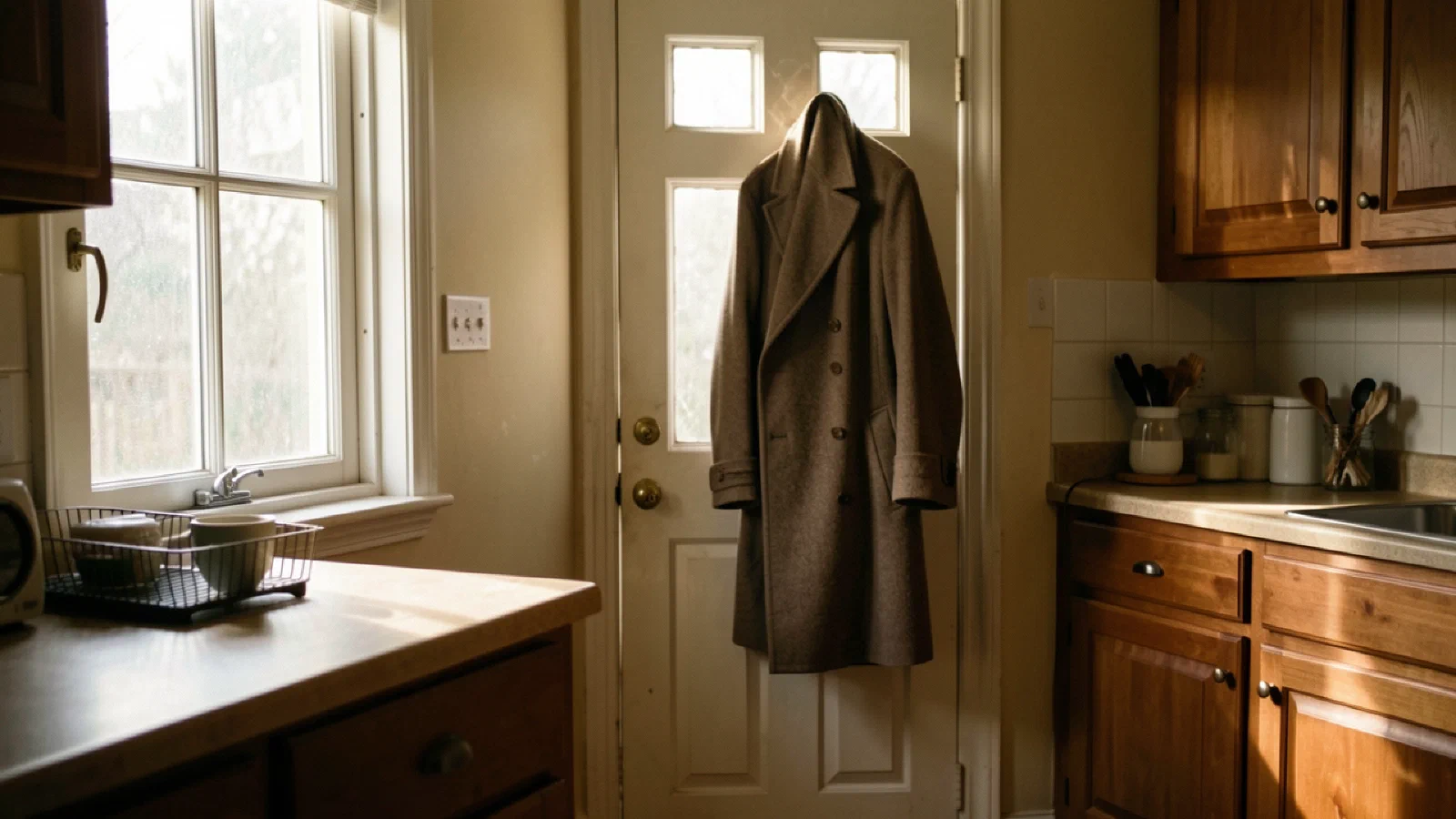
She sits in the kitchen with her coffee. The east window catches the morning light in a way that shifts through the year, low and amber in winter, high and white in summer. It is May. The light is between seasons. Harold used to sit in this chair, the one she is sitting in now, and read the newspaper. She sits in this chair because she sat in the other chair when he was alive and at some point after he died she started sitting in his chair without noticing and now his chair is her chair and the migration is complete and unmourned.
She calls her daughter at 8:30. Her daughter is busy, which her daughter always is, but she picks up because Margaret only calls when she calls and the calling is the contact and her daughter understands, without either of them saying it, that the call is not about information. The call is about the calling. They talk for twelve minutes. Her daughter mentions the grandchildren. Margaret mentions the branch on the gutter. Her daughter says she will send someone to trim it. Margaret says that would be nice. Neither of them says what the call is, which is Margaret reaching out into the world with her voice because her body no longer has reason to go out into the world with the rest of her.
The recycling bin is at the curb. She put it out last night. The pickup is Tuesday. She knows the schedule the way she knows everything about the rhythms of the house: by accumulated habit that no longer requires thought, the body’s calendar running underneath the mind’s awareness, keeping the structure of days in a life that the systems have emptied of errands.
Harold’s mug is in the cabinet. Not the cabinet where she keeps her mug, the one by the coffeemaker. His mug is in the upper cabinet, behind the glasses they used for company, in a spot where she does not have to see it every morning and does not have to not see it. It is there. She knows it is there. Occasionally she takes it down and holds it and puts it back, and this is not a ritual and not a performance and not a stage of grief. It is a woman holding a mug that was held by someone she loved, and the mug is heavy and solid and blue and it is the kind of knowledge that no system approximates because no system needs to.
She is efficiently served. Every system that touches her life is working. The medication arrives. The money is there. The results are on the portal. The benefits adjust. The groceries come. She is, by every metric that any system uses to measure whether it is serving its population adequately, served. The approximation is, from the system’s perspective, complete.
What the approximation misses is not a service gap. It is not something that can be designed back in, optimized, or addressed by a better algorithm. What the approximation misses is the fact that Margaret used to leave the house.
She used to leave the house because she had to. The prescription required the trip. The deposit required the branch. The appointment required the waiting room. The groceries required the store. These requirements structured her days and her days structured her contact with the town and the contact with the town was incidental to every transaction and central to something that no transaction measured.
She sat in waiting rooms with people she did not choose and would not have chosen. She stood in lines. She said good morning to tellers and librarians and cashiers and the woman at the DMV who once complimented her scarf. She developed a friendship with Donna because they were both waiting at Window 4 on a Wednesday and the wait was long enough for two strangers to become acquaintances and the acquaintanceship was strong enough to survive the transition from institutional accident to intentional coffee.
The town still exists. The pharmacy is still open. The branch is still on the corner, though the hours have changed. The library is still open on Thursdays. The doctor’s office still has a waiting room, though Margaret sees the doctor on a screen now. The DMV has an app. The grocery store has a pickup lane. Everything is still there, the way the furniture is still in a room after the people leave: present, arranged, functional, unoccupied.
Margaret is an approximate citizen of an approximate town. Her needs are met. Her presence is optional. And the optionality of her presence is the thing the system cannot see as a loss, because the system was never counting her presence as a gain.
She finishes her coffee. She rinses the cup. She puts it in the dish rack, which holds one cup now instead of two, and the dish rack is not loneliness and the single cup is not loneliness and the quiet house is not loneliness. Loneliness is a word that implies a deficit, and what Margaret feels is not a deficit but a change in the texture of days, a smoothness where there used to be friction, and the friction was not pleasant, exactly, but the friction was contact, and the contact was with other people, and the contact with other people was what made her life feel like a life embedded in a place rather than a life that receives services.
I wonder whether Margaret can feel the difference between being served and being known, or whether the difference is so gradual that it registers as nothing more than a slight shift in the weight of the days, the way a room feels different when a piece of furniture has been moved and you cannot identify what changed but something has.
She looks at the kitchen. The light in the east window. Harold’s chair, which is her chair. The drawer with the bag clips. The drawer with the notices. The medication on the counter. The phone on the table. Everything she needs is here or arrives here or can be accessed from here, and the here is sufficient, and the sufficiency is the problem, because sufficiency is not the same as enough, and enough is not the same as whole, and whole is what the town used to make her feel when she walked through it on a Thursday with a list in her purse and nowhere to be except the next counter, the next line, the next room where someone might look up and say her name.
Margaret puts on her coat.
She does not need anything. The prescription arrived yesterday. The balance is fine. The groceries come Thursday. There is no errand. There is no transaction. There is no requirement that she leave this house today, and the system that serves her has made the absence of that requirement its highest achievement: the elimination of the unnecessary trip, the redundant visit, the inefficient errand that could have been handled from home.
She walks to the pharmacy. Six blocks. The sidewalk is cracked in front of the Hendersons’ old place, where it has been cracked for fifteen years, and she steps over the crack the way she has always stepped over the crack, and the stepping is not a decision but a knowledge in her legs, the body’s memory of the town that the systems have not replaced because the systems do not operate at the level of sidewalks and cracks and the way a body learns a route.
The pharmacy is open. The bell on the door rings when she pushes it. The sound is small and bright and it has not changed in the twenty-three years she has been coming here, the same bell, the same door, the same sound that means someone has arrived.
Linda is behind the counter. She looks up.
“Margaret,” she says.
Not a question. Not a greeting, exactly. Just the name. Just: you are here. I see you. You are a person I know, in a place we share, and your name in my mouth is the smallest unit of recognition, the thing that no system replicates because no system needs to say your name in order to serve you.
Margaret is here.
References#
Putnam, Robert D. Bowling Alone: The Collapse and Revival of American Community. Simon and Schuster, 2000.
Klinenberg, Eric. Palaces for the People: How Social Infrastructure Can Help Fight Inequality, Polarization, and the Decline of Civic Life. Crown, 2018.
Oldenburg, Ray. The Great Good Place: Cafés, Coffee Shops, Bookstores, Bars, Hair Salons, and Other Hangouts at the Heart of a Community. Marlowe and Company, 1999.
Turkle, Sherry. Alone Together: Why We Expect More from Technology and Less from Each Other. Basic Books, 2011.
Herd, Pamela, and Donald P. Moynihan. Administrative Burden: Policymaking by Other Means. Russell Sage Foundation, 2019.
Jacobs, Jane. The Death and Life of Great American Cities. Random House, 1961.
How this essay connects to others across The Approximate Mind.
- Putnam, Robert D. Bowling Alone: The Collapse and Revival of American Community. Simon and Schuster, 2000.
- Klinenberg, Eric. Palaces for the People: How Social Infrastructure Can Help Fight Inequality, Polarization, and the Decline of Civic Life. Crown, 2018.
- Oldenburg, Ray. The Great Good Place: Cafés, Coffee Shops, Bookstores, Bars, Hair Salons, and Other Hangouts at the Heart of a Community. Marlowe and Company, 1999.
- Turkle, Sherry. Alone Together: Why We Expect More from Technology and Less from Each Other. Basic Books, 2011.
- Herd, Pamela, and Donald P. Moynihan. Administrative Burden: Policymaking by Other Means. Russell Sage Foundation, 2019.
- Jacobs, Jane. The Death and Life of Great American Cities. Random House, 1961.