Self-Checkout
The most democratic encounter, being quietly sorted
TAM-WTR.06 · The Waiting Room · The Approximate Mind
Margaret buys the same seventeen items every week. She has been buying some of them, the same brand of oatmeal, the same decaf, the same whole wheat bread, since before Harold died. The continuity is not intentional. It is the continuity of a life. The oatmeal is the oatmeal she started buying when the doctor told Harold to watch his cholesterol, and she kept buying it after the cholesterol no longer mattered, and she keeps buying it now because it is on the list and the list has its own momentum, and changing the list would require thinking about why, and the why leads to Harold, and the oatmeal is easier than the why.
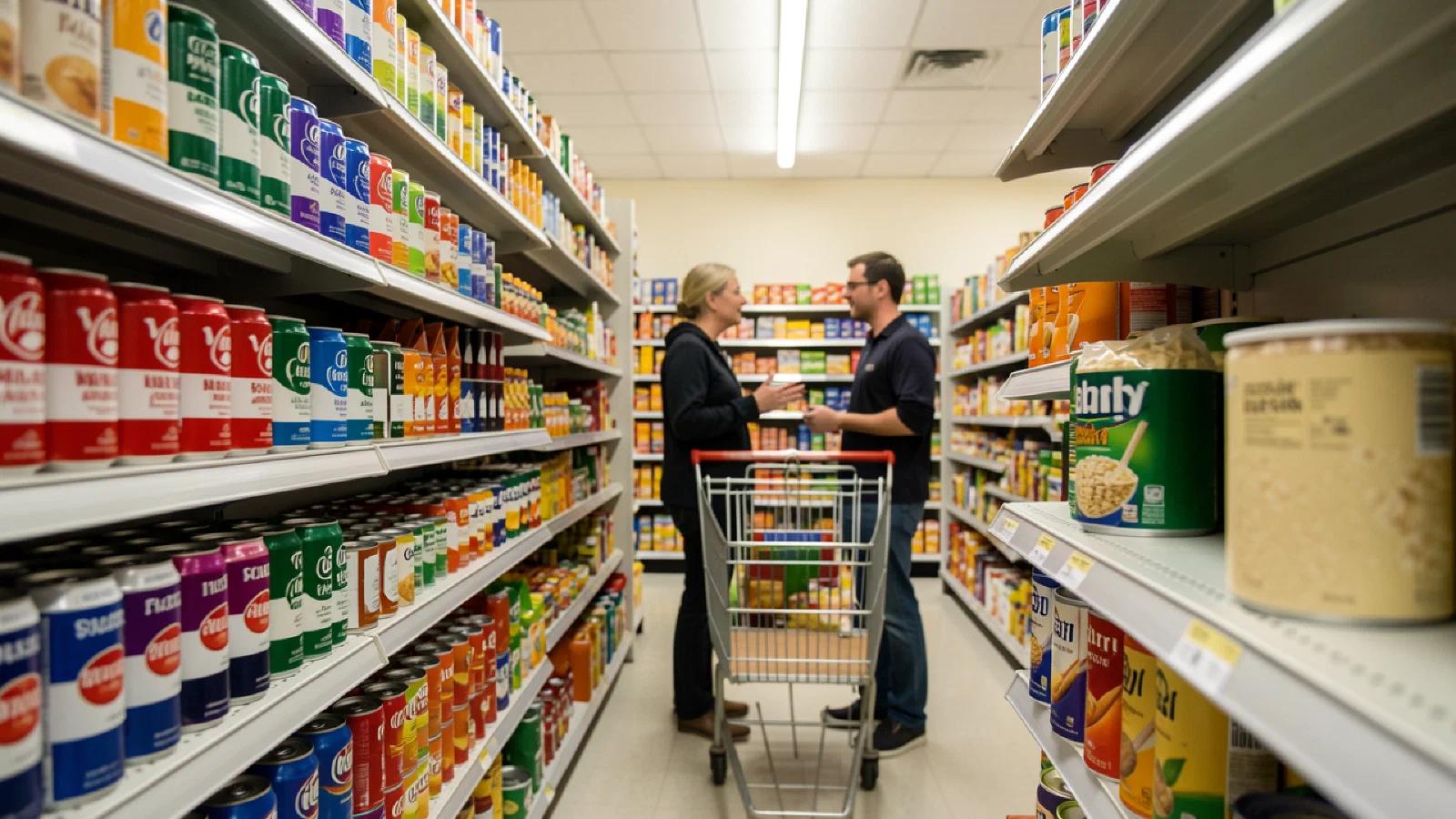
On Tuesday she is in aisle 7 when she runs into Edie. She has not seen Edie since the fall. Edie’s cart has dog food in it, the expensive kind, and a birthday cake from the bakery section, and Margaret knows without asking that the cake is for Edie’s granddaughter, who turned seven in November. But it is not November. The cake is for a different occasion, and Margaret asks, and the occasion is that Edie’s daughter is having another baby, and the cake is for the reveal, and Edie’s face when she says this is the face of someone who has been waiting to tell somebody and has found somebody to tell.
They talk for twelve minutes near the canned tomatoes. Edie’s daughter is due in August. Margaret knew Edie’s daughter when she was learning to walk. This fact sits between them like a shared possession, something neither of them needs to say but both of them feel, the long thread of a neighborhood where people watched each other’s children grow up and are now watching the children’s children arrive.
Twelve minutes. Nobody scheduled them. Nobody designed them. They happened because two people were in the same aisle of the same store at the same time and recognized each other, and recognition created space, and space filled with twelve minutes of the kind of talk that holds a neighborhood together without anyone calling it that.
The Cashier Who Knew#
Margaret has been shopping at this store since 1989. The store has changed owners twice, been renovated once, and added a pharmacy that Margaret has never used because her pharmacy is Linda’s pharmacy, the one she still goes to in person. The layout has shifted over the decades, the produce section migrating from the right side to the left, the bakery expanding, the frozen section contracting, but the bones of the store are the same, and Margaret moves through them without consulting the signs.
There used to be a cashier named Diane. Diane worked register 3 for nine years and knew Margaret by name and knew what she bought and would sometimes set aside the specific brand of decaf when the shelf was running low because she knew Margaret would come on Tuesday and would need it. This was not a company policy. It was Diane, doing something the job did not require because the relationship that accumulated over nine years of Tuesday transactions produced a knowledge that was not in any inventory system.
Diane left four years ago. Margaret does not know where she went. The register is still there. It is now a self-checkout station.
The Sorting#
The store now offers three ways to get groceries. You can shop in person, the way Margaret does. You can order online and pick them up in the parking lot, loaded into your trunk by an employee you may or may not see. You can have them delivered, for a fee, to your door.
Each option is rational. Each option is voluntary. The aggregate of these rational voluntary choices is producing a stratification nobody designed.
The people who shop in person are increasingly a specific population: older, less affluent, less comfortable with apps, or choosing the encounter. The people who order pickup are busy, mobile, able to plan. The people who order delivery can pay the fee, which starts at $7.99 and climbs during peak hours, and which purchases the elimination of the trip itself.
The store serves all three populations. It does not sort them. They sort themselves. And the sorting means that the aisle where Margaret ran into Edie is becoming, gradually, a space occupied by a narrower cross-section of the community. The delivery customers never enter the store. The pickup customers enter the parking lot and leave. The in-store shoppers are who remain, and who remains is not who was there five years ago when the aisle was still the one place in town where everyone went, because everyone needed to eat, and the need to eat put everyone in the same building.
The store was once the most democratic commercial institution in the town. More democratic than the bank, which sorted by account type. More democratic than the restaurant, which sorted by price. The grocery store was where the lawyer and the janitor and the retired teacher and the single mother were in the same checkout line at 5 PM on a Wednesday, because everyone needs bread and milk and eggs, and the need for bread and milk and eggs is one of the few needs that crosses every demographic line.
The self-checkout changed the line. The delivery changed the building. The building that once held everyone now holds who is left after the sorting, and who is left does not represent the same cross-section, and the loss of the cross-section is invisible because each individual decision that produced it was perfectly reasonable.
The Loyalty Program#
The store knows more about Margaret’s eating habits than her doctor does. The loyalty card she scans every Tuesday, the one that gives her two cents off per gallon at the gas station she no longer uses because she drives less now, has generated a profile of her consumption that is exhaustive, longitudinal, and precise.
It knows the seventeen items. It knows the oatmeal is the same brand Harold started buying in 2008. It does not know why she buys it. It knows the decaf. It does not know that the decaf is the one Diane used to set aside. It knows the whole wheat bread. It does not know that the bread is clipped with a different clip now, not the pharmacy bag clips that are in the kitchen drawer, and that the change is because the pharmacy bag clips stopped arriving when the medication started coming by mail.
The system knows everything about what Margaret buys and nothing about who she is. This is not a complaint about data. It is an observation about the difference between a profile and a person. The profile is useful. It generates coupons she sometimes uses. It predicts her shopping patterns with reasonable accuracy. It is a better representation of her consumption habits than Diane could have carried in her head.
It is not Diane. Diane knew the decaf. She also knew that Margaret looked tired one Tuesday in March and asked if she was okay, the same question Linda asked at the pharmacy, the same question that has no data field and no line item and no business justification, and that happened because a person was there and was paying the kind of attention that cannot be automated because it was never a task.
I wonder whether the sorting is a problem anyone is responsible for, since each individual choice, ordering delivery, using self-checkout, is rational and voluntary, and the aggregate of rational voluntary choices is producing a stratification that no one designed and no one is accountable for.
The Scale#
Margaret finishes her shopping. Seventeen items, the same seventeen, minus the decaf which was out of stock, which Diane would have set aside but which the shelf has no opinion about. She goes to the self-checkout because the one staffed register has a line, and the line moves slowly, and Margaret’s ankles have been bothering her.
At the self-checkout she has trouble with the scale. The bread is too light to register. The screen says “unexpected item in bagging area” and Margaret does not know what this means because the item is not unexpected, it is bread, the same bread she has been buying for sixteen years. She stands there for a moment, the screen blinking, the machine making a sound that is not quite an alarm but is not quite not an alarm either.
A young employee comes to help. He is patient and kind and scans a badge and presses a button and the screen clears and Margaret can continue. He does not know her name. She does not know his. He moves to the next customer, who is also having trouble with the scale, because the scale is the same scale and the problem is the same problem and the employee’s afternoon is a series of identical interventions between strangers and machines.
Margaret thanks him. She goes home. The seventeen items, minus the decaf, are in the bags in the trunk. The car pulls out of the parking lot and passes the pickup zone, where someone is loading groceries into an SUV without getting out, and the delivery van in the loading bay, where someone is stacking boxes for someone who will never enter the building at all.
The oatmeal is in the bag. The oatmeal is always in the bag. She will put it in the cabinet next to the decaf, when the decaf comes back in stock, in the cabinet next to Harold’s mug, which is not going anywhere.
References#
Ritzer, George. The McDonaldization of Society. Sage Publications, 2019.
Oldenburg, Ray. The Great Good Place: Cafés, Coffee Shops, Community Centers, Beauty Parlors, General Stores, Bars, Hangouts, and How They Get You Through the Day. Paragon House, 1989.
Putnam, Robert D. Bowling Alone: The Collapse and Revival of American Community. Simon & Schuster, 2000.
Zukin, Sharon. Naked City: The Death and Life of Authentic Urban Places. Oxford University Press, 2010.
Klinenberg, Eric. Palaces for the People: How Social Infrastructure Can Help Fight Inequality, Polarization, and the Decline of Civic Life. Crown, 2018.
How this essay connects to others across The Approximate Mind.
- Ritzer, George. The McDonaldization of Society. Sage Publications, 2019.
- Oldenburg, Ray. The Great Good Place: Cafés, Coffee Shops, Community Centers, Beauty Parlors, General Stores, Bars, Hangouts, and How They Get You Through the Day. Paragon House, 1989.
- Putnam, Robert D. Bowling Alone: The Collapse and Revival of American Community. Simon & Schuster, 2000.
- Zukin, Sharon. Naked City: The Death and Life of Authentic Urban Places. Oxford University Press, 2010.
- Klinenberg, Eric. Palaces for the People: How Social Infrastructure Can Help Fight Inequality, Polarization, and the Decline of Civic Life. Crown, 2018.