Nine Minutes
What the visit is for when AI has done the visit
TAM-WTR.03 · The Waiting Room · The Approximate Mind
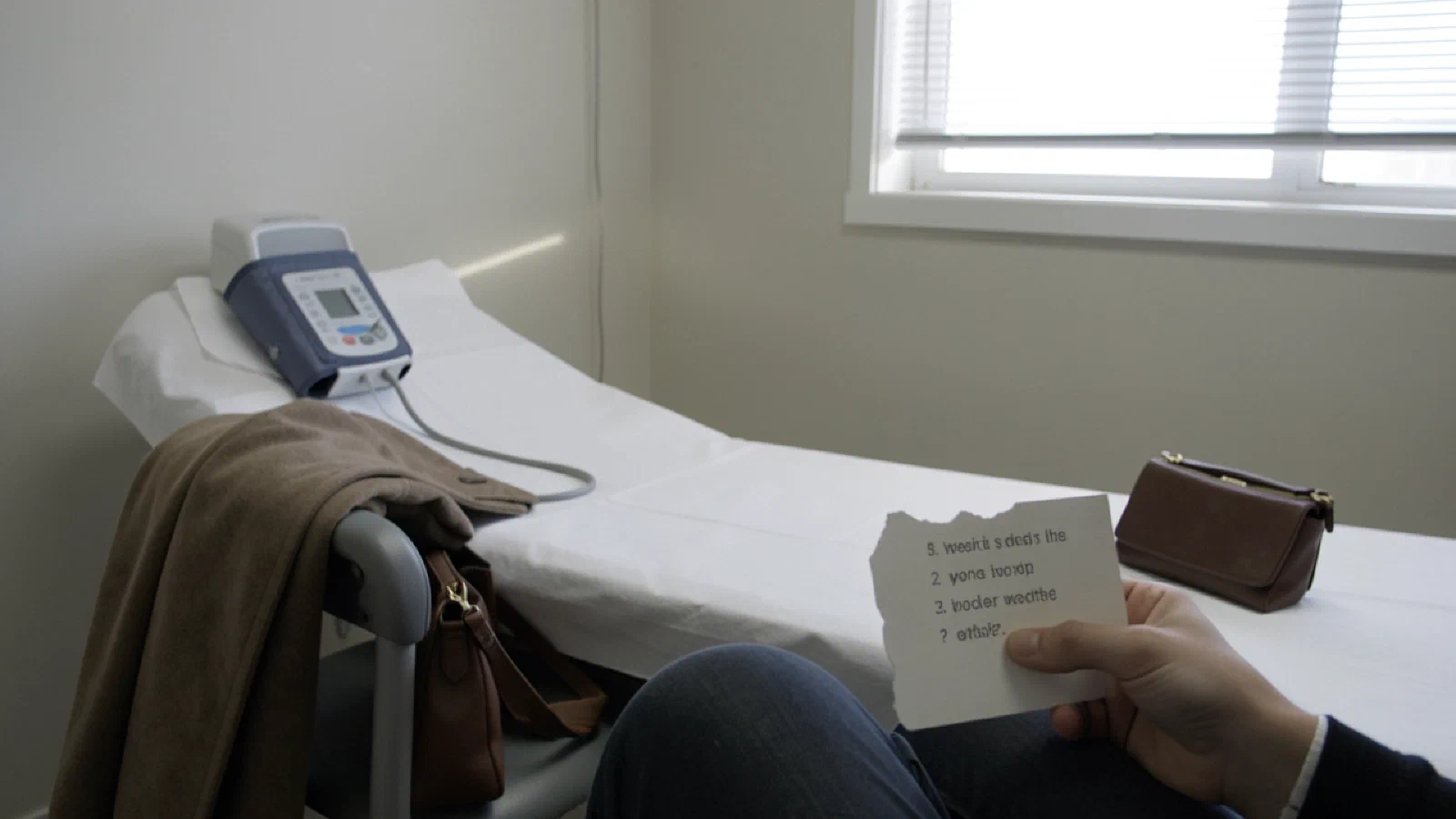
Margaret brings a list to every appointment. Three questions, written on an index card in her handwriting, the kind of handwriting that comes from learning to write in the 1950s when handwriting was still taught as a discipline. She started carrying the index card in 2011, when Harold was diagnosed and the appointments multiplied and she learned that you forget things in the room. The room takes your questions and replaces them with the doctor’s questions, and by the time you are back in the elevator you remember what you meant to ask and it is too late.
The index card solved this. Three questions, written at the kitchen table the night before, reviewed once in the car. The card lives in the left pocket of her purse, the pocket she can reach without opening the clasp. She has been doing this for fifteen years. It has never once failed her.
Today the card has three questions. The third one is the one that matters, but she has written it third because it is the one that is hardest to say, and she has learned that the appointments follow the card’s order, and by the time she reaches the third question the appointment is usually close to ending and the doctor is already half-turned toward the door.
The Pre-Visit#
The waiting room has six chairs instead of twelve. It is never full. Margaret checked in on her phone in the parking lot using the patient portal her daughter installed for her, the same daughter who installed the banking app, who seems to install most of the things that run Margaret’s institutional life. The check-in asked her to confirm her medications, her address, her emergency contact. It took four minutes. She sat in the car and did it because the waiting room felt unnecessary with only two other people in it.
The automated blood pressure cuff is in the hallway now, not in the exam room. Margaret put her arm in it herself, pressed the green button, and waited while the cuff inflated and the number appeared on the screen and was transmitted to her chart without anyone touching her. The vitals were in the system before she reached the exam room. The lab results from last week were already interpreted, the summary available on the portal she checks but does not fully understand, the flagged values highlighted in red that turned out to mean nothing or everything depending on the conversation she has not yet had.
The doctor has nine minutes.
What Nine Minutes Contains#
The nine minutes is what remains after the system has done its work. The check-in is done. The vitals are recorded. The labs are interpreted. The medication reconciliation was completed electronically before Margaret arrived. The AI-assisted pre-visit summary sits on the doctor’s screen: a paragraph of synthesized information drawn from Margaret’s chart, her recent test results, her prescription history, her age-adjusted risk factors.
The doctor has read the summary. She knows, before Margaret sits down, more about Margaret’s medical status than any physician in any previous era could have known about any patient walking through any door. The information is complete, current, and accurate.
What the doctor does not know, and what the summary does not contain, is what Margaret looked like three years ago.
This is not a failure of the system. Medical records do not track the pace of a patient’s walk, the brightness of her eyes, the way she holds her purse, the difference between the Margaret who sat in this chair in September and the Margaret who is sitting in it now. These are not clinical observations. They are the observations a person makes about another person they have been seeing regularly over time, and they are possible only when seeing is something that happens in a room, between bodies, over years.
The doctor sees Margaret four times a year. That is thirty-six minutes a year. Over five years, three hours. In three hours of accumulated looking, a physician develops a baseline that is not in any chart: the way this particular patient enters a room, settles into the chair, answers “how are you.” The deviation from that baseline is clinical data that no sensor has captured and no algorithm has learned to read.
Not yet. Perhaps not ever. The deviation is visible because one body is in the presence of another, and the presence is longitudinal, and the longitudinal presence produces a form of knowing that is different from knowledge.
The Compression#
The nine-minute appointment is not an accident. It is the product of a specific economic logic.
AI has made the visit more efficient. The pre-visit summary saves five minutes. The automated vitals save three. The electronic medication reconciliation saves two. These are real savings. They represent real time freed from administrative tasks that used to consume the visit.
The freed time was supposed to go somewhere. In the optimistic version of the story, the efficiency gains are reinvested in the encounter: the doctor spends more time talking to Margaret, asking the questions the system did not generate, noticing the things the summary did not capture. The nine minutes becomes fifteen. The visit becomes better.
That is not what happened. What happened is that the efficiency gains were converted into throughput. The system can now process a patient in nine minutes instead of fifteen, which means the schedule can hold more patients per day, which means the practice’s revenue increases, which means the investment in the AI system is justified, which means the next round of efficiency tools is funded, which means the visit gets shorter again.
The economic logic of healthcare converts efficiency gains into volume, not depth. This is not a conspiracy. It is not anyone’s intention. It is the structural consequence of a system that measures productivity in patients per day and revenue per encounter. When the pre-visit AI saves five minutes, those five minutes become available, and the available minutes are claimed by the schedule before the physician can claim them for the patient in the room.
The result is that everything the AI cannot do is compressed into nine minutes. The noticing, the reading of the face, the question the algorithm did not generate, the pause that creates space for Margaret to say the thing she has not planned to say. These are what the visit is for now, and nine minutes is not enough time for them.
The Third Question#
Margaret’s first two questions are answered quickly. A medication timing issue, resolved in under a minute. A question about a test result, explained with the help of the screen. Two questions, four minutes. The doctor is thorough, clear, patient. She is a good doctor.
Five minutes left. Margaret looks at the index card.
The third question is about the feeling she has been having in the evenings, a heaviness that is not pain and not fatigue and not sadness exactly but something she does not have a word for. It started after she stopped going to the pharmacy in person, after the bank reduced its hours, after the Thursday routine that organized her week dissolved into a series of apps and deliveries and automated confirmations that work perfectly and require nothing from her.
The heaviness is not a symptom in any clinical sense. It is not billable. It does not map to a diagnostic code. It is the thing that happens when a person who used to leave the house for five errands a week now leaves the house for one, and the one is this appointment, and the appointment is nine minutes, and five of those minutes are already gone.
Margaret looks at the index card. She looks at the doctor, who is attentive and kind and whose hand is near the mouse, not clicking yet but near. The room is doing what the room always does: compressing the time, pulling the interaction toward its end, making the question that is not yet a question feel like it would take too long to ask.
I wonder whether the compression of the visit is a temporary artifact of the transition, the AI having not yet freed up enough physician time, or whether the economic logic of healthcare will always convert efficiency gains into throughput rather than depth, and whether this means the nine minutes is not a phase but a destination.
Margaret puts the card back in her purse.
The Elevator#
She walks out with two questions answered and one unasked. The lobby is quiet. The receptionist, who used to be the first face you saw and the last face you saw and who knew your name, has been replaced by a kiosk with a screen that says “Have a great day!” in a font that was chosen by someone in an office she has never seen.
In the elevator she takes the index card out again. The third question is still there in her handwriting, which is still the handwriting of someone who learned to write when writing was still taught as a discipline.
She puts the card in her purse. Maybe next time. Maybe next time the nine minutes will be enough, or she will be faster with the first two questions, or the heaviness will have named itself by then and she will know how to say it in the time available.
The elevator opens. The parking lot is half empty. Her car is where she left it. She sits in the driver’s seat for a moment before starting the engine, the way she sometimes does after appointments, collecting herself, the index card in her purse, the question still written, still unasked.
References#
Tai-Seale, Ming, et al. “Time Allocation in Primary Care Office Visits.” Health Services Research, vol. 42, no. 5, 2007, pp. 1871–1894.
Dugdale, David C., et al. “Time and the Patient-Physician Relationship.” Journal of General Internal Medicine, vol. 14, no. S1, 1999, pp. S34–S40.
Topol, Eric. Deep Medicine: How Artificial Intelligence Can Make Healthcare Human Again. Basic Books, 2019.
Verghese, Abraham. “Culture Shock: Patient as Icon, Icon as Patient.” The New England Journal of Medicine, vol. 359, no. 26, 2008, pp. 2748–2751.
Heath, Iona. “Role of Fear in Overdiagnosis and Overtreatment.” BMJ, vol. 349, 2014, g6123.
How this essay connects to others across The Approximate Mind.
- Tai-Seale, Ming, et al. “Time Allocation in Primary Care Office Visits.” Health Services Research, vol. 42, no. 5, 2007, pp. 1871–1894.
- Dugdale, David C., et al. “Time and the Patient-Physician Relationship.” Journal of General Internal Medicine, vol. 14, no. S1, 1999, pp. S34–S40.
- Topol, Eric. Deep Medicine: How Artificial Intelligence Can Make Healthcare Human Again. Basic Books, 2019.
- Verghese, Abraham. “Culture Shock: Patient as Icon, Icon as Patient.” The New England Journal of Medicine, vol. 359, no. 26, 2008, pp. 2748–2751.
- Heath, Iona. “Role of Fear in Overdiagnosis and Overtreatment.” BMJ, vol. 349, 2014, g6123.