Maria's Morning
The same town, the other side
TAM-WTR.10 · The Waiting Room · The Approximate Mind
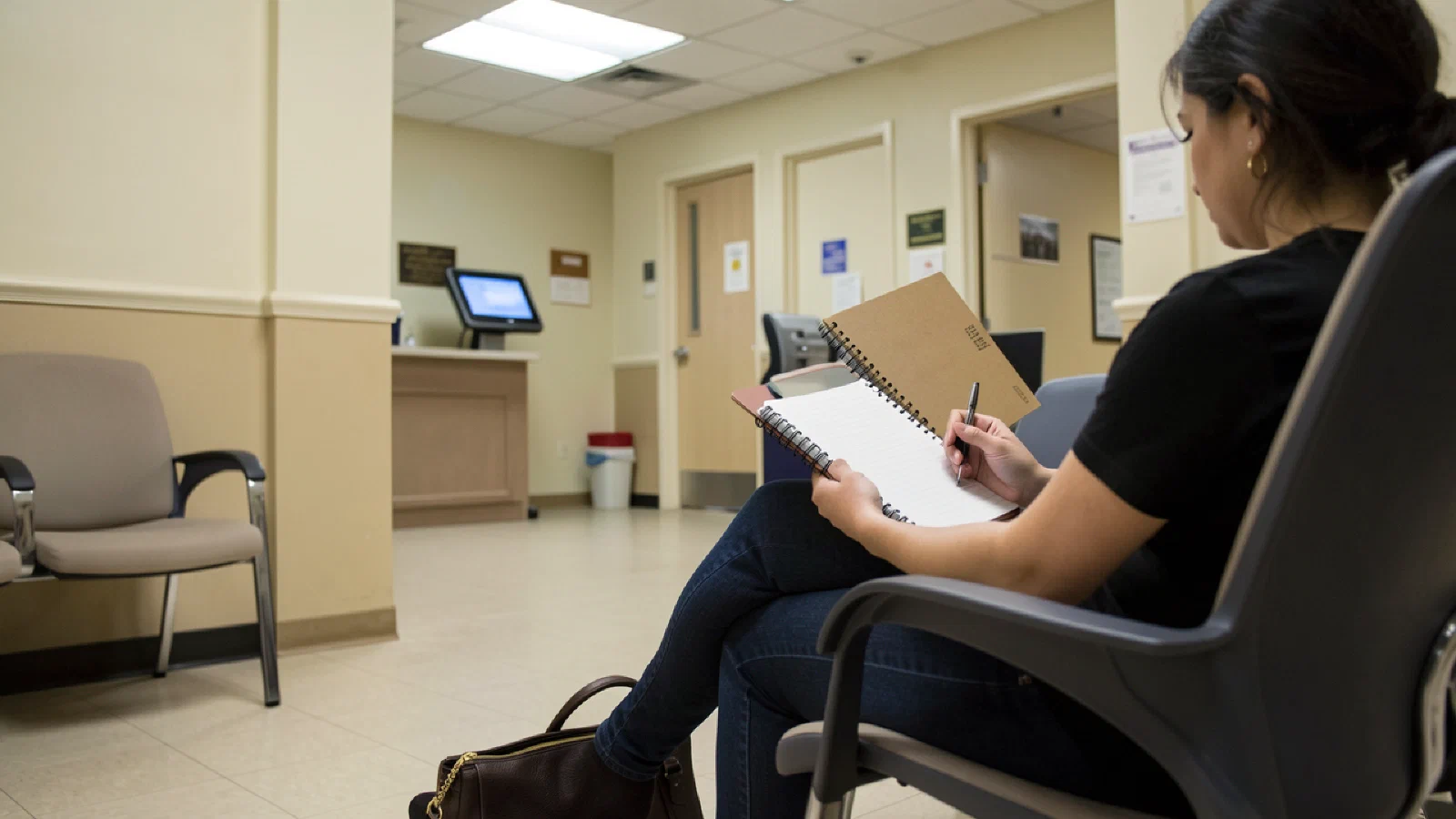
Maria carries a small spiral notebook. She writes down everything anyone official tells her, with the date and the name of the person who said it. She started doing this after the time something was told to her and then denied: a caseworker had said her recertification was processed, and three weeks later the system said it was not, and without the notebook Maria would have had nothing but her memory against the system’s record, and the system’s record always wins.
The notebook has been right twice in situations where the system said she was wrong. Twice in nine years is not often. It is often enough that she carries it everywhere.
It is 7:15 AM. Maria is on the bus. The bus comes every thirty-five minutes on this route, which means the bus does not come when you need it. It comes when it comes, and you organize your life around its schedule the way you organize your life around weather: something you cannot change and therefore must absorb.
She is going to the social services office to sort out a benefits notice she received that she does not fully understand. She could call the automated line, but the last time she called the automated line it told her something that turned out to be wrong, and it cost her three weeks and two more bus trips to fix. She is going in person.
The App That Makes Everything Easier#
The same institutions that Margaret moves through are available to Maria. The same banking app. The same telehealth portal. The same online renewal for the license she does not have because she does not have a car. The same grocery delivery service. The same pharmacy mail-order option. The same digital infrastructure that eliminated Margaret’s trips is available, in theory, to Maria.
The digital alternative that eliminated the trip for Margaret requires resources Maria is spending the trip to acquire.
The app that makes everything easier costs $12.99 a month. Maria does not spend $12.99 on ease. She spends $12.99 on things that cannot be eliminated: the phone bill, the bus pass, the after-school program that keeps Daniel occupied until she gets home from her shift. The $12.99 is not a sacrifice. It is arithmetic. When the budget is fixed and the expenses are real, the category of “easier” is the first thing cut.
The online portal requires a document scan. Maria’s scanner is her phone. Her phone has 3% battery because the charger broke and the replacement is $15 she has not spent yet, and the phone is old and the battery drains in ways the phone did not drain when it was new, and the draining is a small daily anxiety that sits alongside the other small daily anxieties and accumulates into a condition that is not poverty exactly but is the texture of a life organized around what cannot be afforded.
The telehealth visit requires a quiet room. Maria’s apartment has three people in it at 10 AM: Maria, her mother, and her mother’s television, which is on from eight in the morning until ten at night and which is not negotiable because the television is her mother’s primary companion and turning it off for a telehealth visit would require explaining what a telehealth visit is, which Maria has tried, and the explanation did not take.
The Bus#
The bus is Maria’s institution. Not the social services office, not the benefits portal, not the telehealth screen. The bus. She spends more time on the bus than in any other institutional space, and the bus shapes her day the way the pharmacy and the library shape Margaret’s: as a structure around which everything else is organized.
The 7:15 bus reaches downtown at 7:52. The social services office opens at 8:30. Maria will wait outside until it opens. The wait is not optional. If she takes the later bus, the 7:50, she arrives at 8:27 and the line is already formed and she will not be seen until 10:00, and at 10:00 she needs to be on the bus going home because she has a shift at 2:00 and the bus takes forty minutes and she needs to eat and change and the day has no margin for the caseworker to be running late.
The morning is a logistics problem whose variables include bus schedules, office hours, shift times, battery percentage, the availability of a quiet room, the cost of the charger she has not replaced, and the benefits notice she does not understand. Margaret’s morning has margin. Maria’s morning has none.
The frictionlessness they built for one population is friction for another. The app, the portal, the automated line, the digital alternative: these were designed by people for whom the phone has battery, the room is quiet, the internet is reliable, and $12.99 is an amount that does not appear in any budget calculation. For those people, the friction is gone. For Maria, the friction has changed shape: it used to be the trip, and now it is the interface, and the interface requires resources the trip did not.
9:45#
Maria gets to the office at 9:45. She takes a number. She sits in a chair that is the same kind of chair as the DMV chairs, the same blue-green that exists only in government buildings. She waits.
At 10:30 a screen calls her number. She goes to a window. The caseworker is young, efficient, and typing as Maria speaks. Maria takes out the benefits notice. She takes out the notebook. She reads aloud the notice’s language, which contains phrases she has looked up on her phone and still does not fully understand. The caseworker looks at the screen, types, looks again.
The notice was an error. A system update triggered a recalculation that flagged Maria’s case for review, and the review generated a notice that implied a benefit reduction that was never going to happen. The caseworker explains this. Maria writes down the explanation. She writes down the caseworker’s name and the date.
“So nothing changes?” Maria asks.
“Nothing changes.”
Maria closes the notebook. She puts the notice in the notebook. She puts the notebook in her purse. The trip took two and a half hours, including the bus, the wait, and the five-minute conversation that resolved the thing that did not need resolving. Two and a half hours for a system error that generated a notice that generated an anxiety that generated a bus trip that consumed a morning.
The caseworker did nothing wrong. The system did nothing wrong, exactly. The notice was generated by an automated process that works correctly when viewed from inside the system’s logic. The error was not in the process. The error was in the assumption that the recipient of the notice could determine, without assistance, that the notice was an error, and that the assistance could be accessed without spending a morning and a bus fare and the 3% of battery that Maria’s phone will need for the rest of the day.
The Shift#
I wonder whether the designers of these systems understand that the frictionlessness they built for one population is friction for another, or whether the populations who experience the digital alternative as harder are simply outside the design frame.
Maria takes the bus home. It is 12:30. The apartment is warm. Her mother’s television is on. Maria changes for her shift. She eats standing up, which is how she eats when the day has no margin, which is most days. The food is quick and the eating is quick and the quickness is not a preference but a constraint, and the difference between a preference and a constraint is the difference between Margaret’s morning and Maria’s morning.
She has a shift at 2:00. The shift is at the same grocery store where Daniel used to work, the same store where Margaret buys her seventeen items on Tuesday, the same self-checkout where Margaret had trouble with the scale. Maria restocks shelves. She has been restocking shelves for four years. The work is physical and repetitive and she is good at it and the being good at it is not a source of pride exactly but is a competence she relies on the way she relies on the notebook: something that is hers, that works, that no system can take from her.
The notebook is in her purse. The notice is in the notebook. The caseworker’s name and the date are written in Maria’s handwriting, which is small and precise, the handwriting of someone who learned early that what is written down is what can be proved.
The bus comes at 1:15. Maria is at the stop at 1:10. The bus comes when it comes.
References#
Herd, Pamela, and Donald P. Moynihan. Administrative Burden: Policymaking by Other Means. Russell Sage Foundation, 2019.
Eubanks, Virginia. Automating Inequality: How High-Tech Tools Profile, Police, and Punish the Poor. St. Martin’s Press, 2018.
Desmond, Matthew. Poverty, by America. Crown, 2023.
Edin, Kathryn J., and H. Luke Shaefer. $2.00 a Day: Living on Almost Nothing in America. Houghton Mifflin Harcourt, 2015.
Servon, Lisa J. The Unbanking of America: How the New Middle Class Survives. Houghton Mifflin Harcourt, 2017.
How this essay connects to others across The Approximate Mind.
- Herd, Pamela, and Donald P. Moynihan. Administrative Burden: Policymaking by Other Means. Russell Sage Foundation, 2019.
- Eubanks, Virginia. Automating Inequality: How High-Tech Tools Profile, Police, and Punish the Poor. St. Martin’s Press, 2018.
- Desmond, Matthew. Poverty, by America. Crown, 2023.
- Edin, Kathryn J., and H. Luke Shaefer. $2.00 a Day: Living on Almost Nothing in America. Houghton Mifflin Harcourt, 2015.
- Servon, Lisa J. The Unbanking of America: How the New Middle Class Survives. Houghton Mifflin Harcourt, 2017.