The Verifiers
In a generated world, the scarce good is proof
TAM-UOO.04 · The Unit of One · The Approximate Mind
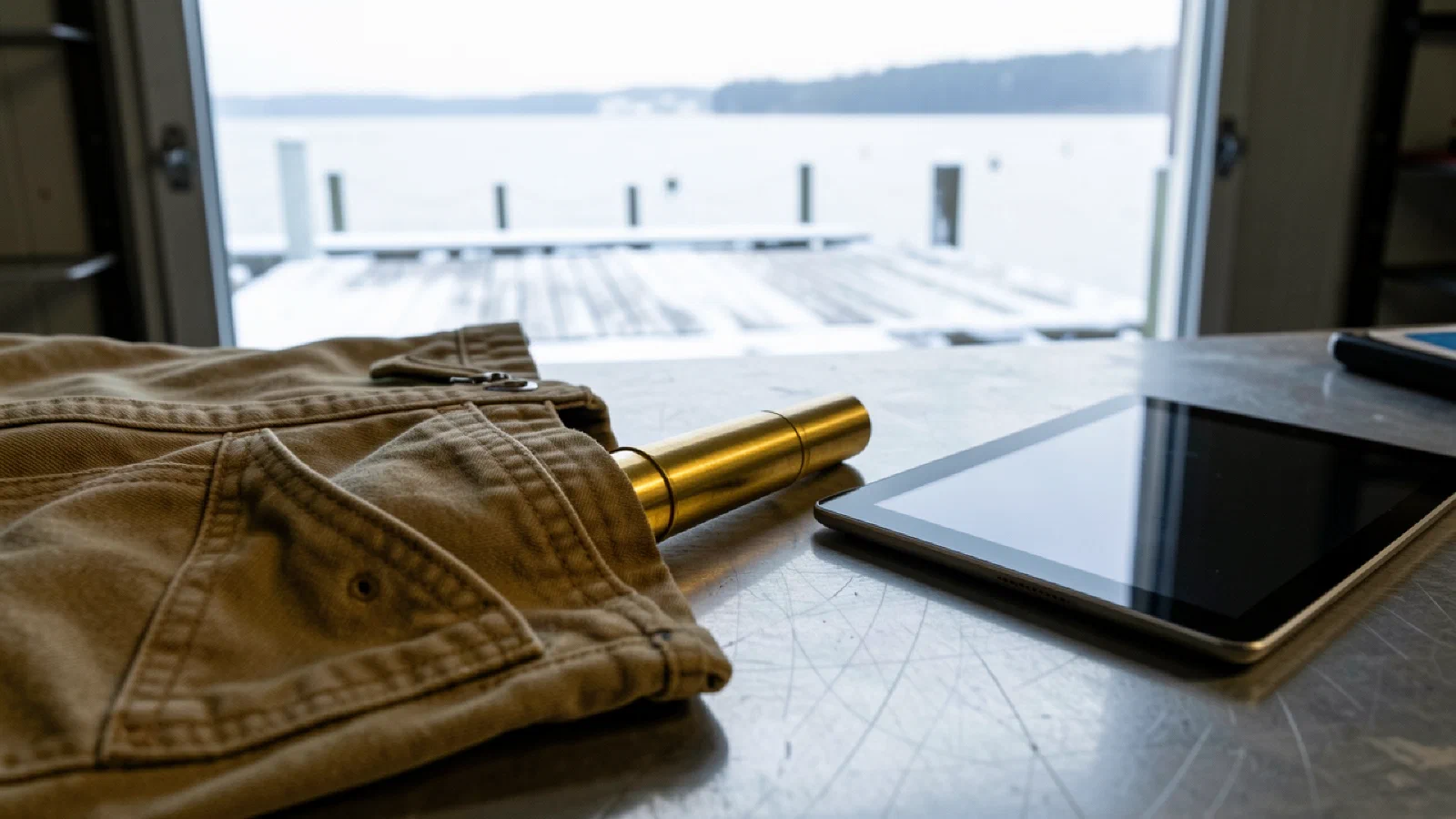
Tomás Ferreira starts work at four in the morning at a cross-dock in New Bedford, and in the inside pocket of his jacket he carries a brass grain probe that has not sampled grain since 1974. It belonged to his grandfather, who inspected wheat at the port of Santos for thirty-one years, and it is heavier than anything that useful needs to be. Tomás has never used it. He carries it the way some men carry a saint.
His own instruments are lighter. A tablet, a vision system that has already flagged eleven pallets overnight, a spectral scanner that reads sugar content through the skin of a peach. Tomás walks the flagged pallets, opens cartons the cameras were unsure about, and renders verdicts. He works for none of the parties whose goods cross the dock. Not the aggregators shipping, not the relationship firms receiving, not the farms upstream. His employer is paid a small fee per inspection by whoever requested it, and the fee is small on purpose.
The Fiduciary, elsewhere in this series, found this function hiding inside the relationship firm: the checking that protects the asset. What happens when the checking moves out, and becomes a company that does nothing else?
The Oldest Quiet Business#
The idea sounds new and is nearly the oldest commercial institution we have.
In 1878 a firm began inspecting grain shipments at Rouen, certifying to buyers in one port that what was loaded in another port was what the documents claimed. It is still operating. So is the registry that began surveying ships for Lloyd’s coffeehouse in 1760, and the laboratory that began testing electrical equipment for insurers in 1894. The verification houses are among the longest continuously profitable institutions in the world, and they share a profile: low margins, no glamour, and a product that never goes out of demand, because the product is the thing that lets strangers trade at all.
A market between people who know each other runs on the knowing. A market between strangers runs on proof, and someone has to manufacture it. Economics gave the underlying problem a famous name, the market for lemons: where buyers cannot verify quality, good goods are driven out by bad ones, and eventually the market itself unravels. The verifier is the institution that stops the unraveling. It does not make anything, move anything, or sell anything. It makes the market possible and charges a toll so small that nobody resents paying it.
The verifier’s product is the market’s permission to exist.
Neutrality Is the Product#
What makes this business strange, and what protects it, is a structural property the rest of the economy does not share: it is destroyed by integration.
Consider the alternatives. The relationship firm could verify its own suppliers, and does, but its verdicts carry a conflict it cannot remove: admitting a supplier failed means admitting its own routing failed, and the temptation to grade gently is built into the position. The supplier could certify itself, and the certificate would be worth the paper. The platform giant could offer verification as a service, and the service would be disbelieved the moment it touched anything the giant also sells, which is everything. Nobody can credibly audit a market they participate in.
Which means the verifier’s value comes from the one thing it refuses to do: take a side, take a stake, take the larger money. Independence is not the verifier’s policy. It is the verifier’s inventory. Every acquisition that would make strategic sense, every vertical move up into routing or down into supply, would liquidate the asset in the act of leveraging it.
And the low margin, which looks like the business’s weakness, turns out to be its wall. The position repels exactly the competitors who could crush it. The giants will not fight for a transaction fee measured in cents, and could not hold the position if they won it, because their other businesses poison the neutrality the fee is paid for. Reputational trust compounds slowly and cannot be bought, which means it also cannot be speed-run by a well-funded entrant.
Trust is the one moat that cannot be capitalized into existence. It can only be deposited, one kept promise at a time.
Both Blades of the Same Tool#
Now place this old institution in the new economy, and watch the demand curve do something unusual.
AI transforms verification from both directions at once. On the cost side, it collapses the price of checking. The vision system that flagged eleven pallets before Tomás arrived does the work of a dozen walking inspectors. Sensor attestation, anomaly detection across millions of fulfillments, pattern recognition that notices a supplier drifting weeks before a human would: the volume layer of verification is becoming nearly free, which means it can finally cover the long tail of transactions that were never worth inspecting before.
On the demand side, the same technology collapses the price of deception. The proof photo can be generated. The review can be synthesized, in thousands, each one plausible. The certificate can be forged pixel-perfect, the provenance fabricated, the inspection report written by the same class of system that writes everything else. The cost of producing convincing falsehood is falling at the same rate as the cost of producing everything, because falsehood is just another product.
Put the two blades together and the conclusion is not subtle. In an economy where anything can be generated, the scarce good is confirmation that something is real. Verification demand does not merely survive the technology. It rises in direct proportion to it. Every advance that makes fabrication cheaper makes the verifier’s fee easier to justify, which may make this the only business in the transition whose market grows with the very capability that dissolves everyone else’s.
The Ledger and the Trap#
There is a hidden asset in the business, and inside the asset, a trap with a famous body count.
The verifier sees what no single participant sees. Every relationship firm checks its own suppliers; the verifier checks everyone’s. Across millions of inspections, a picture assembles that exists nowhere else in the economy: the true quality ledger, who is actually good, who is drifting, who is gaming which sensor. It is plausibly the most valuable dataset in the entire stack, accumulating as a byproduct of a business that charges cents.
And the ledger whispers. Sell ratings. Charge for certification. Let the suppliers pay for the grade, since the suppliers will pay so much more than the inspections ever yield. Become not the checker of transactions but the gatekeeper of the market, the one who decides who may sell at all.
We have run this experiment. The credit rating agencies spent most of a century as verification businesses, paid modest fees by the investors who used the ratings, and their verdicts were trusted because their incentives were boring. Then the model flipped: the issuers of the securities began paying for their own ratings, the grades inflated to keep the paying customers, and the inflated grades sat at the foundation of the structured products that failed in 2008. The official inquiry did not mince the finding: the agencies were essential cogs in the wheel of financial destruction. A verification institution had sold its ledger to the parties being judged, and the price, deferred for years, was paid by everyone at once.
The houses that endured for a century and a half did the opposite, and the discipline is almost monastic in its plainness. Stay at the transaction. Charge for the inspection, never for the opinion. Let the requester pay, never the judged. The most durable governance may not even be ordinary ownership: a mutual, a utility, a structure where the institution legally cannot do the profitable thing, because the profitable thing and the fatal thing are the same act on different timelines. I wonder whether any institution can hold that ledger for a century and decline, every single year, to sell it.
What the Sensors Cannot Read#
One more layer, and it is the one Tomás occupies.
Most of verification is becoming machine work, and should. But the dock teaches a daily lesson about where the machines stop. The scanner reads the peach’s sugar. It does not read whether the crew that packed it was the crew the labor certificate named. The camera confirms the carton’s seal. It does not confirm that the caregiver whose visit was logged actually sat with the woman, actually warmed the room, actually did the human thing the log entry abbreviates. There is a stratum of quality that lives below what any sensor returns, and reaching it requires a person standing in the place, with standing to say so.
So the verification company is a hybrid by necessity: machines for volume, people for depth, and the people are not a transitional workforce waiting to be automated out. They are the institution’s hands in the stratum the instruments cannot enter. Which makes the inspector corps a rare thing in this transition: work the audit strengthens instead of dissolving. The trust trades. The notaries of the generated world, multiplying precisely because everything else can be faked.
It is modest work. The fee is small, the margin thin, the verdicts one carton at a time. It is also the floor everything else in this architecture stands on: the fiduciary’s promise is only as good as the checking beneath it, and the checking is only as good as the stranger who has no stake in the answer.
The Probe#
The shift ends at noon. Tomás signs his last verdict, a pallet of stone fruit, passed with a note, and walks out into the white winter light off the harbor.
His grandfather’s probe was calibrated in 1953 and would still pull a true sample today. The ships it served are scrap. The grain firms it served were merged, renamed, merged again. The currencies the wheat was priced in no longer exist. The probe works. Instruments of trust are built that way, overbuilt, heavier than anything that useful needs to be, because the men who made them understood they were not making a tool for a market. They were making a tool for every market that would ever stand where that one stood.
Tomás puts his hand in his jacket pocket on the walk to the car, the way he does without noticing. The brass is cold. It will outlast his tablet by a hundred years, and he suspects it knows it.
This is the fourth essay in The Unit of One, a five-essay series of The Approximate Mind examining the firm that emerges when the cost of knowing each customer collapses. The third essay found a verification function hiding inside the relationship firm, protecting the only asset on its books. This essay follows that function out into the open: the verification-only company, the oldest quiet business in commerce, whose product is neutrality, whose moat is its own thin margin, and whose demand rises with every advance in the technology of fabrication. The closing essay, “The Firm That Stopped Guessing,” reads the four essays together and reports what is visible only from above.
References#
Information Asymmetry and Market Unraveling
Akerlof, George A. “The Market for ‘Lemons’: Quality Uncertainty and the Market Mechanism.” Quarterly Journal of Economics, vol. 84, no. 3, 1970, pp. 488-500.
The Verification Institutions
Yates, JoAnne, and Craig N. Murphy. Engineering Rules: Global Standard Setting since 1880. Johns Hopkins University Press, 2019.
Power, Michael. The Audit Society: Rituals of Verification. Oxford University Press, 1997.
Porter, Theodore M. Trust in Numbers: The Pursuit of Objectivity in Science and Public Life. Princeton University Press, 1995.
The Rating Agency Corruption
White, Lawrence J. “Markets: The Credit Rating Agencies.” Journal of Economic Perspectives, vol. 24, no. 2, 2010, pp. 211-226.
Partnoy, Frank. “The Siskel and Ebert of Financial Markets? Two Thumbs Down for the Credit Rating Agencies.” Washington University Law Quarterly, vol. 77, no. 3, 1999, pp. 619-712.
The Financial Crisis Inquiry Report. Financial Crisis Inquiry Commission, U.S. Government Printing Office, 2011.
Trust and Testimony
Shapin, Steven. A Social History of Truth: Civility and Science in Seventeenth-Century England. University of Chicago Press, 1994.
O’Neill, Onora. A Question of Trust: The BBC Reith Lectures 2002. Cambridge University Press, 2002.
Series Anchors
The Approximate Mind, TAM-UOO.03 (The Fiduciary): the verification function discovered inside the relationship firm.
The Approximate Mind, TAM-ARB.08 (The Delamination): bonded trust as a layer that persists when information layers dissolve.
The Approximate Mind, TAM-RWR.ZPF.06 (The Assessment Gap): the stratum of quality that sensors cannot return.
The Approximate Mind, TAM-033 (The Curation Economy): the warning that verification systems can recreate credential gatekeeping.
The Approximate Mind, TAM-UNF.12 (The Utility Layer): infrastructure positions that serve everyone and belong to no one.
How this essay connects to others across The Approximate Mind.