The Sale That Tests
When the order comes before the product, the guess disappears
TAM-UOO.02 · The Unit of One · The Approximate Mind
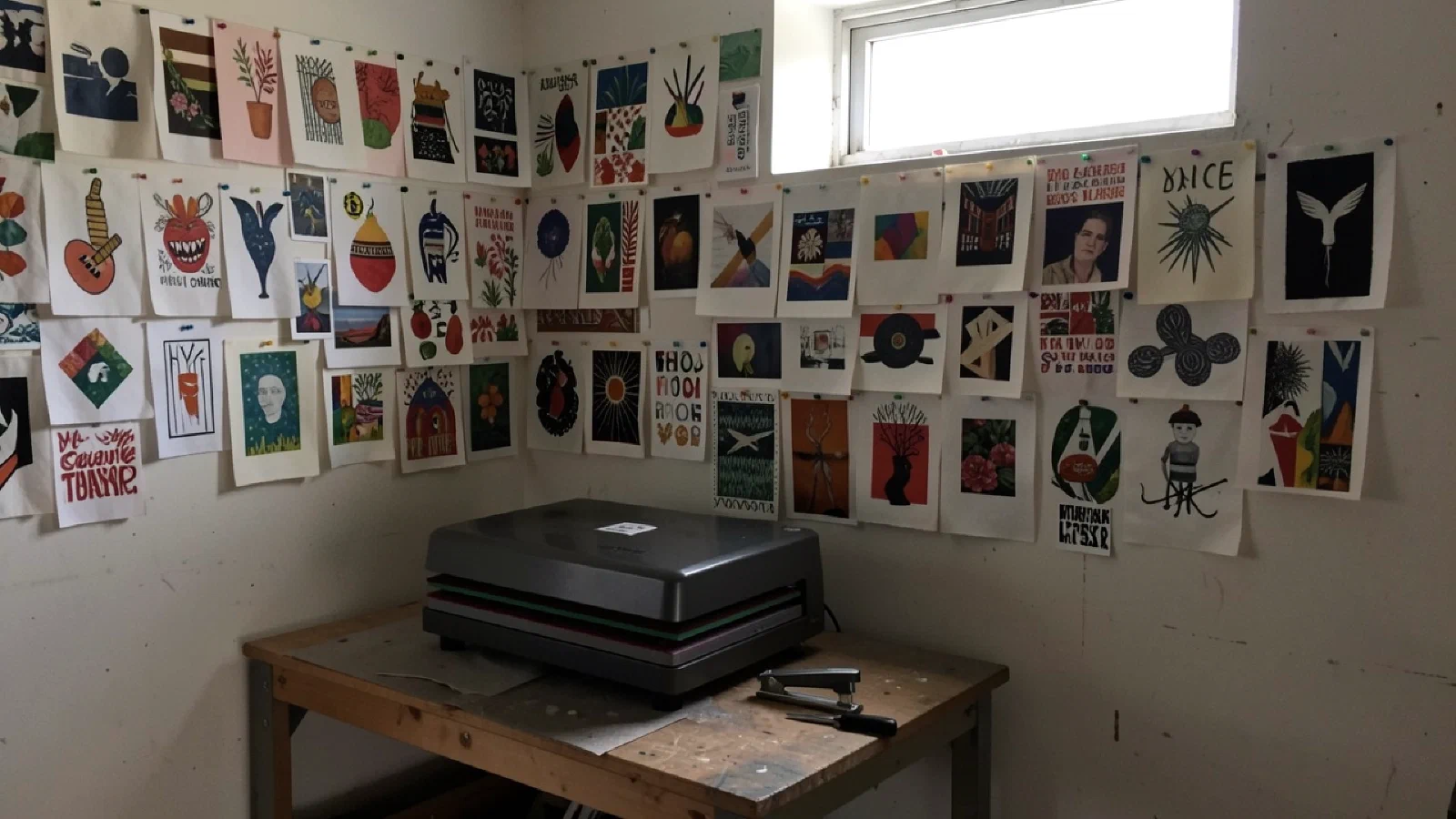
Priya Raman runs a two-person shirt studio out of a converted garage in Pittsburgh, and above her heat press hangs a wall of failures. One print of every design that never sold, pinned edge to edge, going back nine years. She has never explained the wall to anyone, including herself. Visitors assume it is decoration. Her business partner calls it the cemetery and Priya does not correct him, though that is not what it is.
For most of those nine years, the business worked the way the business of making things has always worked. Priya would design a shirt, guess how many people wanted it, order three hundred from the printer, and find out. Sometimes the answer was three hundred. Usually it was ninety, and the remaining two hundred and ten sat in boxes that slowly became furniture, each box a guess she had paid for in advance and could not take back.
Two years ago the sequence reversed, and the wall stopped growing.
The Grammar of the Guess#
It is worth pausing on how deep the old sequence runs, because we stopped noticing it centuries ago.
The industrial economy’s grammar is: produce, then discover demand. Commit first, learn second. The factory runs before the customer speaks. Everything we recognize as a modern firm is built around managing the gap between those two moments, the gap where the guess lives. Forecasting is the science of guessing better. Marketing is the art of making the guess come true. Inventory is the warehouse where wrong guesses go to wait.
Inventory is frozen guesswork, stacked on pallets.
None of this was a choice. It was a compression forced by cost. Finding out what each individual person wanted, before making anything, was possible in principle and ruinous in practice: you would have to ask them, one at a time, and then make them each a different thing. So the firm asked nobody and made everybody the same thing, and the entire apparatus of demand estimation, from the focus group to the test market to the regional rollout, grew up as an expensive ritual for approximating the question it could not afford to ask directly.
The test market deserves a moment of respect on its way out. A consumer goods company would pick a city, Columbus or Peoria, flood it with the new product, and watch. The city stood in for the country. The sample stood in for the population. The whole method was a confession: we cannot ask everyone, so we will ask a few and average the answer. Market research was the science of the stand-in.
The Reversal#
Now watch what happened in Priya’s garage.
The design cost fell first. What once took her a weekend in Illustrator now takes a conversation: she describes, the system drafts, she refines, and a finished print file exists in an hour. Then the commitment cost fell. Print-on-demand meant no minimum order, no three hundred shirts, no boxes becoming furniture. A design could be offered before a single unit existed.
And with those two costs gone, the sequence flipped. The customer speaks first. The shirt is made second. The order is not a withdrawal from a pile of guesses. It is the instruction that causes the thing to exist.
Look at what this does to the test market. Priya does not need Columbus. Every sale is Columbus. Every order is a data point that used to cost a research budget to approximate, and it arrives free, attached to revenue, accurate to the individual rather than averaged across a city.
The test and the sale were always the same event. Only the cost of asking kept them apart.
The Last Advance watched the portfolio dissolve because production cost collapsed and there was nothing left to finance. Here the forecast dissolves because commitment cost collapsed and there is nothing left to guess. The two are the same dissolution seen from opposite ends. The publisher’s portfolio and the manufacturer’s inventory were both ways of carrying the cost of not knowing, and the cost of not knowing is the thing that is going away.
The Convergence#
The death of the guess does not mean the death of the hit.
Priya’s customers do not just buy her designs. They modify them. The system lets each buyer adjust a print before ordering: a color, a phrase, a placement. For months this looked like noise, ten thousand people making ten thousand small choices. Then her order data did something she did not expect. Four hundred separate customers, over six weeks, independently pushed one design in the same direction: the same muted green, the same shortened phrase, the same shift of the print toward the shoulder. Nobody coordinated. Nobody voted. Four hundred individual preferences converged, and the convergence was visible only because every preference had been expressed as an order.
Priya made the converged version a standard product. It became the best seller in the studio’s history.
What happened in that sequence is the new grammar. The segment was not guessed. It was discovered. The hit was not gambled on. It was found, already formed, inside the exhaust of ten thousand individual transactions. Personalization, which looks like the opposite of mass production, turned out to be its research department. The unit of one is the laboratory where the unit of one million is discovered.
This is also why the fear that personalization atomizes culture is only half right. Shared objects still emerge. They simply emerge from the bottom up, condensing out of individual demand the way the converged shirt condensed out of four hundred orders, rather than being chosen by a committee and pushed down. The crowd still gathers. It gathers after the fact, around the thing it turned out to have separately wanted, instead of before the fact, around the thing a gatekeeper bet it would want.
What Discovery Cannot Do#
The honest limit of all this is hiding inside the word discovery, and the series owes it daylight.
Discovery finds what exists. Priya’s converged shirt was assembled from preferences her customers already had. Each of the four hundred was reaching toward something, and the system noticed that they were reaching toward the same thing. Demand-first production is an instrument of extraordinary sensitivity, and everything it detects is already there.
The old supply-first gamble, the one the portfolio financed, had a different and stranger property. Because it committed before anyone spoke, it could make things nobody was reaching toward. Most of those things failed, which is what the portfolio was for. But a few of them created the preference they then satisfied. There was no latent demand for cubism, condensing in anyone’s order data. There was a supply-side bet, made against all visible demand, that taught people to want something they could not have specified.
The demand-first economy is structurally adjacent. It moves from what people want to what they almost want, step by step, each step confirmed by an order. It is very good at the next thing and has no native mechanism for the unimaginable thing. I wonder whether a market that discovers everything can still produce what nobody was reaching toward.
It is possible the answer is yes, by a different route. The cost collapse that killed the guess also made the wild bet nearly free: an artist can now make the unaskable thing for nothing and offer it to the world without anyone’s portfolio approving. The gamble may not be dead. It may have been demoted from a financial decision to a personal one, dispersed from the greenlight committee to anyone with an afternoon. Whether dispersed gambling produces what concentrated gambling produced is one of the questions this series cannot close.
The Wall#
It is a slow Thursday and Priya is cleaning the studio. Her partner suggests, not for the first time, taking the cemetery down. The wall has not gained a print in two years. The failures it commemorates are structurally extinct: there are no more three-hundred-shirt guesses, no more boxes of being wrong.
She stands in front of it with a staple remover and does not use it.
Every print on that wall was made before anyone asked for it. That was the whole problem with them, the reason they failed, the reason they cost her money she did not have in the years she did not have it. And it is also, she realizes, standing there, the only thing the new studio never does. Everything she makes now was asked for first. The wall is not a cemetery. It is the last place in the building where anything was made on faith.
She leaves it up. Not because the old way was better. Because a room should keep one reminder of what asking used to cost, and what, occasionally, not asking used to make.
This is the second essay in The Unit of One, a five-essay series of The Approximate Mind examining the firm that emerges when the cost of knowing each customer collapses. The first essay, “The Last Advance,” traced the dissolution of the portfolio: capital committed before demand reveals itself. This essay follows the inversion that replaces it, in which the order precedes the product, every sale is a market test, and segments are discovered in the exhaust of individual transactions rather than guessed in advance. The third essay, “The Fiduciary,” asks what the firm’s real asset becomes when the product is no longer the point.
References#
Production Sequence and the Cost of Guessing
Ohno, Taiichi. Toyota Production System: Beyond Large-Scale Production. Productivity Press, 1988.
Fisher, Marshall L. “What Is the Right Supply Chain for Your Product?” Harvard Business Review, vol. 75, no. 2, 1997, pp. 105-116.
Makridakis, Spyros, Robin M. Hogarth, and Anil Gaba. Dance with Chance: Making Luck Work for You. Oneworld, 2009.
Mass Customization and User-Driven Design
Pine, B. Joseph, II. Mass Customization: The New Frontier in Business Competition. Harvard Business School Press, 1993.
von Hippel, Eric. Democratizing Innovation. MIT Press, 2005.
Demand Emergence and Cultural Markets
Salganik, Matthew J., Peter Sheridan Dodds, and Duncan J. Watts. “Experimental Study of Inequality and Unpredictability in an Artificial Cultural Market.” Science, vol. 311, no. 5762, 2006, pp. 854-856.
Anderson, Chris. The Long Tail: Why the Future of Business Is Selling Less of More. Hyperion, 2006.
Iterative Validation
Ries, Eric. The Lean Startup. Crown Business, 2011.
Series Anchors
The Approximate Mind, TAM-UOO.01 (The Last Advance): the portfolio as the financed version of the same guess.
The Approximate Mind, TAM-051 (The Choreographed Market): demand as the economy’s output rather than its input.
The Approximate Mind, TAM-ARB.24 (Retail and Media): attention dissolving at the edge and compounding at the interface.
How this essay connects to others across The Approximate Mind.