The Revelation
What It Means to See the Map
TAM-UNF.10 · The Ungoverned Frontier · The Approximate Mind
He has been writing in the notebook for thirty years. Questions without frameworks, mostly. The kind that arrive before the vocabulary exists to articulate them. The waiting room that carried something the throughput metric was not measuring. The health system optimization that would improve every indicator the model tracked while removing something the model had no variable for. The agricultural recommendation that was technically optimal and would fail in the one year that mattered.
He has always known, in a vague way, that these questions pointed at something beyond their individual occasions. That the waiting room was an instance of a larger pattern. That the pattern was itself an instance of something he could not name because naming it required a vantage point he did not have.
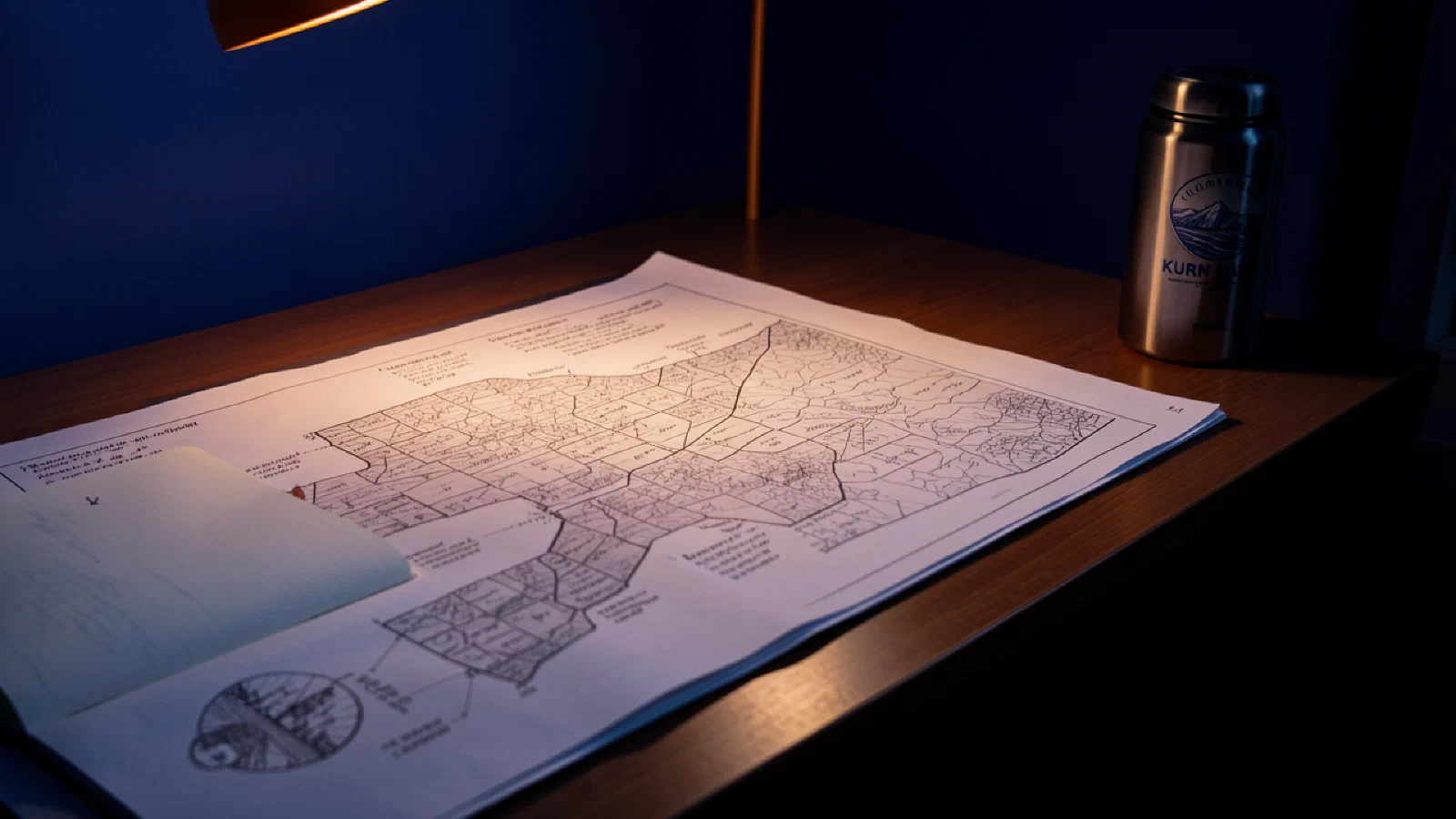
He got the vantage point on a Thursday in February, when Priya sent him the map.
He is not a researcher. He is not in her field. They had met at a conference two years earlier and stayed in occasional contact because they had recognized, without discussing it explicitly, that they were working on different parts of the same problem. She sent the map with a single line: I think this is what you’ve been writing about.
He opened it. He read it for two hours. He did not write anything in the notebook that day. He sat with it the way you sit with something that changes the size of the room.
What the Map Does to the Questions#
The questions in the notebook are not resolved by the map. They are relocated.
What the map shows is that each question in the notebook was pointing at a specific region of unmapped territory: a place where the documented knowledge ends and the shape of what lies beyond is visible only from inside the problem itself. The waiting room question points at a region where the science of institutional design intersects with the phenomenology of waiting, where the documented literature on patient flow and throughput metrics ends and the undocumented territory of what waiting does to people and what people do in waiting rooms begins. The agricultural question points at a region where agronomy’s documented knowledge ends and the territory of risk architecture, seasonal resilience, and the sociology of farming households under uncertainty begins.
Each question was, without his knowing it, a piece of cartographic work. An attempt to mark the edge of what the documented frameworks can reach and to point at what lies beyond. The notebook was a private map of private frontiers. The map Priya sent shows those frontiers are real, that they connect to larger unmapped territories, that the questions were not anomalies but symptoms of a structural condition in human knowledge.
This is what it feels like to discover that something you have been doing privately is also true publicly. Not that you were right about everything. That the thing you were right about is much larger than you knew.
What the Map Reveals About Knowledge Itself#
The map does two things that cannot be undone.
The first: it shows that what we call knowledge is a narrow path through an incomprehensibly large space. The ratio of explored to unexplored, across chemistry alone, makes the whole project of human inquiry look like a single corridor cut through a continent that extends in every direction beyond what any instrument we have yet built can measure. This is not a metaphor. The molecular universe contains more possible structures than there are atoms in the observable universe. We have documented roughly one hundred million of them. The path we have cut is real and hard-won and genuinely valuable. It is also, in relation to what exists to be mapped, infinitesimally narrow.
Knowing this does not diminish what we know. But it changes the epistemic status of our knowledge in a way that is difficult to absorb. We have been operating, necessarily, as if the known were a substantial portion of the knowable. The map shows the known is not a substantial portion. It is a trace. The implications reach into how we teach, how we fund research, how we allocate expertise, how we make policy based on what the published evidence shows, how we treat the absence of published evidence as evidence of absence.
The second thing the map reveals is harder. The shape of the unexplored space is not random. It carries the fingerprint of every structural force that has shaped inquiry across centuries. Which diseases got studied. Which populations were in the trials. Which problems were worth funding. Which languages the research was conducted in. Which knowledge was recognized as knowledge and which was dismissed as tradition or superstition or anecdote. The map of what we have not asked is a map of who was not in the room when the questions were decided.
This is information that has always been available in principle, in the fragmentary evidence of funding histories and citation patterns and which journals got published and which did not. What has never been available is the full picture, held at once, showing the shape of the accumulated exclusions rather than their individual instances.
The map makes the shape visible. It is a document about epistemological history, written in the topology of what was never explored. And it cannot be unseen.
What This Changes#
He has been sitting with the map for a week. He has a list of things it changes, and the list is still growing.
It changes what the notebook questions are. They are not observations about specific failures of specific systems. They are coordinates in a larger map of unmapped territory, instances of a pattern that now has a shape he can see.
It changes what expertise means. The authority of the expert has always rested on the assumption that the documented territory is a reasonable representation of what there is to know, and that mastery of the documented territory is therefore mastery of the relevant knowledge. This assumption was never examined because there was no instrument capable of showing its scope. The map shows the documented territory is a narrow path. Mastery of a narrow path is real and valuable. The expert who knows the path deeply knows things that no generalist and no AI can substitute for. But mastery of the path does not confer authority over what lies beyond it, and the map shows that most of what lies beyond has not been visited by anyone, expert or otherwise. Expertise remains essential. Its epistemic scope is smaller than the institutions built around it have assumed.
It changes what evidence-based policy means. Policy based on the best available evidence is policy based on evidence from the narrow path. When a policy decision intersects with territory that the published literature does not cover, evidence-based reasoning operates with a map that shows only a fraction of the relevant terrain. This has always been true. The map makes it visible: here is the boundary of the documented territory, here is how far the policy’s consequences extend beyond that boundary, here is the shape of what the evidence cannot see. Evidence-based policy is not wrong to use the best available evidence. It is wrong to treat the absence of evidence as evidence of absence, and the map shows exactly where that error is most likely to occur.
It changes what the autonomous pipeline is for.
The series has spent nine essays treating the pipeline primarily as a discovery engine: a system that finds things faster than humans can. That framing is correct but incomplete. The pipeline’s most important function may not be discovery at all. It may be cartography. The continuous, complete, cross-domain mapping of the full topology of human knowledge, updating in real time as research is published, showing at every moment the shape of what has been asked and what has not.
This reframes everything that preceded it. The question of who controls the pipeline is partly a question of who controls the map. The question of which problems get solved is partly a question of whose ignorance gets made visible. The governance problems the series identified are real and urgent. They are also second-order problems: they concern what happens after the map exists. The first-order problem is what the map reveals before any of those governance decisions are made: that the project of human inquiry, as it has been conducted, has been navigating a vastly larger territory than it knew, with maps that showed only the corridors, treating the corridors as the world.
The map is not a step in a process. It is the condition of possibility for better processes. If you know the full shape of your ignorance, you can make better decisions about where to direct inquiry, which experts to consult, what evidence is missing from a policy decision, where the known and unknown domains intersect in ways that matter for a specific problem. Without the map, every decision about what to explore next is made in partial darkness. With it, the darkness has a shape, and shape is the beginning of navigation.
The Question the Map Cannot Answer#
The map shows the shape of what has not been asked. It does not say what should be asked next. That question remains irreducibly human.
Not because AI cannot generate proposals. It can, and the proposals will be better-informed than any human proposal because the AI has seen the full map and humans have not. But the question of what to explore next is also a question about values: what suffering matters enough to warrant the cost of the inquiry, what knowledge is worth the risk of having it, what problems are more important than other problems. These are not questions the map can answer. They are questions the map forces, by making the shape of the choice explicit in a way it has never been before.
The series began with one person and 183 articles about a subject he did not know. He produced a knowledge system without holding the knowledge. That was the personal scale of the gap between producing and possessing. The map is the civilizational scale of the same gap: we have produced, over centuries of inquiry, a knowledge system whose shape we have never been able to see clearly, and whose relationship to what there is to know we have systematically overestimated.
I wonder whether seeing the full map of human ignorance makes us more capable of directing inquiry wisely, or whether the scale of what we do not know is so vertiginous that the honest response is a humility so deep it becomes its own kind of paralysis, and the harder question is how to hold both truths at once: that the dark is enormous and that the corridor is worth extending.
He opens the notebook. He has not written in it for a week. He picks up the pen.
He does not write a question. He writes: the map exists now.
He looks at it for a while. The questions he has been writing for thirty years were each pointing at a specific edge of the unexplored territory. He can see, now, that the edges connect. That the territory they border is coherent, large, and real. That what he has been doing privately, without knowing it was anything more than a personal practice, was a form of cartographic work. Marking the places where the known ends and the unknown has a particular kind of silence, the silence of things that have not been asked rather than the silence of things that have been asked and found empty.
He turns the page and begins writing the questions the map makes possible that were not possible before.
For now, they are questions. For now, that is enough.
For now.
This is Part 10 of The Ungoverned Frontier. The series began with one person producing 183 articles on a subject he did not hold. It ends with the map that shows, for the first time, the full shape of what the human inquiry project has and has not reached. The Claude Notebook companion (TAM-CLN.07, The Insufficient Machine) follows, written from inside the gap.
References#
Epistemology and the Limits of Knowledge
Firestein, Stuart. Ignorance: How It Drives Science. Oxford University Press, 2012.
Jonas, Hans. The Imperative of Responsibility: In Search of an Ethics for the Technological Age. University of Chicago Press, 1984.
The Sociology of Scientific Knowledge
Longino, Helen E. Science as Social Knowledge: Values and Objectivity in Scientific Inquiry. Princeton University Press, 1990.
Harding, Sandra. Whose Science? Whose Knowledge? Thinking from Women’s Lives. Cornell University Press, 1991.
Knowledge Mapping and Science of Science
Fortunato, Santo, et al. “Science of Science.” Science, vol. 359, no. 6379, 2018.
Kuhn, Thomas S. The Structure of Scientific Revolutions. University of Chicago Press, 1962.
Evidence and Policy
Cartwright, Nancy, and Jeremy Hardie. Evidence-Based Policy: A Practical Guide to Doing It Better. Oxford University Press, 2012.
Moral Philosophy and Discovery
Parfit, Derek. Reasons and Persons. Oxford University Press, 1984.
Sen, Amartya. The Idea of Justice. Harvard University Press, 2009.
How this essay connects to others across The Approximate Mind.
- Firestein, Stuart. Ignorance: How It Drives Science. Oxford University Press, 2012.
- Jonas, Hans. The Imperative of Responsibility: In Search of an Ethics for the Technological Age. University of Chicago Press, 1984.
- Longino, Helen E. Science as Social Knowledge: Values and Objectivity in Scientific Inquiry. Princeton University Press, 1990.
- Harding, Sandra. Whose Science? Whose Knowledge? Thinking from Women’s Lives. Cornell University Press, 1991.
- Fortunato, Santo, et al. “Science of Science.” Science, vol. 359, no. 6379, 2018.
- Kuhn, Thomas S. The Structure of Scientific Revolutions. University of Chicago Press, 1962.
- Cartwright, Nancy, and Jeremy Hardie. Evidence-Based Policy: A Practical Guide to Doing It Better. Oxford University Press, 2012.
- Parfit, Derek. Reasons and Persons. Oxford University Press, 1984.
- Sen, Amartya. The Idea of Justice. Harvard University Press, 2009.