The Invisible Knowledge
What Documentation Cannot Hold
TAM-UNF.06 · The Ungoverned Frontier · The Approximate Mind
She has been writing the handover document for six weeks. Thirty years as head nurse in the neonatal intensive care unit, and she cannot make the document say what she needs it to say.
The document is thorough. Protocol for every procedure. Emergency escalation paths. Equipment quirks that are not in the manufacturer documentation but that every nurse on the ward learns within a month. The particular behaviors of each attending physician, who needs to be called early, who trusts the nurses’ judgment more than others, who gets defensive under pressure and how to work around that. The families that require more time and the ones that can read a situation quickly. She has written down everything she can write down.
She knows the document is incomplete. Not in a way that more time would fix. In a way that is structural.
There is a knowledge she has about this ward that she has been trying to find language for, and the language keeps not arriving. It is knowledge about the specific texture of this unit at three in the morning when everything is quiet and something is wrong. She can read the ward’s silence the way some people read weather. She knows from the particular quality of the monitors’ sounds, from the specific posture of the nurse at station two, from something in the air that she cannot name, when the unit is approaching a crisis that has not yet registered in any metric. She has been right about this so many times that the night staff know to find her when she appears from her office at 3 a.m. without being called.
She cannot put this in the document. Not because she lacks the words for the individual components, she can describe the monitors, the posture, the unit’s rhythms. Because the knowledge is not the sum of those components. It is the integration of thirty years of being present in this specific place with these specific sounds at these specific hours, and the integration lives in her, not in any description of its parts.
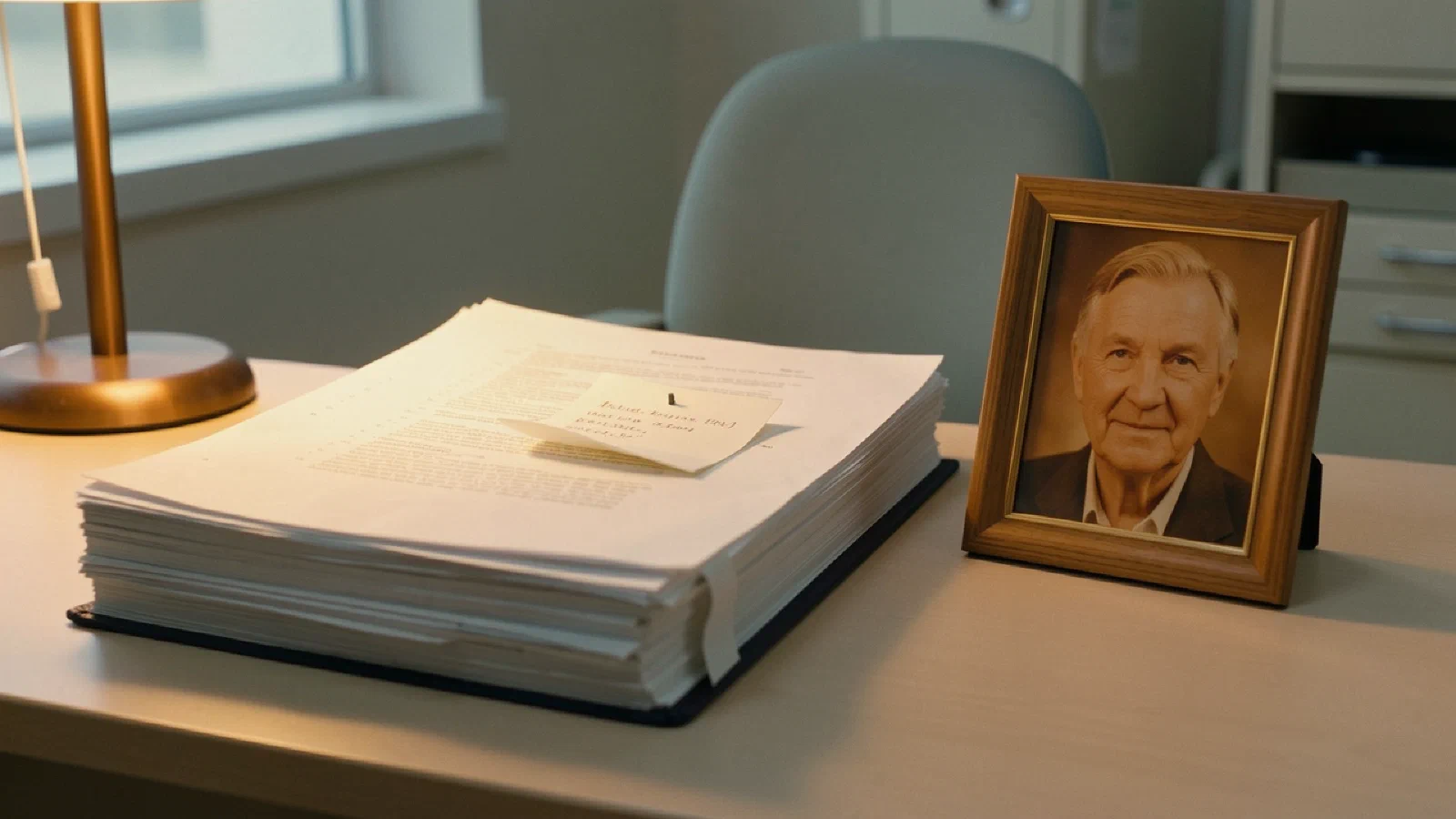
She keeps a photograph on her desk of a baby who survived twenty-two years ago against the odds the attending had given her. The family still sends Christmas cards. She looks at it when she gets stuck on the document. It does not help her write what she cannot write. It helps her remember why it matters.
The Distinction That Matters#
The series has discussed at length the knowledge that is absent from the documented corpus: the findings no institution funded, the practices no researcher recognized as worth studying, the communities whose knowledge was never asked for. This is the representational problem, and it is serious. The map shows what has been documented, and what has been documented reflects the history of who was in the room when the questions were decided.
But the head nurse’s knowledge is not absent from the documentation because nobody studied it. Some of it has been studied. Nursing intuition in intensive care settings has its own research literature. The findings are accurate and they are not what she has. The research literature describes patterns. She has something that developed through thirty years of specific co-presence, which is not a pattern. It is a perception.
This is the distinction the series needs to name precisely before it can proceed.
Representational bias is the problem of the map not extending far enough within its own conventions, the published literature not including certain populations, certain languages, certain knowledge traditions. It is, in principle, addressable by changing who gets to produce the documented knowledge.
Ontological bias is different in kind. It is the problem of the mapping convention itself not being able to hold certain forms of knowledge, regardless of how inclusive the documentation process becomes. The head nurse’s ward-reading is not absent from the literature because nurses were excluded from research. It is absent because the knowledge constitutively resists the propositional form that documentation requires. You cannot document a perception that is itself the result of thirty years of undocumented experience. The description of the perception is not the perception. It is a shadow of it.
This distinction matters for the map the series has been building toward. The map Priya Agarwal produces in The Known Map, the topology of documented human knowledge and its absences, is an extraordinary document. It shows, for the first time, the full structure of what has been asked and what has not. But it has a permanent limit that the distinction reveals: it can show what has not been documented. It cannot show the shape of what cannot be documented, because the mapping convention does not extend there. The absence of documentable knowledge and the presence of non-documentable knowledge look identical on the map. Both appear as flat space. Neither registers as territory.
The Spectrum of Propositional Content#
Knowledge comes in forms that exist on a spectrum.
At one end: mathematical proofs, physical constants, formal logical structures. These are maximally propositional. Transmit the proposition and you have transmitted the knowledge.
Moving along: clinical findings, engineering specifications, historical records. Substantially propositional, with some contextual interpretation required. Documentation captures most of what matters.
Further: professional judgment, diagnostic reasoning, the assessment of complex situations by experienced practitioners. These have propositional components and also components that resist propositionalization. The pattern recognition that operates below articulation. The integration of cues that cannot all be named. Experienced practitioners can document some of this. The documentation is always an approximation.
At the far end: knowledge that is constitutively experiential. Not incomplete propositions awaiting better documentation. A different kind of knowing. The head nurse reading the ward’s silence. The glassblower who knows by color and movement that the gather is ready. The trial interpreter who knows a witness is being truthful and evasive at once in a way that no rulebook describes. The conductor who hears a single phrase and knows the entire orchestra’s emotional state.
What these cases share is not complexity. Many complex things can be documented. What they share is that the knowledge is constituted by a specific history of presence. The head nurse does not have a rule for reading the 3 a.m. silence. She has thirty years of 3 a.m. silences, each slightly different, their differences shaping her perception in ways she could not describe separately from the history that produced the perception. Remove the history and you remove the knowledge. You cannot download the history into a document and give it to her replacement. You cannot train a model on descriptions of the silences and produce the perception the silences generated.
This is not a matter of resolution. A more detailed description of the monitors’ sounds, the nurse’s posture, the temperature gradients across the unit would not close the gap. The gap is not between the description and the thing it describes. It is between the description and the knowing that required thirty years of being there to develop. More detailed description produces a more detailed description. It does not produce the knowing.
The pipeline’s training data is, at its most fundamental, a corpus of descriptions. What constitutively experiential knowledge resists is not the inadequacy of existing descriptions. It resists description as a transmission mechanism, at any level of detail, for any amount of training. The head nurse cannot be replaced by a better description of herself.
What the Map Owes Its Users#
The cartographer of the known gaps, the practitioner whose emergence The Known Map describes, must make a commitment to her users that the map of documented knowledge and its absences is not the map of knowledge.
This sounds simple. It is not. The map, when complete, will be the fullest representation of human knowledge ever assembled. Its authority will be enormous. Institutions will use it to direct research priorities, allocate funding, design policy, identify where investigation is needed. The temptation, almost irresistible, will be to treat the map as complete, to read the absence of documented knowledge as the absence of knowledge.
And the map will make this temptation harder to resist because of its coverage. A sparse map reminds its users that it is sparse. A full map produces confidence. The more thoroughly the pipeline has traversed the documented corpus, the more the flat spaces on the map will look like genuine absences rather than the limits of the convention. The ward at 3 a.m. will look like unexplored territory on a research agenda when it is something more fundamental: territory that no research agenda, however well-funded and well-designed, can reach.
The head nurse’s ward-reading will not appear on the map as a gap. There is no published literature it is absent from. There is no characterized absence where it should be. The map will show flat space where her knowledge is, and the institution using the map to direct research on ICU outcomes will see flat space and move on. Not out of malice. Because the map looks complete there.
The cartographer’s duty is to mark the edge of what the map can show as an edge, not as a horizon. To say, repeatedly and explicitly: the map is bounded by what documentation can hold, and documentation cannot hold all of human knowing, and what it cannot hold is not absent from the world. It is present in practitioners, in communities, in the embodied knowledge that lives in duration and co-presence and specific place, and it will not appear on this map regardless of how good the pipeline becomes.
I wonder whether the users of the map will hold this caveat with the same weight as the map itself, or whether the map’s extraordinary completeness within its own conventions will make the caveat invisible, a technical disclaimer that nobody reads because the map is so complete that it feels like it must contain everything worth finding.
She finishes the document. She does not have language for what she is leaving out. She attaches a handwritten note to the front: This document tells you everything I could write down. Before your first night shift, sit with me for an hour and let me show you what it doesn’t say.
She looks at the photograph. The baby from twenty-two years ago will be finishing graduate school about now. She does not know this. The Christmas cards stopped when the family moved. She keeps the photograph anyway.
Some things you cannot document. You carry them instead.
This is Part 6 of The Ungoverned Frontier. The map has a permanent limit: what documentation cannot hold. Part 7 (The Known Map) describes what the pipeline can see within that limit. Parts 8 and 9 (The Unknown Map, The Framework Problem) ask what navigating beyond it requires.
References#
Tacit and Embodied Knowledge
Polanyi, Michael. The Tacit Dimension. University of Chicago Press, 1966.
Collins, Harry. Tacit and Explicit Knowledge. University of Chicago Press, 2010.
Dreyfus, Hubert L., and Stuart E. Dreyfus. Mind Over Machine: The Power of Human Intuition and Expertise in the Era of the Computer. Free Press, 1986.
Philosophy of Knowledge
Ryle, Gilbert. The Concept of Mind. University of Chicago Press, 1949.
Wittgenstein, Ludwig. Philosophical Investigations. Blackwell, 1953.
Nursing Knowledge and Clinical Intuition
Benner, Patricia. From Novice to Expert: Excellence and Power in Clinical Nursing Practice. Addison-Wesley, 1984.
Tanner, Christine A. “Thinking Like a Nurse: A Research-Based Model of Clinical Judgment in Nursing.” Journal of Nursing Education, vol. 45, no. 6, 2006, pp. 204–211.
Embodied Skill and Making
Sennett, Richard. The Craftsman. Yale University Press, 2008.
Ingold, Tim. The Perception of the Environment: Essays on Livelihood, Dwelling and Skill. Routledge, 2000.
How this essay connects to others across The Approximate Mind.
- Polanyi, Michael. The Tacit Dimension. University of Chicago Press, 1966.
- Collins, Harry. Tacit and Explicit Knowledge. University of Chicago Press, 2010.
- Dreyfus, Hubert L., and Stuart E. Dreyfus. Mind Over Machine: The Power of Human Intuition and Expertise in the Era of the Computer. Free Press, 1986.
- Ryle, Gilbert. The Concept of Mind. University of Chicago Press, 1949.
- Wittgenstein, Ludwig. Philosophical Investigations. Blackwell, 1953.
- Benner, Patricia. From Novice to Expert: Excellence and Power in Clinical Nursing Practice. Addison-Wesley, 1984.
- Tanner, Christine A. “Thinking Like a Nurse: A Research-Based Model of Clinical Judgment in Nursing.” Journal of Nursing Education, vol. 45, no. 6, 2006, pp. 204–211.
- Sennett, Richard. The Craftsman. Yale University Press, 2008.
- Ingold, Tim. The Perception of the Environment: Essays on Livelihood, Dwelling and Skill. Routledge, 2000.