The Unlocked
Who Wins and Who Loses When Everyone Can Make#
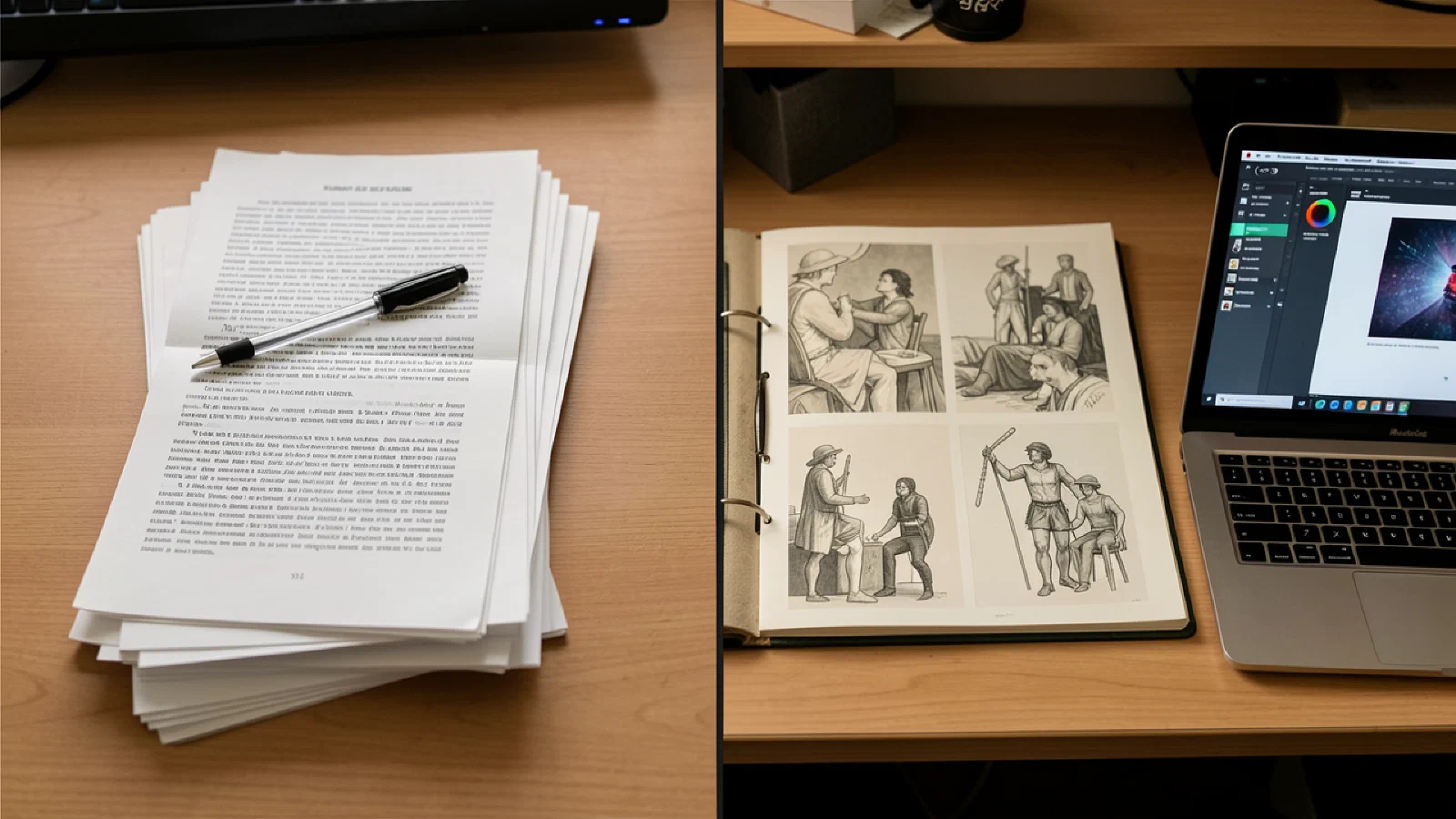
David grows tomatoes badly. He has tried for a decade and they come out small and misshapen, which he considers irrelevant because he finds the growing itself satisfying regardless. He has this quality generally: he will pursue a thing for what it gives him before it produces results. He spent thirty years thinking in intersections. Healthcare and family systems. Technology and dignity. Philosophy and the paperwork of daily life. His mind worked that way, always had. But the essays stayed inside him. He could think them. He could not write them. The craft of prose, the hours required to shape ideas into something others could receive, was a barrier he never crossed. He had a career, a family, a life. Not time enough to develop the skill that would let him express what he saw.
Now he has forty essays. A series that builds toward something. Ideas that exist in the world because AI handles what he could not, and he provides what AI cannot: the vision, the judgment, the meaning. He is prolific for the first time in his life. Not because he became a better writer. Because writing is no longer the bottleneck.
He has been unlocked.
Elena spent fifteen years becoming an illustrator. Art school, student loans, thousands of hours learning to control line and color and composition. Her first mentor told her drawing was just seeing, and she spent years learning to believe him. She built a client base. Magazine work, book covers, corporate projects. Enough to pay rent in a small apartment, to call herself a professional artist, to feel that her decade of craft had purchased something real.
Now her inbox is quiet. The clients who used to hire her prompt AI instead. The work that took her two days takes twenty minutes and costs nothing. Her portfolio, the evidence of her life’s work, looks like what anyone can generate before lunch.
She has been displaced.
Both things are true. The same technology. Different lives.
The Gate That Was Craft#
Expression has always required multiple capacities. Vision: something to say, a way of seeing that others don’t share. Taste: knowing good from bad, recognizing when something works. Judgment: is this right, is this true, is this what I mean. And execution: making it exist. The hand that draws, the voice that writes, the body that performs.
These capacities don’t correlate. Plenty of people with vision lack execution. They see what could be made but cannot make it. Plenty of people with execution lack vision. They can render anything but have nothing to say. The celebrated artists had both, or enough of both. Everyone else was locked out.
Craft was a gate. You had to pass through years of training to earn the right to express. The pianist practiced for a decade before performing. The writer failed for years before publishing. The painter learned anatomy, perspective, color theory, brush technique before anything they made was worth seeing. The gate was high. Many never made it through. Their vision stayed locked inside them, unexpressed, lost when they died.
This was not meritocracy. It was a filter that caught some things worth expressing and let through some things not worth expressing and blocked countless visions that deserved to exist but were trapped in people who could not execute.
AI dissolves the gate. Not entirely, not for everything, but substantially, for many forms of expression. The person who sees an image clearly but cannot draw it can now show what they see. The person who hears music but cannot notate it can now make it audible. The person who thinks in systems but writes slowly can now produce the essays their thinking deserves.
For the locked, this is liberation.
What Collaboration Actually Is#
The shallow version: prompt and publish. Type a sentence, get an image, post it. No iteration, no judgment, no direction. The human as trigger.
This is not what the unlocked are doing.
The real process is collaboration. Direction, generation, judgment, revision. The human says: this way, not that. The AI produces. The human evaluates: closer, but not quite, you’re missing something. The AI adjusts. Iteration after iteration until the thing expresses what the human meant.
This requires everything except execution. Vision to know what you’re aiming for. Taste to recognize when you’ve arrived. Judgment to catch when the AI is wrong, superficial, or missing the point. Meaning to know why this matters at all.
David could not write his essays without AI. But AI could not write his essays without David. His vision, his direction, his judgment at every turn, his life that gave him something to say. The authorship is clearly his. The AI is the instrument. He is the musician. But he could not play without the instrument. And the instrument cannot play itself.
What the Displaced Lost#
Elena did not experience herself as an “executor.” She experienced herself as an artist.
The way she held the brush. The choices made while rendering, hundreds of micro-decisions in every piece. The style that emerged over years of practice, recognizable as hers even to people who had never met her. This was not implementation. This was expression. Her craft was her vision, inseparable. The making was the meaning.
Being told that “vision is what matters” and “execution is just implementation” erases what her whole life was. She did not have a vision that she then executed. The vision emerged through execution. The hand thinking on the page. The discovery of what she meant by making it.
There is a kind of artistry that lives in craft itself. The woodworker who feels the grain. The jazz musician who finds the note by playing, not by planning. The dancer whose body thinks. These people do not separate vision from execution because, for them, they were never separate.
AI severs what was whole. Vision over here, execution over there. The people for whom they were always integrated, for whom craft was thought, are told their half is the replaceable half.
This is not just economic loss. It is an identity wound. The displacement says: what you did was never the valuable part. The market has clarified. You were always, it turns out, just the implementation.
Elena knows this is not entirely true. But the market is speaking, and the market does not care what she knows.
What Happens in the Middle#
The easy version of this story has a clean shape: the visionaries win, the executors lose, and at least the score is settled between them. The actual shape is messier.
Some displaced executors move up. Become directors, curators, people who guide AI with their craft knowledge. They know what good looks like because they used to make it. They can judge AI output from the inside. They survive by shifting from executor to overseer. But this requires different skills, and different isn’t always better. The illustrator who loved drawing alone now has to prompt, direct, curate, refine. Maybe she’s good at this. Maybe the thing she loved was the making, and the making is gone.
Some specialize in human-made. Handcrafted. Artisanal. The market will exist. People who want what a human hand touched. The painting you hang knowing someone labored over it. The furniture built by a person who cared. But this market is smaller and more exclusive than what it replaces. Artisanal is for the excellent and the lucky. The illustrator who made a middle-class living making competent work for clients will not find that living in the artisanal market. The middle hollows out.
Some are displaced entirely. Like the hand-loom weaver, the typesetter, the darkroom technician. History is full of them. The technology textbooks call it progress. The people who lived it called it loss. Both descriptions are accurate. They refer to different things.
The Honest Accounting#
More expression overall. More people unlocking vision. More exploration. More creation. The total amount of human expression in the world increases.
But concentrated pain among those whose livelihood depended on scarcity. Real people. Real suffering. Careers ended. Identities shattered. Skills made worthless through no fault of their own. They did everything right. Developed craft. Built clients. Made a life around what they could do. And the thing they could do is now free.
Every technological transition has this shape. Total benefit. Concentrated loss. The weavers suffered so we could have cheap cloth. The typesetters suffered so we could have desktop publishing. We rarely mourn them while celebrating the transition. The story of progress looks forward. But they existed. They suffered. Their children went hungry while the world, in aggregate, got better.
To tell the story of unlocking without telling the story of displacement is to lie by omission. To pretend the liberation is costless. To ask the displaced to celebrate their own obsolescence because others benefit.
The unlocked should not apologize for being unlocked. But they should not pretend, either, that the technology only liberates. The same tool that opened David’s voice is closing Elena’s market. Both are true. Both deserve recognition.
What we owe, at minimum, is acknowledgment. The displaced are not Luddites for grieving what they lost. They developed real skills. Those skills had real value. The value disappeared. This is not their fault. That society benefits from the transition and might owe something to those the transition discards is not a radical claim. It is the basic logic of shared benefit and distributed cost.
What Art Becomes#
The definition is changing. For a long time, artist meant: one who executes with skill. The skilled hand, the trained voice, the practiced body. Craft was the marker. If you could not execute, you were not an artist.
Now: one who envisions and means it. The vision, the taste, the judgment, the meaning. Execution is available to anyone. What’s scarce is having something to say and knowing whether you’ve said it.
This may be a clarification more than a demotion. The craft was always in service of something. The something was the point. Now the something can exist without the craft, and we discover what we always valued.
But for those who lived in the craft, whose meaning was in the making, this clarification is cold comfort. They are being told, retrospectively, that the point was elsewhere. And they know that isn’t entirely true. The making was the point, for them. The meaning was in the hand meeting the material.
Maybe both were always true. Maybe art always had two points, and AI has separated them, and now different people carry each half. The unlocked carry vision, taste, judgment, meaning. The displaced carried embodied knowledge, the hand that thinks, the execution that was itself expression. Both were art. Both still are. But only one of them has a market now, and the one that lost the market is not the one that was a lesser form of art all along.
Margaret has a painting on her wall that her grandmother made. She does not know if her grandmother had a vision or just a Sunday afternoon and some paint someone gave her. The painting is not technically accomplished. The proportions are wrong in ways that are easy to name. But something in it is clearly hers, a preference, an attention, something her grandmother thought was worth looking at. Margaret has considered this painting a lot since AI images became easy to make. It is not that she thinks her grandmother was a great artist. It is that she would not trade the painting for a better one.
She cannot entirely explain why. I think she is explaining something about provenance: that the painting being her grandmother’s is part of what the painting is. That art is not only the object but the relation between the object and the person who made it, and that relation is not something AI can generate because AI does not have a grandmother.
What Remains#
The performing arts. Dance, theater, live music. The body doing something in space and time, witnessed by other bodies. AI can generate a video of dancing. It cannot dance. The presence, the risk, the liveness cannot be generated. Only performed.
The provenance market. Work valued because of who made it. This will be smaller than what came before. But it will exist.
The collaboration. Human vision, AI execution. A new population of artists who never called themselves artists because they could not execute. Now they can.
And somewhere, in a small apartment, Elena is deciding what to do next. Her skills are devalued. Her market is gone. But her eye, her taste, her knowledge of what makes an image work, these are not gone. She might become a director of AI, using her craft knowledge to guide what she once made by hand. She might find the artisanal niche. She might leave the field entirely, carrying her skill into something else, some other life.
She is not a failure. She is a casualty of a transition that benefits others. She did everything right and it cost her anyway.
We should see her. We should say her name.
That much, at least, we owe.
This is the nineteenth essay in The Transformed and the fifth in Arc 3, “The Stubborn Craft.” After examining teaching, higher education, healthcare, and judgment, this essay turns to creators and artists, where AI’s effect is hardest to place in a single register. The unlocked gain voice; the displaced lose livelihood; and in art, unlike the other professions, the thing being automated was for some people not the means but the meaning itself. The capstone essay will name what all five professions in this arc share, and why the boundary they reveal is not accidental.
References#
Craft and Meaning
Crawford, Matthew B. Shop Class as Soulcraft: An Inquiry into the Value of Work. Penguin Press, 2009.
Sennett, Richard. The Craftsman. Yale University Press, 2008.
Technology and Creative Labor
Benkler, Yochai. The Wealth of Networks: How Social Production Transforms Markets and Freedom. Yale University Press, 2006.
Hesmondhalgh, David. The Cultural Industries. 4th ed., SAGE Publications, 2019.
Technological Displacement
Frey, Carl Benedikt. The Technology Trap: Capital, Labor, and Power in the Age of Automation. Princeton University Press, 2019.
Standing, Guy. The Precariat: The New Dangerous Class. Bloomsbury Academic, 2011.
Art, Expression, and Experience
Collingwood, Robin George. The Principles of Art. Oxford University Press, 1938.
Dewey, John. Art as Experience. Minton, Balch and Company, 1934.
AI and Creativity
Boden, Margaret A. The Creative Mind: Myths and Mechanisms. 2nd ed., Routledge, 2004.
Miller, Arthur I. The Artist in the Machine: The World of AI-Powered Creativity. MIT Press, 2019.
How this essay connects to others across The Approximate Mind.
- Crawford, Matthew B. Shop Class as Soulcraft: An Inquiry into the Value of Work. Penguin Press, 2009.
- Sennett, Richard. The Craftsman. Yale University Press, 2008.
- Benkler, Yochai. The Wealth of Networks: How Social Production Transforms Markets and Freedom. Yale University Press, 2006.
- Hesmondhalgh, David. The Cultural Industries. 4th ed., SAGE Publications, 2019.
- Frey, Carl Benedikt. The Technology Trap: Capital, Labor, and Power in the Age of Automation. Princeton University Press, 2019.
- Standing, Guy. The Precariat: The New Dangerous Class. Bloomsbury Academic, 2011.
- Collingwood, Robin George. The Principles of Art. Oxford University Press, 1938.
- Dewey, John. Art as Experience. Minton, Balch and Company, 1934.
- Boden, Margaret A. The Creative Mind: Myths and Mechanisms. 2nd ed., Routledge, 2004.
- Miller, Arthur I. The Artist in the Machine: The World of AI-Powered Creativity. MIT Press, 2019.