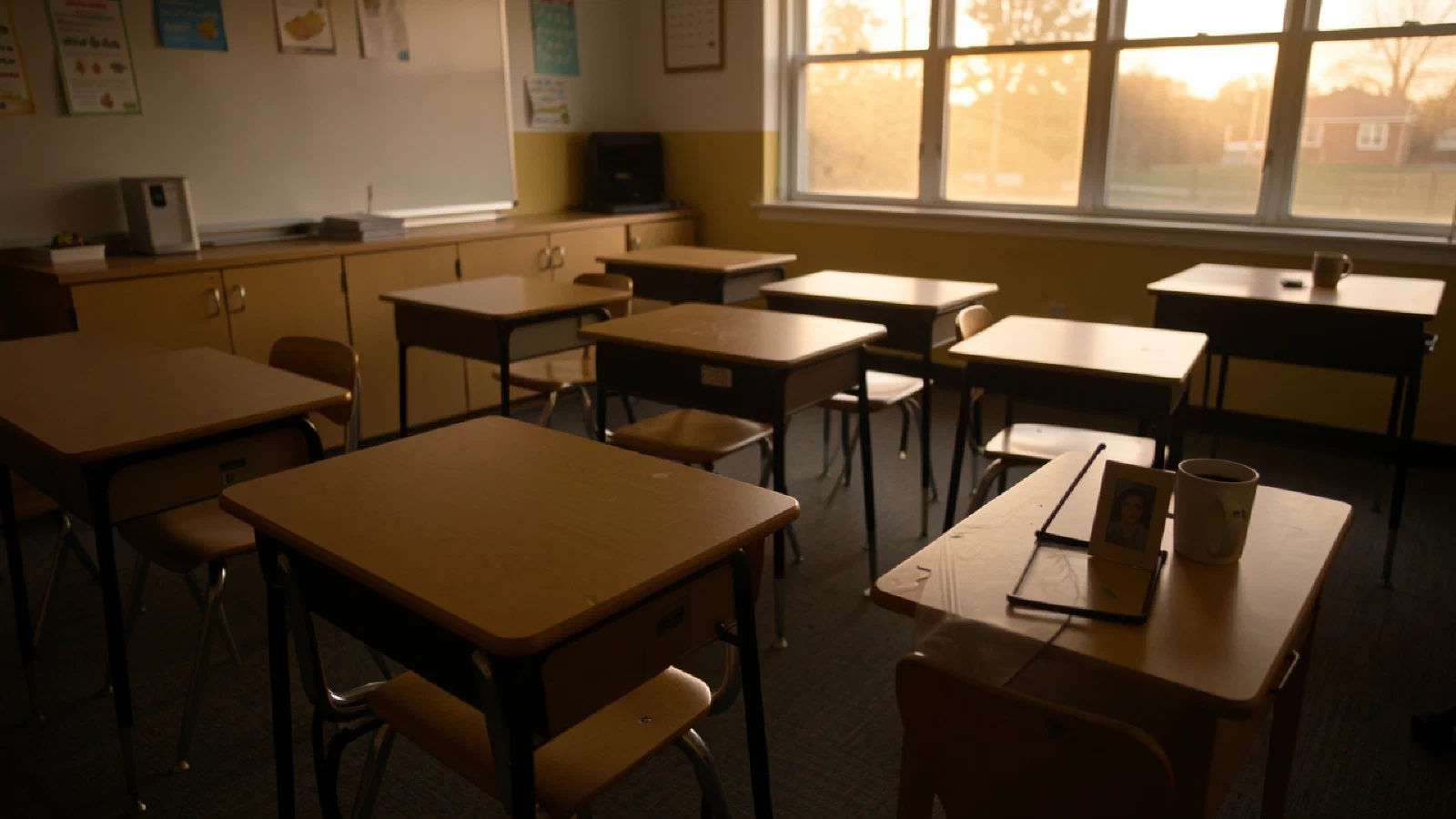
The Shapers
What If Teaching Was Never About Information?#
Margaret is seventy-eight now. She still remembers Mrs. Patterson.
Fourth grade. Margaret’s father had just left. Her mother was working double shifts. Margaret was angry in a way she did not have words for, acting out, disrupting class, the kind of child teachers dread. Mrs. Patterson kept her after school one Tuesday. Margaret expected punishment. Instead, Mrs. Patterson said: “I see you. I know something is hard right now. I’m not going anywhere.”
That was it. Not a lesson. Not a technique. Presence and acknowledgment.
Margaret does not remember what Mrs. Patterson taught her about long division. She remembers being seen when she felt invisible. She remembers having an adult who was not her mother say: you matter, and I am here.
Across town, an AI tutoring system knows exactly where Mia is struggling. It detected her confusion about fractions three lessons ago, adjusted its approach, tried visual representations, then story-based methods, until something clicked. It is patient in a way no human can be. It is available at midnight when Mia cannot sleep and wants to get ahead. It never has a bad day.
Mrs. Okonkwo watches Mia from across the classroom. The tutoring system handles the math. Mrs. Okonkwo notices something else: Mia has been withdrawn for two weeks. She is not raising her hand anymore. She flinches when a particular boy walks past her desk.
The AI is an excellent tutor. It is not what Mia needs.
The Transformation That Already Happened#
Every tech keynote promises AI will transform education. They are late. Education was already transformed by something more basic: the realization that one-on-one tutoring produces dramatically better learning outcomes than classroom instruction.
Benjamin Bloom documented this in 1984. Students who received individual tutoring performed two standard deviations better than students in conventional classrooms. The “2 sigma problem” he named has haunted education ever since. We knew how to help children learn. We just could not afford it.
AI removes the cost constraint. Personalized tutoring for every child, adapting to pace, style, schedule. The child who needs twelve repetitions gets twelve. The child who grasps it instantly moves on. No more forcing twenty-five different minds to move at the same speed through the same material.
This is not speculation. The technology exists and is spreading. The tutoring revolution is real.
And teachers will still be there.
Not because unions protect them. Not because parents are sentimental. Because tutoring was never what teachers actually did.
What School Is Actually For#
If school were information transfer, textbooks would have replaced teachers centuries ago. They did not. If school were skill acquisition, MOOCs would have replaced teachers a decade ago. They did not. The transformation narrative keeps predicting teacher obsolescence and keeps being wrong, and I think the reason is worth taking seriously rather than just celebrating.
The narrative misdescribes the profession. It reduces teaching to its most automatable component and then declares the rest obsolete. What remains, after you strip away content delivery and assessment, is not a lesser version of the job. It is the actual job.
Schools are doing at least five things that have nothing to do with content delivery.
Socialization: twenty-five children in a room, not by choice, learning to share space with people they did not select. Working through conflict. Handling a bully. Making a friend. Waiting their turn. Reading social cues. Understanding that their needs exist alongside others’ needs. For many children, this is the primary developmental function of school. The playground teaches things the curriculum cannot.
Civilization transmission: values, norms, what kind of person to be. Not taught explicitly but modeled constantly. The teacher who admits she does not know something and shows what it looks like to find out. The teacher who treats every child’s question as worthy of respect. Children absorb what adults are, not just what adults say. AI can tell children about honesty. It cannot show them what an honest person looks like navigating a difficult moment.
Legitimate authority: there is something about being pushed past comfort by someone with legitimate authority that AI cannot replicate. The student who does the hard thing because they do not want to disappoint their teacher. The experience of being accountable to a human who sees you and expects something of you. This is preparation for a world full of legitimate authorities, and the muscle for dealing with it develops in childhood.
First-line noticing: the teacher who sees that the quiet child is not just introverted but hungry, or being abused, or depressed, or gifted and bored. School is the only mandatory institution that sees every child regularly. Teachers are the front line of the child welfare system whether we name them that or not. AI can flag attendance patterns. It cannot see the look in a child’s eyes that says she did not sleep because her parents were fighting again.
The third adult: children need adults who are not their parents. Adults who care about them but are not enmeshed with them. Who have authority but not ownership. The teacher as developmental figure, someone to admire, disappoint, impress, rebel against, learn from. A human with a life, with struggles, with mortality. AI is not a person. It has no life the child can observe. It cannot model what it means to be an adult because it is not one.
The Job That Remains#
Strip away everything AI handles. What remains is something the profession has always contained but rarely named: a shaper.
The shaper designs the social environment. Who sits where. How conflicts get resolved. What the norms are. What happens when someone violates them. The architecture of twenty-five children learning to be people together.
The shaper notices. Watches. Knows each child over time. Catches the signal that something has changed. Connects the child to resources when the problem exceeds what the classroom can address.
The shaper embodies. Shows what an adult looks like, modeling curiosity, honesty, patience, fallibility, recovery. Is a person in front of children who are learning what persons can be.
The shaper holds authority. Pushes children past comfort. Insists on standards. Does not let them settle for less than they are capable of. Uses the relationship as leverage for growth.
This is not content delivery. AI handles content. This is human development. It requires a human, and not just any human: a specific adult who knows these specific children over time, whose presence in their lives carries weight because it is consistent and because it is chosen.
The shaper is not a diminished teacher. The shaper is what the teacher was always supposed to be, finally freed from tasks that machines do better.
The Rural School#
Consider the one-room schoolhouse. One adult, multiple grade levels, every subject. The rural teacher has always done everything: content across all grades, social worker, nurse, counselor, community liaison. An impossible job. Burnout made institutional.
AI changes this calculation in a direction the transformation narrative misses entirely.
If AI handles content delivery across all grade levels, the impossible job becomes possible. The rural teacher stops being stretched across five curricula and becomes what they always actually were: the anchor adult for these children. The noticer. The link to the adult world.
The rural school might benefit more from AI than the well-staffed suburban one. The suburban school has enough people to divide labor: counselors, specialists, administrators. The rural school has one person who was drowning in content delivery. AI removes the drowning. What remains is the human work that was always the point.
The Danger#
There is a failure mode.
If we do not understand what shapers do, we will not fund them. We will see AI handling content and conclude that we need fewer adults in schools. Class sizes will grow because the tutoring is individualized anyway. The adult-to-child ratio will worsen precisely as the adult’s role becomes more important.
Presence does not scale. A shaper can know thirty children. Maybe forty, with strain. Not a hundred. The forming of humans requires humans who know the humans they are forming, and that relationship is bounded by the limits of human attention and memory and care. Ratios matter.
The schools that understand this will invest in adult presence even as they adopt AI tutoring. The schools that do not will produce children who are well-tutored and poorly shaped. High test scores, low humanity. We will have measured the wrong thing and optimized for it, as we always do.
The transformation narrative, by misdescribing what teachers do, provides intellectual cover for this failure mode. If teaching is information transfer, then AI teaches and humans become redundant. If teaching is human development, then AI tools and human shapers are complementary, and the question is not whether to replace one with the other but how to design systems that allow both to do what they are actually good at.
Mrs. Patterson’s Work#
The AI tutoring system cannot have the conversation Mrs. Patterson had with Margaret in 1963.
Not because the technology is insufficiently advanced. Not because AI lacks the language to say “I see you.” Because the value of Mrs. Patterson’s words depended entirely on her being a specific person: mortal, affected, with somewhere else to be, choosing to be there. A being who could have left Margaret to her anger and did not. Presence requires the possibility of absence. The weight of showing up depends on the fact that you could have not shown up.
Margaret remembers Mrs. Patterson’s face. She does not remember the year’s curriculum. The knowledge that mattered was not the content of any lesson. It was the knowledge that she was worth a person’s attention when everything in her life suggested otherwise.
That knowledge is not transferable to a system that is always available and never distracted and has no other students waiting. The limitlessness of AI’s availability is precisely what makes it unable to provide what Mrs. Patterson provided.
The shaper’s irreducibility is not sentimental. It is structural. Some things can only be given by beings who have things to give.
This is the fifteenth essay in The Transformed and the first in Arc 3, “The Stubborn Craft,” which examines professions that the transformation narrative insists are on the verge of AI replacement but that will prove stubbornly resistant, not because of technological limitations but because the professions were misdescribed from the start. Teaching was never information transfer. It was always human development, and human development requires humans. Future essays in this arc will examine the formers of higher education, the healers, the judges, and the artists, before the capstone asks what the resistant professions reveal about the boundary of AI transformation itself.
References#
The 2 Sigma Problem and Personalized Learning
Bloom, Benjamin S. “The 2 Sigma Problem: The Search for Methods of Group Instruction as Effective as One-to-One Tutoring.” Educational Researcher, vol. 13, no. 6, 1984, pp. 4-16.
Developmental Relationships and the Ecology of Learning
Bronfenbrenner, Urie. The Ecology of Human Development. Harvard University Press, 1979.
Noddings, Nel. Caring: A Feminine Approach to Ethics and Moral Education. University of California Press, 1984.
Rogoff, Barbara. Apprenticeship in Thinking: Cognitive Development in Social Context. Oxford University Press, 1990.
Vygotsky, Lev S. Mind in Society: The Development of Higher Psychological Processes. Harvard University Press, 1978.
Schools as Social Institutions
Bowles, Samuel, and Herbert Gintis. Schooling in Capitalist America. Basic Books, 1976.
Durkheim, Émile. Education and Sociology. Free Press, 1956.
The Teacher as Person
Palmer, Parker J. The Courage to Teach. Jossey-Bass, 1998.
van der Kolk, Bessel. The Body Keeps the Score. Viking, 2014.
How this essay connects to others across The Approximate Mind.
- Bloom, Benjamin S. “The 2 Sigma Problem: The Search for Methods of Group Instruction as Effective as One-to-One Tutoring.” Educational Researcher, vol. 13, no. 6, 1984, pp. 4-16.
- Bronfenbrenner, Urie. The Ecology of Human Development. Harvard University Press, 1979.
- Noddings, Nel. Caring: A Feminine Approach to Ethics and Moral Education. University of California Press, 1984.
- Rogoff, Barbara. Apprenticeship in Thinking: Cognitive Development in Social Context. Oxford University Press, 1990.
- Vygotsky, Lev S. Mind in Society: The Development of Higher Psychological Processes. Harvard University Press, 1978.
- Bowles, Samuel, and Herbert Gintis. Schooling in Capitalist America. Basic Books, 1976.
- Durkheim, Émile. Education and Sociology. Free Press, 1956.
- Palmer, Parker J. The Courage to Teach. Jossey-Bass, 1998.
- van der Kolk, Bessel. The Body Keeps the Score. Viking, 2014.