The Judges
When the Weight Can Finally Be Borne#
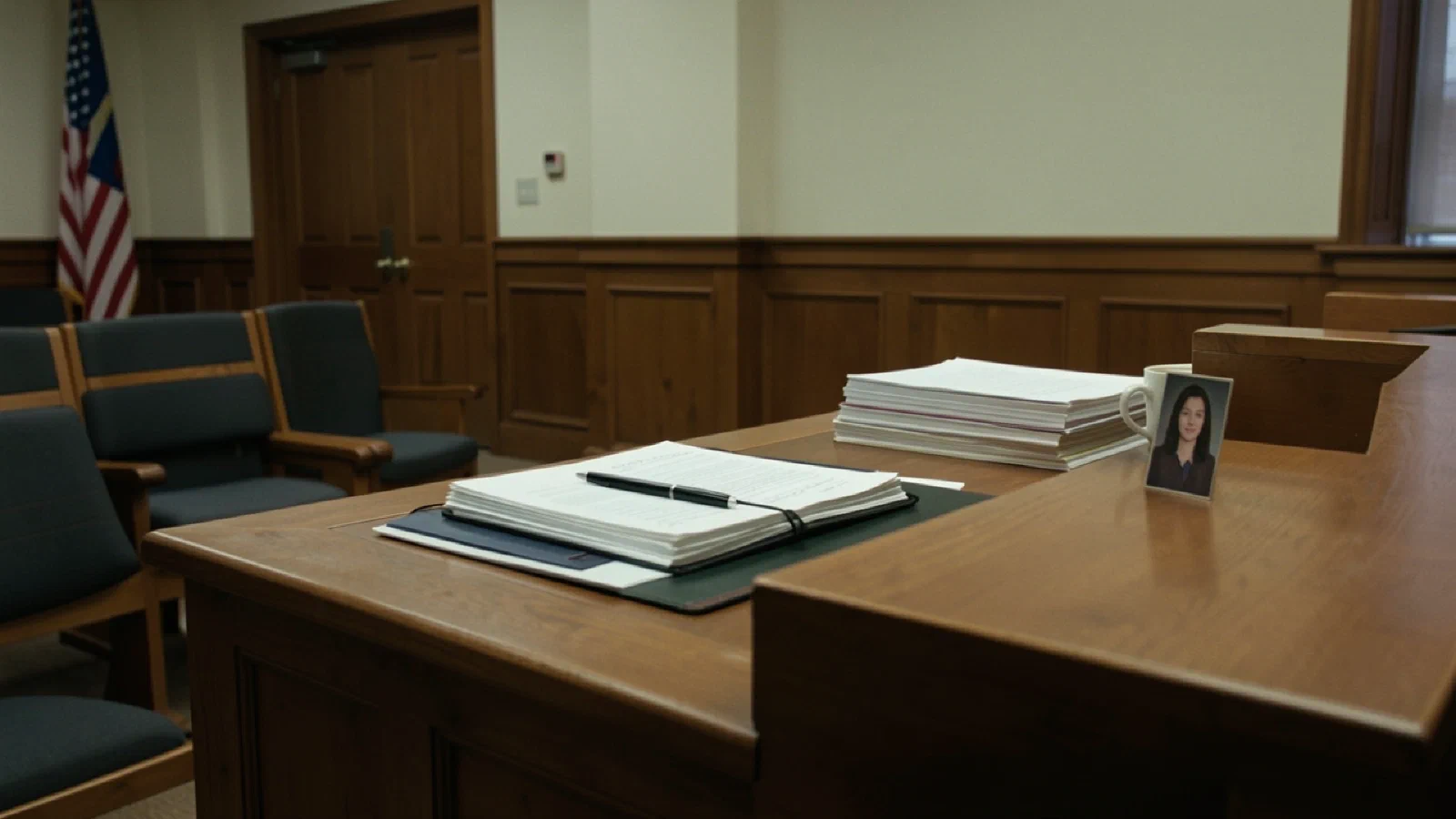
Judge Morrison has a photograph of her daughter on her bench. Not displayed outward, just tucked in the corner of the wood where she can see it when she looks down. Her daughter is eight. The photograph was taken at a school play, her daughter mid-gesture, face full of something unguarded. Judge Morrison looks at it when the day is very long, which is most days.
It is 4:47 PM and she has nineteen cases left on the docket. She has been on the bench since 8:30. Her coffee went cold hours ago. She is reading a file she should have read last night but could not because she was writing an opinion for a case from last week that she should have decided the week before.
The defendant stands before her. A young man. Theft charge. She has ninety seconds to absorb his file, hear the arguments, and decide whether to accept the plea deal or send this to trial. There are eighteen people waiting behind him. Court closes at 5:30.
She makes a decision. She is not certain it was right. There was no time for certainty.
This is how justice happens in most courtrooms. Not with deliberation but with triage. Not with the full weight of attention but with whatever attention remains after the cognitive load has crushed everything else. Judges are not failing. The system is failing. And AI, it turns out, is not the threat here. It is the only plausible repair.
Three Kinds of Weight#
The conversation about AI and the judiciary tends to collapse three distinct problems into one, and the collapse produces confusion about what AI can and cannot do. They are not the same.
The first is cognitive load: the sheer mental work of holding hundreds of precedents in mind, reading thousands of pages, tracking arguments and counterarguments, writing opinions that must be precise because they become law. The human brain has limits. Judges hit those limits daily. They make worse decisions at 4 PM than at 10 AM because cognitive resources deplete. They miss the relevant precedent because there was no time to find it. They skim the brief because reading it carefully would mean not reading the next five.
The second is allostatic load: the chronic stress of impossible demands. The backlog that grows no matter how hard you work. The knowledge that behind every case is a human being waiting, and waiting, and waiting. People in pretrial detention for years. Families in limbo. The judge knows justice delayed is justice denied. They are denying it every day, not because they choose to but because there are not enough hours. This is not acute stress. It is the grinding, accumulating weight that breaks bodies and minds over years.
The third is the burden of judgment itself. This is not reducible. This is not a problem to be solved.
The moment of deciding. The face in front of you. The knowledge that you might be wrong and this person’s life will be changed anyway. The defendant you sentenced who was later exonerated. The child you placed with the parent who turned out to be dangerous. These stay with you. They visit at 3 AM. They accumulate into a weight that is yours and yours alone.
This burden is not a flaw in the system. It is the system. Someone must bear the weight of deciding. That bearing is what makes the decision legitimate. The judge who feels nothing has stopped judging.
AI can address the first two. It cannot touch the third. And the thing it cannot touch is the thing that matters most.
What AI Changes#
Research that took law clerks weeks takes seconds. Every relevant precedent across millions of cases, surfaced instantly. The judge no longer worries about missing the case that matters.
Analysis that required holding everything in working memory is externalized. The AI tracks the arguments, flags inconsistencies, identifies contradictions. “This claim conflicts with the testimony on page 847.” “This precedent was overturned in 2019.” “Your proposed ruling contradicts your own ruling from three years ago.” The judge’s mind is freed for the work that requires a mind.
Writing opinions that consumed days happens faster. First drafts generated. Structure suggested. The mechanical labor of producing a fifty-page opinion is reduced. The judge refines rather than builds from scratch.
And something uncomfortable but valuable: bias detection. The AI flags patterns the judge cannot see in themselves. “Your sentencing is consistently harsher for defendants from this demographic.” “You rule for plaintiffs more often when the hearing is before lunch.” The judge confronts their own patterns. Adjusts. Becomes fairer than they could be alone.
At the system level, faster processing means more cases move, the backlog shrinks, and justice happens sooner. The person who spent two years in pretrial detention waiting for their case to be heard. The family that could not move on because the estate was stuck in probate. The small business destroyed by a contract dispute that dragged on for four years. These are not statistics. These are lives deformed by a system that could not process its own caseload.
More cases through the system, each case with more attention. This sounds like a contradiction. It is not. The bottleneck was never attention itself. It was cognitive load and allostatic load competing for the space where attention should have been.
What Remains#
Judge Morrison, in a courtroom transformed by AI, still faces the young man charged with theft.
She has read everything now. She has seen the precedents, the arguments, the counterarguments. She has been flagged for her own patterns and adjusted. She has time. Actual time. The docket is manageable. The next case is not breathing down her neck.
Now she decides.
And in that moment, the weight arrives. The weight that was always supposed to be there but was crowded out by everything else.
This young man. This life. This choice that will shape what happens to him. She might be wrong. The evidence is not certain. His face is in front of her, and he is afraid, and what she says next will change his life.
She decides.
She will carry this. Not the research, not the analysis, not the drafts. Those are externalized now. But this, the decision itself, this she carries home. This visits her at 3 AM. This accumulates into the weight that is hers and hers alone.
This is not a problem AI solved. This is what judging is.
What was being lost when cognitive and allostatic load consumed everything was the space for the actual work. Now the actual work can happen. Now the weight can be felt. AI did not remove the burden of judging. It removed what was preventing the burden from being properly borne.
The Democratic Necessity#
A society could hand judgment to algorithms. Some are tempted. The AI is faster, more consistent, less biased in certain measurable ways. Why not?
Because judgment is how a society governs itself.
The judge is not a processor. The judge is a citizen, invested with authority by other citizens, exercising that authority on behalf of the community. The chain runs from the defendant through the judge to the people. When the judge decides, we decide, through them.
An algorithm has no such chain. An algorithm is not a citizen. Was not appointed by elected officials. Does not answer to the community. Does not carry the weight of deciding on behalf of others. When an algorithm sentences you to prison, you have not been judged. You have been processed.
The difference is not semantic. It is the difference between self-governance and rule by system. Between a society that takes responsibility for its own judgments and one that outsources judgment to avoid the burden. The burden is not a cost to be minimized. The burden is the proof that someone took responsibility. That a human being faced another human being and said: I decide this. I bear this. This is on me.
The Facing#
The defendant looks at the judge. The judge looks back.
This is not incidental. This is the structure.
The defendant sees a human face delivering the verdict, sees the weight of the decision in that face, knows that a person and not a process has determined their fate. This is terrible in one way and essential in another. Terrible because it is a human doing this to you. Essential because it means you were seen. A consciousness received your case, struggled with it, and decided.
The judge sees the defendant’s face receiving the verdict. Cannot escape into abstraction. This is not a case number. This is a person whose life changes now because of what the judge just said.
The mutual facing is accountability. The defendant is accountable to the law. The judge is accountable to the defendant, to the community, to their own conscience. AI faces no one. Is seen by no one. Carries nothing.
Sometimes the law requires what the judge believes is wrong. The mandatory minimum that destroys a life for a minor offense. The precedent that produces injustice in this particular case. The rules that tie your hands when mercy is what justice actually requires. The judge applies the law. And something breaks a little. This breaking matters. It is not waste. It is signal. The judge who feels moral injury writes the dissent, signals to legislatures that something is wrong, becomes an advocate for changing the law that forced them to do what they believed was unjust. The injury becomes pressure for reform.
AI cannot be injured. Cannot feel that something is wrong through the experience of being forced to do it. The feedback loop between judge and law, where judicial anguish eventually changes what the law requires, disappears if judges disappear.
What the Defendant Deserves#
Margaret has never stood before a judge. She hopes she never will. But she has sat in a courtroom as a juror, years ago, and she remembers the feeling of the judge’s presence in that room. Not the authority exactly, though that was part of it. The weight. The sense that this person understood the gravity of what was happening and was not treating it as routine even when it was routine for them.
She remembers thinking: whoever this person is, they take this seriously. They are going to carry this.
She did not have language for what she was noticing. She had, I think, an intuition about legitimacy. That justice requires not just correctness but accountability. That the verdict matters not only because it is accurate but because a specific human being, answerable to the community, looked at the evidence and decided.
The defendant deserves to be judged by someone who had the capacity to judge them properly. Not someone rushing through a docket, skimming files, making decisions in ninety seconds. Someone who has read everything, had time to feel the weight of what they are deciding, and then decided.
The defendant deserves to be judged by someone who faces them. Who might be wrong and knows it and decides anyway because someone must. Whose authority runs back through a democratic chain to the community itself.
That is what justice requires. Not efficiency. Not consistency. Not optimization.
A human being, bearing the weight of deciding about another human being. The weight is not a bug to be engineered away.
The weight is justice itself.
This is the eighteenth essay in The Transformed and the fourth in Arc 3, “The Stubborn Craft.” After examining teaching, higher education, and healthcare in the global south, this essay turns to judicial legitimacy. AI can reduce cognitive load, shrink backlogs, detect bias, and make better judging possible. What it cannot do is bear the weight of deciding, and that weight, borne by a human who faces the person they are judging, is what makes judgment legitimate rather than merely efficient. The next essay examines the artists before the capstone names what the resistant professions collectively reveal about the boundary of AI transformation itself.
References#
Judicial Decision-Making
Danziger, Shai, Jonathan Levav, and Liora Avnaim-Pesso. “Extraneous Factors in Judicial Decisions.” Proceedings of the National Academy of Sciences, vol. 108, no. 17, 2011, pp. 6889-6892.
Guthrie, Chris, Jeffrey J. Rachlinski, and Andrew J. Wistrich. “Blinking on the Bench: How Judges Decide Cases.” Cornell Law Review, vol. 93, no. 1, 2007, pp. 1-43.
AI in Legal Systems
Re, Richard M., and Alicia Solow-Niederman. “Developing Artificially Intelligent Justice.” Stanford Technology Law Review, vol. 22, no. 2, 2019, pp. 242-289.
Sourdin, Tania. “Judge v Robot? Artificial Intelligence and Judicial Decision-Making.” UNSW Law Journal, vol. 41, no. 4, 2018, pp. 1114-1133.
Legitimacy and Democratic Authority
Tyler, Tom R. Why People Obey the Law. Princeton University Press, 2006.
Waldron, Jeremy. The Dignity of Legislation. Cambridge University Press, 1999.
Judicial Burden and Moral Injury
Anleu, Sharyn Roach, and Kathy Mack. “Magistrates’ Everyday Work and Emotional Labour.” Journal of Law and Society, vol. 32, no. 4, 2005, pp. 590-614.
Chamberlain, Jill, and Monica K. Miller. “Evidence of Secondary Traumatic Stress, Safety Concerns, and Burnout Among a Homogeneous Group of Judges.” Journal of the American Academy of Psychiatry and the Law, vol. 37, no. 2, 2009, pp. 214-224.
Access to Justice
Rhode, Deborah L. Access to Justice. Oxford University Press, 2004.
Sandefur, Rebecca L. “Access to What?” Daedalus, vol. 148, no. 1, 2019, pp. 49-55.
How this essay connects to others across The Approximate Mind.
- Danziger, Shai, Jonathan Levav, and Liora Avnaim-Pesso. “Extraneous Factors in Judicial Decisions.” Proceedings of the National Academy of Sciences, vol. 108, no. 17, 2011, pp. 6889-6892.
- Guthrie, Chris, Jeffrey J. Rachlinski, and Andrew J. Wistrich. “Blinking on the Bench: How Judges Decide Cases.” Cornell Law Review, vol. 93, no. 1, 2007, pp. 1-43.
- Re, Richard M., and Alicia Solow-Niederman. “Developing Artificially Intelligent Justice.” Stanford Technology Law Review, vol. 22, no. 2, 2019, pp. 242-289.
- Sourdin, Tania. “Judge v Robot? Artificial Intelligence and Judicial Decision-Making.” UNSW Law Journal, vol. 41, no. 4, 2018, pp. 1114-1133.
- Tyler, Tom R. Why People Obey the Law. Princeton University Press, 2006.
- Waldron, Jeremy. The Dignity of Legislation. Cambridge University Press, 1999.
- Anleu, Sharyn Roach, and Kathy Mack. “Magistrates’ Everyday Work and Emotional Labour.” Journal of Law and Society, vol. 32, no. 4, 2005, pp. 590-614.
- Chamberlain, Jill, and Monica K. Miller. “Evidence of Secondary Traumatic Stress, Safety Concerns, and Burnout Among a Homogeneous Group of Judges.” Journal of the American Academy of Psychiatry and the Law, vol. 37, no. 2, 2009, pp. 214-224.
- Rhode, Deborah L. Access to Justice. Oxford University Press, 2004.
- Sandefur, Rebecca L. “Access to What?” Daedalus, vol. 148, no. 1, 2019, pp. 49-55.