The Healers
What the Global South Could Build#
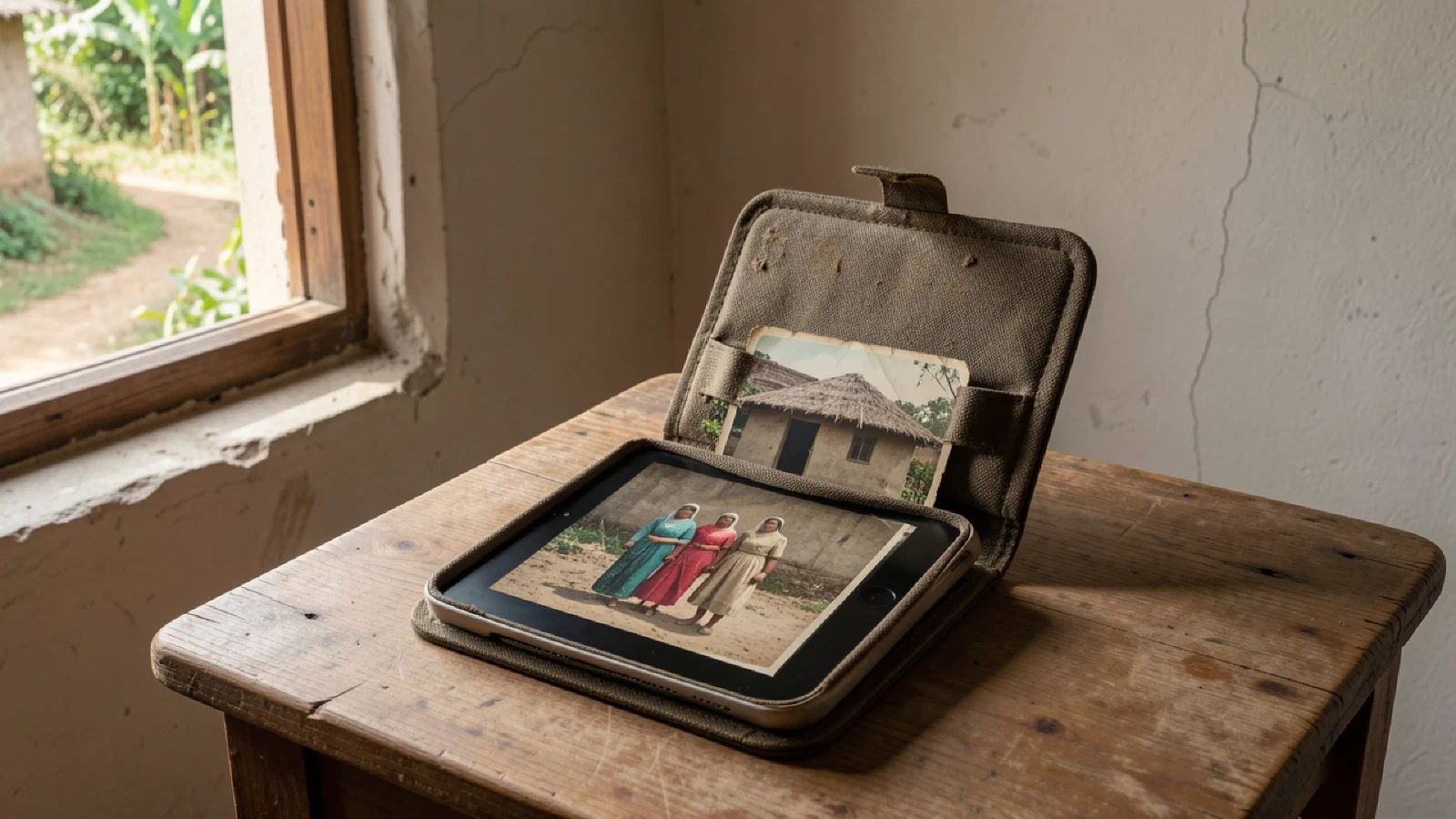
Grace has a photograph she carries in her tablet case. Her mother, her aunt, and her grandmother standing outside the same one-room home outside Lilongwe where Grace now works. Three generations of women who cared for people in this community. Her grandmother used roots and prayer. Her mother used what the government clinic provided when it was open, which was not always. Grace uses an AI tablet and a telemedicine connection to a regional hospital sixty kilometers away. She thinks about this sometimes, the continuity and the gap, what changed and what did not.
Today she is sitting with Amara.
Amara is thirty-four, pregnant with her fourth child, and something is wrong. She has been bleeding. Not much, but enough to worry. Grace enters what she observes into the tablet: the bleeding, the timing, Amara’s history, her vital signs taken with a small clip-on monitor. The AI processes. Likely placenta previa, it suggests. Recommends ultrasound confirmation. Flags the case as high-risk.
Grace does not have an ultrasound machine. But she has Dr. Banda on telemedicine at the regional hospital. She initiates the call. Dr. Banda reviews the AI’s assessment, asks Grace to palpate Amara’s abdomen in specific ways, watches through the tablet’s camera. She agrees. This pregnancy needs close monitoring. If the bleeding worsens, Amara must get to the hospital immediately.
Grace will check on Amara every day.
She knows Amara’s mother and her children and her husband who works in South Africa and sends money when he can. She is from this community. She will be here tomorrow and next week and when the baby comes. The AI will help her know what to look for. Dr. Banda is a call away. But Grace is the one who is there.
What is Grace’s profession?
She is not a physician. She has two years of training, not ten. But with AI support, she provides diagnostic reasoning that rivals what physicians provided a generation ago. She is not a nurse in the Western sense. There is no doctor above her in a hierarchy. She is the healthcare system for this community, and the telemedicine physician is a consultant she calls when needed. She is not a community health worker in the traditional sense. Her scope is far broader than education and screening.
She is something new. Or something very old, finally possible again.
The Hierarchy That Made Sense and Then Didn’t#
The wealthy world built healthcare around scarcity.
Physicians were rare and expensive. Their training took a decade. So they were reserved for diagnosis, treatment decisions, complex procedures. Nurses executed what physicians ordered: monitored, administered, documented, comforted. Community health workers educated and screened, their scope deliberately limited because their training was limited.
This hierarchy made sense when clinical knowledge lived only in human heads. Training a physician meant transferring vast amounts of knowledge and judgment through years of study and apprenticeship. The process could not be shortened. So you built tiers: the few with the full knowledge, the more with partial knowledge, the many with basic knowledge.
AI changes the equation. Clinical knowledge no longer requires a decade of memorization. It is in the tablet. Diagnostic reasoning that took years to develop is available instantly. Treatment protocols that required deep expertise are accessible to anyone who can describe symptoms and enter data.
The knowledge gradient that justified the hierarchy has flattened. What remains is not knowledge. What remains is everything knowledge was not.
Hands. Someone has to examine Amara. Palpate her abdomen. Take her blood pressure. Administer the injection if she needs it. AI can interpret. AI cannot touch.
Presence. Someone has to be there, in the home, in the village, in the community. Telemedicine extends reach. It does not replace proximity.
Judgment at the edges. AI provides protocols. Protocols do not cover everything. The case that does not fit the pattern. The patient whose situation makes the standard recommendation wrong. The moment when something feels off and you override. This judgment develops through practice, through mentorship, through mistakes and recovery. It cannot be downloaded.
Trust. Amara trusts Grace because Grace is from here. This trust was not built in a single visit. It accumulated over years of Grace being present, being competent, being compassionate. Trust cannot be installed through an app.
Compassion. Grace cares about Amara, not abstractly, not as a case, but as a person whose suffering moves her. She is with Amara in the old sense of the word: accompanying her, invested in what happens. AI processes Amara’s symptoms. Grace feels Amara’s fear.
None of these sort neatly into the three tiers the wealthy world built. The judgment that matters is not separable from the presence. The trust is not separable from the community embeddedness. The compassion is not something you add at the bottom of the hierarchy. It is the foundation everything else stands on.
The Healer#
What if you built one profession that combined them all?
Call her a community nurse practitioner if you need credentialing language. But functionally she is the healer: the person in your community who cares for you when you are sick. Not fragmented across three professions with three different relationships. Whole.
She lives in or near the community she serves. She knows the families, the social context, the history. She is trusted because she has earned trust over years of presence.
She has AI tools that give her clinical capability beyond any single human’s knowledge. She has telemedicine connection for escalation and consultation. When she encounters something beyond her capability, she calls the regional hub. A specialist appears on her screen and they work the case together. The specialist extends her reach. The specialist does not replace her presence.
She does hands-on care, examinations, basic procedures, medication administration. The physical work that requires a body with the patient’s body. And she provides compassionate presence: she is with people when they suffer, she sits with the dying, she holds families when the news is bad.
This requires different training than any of the three professions it combines. Shorter than physician training, because much of what physicians spent years memorizing is now in the tablet. Longer than current community health worker training, because a few weeks is not enough to develop judgment or build the clinical skills that AI cannot perform. Perhaps two or three years. Long enough to develop what matters. Short enough to scale.
The curriculum is not about knowledge accumulation. It is about developing what knowledge cannot provide: working with AI and recognizing when it is wrong. Clinical skills that require hands. Compassion and presence, how to be with suffering, how to sustain the work without burning out, how to stay open when staying open is hard. Community integration. Knowing when to call the telemedicine hub, and how to present a case.
What the Global South Could Do That the Wealthy World Cannot#
The global south does not have to replicate the mistake the wealthy world made.
The wealthy world built healthcare around physician scarcity, then layered nurses and community health workers beneath, a hierarchy designed for a world where clinical knowledge was rare and expensive. Dismantling that hierarchy is nearly impossible because every tier has professional associations, licensing bodies, insurance billing codes, and decades of institutional inertia defending it.
The global south, building from necessity rather than inheritance, has a different option. Instead of trying to train enough physicians, which is impossible, takes too long, and fails when they emigrate, build a new profession designed for what AI actually makes possible.
Start with what the community needs: someone there, someone capable, someone compassionate, someone they trust, someone connected to wider expertise when needed. Build the profession around that. Use AI and telemedicine to provide clinical capability that used to require a decade of training and concentration in cities. Use local training to develop what AI cannot provide.
I am aware this argument could be read as advocating second-tier care for people who cannot afford the real thing. That reading misunderstands the claim. The healer is not a physician substitute for people who cannot have a physician. She is a different kind of provider entirely, one who combines what the fragmented wealthy-world system splits apart. The wealthy world’s patients also need a continuous presence who knows them, trusts them, can be trusted by them. They mostly do not have one. The healer is not a cheaper version of what they have. It may be something better.
What Compassion Requires#
Grace will check on Amara every day until the baby comes. Not because the protocol requires it. Because she cares what happens to Amara.
This caring is the thing. The irreducible element. Everything else is infrastructure to support it or extend it.
AI extends clinical capability. Telemedicine extends reach. Training extends competence. But at the end of every extension, someone must be present who suffers with the patient. Who is moved by their pain. Who stays when staying is hard.
Compassion cannot be automated because compassion requires being the kind of thing that can feel.
AI processes Amara’s symptoms. It does not feel Amara’s fear. The gap is not technical. It is about the nature of the entity providing the care. The patient knows this somewhere, maybe not consciously. They know: this person chose to be here. This person feels something. This person’s presence costs them something and they came anyway. That cannot be faked. That cannot be scaled infinitely.
Crush the healer under impossible caseloads and the compassion dies. What remains is task execution. The patient will feel the difference, even if they cannot name it.
When the time comes, Grace will be there. If the birth is uncomplicated, she will deliver the baby herself. If it is complicated, she will stabilize Amara and get her to the hospital. After the baby comes, she will visit. Will watch for postpartum complications. Will be available when Amara has questions, when she is exhausted, when she needs someone who understands.
This is healthcare. Not the AI. Not the telemedicine. Not the protocols. Those are tools. Healthcare is Grace in the room with Amara. Capable because of the tools. Present because that is what the work requires.
The tools are transforming.
Grace’s grandmother used roots and prayer, and people trusted her. Grace uses an AI tablet and a telemedicine connection, and people trust her. The instrument changed. The thing being provided did not.
This is the seventeenth essay in The Transformed and the third in Arc 3, “The Stubborn Craft.” Where The Shapers examined teaching and The Formers examined higher education, this essay turns to a different question: not what resists transformation but what AI makes possible for the first time. The healer is a new integrated profession that AI enables in the global south, combining what three separate professions were required to provide in the wealthy world. What remains irreducibly human is not clinical knowledge but compassionate presence: the capacity to suffer with those who suffer. Future essays will examine the judges and the artists before the capstone names what the resistant professions collectively reveal about the boundary of AI transformation.
References#
Global Health Workforce
Bhutta, Zulfiqar A., et al. “Global Experience of Community Health Workers for Delivery of Health Related Millennium Development Goals.” The Lancet, vol. 375, no. 9722, 2010, pp. 1254-1266.
World Health Organization. Global Strategy on Human Resources for Health: Workforce 2030. WHO Press, 2016.
Task Shifting and New Care Models
Fulton, Brent D., et al. “Health Workforce Skill Mix and Task Shifting in Low Income Countries.” Human Resources for Health, vol. 9, no. 1, 2011, pp. 1-11.
Lewin, Simon, et al. “Lay Health Workers in Primary and Community Health Care for Maternal and Child Health and the Management of Infectious Diseases.” Cochrane Database of Systematic Reviews, no. 3, 2010.
AI in Global Health
Topol, Eric J. Deep Medicine: How Artificial Intelligence Can Make Healthcare Human Again. Basic Books, 2019.
Wahl, Brian, et al. “Artificial Intelligence and Global Health.” The Lancet, vol. 391, no. 10129, 2018, pp. 1444-1446.
Compassion and Presence in Care
Halifax, Joan. “A Heuristic Model of Enactive Compassion.” Current Opinion in Supportive and Palliative Care, vol. 6, no. 2, 2012, pp. 228-235.
Youngson, Robin. Time to Care: How to Love Your Patients and Your Job. Rebelheart Publishers, 2012.
Telemedicine and Remote Care
Mars, Maurice. “Telemedicine and Advances in Urban and Rural Healthcare Delivery in Africa.” Progress in Cardiovascular Diseases, vol. 56, no. 3, 2013, pp. 326-335.
How this essay connects to others across The Approximate Mind.
- Bhutta, Zulfiqar A., et al. “Global Experience of Community Health Workers for Delivery of Health Related Millennium Development Goals.” The Lancet, vol. 375, no. 9722, 2010, pp. 1254-1266.
- World Health Organization. Global Strategy on Human Resources for Health: Workforce 2030. WHO Press, 2016.
- Fulton, Brent D., et al. “Health Workforce Skill Mix and Task Shifting in Low Income Countries.” Human Resources for Health, vol. 9, no. 1, 2011, pp. 1-11.
- Lewin, Simon, et al. “Lay Health Workers in Primary and Community Health Care for Maternal and Child Health and the Management of Infectious Diseases.” Cochrane Database of Systematic Reviews, no. 3, 2010.
- Topol, Eric J. Deep Medicine: How Artificial Intelligence Can Make Healthcare Human Again. Basic Books, 2019.
- Wahl, Brian, et al. “Artificial Intelligence and Global Health.” The Lancet, vol. 391, no. 10129, 2018, pp. 1444-1446.
- Halifax, Joan. “A Heuristic Model of Enactive Compassion.” Current Opinion in Supportive and Palliative Care, vol. 6, no. 2, 2012, pp. 228-235.
- Youngson, Robin. Time to Care: How to Love Your Patients and Your Job. Rebelheart Publishers, 2012.
- Mars, Maurice. “Telemedicine and Advances in Urban and Rural Healthcare Delivery in Africa.” Progress in Cardiovascular Diseases, vol. 56, no. 3, 2013, pp. 326-335.