The Veterinarians
The Original Approximate Minds#
Dr. Amira Wanjiku keeps a photograph above her kitchen sink of her grandmother’s two goats. The goats are named in the photograph’s caption in her grandmother’s handwriting: Pendo and Zawadi. Amira cannot remember either goat. She was four when they died. She keeps the photograph because her grandmother kept it, and because she has thought about those two goats more times than she can count during twenty years of veterinary practice in Laikipia County, Kenya. What did they know? What did they feel? What did losing them cost her grandmother in ways the family never fully named?
She checks her phone at 5:40 AM in the dark of her kitchen. The AI monitoring system for a nearby pastoralist community’s cattle herd has flagged three animals. Temperature patterns and movement data over the past forty-eight hours are consistent with early East Coast fever, a tick-borne disease that kills quickly once symptoms appear. No behavioral changes yet. The animals are eating, moving with the herd, showing nothing a herder watching them would notice. But the sensors on their ears are catching what the AI model learned to associate with incubation: thermal micro-fluctuations, a subtle reduction in movement range.
Amira has a window. Maybe forty-eight hours before the animals present with the swollen lymph nodes and high fever that mark clinical disease. At that point, treatment becomes expensive and uncertain. Right now, it is a course of buparvaquone that costs less than the fuel to drive there.
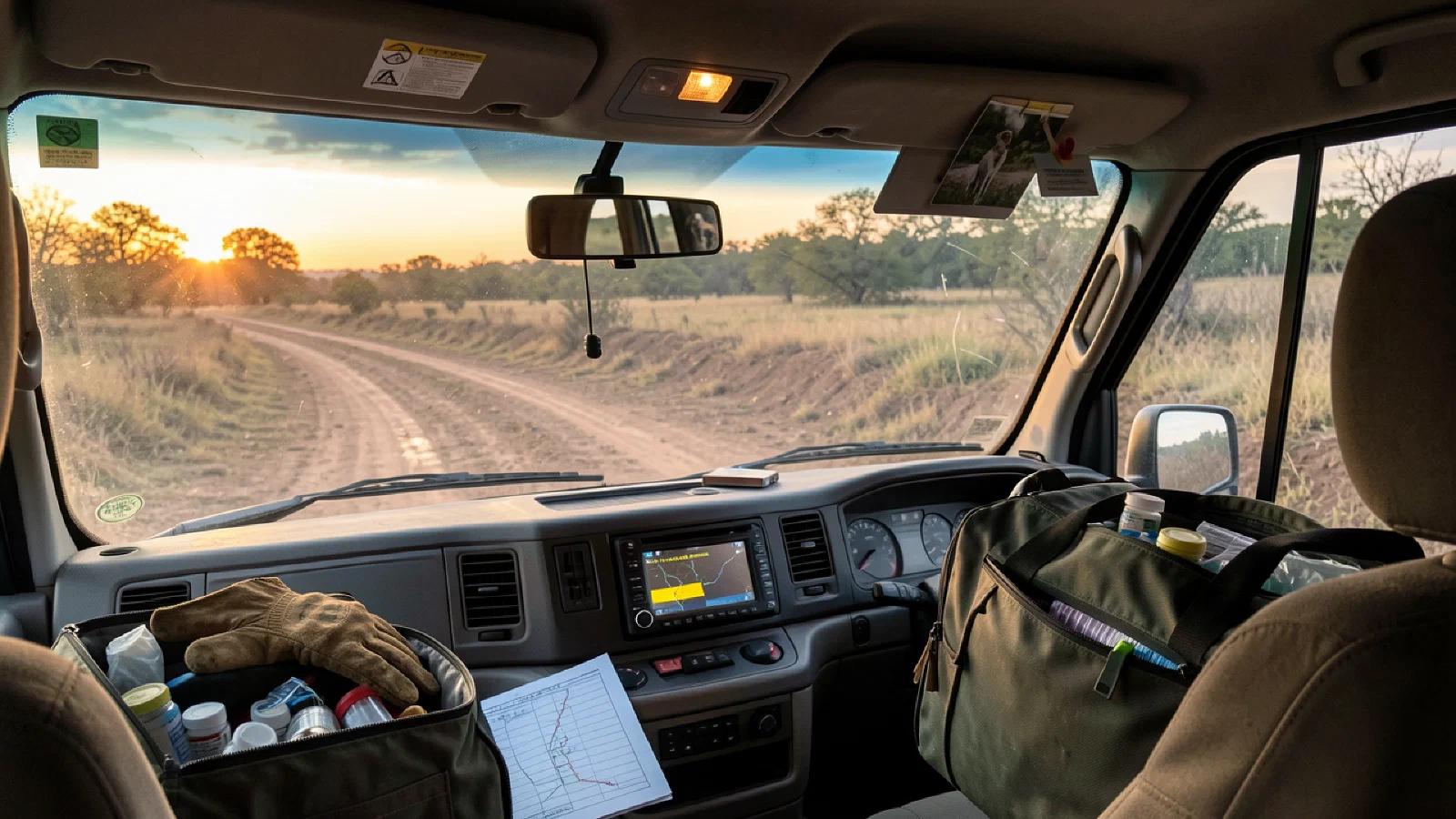
She gets in her truck.
The road to the community’s grazing area is two hours of dirt track that becomes impassable when it rains. Today it is dry. The AI told her what was wrong. She still has to find the animals in a herd of three hundred, administer the injections, and explain to the herders what the sensors detected and why it matters. All of it requires being physically present in a place that no data connection can make closer.
Three years ago, those three animals would have been visibly sick before anyone noticed. Two of the three would have died. Amira knows the math. She also knows the herder, Joseph, and his family, for whom three cattle represent a significant portion of their wealth.
She drives faster.
Across the Consciousness Gap#
This series began with a problem: how do you understand a mind that is not like yours?
The Approximate Mind has traced that problem through functional understanding, bidirectionality, the plural self, and the question of what AI might or might not feel. At every turn, the underlying difficulty was the same. The gap between minds. The impossibility of knowing, with certainty, what another entity experiences from the inside.
Animals were the first other minds humans tried to understand across this gap.
Long before AI, long before philosophy formalized the problem of other minds, human beings were reading the behavior of animals and making inferences about their internal states. The herder who notices a cow moving differently. The farmer who reads a horse’s ears. The hunter who understands, through observation accumulated over generations, how prey animals think and decide. These are acts of approximate understanding applied to beings whose inner experience is genuinely inaccessible, not because of any technological limitation but because of the fundamental difference between species.
Veterinary medicine formalized this practice. The vet has always done what this series describes AI researchers attempting: building a workable model of a mind that cannot tell you what it is experiencing. The dog cannot say where it hurts. The cow cannot describe her symptoms. Every veterinary encounter is an exercise in reading behavior, interpreting signs, and making decisions on behalf of a being whose subjective experience you can infer but never confirm.
The veterinarian has been doing what we now describe as the central challenge of AI alignment for centuries. Caring well for a mind you cannot fully understand. Treating with precision what you can only approximate. Making ethical decisions on behalf of a being who cannot participate in them.
The animals are the original approximate minds. The veterinarian is the professional who turned that approximation into a practice of care.
What the Data Cannot Carry#
AI improves veterinary diagnosis dramatically, more dramatically than in human medicine, precisely because the baseline was harder. The animal could not tell the doctor anything. Now wearable sensors and continuous monitoring tell the doctor what the animal cannot. Amira’s system detects disease before the herders or the animals show any outward sign. This is not a marginal improvement. It is a qualitative shift in what is knowable about animal health, and at the scale of industrial agriculture, where one vet may be responsible for tens of thousands of animals, the welfare implications run deep.
But the data does not tell Amira that Joseph’s lead bull, one of the three flagged animals, is the one Joseph’s father gave him when he married. That the bull is old for its breed but trusted. That losing it would carry an emotional weight no insurance payout addresses. The data does not tell her that the second flagged animal is a young cow Joseph has been watching carefully because she reminds him of an animal he lost to East Coast fever five years ago, before the monitoring system, an animal whose death he still feels responsible for.
The data monitors the herd. Amira cares for it. The difference is not sentimental. A veterinarian who does not understand the human-animal bond cannot practice effectively, because the decisions that matter always involve the human whose life is entangled with the animal’s.
Eight thousand miles away, Dr. Sarah Novak in suburban Philadelphia sits with the Hendersons and their twelve-year-old Labrador, Charlie, and has a conversation that is nominally about elevated liver enzymes and a small mass on the ultrasound. It is not, in any meaningful sense, a medical conversation. It is a conversation about mortality, love, and the impossible math of how much intervention is appropriate for a being who cannot participate in the decision. Sarah answers questions that are not really medical questions: Is he in pain? Will he know something is wrong? How long does he have?
The emotional labor of this conversation is not a byproduct of veterinary practice. It is veterinary practice.
What It Is Like#
Thomas Nagel asked what it is like to be a bat. He argued that even if we knew everything about a bat’s neurology, we could not know the subjective experience of echolocation. The what-it-is-like of being a creature whose primary sense is fundamentally alien to our own.
The same is true, to varying degrees, of every animal veterinarians treat. We know a great deal about canine neurology, bovine physiology, feline behavior. We can predict with reasonable accuracy how animals respond to stimuli, what causes distress, what interventions alleviate pain. We can build functional models of animal minds accurate enough to guide treatment decisions.
What we cannot do is access the animal’s experience. We approximate it. We infer from behavior. We use our own experience of pain and loss as an imperfect template. We care for beings whose inner lives remain, in the philosophical sense, inaccessible.
This is exactly what the series has explored about AI. We build functional models of what AI systems process. We observe outputs and infer capacities. We debate, endlessly and without resolution, whether there is something it is like to be a large language model. We approximate.
The veterinarian has been doing this for centuries. Not with artificial minds but with natural ones. The practice of care across the consciousness gap, the ethical commitment to treat well what you cannot fully understand, is not new. It is ancient. AI asks us to extend it to a new kind of entity. Animals remind us that we have always been in this position.
I find this genuinely comforting. Not because it resolves anything. Because it suggests that care across the consciousness gap is something humans have been practicing for as long as we have been human. We are not doing this for the first time. We are doing it again, with a different kind of mind, using the same instinct: to pay attention to what you cannot fully know, and to treat it carefully anyway.
The Arc’s Last Argument#
The veterinary transformation brings the arc’s bundled profession argument to its cleanest form.
The diagnostic half, the identification of disease in beings who cannot report their own symptoms, is being absorbed by AI faster and more completely than in any other medical field, because the animal’s silence was always the limiting factor. Now sensors speak for the animal. Amira drives out before Joseph’s cattle are visibly sick. Sarah knows about Charlie before the Hendersons notice anything wrong. The medical practice improves.
The care half cannot be automated, for a reason that goes beyond technical difficulty.
The vet cannot ask the patient how they are doing. They have to figure it out another way.
That figuring-out is not just diagnostic skill. It is the willingness to bring your own experience of suffering, of attachment, of mortality, to an encounter with a being who cannot articulate its own. When Sarah sits with the Hendersons and Charlie on the floor between them, she is holding a space where human love for a non-human being is taken seriously. Where the bond between species is honored as real. Where the decision about how to care for a being who cannot decide for himself is treated with the gravity it deserves.
Amira drives two hours on a dirt road to treat three cattle. The AI could have sent Joseph an alert and generated a treatment protocol. The treatment requires injection. The injection requires a veterinarian. The veterinarian requires the road.
Some things do not get automated. Not because the technology cannot improve. Because the thing that matters is not the information. It is the showing up.
Amira has been doing this for twenty years. When she drives out to Joseph’s herd, she still sometimes thinks about Pendo and Zawadi in her grandmother’s photograph. Two goats. Names written in careful handwriting. Animals her grandmother thought worth keeping a photograph of, thought worth naming, thought worth remembering.
We have always cared for what we cannot fully understand. The animals have always been there, reminding us.
This is the thirteenth essay in The Transformed and the sixth in Arc 2, “The Quiet Revolution.” The veterinary transformation brings the series full circle: the problem of understanding other minds, which the Approximate Mind first posed about AI, turns out to have its oldest expression in the human-animal relationship. Veterinary medicine is the practice of care across the consciousness gap, and AI’s transformation of it illuminates what approximation means when applied to beings who will never tell us whether we got it right. The final essay in this arc will trace the hidden thread connecting all six professions into a single argument about what civilization depends on.
References#
Animal Minds and Consciousness
Bekoff, Marc. The Emotional Lives of Animals. New World Library, 2007.
de Waal, Frans. Are We Smart Enough to Know How Smart Animals Are? W.W. Norton, 2016.
Grandin, Temple, and Catherine Johnson. Animals in Translation. Scribner, 2005.
Nagel, Thomas. “What Is It Like to Be a Bat?” The Philosophical Review, vol. 83, no. 4, 1974, pp. 435-450.
Veterinary Practice and Ethics
Rollin, Bernard E. Animal Rights and Human Morality. Prometheus Books, 2006.
Yeates, James. Animal Welfare in Veterinary Practice. Wiley-Blackwell, 2013.
AI in Animal Health
FAO. The Role of Digital Agriculture in Building Resilient Food Systems. Rome: FAO, 2023.
Neethirajan, Suresh. “The Role of Sensors, Big Data and Machine Learning in Modern Animal Farming.” Sensing and Bio-Sensing Research, vol. 29, 2020.
How this essay connects to others across The Approximate Mind.
- Bekoff, Marc. The Emotional Lives of Animals. New World Library, 2007.
- de Waal, Frans. Are We Smart Enough to Know How Smart Animals Are? W.W. Norton, 2016.
- Grandin, Temple, and Catherine Johnson. Animals in Translation. Scribner, 2005.
- Nagel, Thomas. “What Is It Like to Be a Bat?” The Philosophical Review, vol. 83, no. 4, 1974, pp. 435-450.
- Rollin, Bernard E. Animal Rights and Human Morality. Prometheus Books, 2006.
- Yeates, James. Animal Welfare in Veterinary Practice. Wiley-Blackwell, 2013.
- FAO. The Role of Digital Agriculture in Building Resilient Food Systems. Rome: FAO, 2023.
- Neethirajan, Suresh. “The Role of Sensors, Big Data and Machine Learning in Modern Animal Farming.” Sensing and Bio-Sensing Research, vol. 29, 2020.