The Farmers
When the Land Becomes Data#
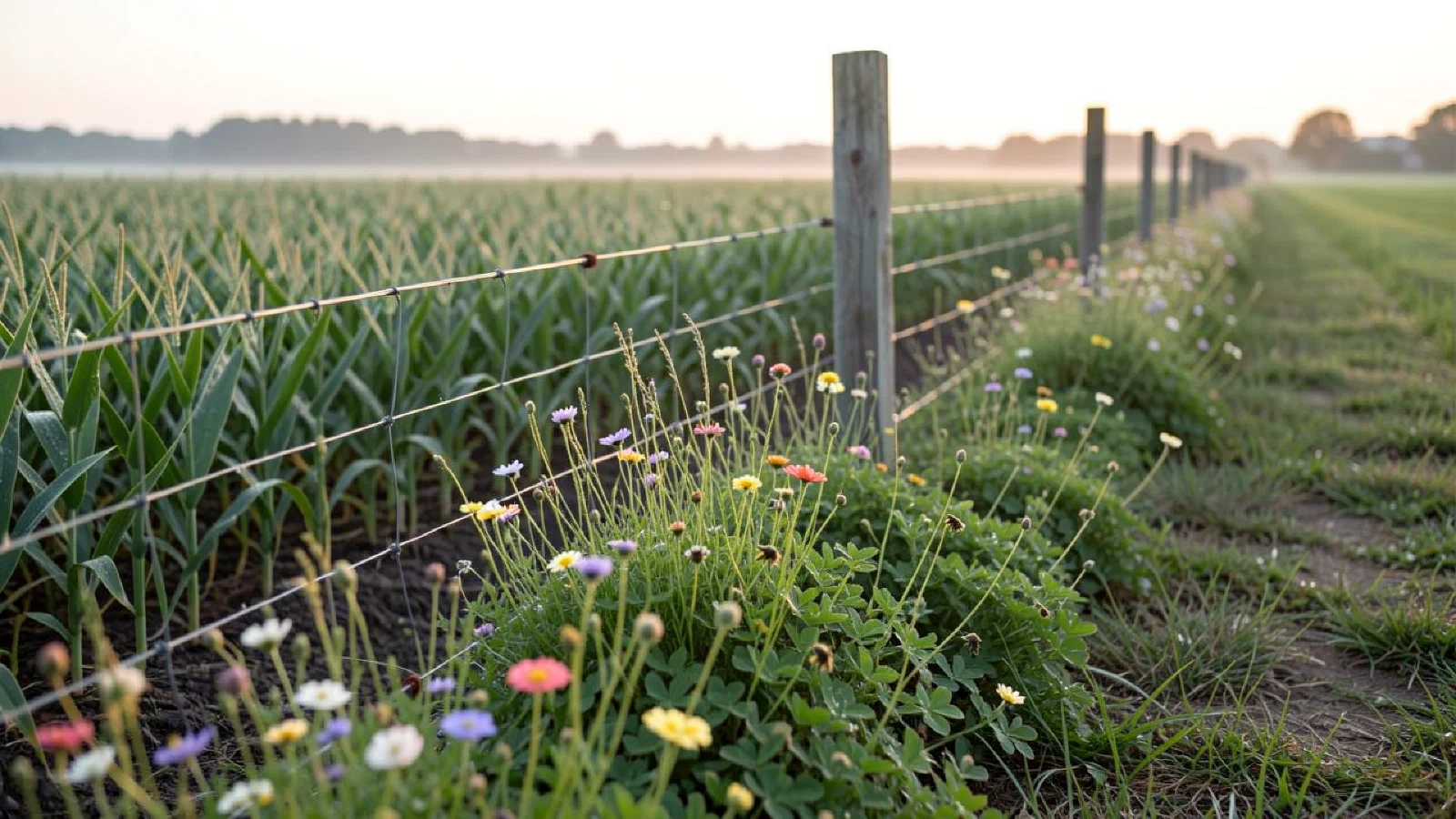
Dot walks her fields at dawn because she has walked her fields at dawn for forty years.
She would not describe what she does as gathering information. She would probably say she is checking on things, or just walking, the way you say you are “just” doing something that is in fact the organizing practice of your life. But something is happening during those walks that I have been trying to understand. The soil on the east plot is heavier than the west, a difference she registers through her boots before she registers it consciously. The wildflowers along the fence line tell her about the moisture two weeks ago, not today. The way the bees are working the clover tells her whether the nectar flow has started or whether they are still drawing on the sugar syrup she set out in March.
None of this is data in the sense that a sensor produces data. It is knowledge stored in the body, refined through repetition across four decades, impossible to fully articulate. Dot could not write a manual for what she knows. She could only walk a field with you and point.
Her neighbor Ray Calloway installed a full precision agriculture system last spring. Drones survey his acreage every morning, producing multispectral images that map crop health at sub-meter resolution. Soil sensors buried at three depths report moisture, nitrogen, phosphorus, and pH in real time. His tractor drives itself along GPS-guided paths, planting and applying inputs at variable rates calibrated to each micro-zone. An AI platform integrates all of it, plus weather forecasts, commodity prices, and historical yield data, into recommendations that tell Ray what to do and when.
Ray’s yields are up. His input costs are down. He estimates the system paid for itself in eighteen months.
He has not walked his fields in two months.
Dot watches Ray’s drones from her porch while she drinks coffee. She is not hostile to technology. She does not resent him. But she is sixty-three years old, and she is beginning to wonder whether what she knows, the knowledge that lives in her boots and her hands and her nose, will outlast her. Not because it is wrong. Because the world may stop having a place for it.
The Epistemological Shift#
What is happening in agriculture right now is not new tools arriving for farmers. It is a different relationship to land becoming available, and in some places becoming mandatory.
When Dot walks her fields, she is inside the ecosystem. She reads signals her body learned over decades: the smell of soil after rain, the color of leaves at different times of day, the sound the insects make in dry weeks versus wet. Her knowledge is embodied. It cannot be separated from the body that learned it or from the specific land that taught it.
When Ray checks his dashboard, he is outside the ecosystem looking in. The data is accurate, complete, and actionable. It tells him things Dot could never know: the precise nitrogen content at a given GPS coordinate, the water stress index of a specific plant row, the probability of pest emergence based on regional models. His knowledge is abstract. It can be transferred to any farmer with the same system, on any land, anywhere.
Both produce food. They produce different farmers.
The yield conversation tends to obscure this. The question is not only whether AI-driven farming produces more per acre, though it does. The question is what kind of relationship to land farming becomes when the land is primarily encountered as a data stream.
Dot can feel the difference between the east plot and the west. She has mentioned this to Ray, who checked his sensor data and found no significant variation in the metrics his system tracks. This does not settle the question. It might mean the difference she perceives involves something the sensors are not measuring: a quality of soil structure or microbial life or drainage that her body detects through pressure and texture but that no current instrument captures. It might mean she is picking up on a difference so small it falls within the sensor’s margin of error but matters cumulatively across a growing season. It might mean she is wrong, and the difference is an artifact of memory rather than observation.
All three deserve to be taken seriously. The third is no more likely than the first two.
The agricultural science literature has documented repeatedly that experienced farmers carry knowledge that resists formal capture. They can predict frost from atmospheric conditions that models miss. They time planting by indicators, the bloom of a particular tree, the arrival of certain birds, that encode ecological relationships too complex for current models to replicate. They read soil health through feel in ways that correspond to measurable properties but detect nuances that individual metrics do not.
We know more than we can tell. This was Polanyi’s formulation, and it describes precisely what Dot carries in her boots. The knowledge is not mystical. It is the compressed product of thousands of hours of careful attention, encoded in the body as well as the mind.
Agricultural optimization has been here before. The Dust Bowl. The Green Revolution’s chemical dependencies. The collapse of soil health under industrial monoculture. In each case, the optimization was real and the metrics were accurate. What was missed was a dimension of the system that the metrics did not capture. The farmers who resisted, the stubborn ones who kept doing it the old way, often turned out to be maintaining something the optimizers had not thought to measure.
This is not an argument against precision agriculture. It is a reason for holding the question of what we are losing alongside the data about what we are gaining.
What Farming Is For#
Farming is the oldest human profession. Before there were doctors or builders or priests, there were people who worked the land. And the working of land has never been only about food.
The rice paddy in Japan is a cultural inheritance, tended the same way for a thousand years. The milpa system in Mexico, where corn, beans, and squash have been grown together for thousands of years, is an agricultural technology, a nutritional system, and a cultural practice woven together. The subsistence garden in West Africa feeds a family and teaches children and connects generations and anchors a community’s relationship to place. Even in the industrialized West, where farming has been most thoroughly commercialized, the family farm carries cultural weight that no yield statistic captures.
AI optimization treats farming as a production problem. Given inputs, maximize output. This framing is not wrong. Farming is a production problem. People need food. But it is also a relationship, a practice, a culture, a way of being in the world, and the parts that are not about production are often the parts that make communities cohere and give people reasons to stay on the land.
Ray keeps planting two acres of his grandfather’s heirloom variety in the corner of the east field. His system would not recommend it. The variety yields less. But his grandfather brought the seed from Germany, and the corner of the east field is where that connection lives. The algorithm is not wrong about the yield. Ray is not wrong about what the yield numbers fail to measure. Both are true, and they are in tension, and the tension is not resolvable by better data.
When your neighbor’s yields are thirty percent higher because he follows the algorithm exactly, the cost of planting your grandfather’s variety is not only sentimental. It is competitive. The market does not grade on sentiment.
The Capital Divide#
Dot’s honey operation runs on eleven acres, a plywood stand, and forty years of knowledge. Ray’s precision system cost over $200,000 in sensors, drones, autonomous equipment, and data subscriptions, offset by financing arrangements with the equipment manufacturers and a cost-share program through the county extension service.
The capital requirements of precision agriculture are accelerating a consolidation already well underway. Large operations afford the technology, achieve the efficiency gains, and spread costs across enough acreage to make the investment rational. Small operations cannot. The gap between them grows with each cycle, as the efficiency gains of precision farming compound while the small farm’s traditional advantages, local knowledge, customer relationships, the ability to do things that do not scale, erode under the same economic pressure.
Drone rental services and cooperative technology-sharing models exist and are growing, particularly in parts of Asia and Africa where smallholder agriculture is the norm. These genuinely democratize access to some tools. But the full integrated system that produces Ray’s improvements requires not just hardware but data infrastructure, connectivity, and the digital literacy to operate it. These requirements track closely with existing economic disparities.
The world needs to produce substantially more food to feed a projected population of ten billion, on less arable land with less water under increasingly volatile climate conditions. Precision agriculture is one of the few plausible paths to that. AI-optimized planting schedules could transform yields in regions facing food insecurity. Drone-based monitoring could serve farmers who have never had access to an agronomist. The same technology that consolidates farming in Iowa could empower subsistence farmers in Ethiopia who have never had access to any extension service at all.
Both outcomes are currently under construction. The difference between them is not primarily technical. It is political. It is about who builds the systems, who owns the data, who captures the efficiency gains, and who gets left behind when the capital requirements price them out.
Dot and Margaret#
Margaret has been buying Dot’s honey for fifteen years. She remembers the first time: she pulled over on Route 9, spotted the hand-lettered sign, and met a woman who talked about bees the way some people talk about their children. The honey was golden and warm from the sun. She came back because it was good, and because she liked Dot, and because after a few visits she felt that buying Dot’s honey was part of who she was.
Dot’s honey has no data profile. No reviews, no SKU, no delivery infrastructure. Margaret’s grocery AI has never recommended it and never will, because by every metric the algorithm uses, Dot does not exist.
But Dot exists in a different register. She exists in the register of embodied knowledge, where farming is not a data operation but a practice. She exists in the register of local economy, where the honey stand on Route 9 is part of a web of small transactions that hold a community together. She exists in the register of cultural meaning, where a woman who keeps bees and walks her fields at dawn represents something about the relationship between people and land that precision agriculture’s metrics were not designed to capture.
What I cannot answer, because nobody can answer it yet, is whether Dot’s register of existence has a future. Not Dot personally. She is sixty-three and her bees will outlast her. But the kind of farming she represents: small, embodied, local, culturally embedded, economically marginal, ecologically attentive. The kind that depends on knowledge you cannot download.
What the Data Does Not Know#
Farming was always two things bundled together: the production of food and the cultivation of a relationship between people and land. Mechanization began the unbundling a century ago, moving farming from the body toward the machine. Precision agriculture completes it, moving farming from the field to the screen.
The production continues, and improves. More food, more efficiently, more sustainably. This is not trivial. The people who will be fed because AI-optimized agriculture produces more are real people with real hunger, and they deserve to be in the accounting.
The relationship attenuates. The farmer who encounters the land through a dashboard has a different relationship to it than the farmer who encounters it through her boots. Different does not necessarily mean worse. But it means different, and the difference involves the loss of a form of knowing, embodied, accumulated through presence, possibly the oldest form of human knowledge on Earth, that may be carrying things we do not yet know how to measure.
The Dock Workers asked what happens when physical leverage is automated away. The farming transformation asks the complementary question: what happens when physical knowledge is optimized away?
Dot does not ask this question. She walks her fields, tends her bees, puts honey in jars, and drives to the stand on Route 9. The question is happening around her, in Ray’s drones and in the capital flows that favor his operation over hers and in the slow erosion of the economic habitat that makes her way of life possible.
The land is becoming data. The data is good.
What the data does not know is what it is not measuring.
This is the ninth essay in The Transformed and the second in Arc 2, “The Quiet Revolution.” It builds on the exploration of physical leverage in The Dock Workers, shifting from the industrial waterfront to the agricultural land. The characters Dot and Margaret first appeared in The Monoculture, which examined how AI recommendation systems erode the economic habitat of small producers. This essay extends that argument into the epistemological dimension: not just whether small farming can survive economically, but what is lost when embodied knowledge of land gives way to algorithmic knowledge of data. Future essays in this arc will examine skilled trades, dentists, clergy, veterinarians, and the infrastructure that connects them all.
References#
Agricultural Knowledge and Practice
Berry, Wendell. The Unsettling of America: Culture and Agriculture. Sierra Club Books, 1977.
Howard, Albert. The Soil and Health: A Study of Organic Agriculture. Devin-Adair, 1947.
Polanyi, Michael. The Tacit Dimension. Doubleday, 1966.
Scott, James C. Seeing Like a State: How Certain Schemes to Improve the Human Condition Have Failed. Yale University Press, 1998.
Precision Agriculture and Technology
Food and Agriculture Organization. The State of Food and Agriculture 2022. Rome: FAO, 2022.
McKinsey and Company. “Agriculture’s Connected Future: How Technology Can Yield New Growth.” McKinsey Global Institute, Oct. 2020, www.mckinsey.com.
Food Sovereignty and Cultural Dimensions
Altieri, Miguel A. Agroecology: The Science of Sustainable Agriculture. Westview Press, 1995.
Shiva, Vandana. Monocultures of the Mind: Perspectives on Biodiversity and Biotechnology. Zed Books, 1993.
Farm Consolidation and Rural Economy
Hendrickson, Mary K., and Harvey S. James. “The Ethics of Constrained Choice: How the Industrialization of Agriculture Impacts Farming and Farmer Behavior.” Journal of Agricultural and Environmental Ethics, vol. 18, 2005, pp. 269-291.
Lobao, Linda, and Katherine Meyer. “The Great Agricultural Transition: Crisis, Change, and Social Consequences of Twentieth Century US Farming.” Annual Review of Sociology, vol. 27, 2001, pp. 103-124.
How this essay connects to others across The Approximate Mind.
- Berry, Wendell. The Unsettling of America: Culture and Agriculture. Sierra Club Books, 1977.
- Howard, Albert. The Soil and Health: A Study of Organic Agriculture. Devin-Adair, 1947.
- Polanyi, Michael. The Tacit Dimension. Doubleday, 1966.
- Scott, James C. Seeing Like a State: How Certain Schemes to Improve the Human Condition Have Failed. Yale University Press, 1998.
- Food and Agriculture Organization. The State of Food and Agriculture 2022. Rome: FAO, 2022.
- McKinsey and Company. “Agriculture’s Connected Future: How Technology Can Yield New Growth.” McKinsey Global Institute, Oct. 2020, www.mckinsey.com.
- Altieri, Miguel A. Agroecology: The Science of Sustainable Agriculture. Westview Press, 1995.
- Shiva, Vandana. Monocultures of the Mind: Perspectives on Biodiversity and Biotechnology. Zed Books, 1993.
- Hendrickson, Mary K., and Harvey S. James. “The Ethics of Constrained Choice: How the Industrialization of Agriculture Impacts Farming and Farmer Behavior.” Journal of Agricultural and Environmental Ethics, vol. 18, 2005, pp. 269-291.
- Lobao, Linda, and Katherine Meyer. “The Great Agricultural Transition: Crisis, Change, and Social Consequences of Twentieth Century US Farming.” Annual Review of Sociology, vol. 27, 2001, pp. 103-124.