The Dock Workers
When the Port Thinks for Itself#
Marcus Washington’s daughter plays travel soccer. This is how he spends his weekends: in lawn chairs along fields in New Jersey and Pennsylvania, watching a nine-year-old who moves, he says, like she’s angry at the ground. He has a thermos he fills with bad coffee and a folding chair with a broken cupholder he keeps meaning to replace. His wife makes fun of his commentary from the sideline. He is embarrassingly loud.
I mention this because when the conversation about dock workers and automation begins, Marcus disappears. He becomes a statistic, a symbol, a position in a labor dispute. He becomes evidence. And what he actually is, before anything else, is a man who spends his weekends yelling at a nine-year-old playing soccer and drinking coffee from a dented thermos.
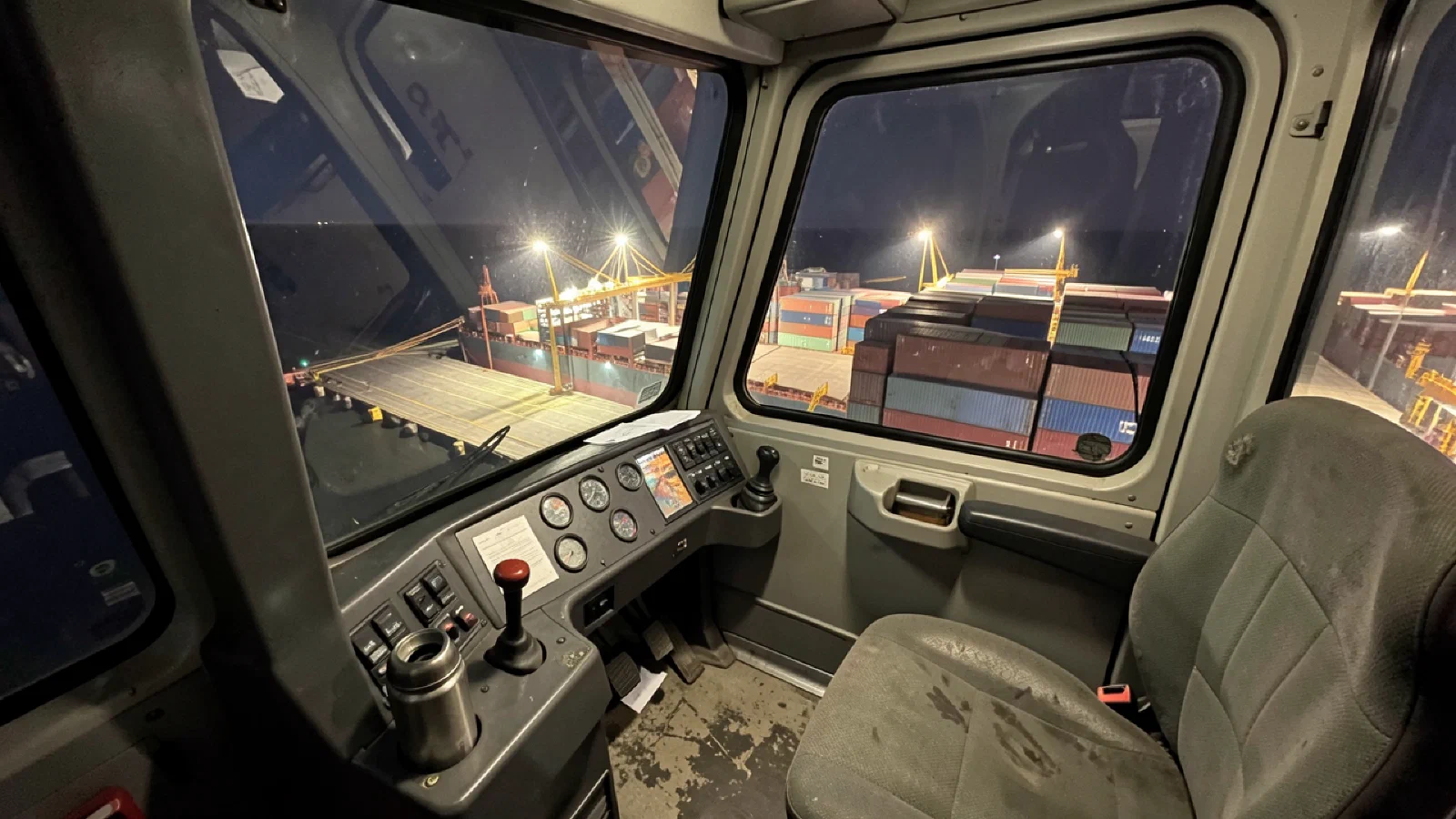
He is also, on weekday nights, sixty meters above the deck of the MSC Adriana at the Port of Newark, reading the weight and sway of a thirteen-thousand-TEU container ship in the dark.
Marcus has been a crane operator for twenty-two years. His father worked this port. His uncle worked this port. His son is on the ILA waiting list. When he talks about what he does, he does not say “I operate a crane.” He says “I’m a longshoreman.” The distinction carries more than any efficiency metric can touch.
The Port as Organism#
At 3:47 on a Tuesday morning, Terminal C and Terminal D at Newark are running two different philosophies of how things should work.
On the east side, Marcus’s terminal processes the MSC Adriana. Below his cab, lashers move through the container stacks, unhooking twist locks by feel in the dark. Truck drivers queue at the gate, engines idling. A yard foreman named Jimmy DiNapoli directs with hand signals and a radio voice that hasn’t changed cadence in thirty years. The work is human in the oldest sense: distributed intelligence, embodied knowledge, people reading each other and the ship at once.
On the west side, Terminal D processes the Maersk Elba. No one is on the dock. Autonomous guided vehicles move in patterns no human choreographed, their routes recalculated every ninety seconds based on conditions across the entire terminal: wind speed, vessel trim, the position of every other vehicle, the predicted arrival time of the next truck. Robotic cranes lift in sequences optimized by a system that sees the whole port as a single problem. In a control room four hundred meters away, two operators watch screens. They intervene perhaps three times per shift, usually for the same reason: something that wasn’t in the data.
Both terminals will finish their ships within an hour of each other tonight. By next year, Terminal D will process vessels forty percent faster.
Marcus knows this. He has watched from across the barrier. He has done the arithmetic.
You can summarize this as robots displacing workers. A robot replacing a worker is incremental. What is happening at Terminal D is structural. The port does not have robots. The port becomes a robot.
A traditional working port is a feat of distributed human intelligence. Thousands of decisions per hour made by hundreds of people with different specializations, connected by radio and hand signal and the accumulated knowledge of how things actually work when the weather turns or the equipment fails or a container comes up misloaded. The crane operator reads the ship. The lashers read the crane operator. The yard planner reads the terminal. The foreman reads all of it. It is a human system, and its intelligence lives in the people who comprise it.
An automated terminal dissolves this system and reconceives the port as a single coordinated entity. Container movements that once involved six discrete handoffs between specialized workers become one continuous flow. The concept of “shifts” changes meaning. The concept of “positions” becomes almost irrelevant. The system does not need a crane operator and a vehicle driver and a yard planner and a foreman doing separate jobs in coordination. It needs a single intelligence managing the movement of physical objects through space.
China now operates more than sixty automated container terminals. Qingdao and Shanghai show throughput increases of fifteen percent or more while reducing the workforce per container handled by an order of magnitude. Rotterdam moves over thirteen million containers annually with fewer than fifteen hundred port employees. New York and New Jersey require more than thirty-seven hundred ILA workers to handle roughly nine million. The industry understands what these numbers mean even when the public conversation has not caught up.
The Union Question#
On October 1, 2024, forty-five thousand members of the International Longshoremen’s Association walked off the job at fourteen ports from Boston to Houston. The three-day strike shut down container handling across the East and Gulf Coasts, disrupting an estimated two billion dollars in trade per day.
The headlines said wages. The actual dispute was automation.
Harold Daggett, the union’s president, called automation an existential threat. His son Dennis framed it in terms that extended beyond labor relations: this was not just about protecting jobs but about preserving communities, families, and the future being built for the next generation. The union’s initial demand was a complete ban on automation at ILA-controlled ports.
The eventual settlement, ratified by nearly ninety-nine percent of the membership in early 2025, secured a sixty-two percent wage increase over six years and permitted limited automation with guarantees that new equipment would come paired with new union positions. For every semi-autonomous crane installed, the port would hire one new ILA member. Fully autonomous cranes were banned entirely.
It was a remarkable show of leverage. The ILA controls a chokepoint in global commerce: nothing moves through half of America’s container capacity unless ILA members move it. That physical control, the irreducible fact that human hands must touch the cargo, is the foundation of the union’s power.
And it is precisely what automation dissolves.
I keep coming back to this, because it illuminates something that extends far beyond the waterfront. The labor movement in its most powerful form has always been grounded in physical leverage. The factory worker’s power came from the fact that the factory could not run without the factory worker. The miner’s power came from the fact that coal did not mine itself. The longshoreman’s power came from the fact that containers do not walk off ships. When you control a physical bottleneck in the economy, your bargaining position is structural, not merely contractual. You do not need permission to matter.
Automation does not merely reduce the number of workers needed. It dissolves the bottleneck itself.
When the port thinks for itself, when containers flow from ship to truck through a single AI-coordinated system, the physical chokepoint that gave workers their bargaining power ceases to exist. The ILA’s sixty-two percent raise and its automation guardrails are real victories. But they are victories negotiated from a position of leverage that is actively eroding.
The six-year contract runs through 2030.
What the Container Knew#
There is something else being lost in the automated terminal that the efficiency numbers do not capture, and this is where I find the question genuinely hard.
Marcus, sixty meters up in his crane cab, is not simply executing a series of prescribed movements. He is reading. The weight distribution tells him something. The way a container shifts in the spreader tells him something. The sound of the locking pins, the angle of the ship’s deck in a particular tide, the way Jimmy DiNapoli’s hand signal changed slightly because the wind picked up in the last twenty minutes. He has built this reading over twenty-two years, and he cannot fully articulate what he knows. This is not a failure of introspection. It is the nature of the knowledge.
The philosopher Michael Polanyi called this “tacit knowledge.” We know more than we can tell. A doctor knows something from the moment a patient walks into the room before any examination begins. A farmer knows the soil by how it feels in the hand before any analysis is run. A crane operator knows something about the ship that the sensors do not yet register. This knowledge is not mystical. It is the compressed product of thousands of hours of careful attention, encoded in the body as well as the mind.
Does this knowledge matter?
Terminal D’s system makes fewer errors than Terminal C on the metrics that matter to port operators: container damage rates, vessel turnaround times, truck dispatch efficiency. The AI sees the whole terminal; Marcus sees his corner of it. On the dimensions being measured, the machine is better.
What the machine does not have is Marcus’s accumulated reading of what is not yet a problem. The hunch about a particular container that turned out to be misloaded and would have fouled the stack three moves later. The sense that Jimmy’s silence on the radio means something. The feel of a shift where something is slightly off before anything actually goes wrong.
Whether this matters, practically, operationally, economically, is genuinely unclear to me. I do not think the answer is obvious. I think it is possible that the distributed, tacit intelligence of a working human crew catches things that sensor arrays miss. I also think it is possible that sensor arrays catch things that distributed human crews miss, and that the net effect favors the machine. I do not know. What I know is that the knowledge Marcus carries is real, and that the question of whether it is being replaced or simply made redundant is not a settled one.
What Does Not Replace Itself#
The automation of the longshoreman’s leverage is not a labor relations story. It is a question about the architecture of democratic power.
For two centuries, working people’s ability to bargain collectively depended on their physical indispensability. You did not need a law degree to exercise it. If you stood between the goods and the market, you had leverage. The teamsters had it. The miners had it. The longshoremen had it in its most direct form: nothing enters the country unless we move it.
This leverage was not negotiated. It was inherent in the physical arrangement of the economy. And it was the foundation of the modern labor movement, which emerged not from theory but from the material fact that industrial economies required human bodies at every critical juncture.
When AI and robotics automate the critical junctures, the leverage evaporates. Not because of a decision. Not because of a conspiracy. Because the physical architecture of the economy reorganized around systems that do not require human bodies at the chokepoints.
The leverage was not taken away. It was dissolved by a change in how the world works.
This is why the 2024 strike, for all its drama and its genuine victory, may represent the last act of an old playbook more than the first chapter of a new one. The strike worked because the chokepoint still exists. In 2024, nothing moves through Newark without ILA members. In 2034, that question is open. And if the answer is that goods can move without human hands at the critical junctures, then the kind of power that longshoremen wielded, the kind of power that built the American middle class, will need a new foundation entirely.
What that foundation looks like is a question I do not have a satisfying answer to. Regulation? Legislation? Worker ownership in the automated systems? Some form of universal basic income as the leverage disappears? All of these have been proposed. None has been tested at the scale that port automation implies. And the clock is running.
The dock workers are not a special case. They are the first visible case of a transformation that will reach every profession where human physical presence at a critical juncture is the basis of bargaining power. The warehouse workers. The delivery drivers. The construction crews. The agricultural laborers. Each will face its own version of the same question: when the work no longer needs your body, what remains of your power?
What Margaret Sees#
Margaret does not think about ports. Nobody does, which is exactly the point.
She grew up in Galena, Illinois, where her father drove a grain truck. She knows more than most people do about supply chains, or at least about the particular anxiety of watching grain prices and wondering if the numbers will clear the loan payment. She moved east twenty years ago. She does not connect the supermarket shelf to the Port of Philadelphia, or the pharmaceutical bottle to the container from Newark. She connects those things to the store, and the store appears to run itself.
She remembers the 2024 strike. She remembers the news footage: men on picket lines, signs about automation, a union president on television talking about families and futures. She remembers thinking that $150,000 seemed like a lot of money for dock work, and then feeling vaguely guilty for thinking it, because she did not actually know what dock work involved and she suspected it was harder than it looked.
What Margaret did not have, and what the news coverage did not offer her, was any way to connect the longshoremen’s fight to her own experience. She did not have a framework for thinking about physical leverage, about the architecture of democratic power, about what happens to a society when the structural indispensability of its working class is engineered away.
She might, if someone gave her time to think about it.
That is, in the end, what the discourse owes these workers: not sympathy, not nostalgia, but the basic recognition that what is happening at Terminal D is not a labor story or a logistics story or an efficiency story. It is a question about how democratic power survives the automation of the physical world. And the answer has not arrived yet.
Marcus’s daughter plays travel soccer. He fills the thermos on Saturday mornings. He goes to the port on weeknights and reads the ships.
He is fifty-one years old.
What is his son inheriting?
This is the eighth essay in The Transformed and the first in Arc 2, “The Quiet Revolution,” which examines professions that the mainstream AI discourse overlooks entirely. The Transformed builds on foundations laid across the main series, particularly The New Work, The Empty Ledger, and The Invisible Tiers. Arc 1 explored professions everyone expects AI to change. Arc 2 turns to the professions nobody sees coming: the jobs that make civilization function while the discourse looks elsewhere. Future essays in this arc will examine farmers, skilled trades workers, dentists, clergy, veterinarians, and the hidden thread connecting them all.
References#
Port Automation and Logistics
Bonacich, Edna, and Jake B. Wilson. Getting the Goods: Ports, Labor, and the Logistics Revolution. Cornell University Press, 2008.
Graham, Stephen, and Simon Marvin. Splintering Urbanism: Networked Infrastructures, Technological Mobilities and the Urban Condition. Routledge, 2001.
Levinson, Marc. The Box: How the Shipping Container Made the World Smaller and the World Economy Bigger. Princeton University Press, 2006.
Rodrigue, Jean-Paul. The Geography of Transport Systems. 5th ed., Routledge, 2020.
Star, Susan Leigh. “The Ethnography of Infrastructure.” American Behavioral Scientist, vol. 43, no. 3, 1999, pp. 377-391.
World Bank. Container Port Performance Index 2022. Transport Global Practice, 2023.
Labor, Power, and Port Politics
International Longshoremen’s Association. Master Contract Settlement. Ratified Feb. 2025.
Silver, Beverly J. Forces of Labor: Workers’ Movements and Globalization since 1870. Cambridge University Press, 2003.
Occupational Identity and Deindustrialization
Hughes, Everett C. Men and Their Work. Free Press, 1958.
Linkon, Sherry Lee. The Half-Life of Deindustrialization: Working-Class Writing about Economic Restructuring. University of Michigan Press, 2018.
Sennett, Richard. The Corrosion of Character: The Personal Consequences of Work in the New Capitalism. W.W. Norton, 1998.
Embodied Knowledge
Crawford, Matthew B. Shop Class as Soulcraft: An Inquiry into the Value of Work. Penguin, 2009.
Dreyfus, Hubert L. “Intelligence Without Representation.” Phenomenology and the Cognitive Sciences, vol. 1, no. 4, 2002, pp. 367-383.
Polanyi, Michael. The Tacit Dimension. Doubleday, 1966.
How this essay connects to others across The Approximate Mind.
- Bonacich, Edna, and Jake B. Wilson. Getting the Goods: Ports, Labor, and the Logistics Revolution. Cornell University Press, 2008.
- Graham, Stephen, and Simon Marvin. Splintering Urbanism: Networked Infrastructures, Technological Mobilities and the Urban Condition. Routledge, 2001.
- Levinson, Marc. The Box: How the Shipping Container Made the World Smaller and the World Economy Bigger. Princeton University Press, 2006.
- Rodrigue, Jean-Paul. The Geography of Transport Systems. 5th ed., Routledge, 2020.
- Star, Susan Leigh. “The Ethnography of Infrastructure.” American Behavioral Scientist, vol. 43, no. 3, 1999, pp. 377-391.
- World Bank. Container Port Performance Index 2022. Transport Global Practice, 2023.
- International Longshoremen’s Association. Master Contract Settlement. Ratified Feb. 2025.
- Silver, Beverly J. Forces of Labor: Workers’ Movements and Globalization since 1870. Cambridge University Press, 2003.
- Hughes, Everett C. Men and Their Work. Free Press, 1958.
- Linkon, Sherry Lee. The Half-Life of Deindustrialization: Working-Class Writing about Economic Restructuring. University of Michigan Press, 2018.
- Sennett, Richard. The Corrosion of Character: The Personal Consequences of Work in the New Capitalism. W.W. Norton, 1998.
- Crawford, Matthew B. Shop Class as Soulcraft: An Inquiry into the Value of Work. Penguin, 2009.
- Dreyfus, Hubert L. “Intelligence Without Representation.” Phenomenology and the Cognitive Sciences, vol. 1, no. 4, 2002, pp. 367-383.
- Polanyi, Michael. The Tacit Dimension. Doubleday, 1966.