The Dentists
When Your Mouth Has a Dashboard#
Dr. Priya Patel has a photograph on her desk of the first cavity she ever filled. Not the tooth, a photograph she took of the X-ray, printed and framed, her own handwriting in the white border: Class II, 14-MO, June 2009. Her supervising professor stood behind her that day and said nothing for the first twenty minutes, which was the highest praise he gave.
She still has the radiograph eye. She still knows what early demineralization looks like at the density level, the barely-there shadow that her first-year students walk past every time. She just rarely uses it anymore.
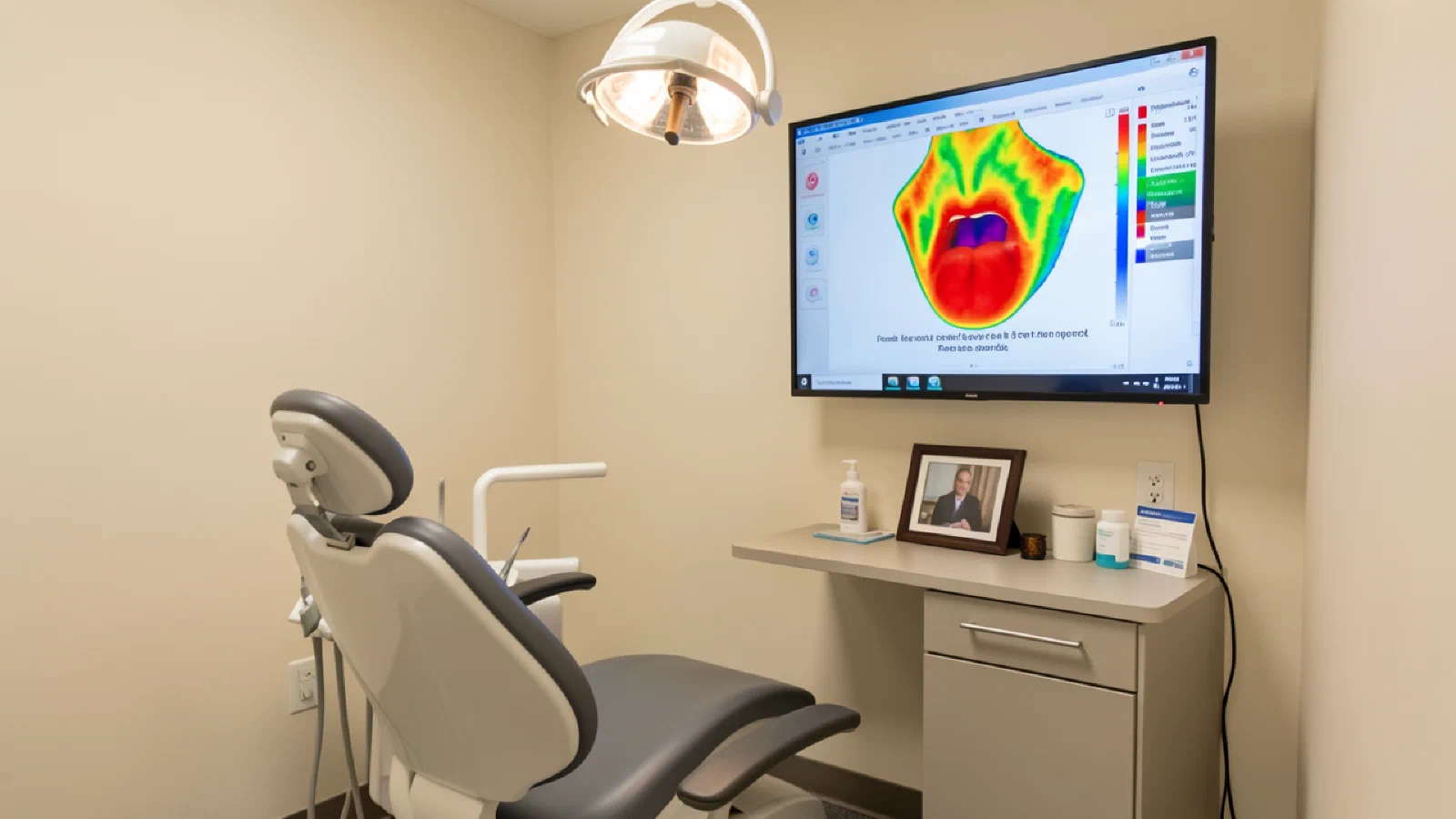
Margaret is in the chair. The screen has been talking about her mouth for forty-five seconds before Dr. Patel walks in: six months of data from Margaret’s smart toothbrush, aggregated and analyzed, displayed as a color-coded map. Brushing duration by quadrant. Pressure patterns. Areas of consistent under-coverage, the upper left molars, the lingual surfaces of the lower front teeth, the same spots the hygienist has been noting in Margaret’s chart for years. Below the brushing data, the AI’s analysis of her panoramic X-ray, taken three minutes ago by a machine that required her to stand still and bite down on a tab. Three flagged items. Confidence scores attached to each.
Dr. Patel reviews the screen in about thirty seconds. “The system caught something early on that lower molar,” she says. “We have options. Let’s talk about them.”
Margaret remembers when the dentist squinted at an X-ray clipped to a light box and said hmm. She is not sure which version she trusts more. She is not entirely sure which version she prefers, and she finds it strange that she has a preference at all.
The Most Common Medical Relationship#
Dentistry is the medical profession most people actually encounter on a regular basis. More people see a dentist twice a year than see their primary care physician. The dental visit is the most routine, most predictable, and most universal medical interaction in the developed world, which makes it the most revealing test case for what happens when AI transforms the relationship between patient and practitioner.
The Diagnosticians examined that transformation through high-stakes clinical complexity: chronic disease management, cardiac imaging, ambiguous radiology findings. Scenarios where the interplay between AI precision and clinical judgment was genuinely hard.
Dentistry is not that. Most dental care is routine. Most visits produce no surprises. The cleaning, the exam, the X-rays, the everything-looks-good-see-you-in-six-months. This is the bread and butter of the profession, and it is precisely the kind of predictable, pattern-based work that AI transforms most completely.
Dentistry is where the transformation reaches the most people, in the most ordinary setting, with the least drama and the most consequence for how millions of people experience AI-mediated care.
Reading the Mouth#
AI reads dental X-rays with accuracy that matches or exceeds experienced clinicians in detecting caries, fractures, and periodontal bone loss. The systems are in clinical use now. They analyze images in seconds, flag anomalies with confidence scores, and present findings in a format that allows the dentist to review rather than discover.
The implications track closely with what happened in radiology, but with a twist. In radiology, AI reads images that the radiologist would have read: the professional role shifts, but it remains centered on image interpretation. In dentistry, image reading is one part of a much larger job that includes the physical exam, the treatment planning, the hands-in-mouth work of drilling and filling and restoring. The diagnostic layer is a smaller proportion of the dentist’s total professional identity. Losing it is less existentially threatening.
What changes is the character of the encounter.
When AI has already analyzed the images before the patient sits down, the dentist’s first move is no longer let me take a look and see what’s going on. It is the system has identified these findings; let me explain them and discuss options. The dentist shifts from discoverer to interpreter. From detective to translator. The clinical eye that could spot a shadow on a film, the one that took years to develop and that separated the good diagnostician from the adequate one, is no longer the rate-limiting factor in dental care.
Dr. Patel spent her first five years developing that eye. Thousands of images, her professor standing silent behind her, until she could see what she needed to see. Her associate graduated two years ago. He reviews the AI’s findings, confirms or questions them based on the clinical exam, and moves to treatment planning. He is a good dentist. He has never read a radiograph without AI assistance, and he does not think of this as a gap.
The system that eliminates the need for a skill also eliminates the developmental path that produced it.
I am not sure this is a problem. But I am not sure it isn’t.
The Continuous Mouth#
The biannual dental visit was always an artifact of a system that could only evaluate your mouth when you showed up. Twice a year, a professional looked at your teeth, measured pockets, rendered a verdict. Between visits, your oral health was a black box. You brushed or did not brush, flossed or did not floss, and the consequences accumulated invisibly until the next appointment revealed them.
Continuous monitoring changes this the same way continuous glucose monitoring changed diabetes management for Margaret. Connected oral health sensors, from toothbrushes that track brushing patterns to sensors embedded in dental appliances, are creating the possibility of real-time oral health assessment. Changes detected as they develop. Interventions before problems manifest.
The implication for the visit is significant. When continuous monitoring can detect early gum inflammation, track enamel changes, and flag brushing deterioration between appointments, what is the visit actually for?
The clinical answer: confirmation, treatment of identified issues, professional cleaning that home care cannot replicate, and human judgment interpreting data in the context of the whole patient. These are real. The visit does not become unnecessary. It becomes different.
The experiential answer is harder.
For many patients, the dental visit is not primarily a diagnostic event. It is a ritual of maintenance, a biannual commitment to the care of their body that structures their relationship to their own health. The cleaning feels productive. The everything looks good feels reassuring. The visit provides a psychological checkpoint that continuous monitoring, precisely because it is continuous, does not replicate. There is no arrival, no verdict, no moment of being told you can go.
Margaret does not check her toothbrush dashboard. She brushes twice a day, the way her mother taught her, and she goes to Dr. Patel twice a year because that is what responsible people do. The data accumulates regardless of whether she looks at it. The AI analyzes it regardless of whether she understands it. The system works whether or not Margaret participates in her own monitoring as an informed consumer of her oral health data.
The system generates information. The information generates obligations. The obligations generate administrative burden. And Margaret, at the center of it all, just wants to know whether her teeth are okay.
Where Access Was Always the Real Question#
There are places in the world where questions about the character of the dental encounter, whether it feels more like being scanned than being examined, are an absurd luxury. There are places where the question is not what kind of dentistry but any dentistry at all.
Dental care is among the most inequitably distributed forms of healthcare on Earth. In sub-Saharan Africa, there is approximately one dentist per 150,000 people. In parts of rural India, the ratio is worse. Untreated dental disease causes chronic pain, nutritional impairment, systemic infection, and social stigma that compounds across a lifetime.
AI-assisted dental screening via smartphone imaging could bring basic diagnostic capability to populations that have never had it. The technology exists. An AI model trained on dental images can identify caries, assess gum health, and flag conditions requiring intervention from a photograph taken with a standard phone camera. The accuracy is not as high as a clinical X-ray analysis. It is vastly better than no screening at all, which is the current baseline for billions of people.
There are not enough dentists to serve the world’s population through the traditional model, and training enough through that model would take decades. AI does not replace the dentist. It extends dental awareness to populations that were never going to be reached. The community health worker with a smartphone and a screening app cannot perform a root canal. She can identify the child whose tooth infection is becoming dangerous and route that child to care before the infection becomes life-threatening.
The comparison that matters is not between AI-assisted screening and Dr. Patel’s clinical exam. It is between AI-assisted screening and nothing.
The Feeling of Being Looked At#
Dentistry involves a particular intimacy. Someone’s hands are in your mouth. Your face is inches from theirs. You are reclined, unable to speak. The relationship requires a specific kind of trust: not the trust you place in a surgeon whose work you will never see, but the trust you place in someone working inside your body while you are awake.
This intimacy resists virtualization in ways that other medical encounters do not. Telehealth works for a conversation with your endocrinologist. It does not work for a cleaning. The physical dimension of dental care is irreducible. AI can diagnose remotely. It cannot treat remotely. The dentist’s hands remain essential even as the diagnostic periphery is automated.
But the intimacy is changing character.
When Dr. Patel examines Margaret now, she is not discovering Margaret’s oral health through her own senses and training. She is confirming what the AI has already reported. The exam becomes a verification step rather than an investigation. The human touch remains. The human discovery is diminished.
Margaret notices this, though she could not articulate it. Something is different about the visit when the screen has already told everyone what the visit will find. The suspense is gone. The hmm, the moment of professional uncertainty that paradoxically made Margaret feel her individual mouth was being individually assessed, has been replaced by a readout that feels complete and impersonal.
She does not miss the anxiety of waiting for the dentist to find something wrong. She does, a little, miss the feeling of being looked at rather than scanned.
I think this distinction matters more than the outcomes data suggests. The experience of being examined by someone using their own judgment, someone who might notice something the system missed or see something the confidence scores cannot capture, does something for the patient that the data cannot replicate. Whether it does something for the oral health outcomes is a different question. Those outcomes are measurably better. The experience of being known rather than monitored is harder to measure, and the difficulty of measuring it does not mean it isn’t real.
What the Dashboard Cannot Know#
Dentistry, like every profession in this arc, was always two things bundled together.
It was a healthcare service: the prevention, diagnosis, and treatment of oral disease. This function continues and improves. AI makes it more accurate, more predictive, more accessible. The healthcare service gets better.
It was also a relationship. The practitioner who knows your mouth, who remembers that you grind your teeth when you are under stress, who notices you have not been flossing even when you claim you have, who asks about your grandchildren while the suction tube hums. This relationship was not incidental to the care. For many patients, it was the mechanism through which care happened. Margaret takes care of her teeth because Dr. Patel will notice if she does not. The accountability was personal.
The transformation preserves the relationship in form while changing it in substance. Dr. Patel still sees Margaret twice a year. She still asks about the grandchildren. But the center of gravity has shifted from the human encounter to the data encounter. The visit confirms what the system already knows. The relationship becomes the frame around the data rather than the source of the knowledge.
Whether this matters depends on what you think the dental visit is for.
If it is for oral health outcomes, the transformation is positive. If it is for the experience of being cared for by someone who is learning about you rather than confirming what they already know, the transformation introduces something the outcomes data does not capture.
Dr. Patel still has the photograph on her desk. First cavity, June 2009, her professor’s silence behind her. She keeps it because it reminds her of what she learned to do, and because she is not entirely sure her associates will have anything equivalent to frame.
Margaret will keep going to Dr. Patel. She will keep not checking her toothbrush dashboard. She will keep brushing the way her mother taught her. And the system will keep watching, keep analyzing, keep flagging, whether Margaret participates in her own monitoring or not.
The mouth has a dashboard now. It works. Margaret is healthier for it.
She does not love it. She does not need to.
This is the eleventh essay in The Transformed and the fourth in Arc 2, “The Quiet Revolution.” Dentistry brings the transformation examined in The Diagnosticians to its most common, most universal form. Where that essay explored AI’s impact on complex clinical judgment, this essay examines what happens when the transformation reaches the medical relationship most people actually have. Margaret returns here as the patient who experiences the shift from being looked at to being scanned. Future essays will examine the clergy, veterinarians, and the hidden infrastructure thread connecting all six professions.
References#
Dental Technology and AI
Hwang, Jae-Joon, et al. “An Overview of Deep Learning in the Field of Dentistry.” Imaging Science in Dentistry, vol. 49, no. 1, 2019, pp. 1-7.
Schwendicke, Falk, et al. “Artificial Intelligence in Dentistry: Chances and Challenges.” Journal of Dental Research, vol. 99, no. 7, 2020, pp. 769-774.
Oral Health Equity
Peres, Marco A., et al. “Oral Diseases: A Global Public Health Challenge.” The Lancet, vol. 394, no. 10194, 2019, pp. 249-260.
World Health Organization. Global Oral Health Status Report: Towards Universal Health Coverage for Oral Health by 2030. WHO, 2022.
Patient Experience and the Clinical Encounter
Armfield, Jason M. “How Do We Measure Dental Fear and What Are We Measuring Anyway?” Oral Health and Preventive Dentistry, vol. 8, no. 2, 2010, pp. 107-115.
Topol, Eric. Deep Medicine: How Artificial Intelligence Can Make Healthcare Human Again. Basic Books, 2019.
How this essay connects to others across The Approximate Mind.
- Hwang, Jae-Joon, et al. “An Overview of Deep Learning in the Field of Dentistry.” Imaging Science in Dentistry, vol. 49, no. 1, 2019, pp. 1-7.
- Schwendicke, Falk, et al. “Artificial Intelligence in Dentistry: Chances and Challenges.” Journal of Dental Research, vol. 99, no. 7, 2020, pp. 769-774.
- Peres, Marco A., et al. “Oral Diseases: A Global Public Health Challenge.” The Lancet, vol. 394, no. 10194, 2019, pp. 249-260.
- World Health Organization. Global Oral Health Status Report: Towards Universal Health Coverage for Oral Health by 2030. WHO, 2022.
- Armfield, Jason M. “How Do We Measure Dental Fear and What Are We Measuring Anyway?” Oral Health and Preventive Dentistry, vol. 8, no. 2, 2010, pp. 107-115.
- Topol, Eric. Deep Medicine: How Artificial Intelligence Can Make Healthcare Human Again. Basic Books, 2019.