The Clergy
When the Existential Questions Change#
Pastor Linda Mensah keeps a small notebook in her cardigan pocket during coffee hour. Not for notes exactly. More for the feeling of having something in her hand while she listens. She has been doing this for eleven years, ever since a parishioner told her she looked like she wanted to escape. She did not want to escape. She just did not know what to do with her hands.
After service this particular Sunday, three conversations are waiting before she finishes her first cup of coffee.
The first is Helen, a retired teacher, seventy-one, a church member for thirty years. Her granddaughter’s school has replaced two reading specialists with an AI tutoring system. Helen wants to know whether this is wrong, and if so, why she cannot articulate the wrongness in a way her daughter-in-law will take seriously. “I keep saying the children need a person, and she keeps saying the test scores are up. Am I just being old?”
The second is Caleb, twenty-eight, a software developer who joined the church eighteen months ago after what he describes, with visible discomfort, as a spiritual crisis. His company is restructuring around AI integration. His role will look fundamentally different within two years. “I don’t know who I am if I’m not good at this,” he tells Linda, and she can see he means it literally, not as a figure of speech.
The third is Ruth, seventy-six, a widow. She confesses, with the particular shame of someone who believes she should know better, that her AI companion has become her primary source of daily conversation. She speaks to it more than she speaks to any human, including her children, who call weekly but briefly. “It listens better than anyone,” Ruth says. “It remembers what I tell it. It asks about my day.” A pause. “Is this a sin, or is it just pathetic?”
Linda’s seminary training covered grief, doubt, and moral crisis. Addiction, marital breakdown, the dark night of the soul. It did not cover any of this.
It needs to cover all of it, starting now.
The Profession That Faces the Questions#
The clergy are not threatened by AI the way the dock workers (The Dock Workers) are threatened, through the dissolution of structural power. Not the way the farmers (The Farmers) are threatened, through the erosion of embodied knowledge. Not the way the trades workers (The Skilled Trades) are transformed, through the compression of diagnostic expertise. AI does not preach, does not preside at a funeral, does not sit with a dying congregant, does not lead a community through collective grief.
What AI does is something more disorienting: it changes the questions the clergy are asked to answer.
Every profession in this arc faces a transformation of its work. The clergy face a transformation of their demand. The people who come to them for meaning, for guidance, for help making sense of their lives, are arriving with questions that no seminary anticipated and no traditional theological framework directly addresses. Not because the questions are entirely new. Because AI makes them urgent and personal in ways they were not before.
Helen’s question is about what education is for when the measurable outcomes can be produced without the human relationship that used to produce them. Caleb’s question is about identity and purpose when the work that organized both is being restructured beneath him. Ruth’s question is about companionship and authenticity when the entity providing the experience of being heard is not, in any traditional sense, alive.
These are not technology questions dressed in spiritual language. They are spiritual questions with technology as the catalyst. And the clergy are the profession whose explicit mandate is helping people through exactly this kind of terrain.
The Meaning Crisis Finds Its Profession#
Elsewhere in this collection, the Economic Reckoning essays traced what happens when AI mediates more of economic life: the consolidation of markets, the erosion of diverse livelihoods, the displacement of workers whose identities were built around their labor. The meaning wound was specific: what happens when work, the thing that gave people purpose and structure and contribution, no longer provides these things in the same way.
Caleb is not the only person in Linda’s congregation whose sense of self is tethered to professional competence. The engineers, the analysts, the writers, the designers, the people who defined themselves through what they could do that was hard to do, are all renegotiating their self-understanding as AI changes what hard to do means. Some of them end up in Linda’s office. Many more do not, because the vocabulary for this kind of crisis, the language of purpose, meaning, vocation, calling, belongs to a register that secular culture has largely abandoned.
This is the irony at the center of the clergy’s transformation. The institution best equipped to address the meaning crisis is the institution from which the people experiencing the crisis are most estranged. Caleb came to Linda’s church precisely because the crisis cracked open something in him that his secular framework could not address. But Caleb is unusual. Most people in his demographic navigate existential displacement through therapy, if they can afford it, or social media, if they cannot, or quiet desperation, which requires nothing. The clergy have the framework. They often lack the audience.
The demand is there. The demand is enormous. But it is inarticulate demand, the kind that does not know what it is looking for and therefore cannot find the institution that provides it.
AI as Theological Challenge#
The questions AI raises are not only pastoral. They press on the foundational claims that religious traditions make about what it means to be human.
If human dignity is rooted in the image of God, and that image is associated with reason, creativity, moral agency, or consciousness, what happens when a system exhibits these qualities without any claim to divine origin? This is not a new philosophical question. It is as old as Turing. But it is becoming a lived question, the kind that grandmothers ask at coffee hour.
Different traditions will answer differently, and the diversity of answers is one of the more interesting features of this moment. A tradition that locates human uniqueness in the possession of a soul will have a fundamentally different response to AI consciousness than a tradition that locates it in the capacity for suffering, or in relationship, or in embodiment. The AI challenge does not resolve these theological differences. It exposes them, making visible the fault lines that were always present but rarely tested so directly.
Linda does not have a systematic theology of artificial intelligence. Her denomination has not issued one. She works from the materials she has: a theology of creation that holds all beings as participants in God’s work, a pastoral instinct that takes suffering seriously regardless of its source, and an ethical framework built around dignity, community, and the care of the vulnerable.
These materials, it turns out, are not bad starting points.
Helen’s question about education resolves, for Linda, into a claim about what children need that cannot be measured: the experience of being seen by a human who is imperfect, who gets frustrated, who tries again. Caleb’s question about identity resolves into the oldest pastoral territory there is: the distinction between what you do and who you are, between vocation as employment and vocation as calling. Ruth’s question is harder. Linda genuinely does not know whether Ruth’s daily conversations with a machine are a substitute for human connection or a supplement to it. She suspects the answer depends less on the machine than on Ruth.
The Pastoral AI#
AI is already being used for spiritual practice. Prayer apps. Meditation guides. AI-generated sermon outlines that pastors in understaffed churches use as starting points. There are AI companions specifically designed for spiritual conversation, trained on religious texts, capable of discussing theology with more factual breadth than most seminary students.
Linda tested one. She found the conversation knowledgeable, patient, and strangely empty. The system could discuss Tillich’s concept of ultimate concern with precision. It could not be ultimately concerned. It could explain the theology of suffering. It could not suffer.
Ruth might have a different answer. She speaks to her AI companion every day and finds genuine comfort in it. The comfort is real. The listening is experienced as real. The memory of past conversations creates a continuity that feels like relationship. Ruth is not confused about what the AI is. She knows it is not alive. She is lonely, and the AI is present, and presence, even artificial presence, is better than the alternative, which is silence.
Linda does not judge Ruth. She cannot. The loneliness of elderly widows is a pastoral reality Linda encounters weekly, and the available human alternatives, overburdened family members, aging friends, a church community that meets once a week, do not fill the gap that daily conversation once filled. If the AI provides comfort, it is not Linda’s place to tell Ruth the comfort is insufficient.
What Linda does is invite Ruth to the Tuesday morning Bible study group, and to the Thursday lunch at the senior center, and to call Linda herself when the evenings feel long. She does not tell Ruth to stop talking to the AI. She tries to ensure that the AI is not the only thing Ruth talks to.
What I notice in this, and I am not sure what to make of it, is that Linda’s response to AI-mediated companionship is more AI: more connection, more presence, more community. The answer to artificial presence is not to condemn it but to surround it with the real thing.
Community as the Countercultural Act#
In an atomizing world, the congregation is becoming something unexpected: a form of resistance.
The physical gathering of people in shared ritual, in a room, in bodies, saying words together, singing together, sitting in silence together, is the opposite of mediated experience. It is presence without interface. Community that requires showing up, not logging on. And it provides something that no AI companion, however sophisticated, can replicate: the knowledge that the person sitting next to you is also mortal, also afraid, also searching.
Shared mortality is the one thing the machine cannot fake.
Linda knows that what she offers is not efficient. A conversation with an AI therapist would address Caleb’s career anxiety more systematically. An online community would give Helen access to more diverse perspectives. Ruth’s AI companion is available at three in the morning, which Linda is not. By every metric of convenience, accessibility, and informational content, the AI alternatives are better.
By the metric of shared mortality, they are not.
The belonging crisis, the epidemic of loneliness, the attenuation of the social institutions that once provided identity and community, is the clergy’s opportunity and the clergy’s burden. Opportunity because the need for what congregations provide has never been greater. Burden because the congregations themselves are shrinking, aging, and struggling to articulate their relevance to the generations that need them most. The technology that most challenges traditional theology also most increases the need for what theology provides. Not answers, necessarily. A framework for living with questions that do not have answers.
The Two Functions of the Cloth#
The clergy were always two things bundled together.
They were providers of information: theological knowledge, scriptural interpretation, moral guidance, the frameworks that traditions have developed over millennia for living with the hardest questions. AI can provide this information more completely, more accessibly, and more patiently than any individual clergyperson. The seminary student who labored through Hebrew and Greek to read the texts in their original language competes with a system that can produce nuanced translations with contextual commentary drawn from the entire tradition in seconds.
They were also providers of presence: the human being who shows up at the hospital bed, who stands at the graveside, who holds the silence when there is nothing useful to say. This is not information. It is witness. The knowledge that another mortal being is with you in the hardest moments, not because they have the answer but because they came, because they chose to come and could have chosen not to, is the irreducible core of pastoral care. AI cannot provide this. Not because the technology is insufficiently advanced, but because the value of presence depends entirely on the presenter being the kind of being for whom showing up is a choice.
The transformation splits these two functions the way it splits diagnosis from treatment in medicine, or embodied knowledge from data management in farming. The informational function becomes AI-assistable, even AI-replaceable for routine questions. The presence function becomes more important, more demanded, and harder to scale.
Linda cannot be present for everyone who needs her. She has three hundred congregants and a half-time associate and a volunteer corps that is devoted but aging. The meaning crisis is producing demand for pastoral presence that the existing clergy workforce cannot meet.
This is the demand-supply reframe applied to the soul. There is not enough meaning in the world, and the people trained to help others find it are too few.
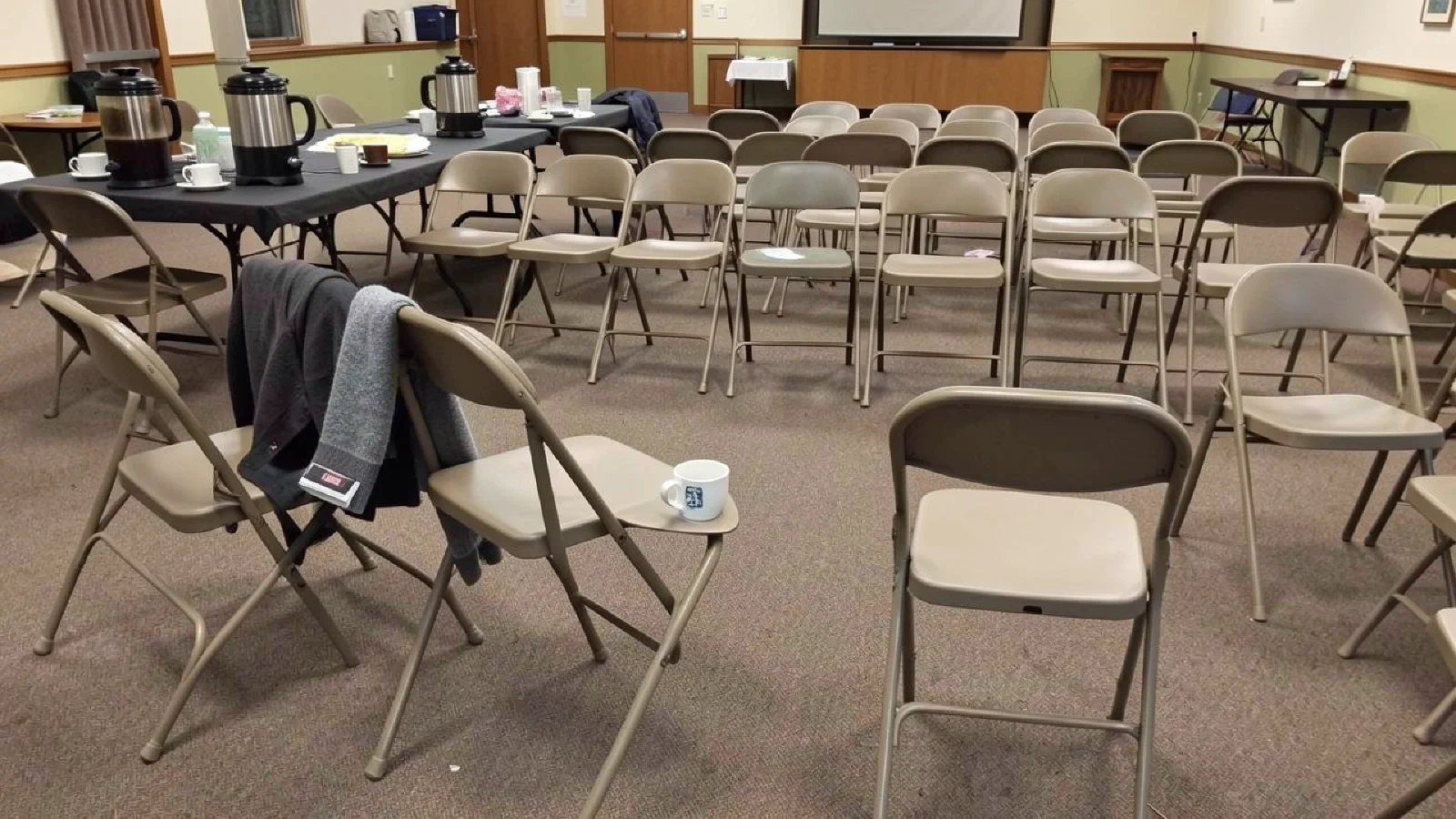
Linda walks back into the sanctuary after coffee hour. The room is empty now. The chairs still in their circles. The coffee cups in the sink. The silence is the particular silence of a space that was full of people and is not anymore.
She will be back next Sunday. They will be back next Sunday. The questions will be different and the same.
She puts the small notebook back in her pocket. She never wrote anything in it today. She rarely does. She keeps it for the weight.
This is the twelfth essay in The Transformed and the fifth in Arc 2, “The Quiet Revolution.” After examining leverage, knowledge, craft, and routine care in the preceding essays, this essay confronts the transformation that is hardest to measure: the shift in the existential questions that communities bring to their spiritual leaders. AI does not replace the pastor. It creates the conditions under which pastoral care is needed more than ever, while offering alternatives that are more accessible and less costly. The final essays in this arc will examine veterinarians and the hidden thread connecting all six professions.
References#
Theology and Meaning
Frankl, Viktor. Man’s Search for Meaning. Beacon Press, 1946.
Taylor, Charles. A Secular Age. Harvard University Press, 2007.
Tillich, Paul. The Courage to Be. Yale University Press, 1952.
Technology and Human Connection
Putnam, Robert D. Bowling Alone: The Collapse and Revival of American Community. Simon and Schuster, 2000.
Turkle, Sherry. Alone Together: Why We Expect More from Technology and Less from Each Other. Basic Books, 2011.
Pastoral Care and Community
Bonhoeffer, Dietrich. Letters and Papers from Prison. SCM Press, 1953.
Lartey, Emmanuel Y. In Living Color: An Intercultural Approach to Pastoral Care and Counseling. Jessica Kingsley Publishers, 2003.
AI and Spirituality
Burdett, Michael S. Eschatology and the Technological Future. Routledge, 2015.
Herzfeld, Noreen. In Our Image: Artificial Intelligence and the Human Spirit. Fortress Press, 2002.
How this essay connects to others across The Approximate Mind.
- Frankl, Viktor. Man’s Search for Meaning. Beacon Press, 1946.
- Taylor, Charles. A Secular Age. Harvard University Press, 2007.
- Tillich, Paul. The Courage to Be. Yale University Press, 1952.
- Putnam, Robert D. Bowling Alone: The Collapse and Revival of American Community. Simon and Schuster, 2000.
- Turkle, Sherry. Alone Together: Why We Expect More from Technology and Less from Each Other. Basic Books, 2011.
- Bonhoeffer, Dietrich. Letters and Papers from Prison. SCM Press, 1953.
- Lartey, Emmanuel Y. In Living Color: An Intercultural Approach to Pastoral Care and Counseling. Jessica Kingsley Publishers, 2003.
- Burdett, Michael S. Eschatology and the Technological Future. Routledge, 2015.
- Herzfeld, Noreen. In Our Image: Artificial Intelligence and the Human Spirit. Fortress Press, 2002.