The Unbounded
What Replaces the Career When the Career Dissolves#
“So what are you going to do?”
The uncle means it kindly. He has asked this question at family gatherings for thirty years, and the question has always had a grammar that both parties understood. “What are you going to do” means “what profession will you enter.” The expected answers are noun phrases: doctor, lawyer, engineer, teacher. The uncle, who worked in supply chain management for twenty-six years before his role was reorganized by AI logistics systems into something he no longer recognizes, has the particular tenderness of someone asking a question whose premises have collapsed in his own life but which he does not know how to stop asking.
Amara is nineteen. She considers the question the way you consider a sentence in a language you almost speak.
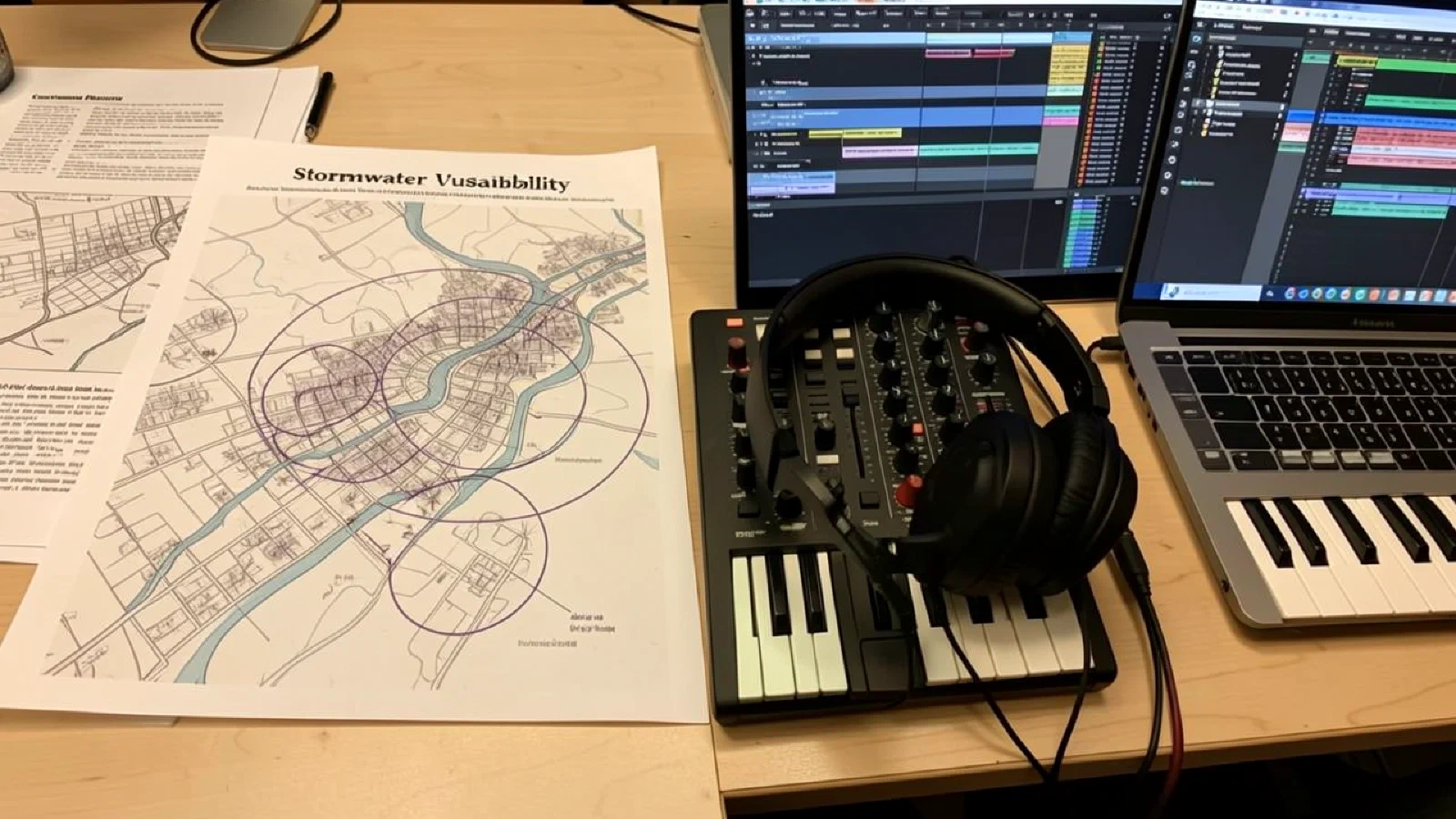
She has spent the past year doing several things, none of which she would call a career. She worked on a stormwater management project, using AI-driven models to identify neighborhoods vulnerable to flooding, collaborating with engineers and community organizers, contributing analysis that would have required a master’s degree a decade ago. She produced it in weeks, working with AI that handled the technical modeling while she provided the judgment about which neighborhoods mattered, which data was being used to obscure rather than illuminate, which solutions the community would actually trust.
She also made music. Not as a hobby. Work that has a small but committed audience, built through a process that blurred the line between her voice and the AI’s contribution. She does not think of the music as separate from the stormwater work. Both use her judgment. Both are her life.
She also ran a weekly community gathering at a neighborhood center, because she noticed that the older residents were lonely and the younger ones were disconnected. The gathering is small, unfunded, uncredentialed. It may be the most important thing she does.
The uncle asks “what are you going to do” and Amara does not know how to answer, because the question assumes a sorting she does not perform. She is not going to do one thing. She has no career plan because the concept of a career does not describe anything she recognizes as available or desirable.
“I’m figuring it out,” she says, because it is the shortest true answer. The uncle nods and changes the subject, and neither of them says what they are both thinking: that “figuring it out” used to be a phase you passed through on the way to an answer, and for Amara it might be the answer itself.
The Script#
For roughly a century and a half, professional identity provided the organizing structure of adult life. You trained for a profession. You entered it. You advanced within it. You retired from it. Your profession told you and everyone else who you were. “I am a doctor” was not a job description. It was an identity, a social position, a community, and a story about what kind of life you would live.
AI did not break this script alone. It was already under pressure. But AI accelerated the break, and for N1, the break is not something that happened to them. It is the condition they inherited. They watched their parents’ professions dissolve during their formative years. They heard the dinner table arguments. They saw the anxiety. And they absorbed, without anyone telling them directly, the lesson that the professional script was no longer reliable.
The result is a generation that arrives at adulthood without the narrative structure that told every previous generation what a life was supposed to look like.
Three Patterns#
Three patterns are emerging, and it is too early to know which ones hold.
The first is exploration. Amara is an explorer. She moves between domains, using AI to rapidly acquire knowledge that would have required years of training, contributing genuine value through judgment and integration, then moving to the next thing when curiosity pulls her. AI collapsed the cost of domain entry. Previous generations paid for exploration in years. Each domain had a wall of prerequisite knowledge. Exploration meant a lifetime of climbing walls. AI lowered the walls. Not by eliminating the knowledge but by making it accessible without the traditional investment of time.
Amara’s stormwater analysis is genuinely good. Engineers confirm this. Her music is genuinely distinctive. Her community work is genuinely valued. She is not performing competence. She is exercising it across domains where previous generations would have needed separate professional identities.
Whether exploration produces the depth that sustained immersion in a single domain produces, whether judgment across domains substitutes for judgment within a domain, we do not yet know. The experiment is running.
The second pattern is drift. Drift looks like exploration from the outside. The drifter also moves between domains, also declines to commit. The difference is internal: the explorer is pulled by curiosity toward the next thing. The drifter is pushed by restlessness away from the current thing. The outputs can look identical. The experience is entirely different.
I do not think drift is laziness or a failure of character. I think it is what happens when a person with normal needs for direction and purpose is placed in an environment that provides neither through external structure, and has not developed sufficient internal structure to provide them for themselves.
The career ladder was rigid and it was orienting. You knew where you were. You knew what “up” meant. N1 drifters have no ladder. They have possibility, which is not the same as direction. They have comfort, because AI-augmented productivity has reduced the economic pressure that forced previous generations into commitments. A drifting N1 member can maintain a reasonable standard of living through intermittent work without ever committing to anything long enough to discover whether commitment would have transformed them.
Comfort without purpose is the novel condition. Previous generations drifted in poverty, which at least provided urgency. The comfortable drifter has no urgency. Nothing forces a decision. And in the absence of necessity, some N1 members discover that they have not developed the capacity to choose.
The third pattern is the project life. A project has what a career has and what drift lacks: a beginning, a middle, and an end. A team, which provides belonging. A problem, which provides direction. A product, which provides completion. Then it ends, and the next project begins.
The project life is exhilarating for people who thrive on novelty. It is also structurally precarious. Each project provides meaning while it lasts. When it ends, the team disperses, the relationships attenuate, the institutional connection dissolves. There is no accumulation. No seniority. No community of colleagues who remember you at twenty-five and celebrate you at sixty. The project life is all peak and no plateau, and the plateau, tedious as it was, is where much of life’s relational depth was built.
The Line Through All Three#
There is a class line running through every pattern, and I think it is the thing that matters most.
The explorer pattern requires resources, formation, and social capital. You need economic security to choose projects by interest. You need the educational formation that builds self-direction. You need the social network that connects you to opportunities. Amara has these. Not because she is wealthy but because her formation equipped her to navigate an unstructured world.
N1 members without these advantages face a different unboundedness. The career ladder was rigid and hierarchical, and it was also the primary mechanism for class mobility. You did not need social capital to climb it. You needed to show up, do the work, and advance through a system that, for all its flaws, had visible rungs and a legible path upward.
The career ladder was constraining and it was democratic. The project life is liberating and it is aristocratic. The N1 members who can navigate unboundedness are overwhelmingly the ones whose formation equipped them for self-direction. The ones who cannot are overwhelmingly the ones whose formation did not.
The old system was unfair. The new system may be more unfair, because the old system’s unfairness was visible. A profession had gatekeepers. Gatekeepers could be challenged, regulated, held accountable. The unbounded world has no gatekeepers. It has gravity: the invisible pull of formation and social capital that draws some N1 members toward exploration and others toward drift, with no gate to storm and no one to hold accountable for the sorting.
The Grandmother#
The uncle has moved on. Amara sits with her grandmother, who is eighty-one and worked as a bookkeeper for forty-three years at the same firm. The grandmother does not ask what Amara is going to do. She asks what she did today.
Amara tells her about the stormwater project. About a neighborhood where the flooding models revealed a vulnerability the city’s engineers had missed. About the community meeting where residents who had been ignored for years heard someone with data confirming what they already knew from experience.
The grandmother listens. She does not fully understand the technology. She understands the feeling. She spent forty-three years making sure the numbers were right, knowing that behind every number was a person who depended on the accuracy.
“That sounds like good work,” she says.
Amara notices the word. The grandmother did not say “good career” or “good plan” or “something that will lead somewhere.” She said “good work.” The word contains everything: effort, purpose, contribution, care. It does not require a professional label. It does not require a trajectory.
It requires only that you did something that mattered, today, with attention and integrity.
Amara does not know what she is going to do with her life. She knows what she did today. For the first time she wonders whether that distinction, which her generation lives inside and her uncle’s generation cannot comprehend, might be not a failure of direction but a different understanding of what direction means.
Not a path. Not a ladder. A practice of attention, applied to whatever the world puts in front of you, for as long as it matters.
Whether this is enough to build a life on, N1 is about to find out.
This is the fourth essay in Arc 5 of The Transformed, “The Natives.” Previous essays established who N1 is, how they were educated, and how they formed with AI companions. This essay examines what happens when they arrive at adulthood without the professional identity structure that organized every prior generation’s life narrative. The Transformed builds on The New Work, The Empty Ledger, and The Invisible Tiers.
References#
Hughes, Everett C. Men and Their Work. Free Press, 1958.
Abbott, Andrew. The System of Professions: An Essay on the Division of Expert Labor. University of Chicago Press, 1988.
Sennett, Richard. The Corrosion of Character: The Personal Consequences of Work in the New Capitalism. W.W. Norton, 1998.
Frankl, Viktor E. Man’s Search for Meaning. Beacon Press, 1946.
Crawford, Matthew B. Shop Class as Soulcraft: An Inquiry into the Value of Work. Penguin, 2009.
Arendt, Hannah. The Human Condition. University of Chicago Press, 1958.
Sandel, Michael J. The Tyranny of Merit: What’s Become of the Common Good? Farrar, Straus and Giroux, 2020.
Standing, Guy. The Precariat: The New Dangerous Class. Bloomsbury Academic, 2011.
Deci, Edward L., and Richard M. Ryan. Intrinsic Motivation and Self-Determination in Human Behavior. Plenum Press, 1985.
Csikszentmihalyi, Mihaly. Finding Flow: The Psychology of Engagement with Everyday Life. Basic Books, 1997.
Bourdieu, Pierre. Distinction: A Social Critique of the Judgement of Taste. Translated by Richard Nice, Harvard University Press, 1984.
Putnam, Robert D. Our Kids: The American Dream in Crisis. Simon and Schuster, 2015.
How this essay connects to others across The Approximate Mind.
- Hughes, Everett C. Men and Their Work. Free Press, 1958.
- Abbott, Andrew. The System of Professions: An Essay on the Division of Expert Labor. University of Chicago Press, 1988.
- Sennett, Richard. The Corrosion of Character: The Personal Consequences of Work in the New Capitalism. W.W. Norton, 1998.
- Frankl, Viktor E. Man’s Search for Meaning. Beacon Press, 1946.
- Crawford, Matthew B. Shop Class as Soulcraft: An Inquiry into the Value of Work. Penguin, 2009.
- Arendt, Hannah. The Human Condition. University of Chicago Press, 1958.
- Sandel, Michael J. The Tyranny of Merit: What’s Become of the Common Good? Farrar, Straus and Giroux, 2020.
- Standing, Guy. The Precariat: The New Dangerous Class. Bloomsbury Academic, 2011.
- Deci, Edward L., and Richard M. Ryan. Intrinsic Motivation and Self-Determination in Human Behavior. Plenum Press, 1985.
- Csikszentmihalyi, Mihaly. Finding Flow: The Psychology of Engagement with Everyday Life. Basic Books, 1997.
- Bourdieu, Pierre. Distinction: A Social Critique of the Judgement of Taste. Translated by Richard Nice, Harvard University Press, 1984.
- Putnam, Robert D. Our Kids: The American Dream in Crisis. Simon and Schuster, 2015.