The Rememberers
The Last Generation That Will Know What Was Lost#
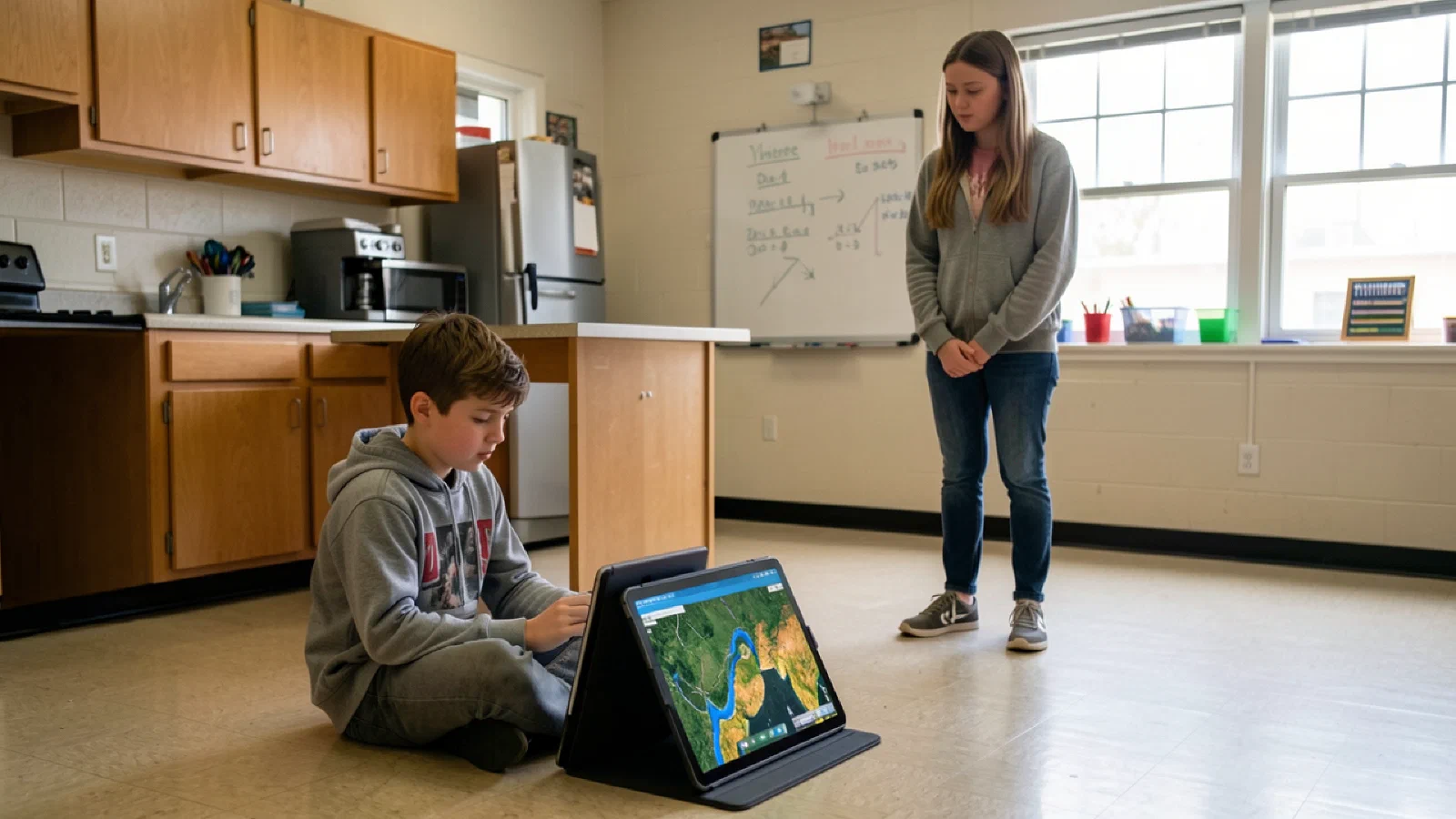
Noor is sixteen and she is trying to explain worksheets.
Her brother Kai is ten. He is doing homework, which for him means a conversation with his learning system about watersheds, the AI adapting in real time to his questions, pulling up satellite imagery when he asks about erosion. He has never known any other way to learn.
Noor is watching him and feeling something she cannot name.
She remembers, dimly, sitting in a classroom where a teacher stood at the front and talked. She remembers everyone getting the same worksheet, the same twenty problems, regardless of whether you already understood the concept or had never encountered it. She remembers a boy named Devin who always finished first and drew comics in the margins. She remembers a girl who cried once because she could not understand fractions and the teacher had already moved on.
She tried to describe this to Kai last week. He stared at her. Why would everyone do the same problems? Why would the teacher keep talking if someone was crying?
Noor did not have good answers. She just remembered that it happened.
The Seam#
The children born roughly between 2012 and 2016 did not grow up using AI the way their parents grew up using the internet. They grew up inside it. The distinction matters the way the difference between learning to swim and growing up near the ocean matters. The adult swimmer may become excellent. But the ocean child has salt in their developmental architecture. It is not a skill they acquired. It is a condition they formed inside.
AI was not a tool N1 adopted. It was ambient. Present before they had a framework for what its absence would feel like, shaping how they think, how they relate, what they expect from knowledge and effort and other people, the way any pervasive environmental condition shapes development.
I call them N1. N for native, not in the shallow sense of interface comfort but in the deep sense of environmental formation. 1 for first: the first generation of AI-environment natives, with the acknowledgment that N2 is already here. Kai is N2. For him, the world as it exists is simply the world. He does not experience AI-mediated learning as AI-mediated. He experiences it as learning. The constructedness of his environment is invisible because he has no contrast point.
Noor is the seam between them.
She has just enough memory to know that things were once different, and just enough nativity to understand the new world from the inside. She cannot explain the old world with her parents’ analytical depth, and she cannot accept the new world with her brother’s uncomplicated fluency. She is stretched between two operating systems, carrying fragments of one while running on the other.
This is what bridge generations do. The generation that straddled oral and written culture could still recite from memory but also read from scrolls. The generation that grew up during electrification remembered kerosene and also wired the new house. In each case, the bridge generation translated. They carried the wisdom of the old world into the language of the new one. They were the last people who could feel, rather than merely study, what had been lost.
N1 is the last generation that will feel, even dimly, what the world was like before AI became environmental. When they are old, when the last person who remembers worksheets and phone books and the sound of a modem connecting has died, the before-times will be history, not memory. Accessible to scholars but not to anyone who lived it.
What They Almost Remember#
Here is a partial list of things that N1 members born in 2014 will vaguely remember by the time they are seventeen:
A parent’s job that existed in a form that no longer makes sense. The father who drove to an office every day to do something that now happens automatically. The dinner table tension when the job changed, slowly, then suddenly, then you realize the ground has shifted beneath you.
A teacher who was a person, not a role. A specific human being with coffee breath and bad jokes who stood at the front of a room and tried to explain long division to thirty children at once, and who went home tired in a way that was about the work itself, not about managing the systems that do the work.
A moment before the companion. A stretch of childhood, however brief, when there was no AI entity that listened, responded, adapted, remembered. When boredom was met with imagination or frustration rather than with a system designed to engage.
A library. The physical space where a person behind a desk knew your name and what you liked to read, not because an algorithm tracked your borrowing history but because she saw you every Saturday.
A phone that was a phone. Before the device in their parents’ hands became the portal through which AI managed everything.
These memories are unreliable. Seven-year-olds do not encode experience with analytical precision. Noor’s memory of the crying girl may be a composite. The library she remembers may have been smaller and dingier than her memory suggests.
It does not matter that the memories are imprecise. What matters is that they exist.
Kai will not have them. Not imprecise versions, not distorted versions. No versions. For Kai, the AI-mediated classroom is the classroom. The companion is a companion. There is no contrast, no felt sense of difference.
Children do not notice the air. They breathe it. Kai breathes AI the way his grandparents breathed the assumptions of industrial capitalism: as the invisible medium in which life occurs.
N1 is the last generation that will cough.
The Grief of Fading#
There is a specific form of grief that belongs to bridge generations. Not the grief of loss, which is sharp and nameable. The grief of fading, which is diffuse and hard to articulate.
The feeling that something important is receding and you cannot hold it. That the thing you almost remember mattered in a way you cannot explain. That the people around you do not miss it because they never had it.
N1 will carry this grief. Some will articulate it. Most will not. It will emerge as a vague unease, a nostalgia for an experience they had too briefly to fully possess. Their parents will recognize the feeling but cannot help, because the parents’ grief is different: sharper, built on full memories rather than fragments. Their younger siblings will not understand it at all.
Whether this grief produces wisdom or merely wistfulness depends on what N1 does with it.
Some will let the fragments fade. They will adopt the new world completely and join Kai in the ahistorical present where things are as they are.
Some will romanticize them. They will gild worksheets and phone calls and libraries with a nostalgic glow that obscures the fact that the old world was not uniformly good. Worksheets were often terrible pedagogy. Libraries were often underfunded. Nostalgia is not wisdom.
And some will do the harder thing. They will hold the fragments honestly, seeing both what was good and what was broken, and they will ask a question no one else can ask: what did we lose that was worth keeping, and how do we carry it forward?
That is civilizational translation. N1 did not choose the work. It was assigned by birth year. But when they are gone, the translation capacity is gone with them, and whatever was not translated is simply lost.
The First Draft#
It is easy to look at N1 and see either a problem or a marvel. They are screen-addicted and socially atrophied. They are the most empowered generation in history.
Both framings miss the point.
N1 is a generation of human beings whose formation occurred inside conditions that no prior generation experienced and no existing developmental theory fully accounts for. They carry capabilities we designed and vulnerabilities we did not intend, strengths we can measure and absences we may not detect for years. The absence of something that never formed is the most invisible kind of loss.
I think about this when I watch Noor watch Kai. She carries something he does not: the felt memory of a world organized differently. She does not know what to do with it. Nobody has told her it matters. Nobody has told her that the vague unease she feels when she watches her brother learn in a way she barely recognizes is not a symptom of her inability to adapt. It is information. It is her body telling her that something present in her early formation is absent from his, and that the absence might matter in ways nobody is measuring.
We talk endlessly about what AI does to the world. N1 is what AI does to the world, embodied in human development. They are not observers of the transformation. They are the transformation’s product, the first draft of the human being our choices about AI will produce at scale.
The draft is still being written. Noor is sixteen. Kai is ten. The older N1 members are just entering the years where the developmental architecture laid down in childhood begins to bear the weight of adult life. We do not yet know whether it will hold.
Every choice we make about AI right now, every design decision, every educational structure, every institutional adaptation, is a formation question. It shapes the environment inside which the next million Noors and Kais are becoming whoever they will become.
The children are not the future. They are the present, forming now, inside conditions we are setting now, carrying consequences we will discover later.
Noor sits on the couch watching her brother learn about watersheds. She remembers something she cannot name. She does not know yet that the thing she almost remembers might be the most important thing she carries.
None of us do.
This is the first essay in Arc 5 of The Transformed, “The Natives,” which examines Gen N1: the first generation whose cognitive and social formation occurred inside an AI-ambient environment. Previous arcs explored professionals being transformed by AI. This arc explores humans being formed by it. The Transformed builds on the philosophical foundations of The Approximate Mind, particularly My Childhood AI Buddy, The Village in the Machine, and The Parent in the Loop.
References#
Prensky, Marc. “Digital Natives, Digital Immigrants.” On the Horizon, vol. 9, no. 5, 2001, pp. 1-6.
Palfrey, John, and Urs Gasser. Born Digital: Understanding the First Generation of Digital Natives. Basic Books, 2008.
Bronfenbrenner, Urie. The Ecology of Human Development: Experiments by Nature and Design. Harvard University Press, 1979.
Vygotsky, L.S. Mind in Society: The Development of Higher Psychological Processes. Harvard University Press, 1978.
Erikson, Erik H. Identity: Youth and Crisis. W.W. Norton, 1968.
Fivush, Robyn. “The Development of Autobiographical Memory.” Annual Review of Psychology, vol. 62, 2011, pp. 559-582.
Halbwachs, Maurice. On Collective Memory. Translated by Lewis A. Coser, University of Chicago Press, 1992.
Ong, Walter J. Orality and Literacy: The Technologizing of the Word. Methuen, 1982.
Havelock, Eric A. Preface to Plato. Harvard University Press, 1963.
Turkle, Sherry. Alone Together: Why We Expect More from Technology and Less from Each Other. Basic Books, 2011.
Livingstone, Sonia, and Alicia Blum-Ross. Parenting for a Digital Future. Oxford University Press, 2020.
Postman, Neil. Technopoly: The Surrender of Culture to Technology. Vintage, 1993.
Ellul, Jacques. The Technological Society. Translated by John Wilkinson, Vintage, 1964.
How this essay connects to others across The Approximate Mind.
- Prensky, Marc. “Digital Natives, Digital Immigrants.” On the Horizon, vol. 9, no. 5, 2001, pp. 1-6.
- Palfrey, John, and Urs Gasser. Born Digital: Understanding the First Generation of Digital Natives. Basic Books, 2008.
- Bronfenbrenner, Urie. The Ecology of Human Development: Experiments by Nature and Design. Harvard University Press, 1979.
- Vygotsky, L.S. Mind in Society: The Development of Higher Psychological Processes. Harvard University Press, 1978.
- Erikson, Erik H. Identity: Youth and Crisis. W.W. Norton, 1968.
- Fivush, Robyn. “The Development of Autobiographical Memory.” Annual Review of Psychology, vol. 62, 2011, pp. 559-582.
- Halbwachs, Maurice. On Collective Memory. Translated by Lewis A. Coser, University of Chicago Press, 1992.
- Ong, Walter J. Orality and Literacy: The Technologizing of the Word. Methuen, 1982.
- Havelock, Eric A. Preface to Plato. Harvard University Press, 1963.
- Turkle, Sherry. Alone Together: Why We Expect More from Technology and Less from Each Other. Basic Books, 2011.
- Livingstone, Sonia, and Alicia Blum-Ross. Parenting for a Digital Future. Oxford University Press, 2020.
- Postman, Neil. Technopoly: The Surrender of Culture to Technology. Vintage, 1993.
- Ellul, Jacques. The Technological Society. Translated by John Wilkinson, Vintage, 1964.