The Divided
Two Childhoods, One Generation#
Same year. Same birthday, almost. April 2016.
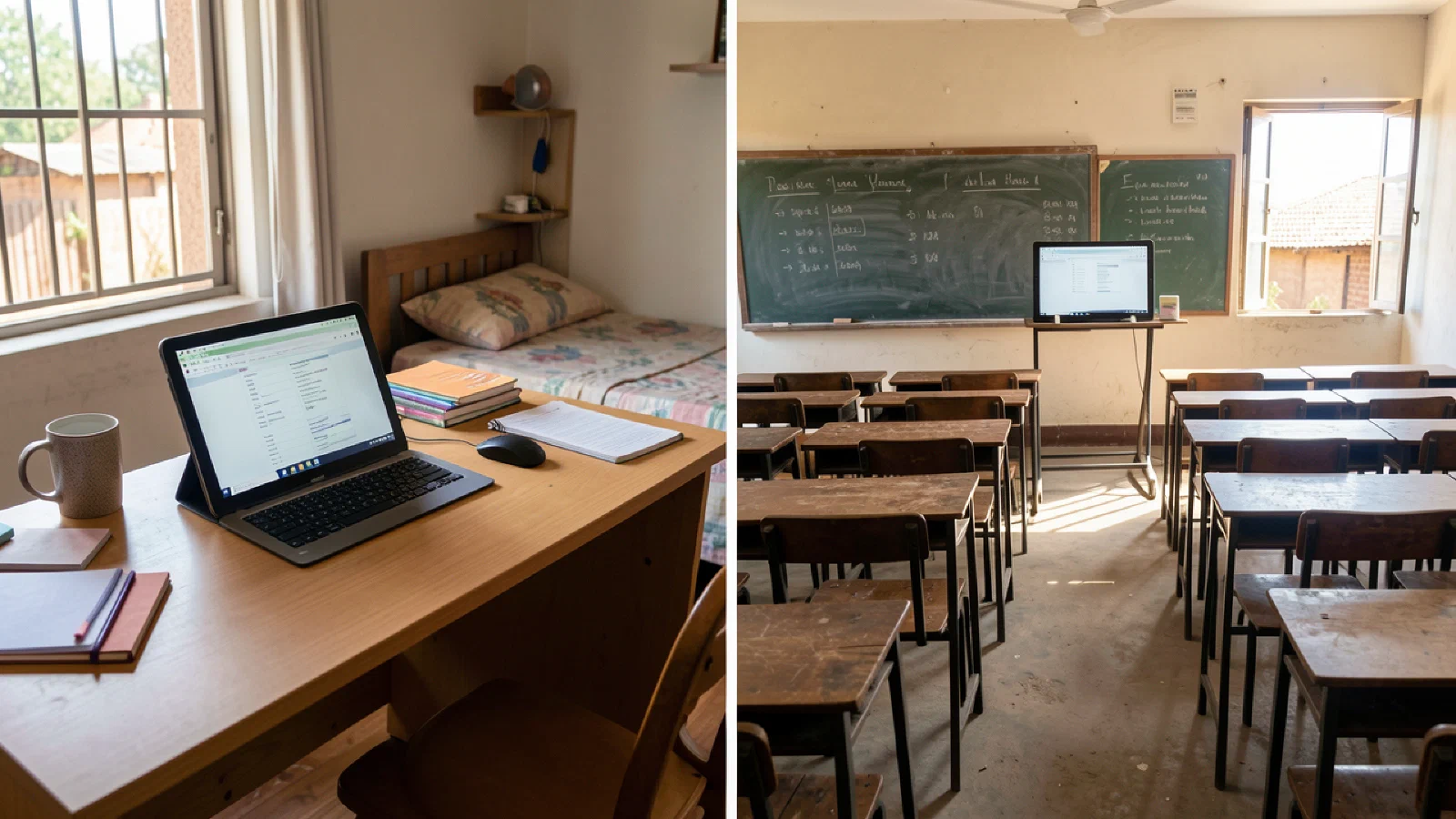
Sonia wakes at 6:40 AM in a mid-sized city in the American Midwest. Her learning companion has already assembled the day: a project on urban heat islands integrating atmospheric science, city planning, and environmental justice, calibrated to questions she asked yesterday. Her AI tutor has a reading queued. Her schedule is managed, her ride confirmed, her parents briefed on her developmental progress. She is fifteen and the infrastructure of her formation is invisible to her the way plumbing is invisible. She turns the tap and water comes out.
Kofi wakes at 5:30 AM in a mid-sized city in Ghana. He walks forty minutes to school. His school has AI tutoring, introduced two years ago through a partnership with an education technology company in London. The system is available one hour daily on shared tablets, twelve students per device. The AI speaks English in an accent that does not match how English is spoken in Kofi’s community. The curriculum references cities he has never visited. The problem framings assume infrastructure his city does not have. Kofi is good at the tutoring hour. He is also good at everything else in his day that does not involve AI: the mathematics Mr. Asante writes on the blackboard, the apprenticeship at his uncle’s electronics repair shop, the evening conversations with his grandmother who speaks Twi and does not understand why the school wants her grandson to learn from a machine.
Both children are N1. Both were born into a world where AI already existed. Both are being formed by their conditions, as every child is. The conditions are so different that placing them in the same generational category feels dishonest.
But the category is not about shared experience. It is about shared historical position. Both are forming inside the same transition. What separates them is not the transition itself but the resources, design choices, and institutional investments that shape how it reaches them. Same wave. Different ground.
Not Access#
The familiar framing of this gap is wrong.
The digital divide was about access: who had devices, connectivity, the basic infrastructure of participation. It was visible, measurable, addressable. Kofi’s school has AI tutoring. His mother’s phone has a chatbot. If access were the issue, it would be largely resolved.
The gap is not in the technology. It is in the formation.
Sonia’s AI environment is ambient. It surrounds her, scaffolds her learning, her social life, her creative expression. It was integrated into her development by institutions and parents who understood, at least partially, what thoughtful AI integration requires. Her school restructured. Her parents educated themselves. Her companion was chosen deliberately.
Kofi’s AI environment is episodic. It appears for one hour daily and recedes. It was deployed by an organization with good intentions and insufficient understanding of the context. It sits on top of an educational structure already underfunded and understaffed. It was not integrated into Kofi’s development. It was inserted into it, the way you might install a medical device without regard for the body’s existing systems.
The difference between ambient and episodic AI formation is not a difference in degree. It is a difference in kind. Both children had access. The access produced categorically different developmental experiences.
This is what makes the formation gap harder to address than the digital divide. You can ship devices. You can lay fiber. You cannot ship the institutional adaptation, the parental mediation, the cultural sensitivity, and the developmental intentionality that determine whether AI access becomes AI formation.
Two Architectures#
Sonia treats not-knowing as a starting position for inquiry. When she encounters something she does not understand, her instinct is to frame a question, engage with AI, evaluate the output, refine, iterate. This is not a skill she was taught. It is a cognitive habit built through thousands of interactions with systems that rewarded inquiry over recall.
Kofi treats not-knowing differently. Mr. Asante’s classroom rewards retention and accuracy. The AI tutoring hour rewards following progressions and demonstrating mastery. His uncle’s shop rewards diagnosis, improvisation, fixing a device with whatever parts are available. Kofi moves between these cognitive environments daily, code-switching between their expectations with a fluency Sonia has never needed to develop.
Sonia is deeper within one paradigm. Kofi is more versatile across several.
The global economy will reward Sonia’s paradigm more visibly. Her AI-native cognitive style maps onto the knowledge economy’s expectations. Kofi’s versatility, his ability to function across radically different cognitive environments, is less legible to the systems that sort people into opportunities. It does not show up on assessments. It shows up in his uncle’s shop at 4 PM, where a broken radio becomes an education in electrical systems, material constraints, and the kind of improvisation no tutoring hour could teach.
Which formation is better depends on the environment in which it will be deployed. In AI-rich environments where the systems work, Sonia’s is advantageous. In AI-fragile environments where systems fail and the gap between what the technology promises and what it delivers must be bridged by human resourcefulness, Kofi’s may prove more resilient.
The Colonial Vector#
Here is the thing the well-intentioned initiatives rarely confront.
The AI tutoring system in Kofi’s school was designed in London. Its curriculum was developed by educators trained in British and American pedagogical traditions. Its examples are European. Its English carries assumptions about syntax and culture that do not map onto Kofi’s community, let alone the Twi in which his deepest thinking occurs. The system’s model of “a good student” was trained on data from contexts that share almost nothing with his.
This is not a bug that will be fixed in the next version. It is the structural condition of deploying AI systems at global scale: the systems are built somewhere, by someone, with some model of the world, and that somewhere is overwhelmingly the global north.
When these systems deliver content, the colonial dimension is concerning but legible. A teacher can notice the wrong examples. A parent can observe that the references do not land. But when these systems participate in formation, when a child builds cognitive habits through daily interaction, absorbing not just content but ways of thinking, ways of framing problems, ways of relating to knowledge, the colonial dimension becomes something else.
Developmental colonialism. The formation of another society’s children according to your assumptions about how minds should work, delivered at scale, experienced not as imposition but as technology, as modernity, as progress.
Kofi’s grandmother sees something wrong in the tutoring hour. She cannot articulate it precisely. She tells him the machine does not know him, does not know his people. She is right in ways that exceed her ability to explain, and that the system’s designers lack the framework to hear.
What Kofi Has#
It would be dishonest, and it would reproduce a different kind of colonial assumption, to tell only a story of inequity.
Kofi can function when the AI is unavailable. This is not trivial. When the power goes out, the server is down, the device breaks, Kofi continues. He has Mr. Asante and the blackboard. He has his uncle’s shop. He has his grandmother’s stories. He has the daily experience of extracting value from conditions that were not optimized for him.
He can tolerate imperfection. Sonia’s environment was designed around her. Kofi’s was not designed around anyone. The classroom is crowded. The tutoring hour is awkward. The walk to school is long and hot. Within it, he has developed a practical relationship with difficulty: this is how things are, and here is what I can do.
None of this negates the inequity. A child who develops strong arms from carrying water should not be praised for strong arms. The child should have running water. But the simple story, that Sonia’s formation is better and Kofi’s is worse, that AI-rich produces superior humans and AI-poor produces deficient ones, is not true. Sonia carries capabilities Kofi lacks. Kofi carries capacities Sonia has never needed to develop. The global economy’s sorting systems were designed to see Sonia’s kind.
The Compounding#
The deepest problem with the formation gap is not its existence but what it does over time.
Sonia’s formation equips her to use AI more effectively. Better formation produces better usage produces better outcomes produces more opportunities. The cycle accelerates. Sonia is not just advantaged now. She is advantaged in a way that will amplify across her life, because the capacity to leverage AI effectively is itself a form of capital that appreciates with use.
Kofi’s formation equips him to use AI episodically. His outcomes are adequate but not exceptional by the metrics that matter to global sorting systems. The formation he can provide his own children will depend on institutional resources that are, in 2031, still inadequate, still designed elsewhere.
I keep returning to something from The Invisible Tiers: AI is both a leveling machine and a sorting machine. For N1, it leveled the knowledge barriers that kept people out of professional domains. And it sorted, invisibly, by the developmental advantages that determine who can use the leveled ground and who is stranded on it.
Kofi’s Walk Home#
Kofi walks home from school. It is hot. The road is dusty. He is thinking about a problem from Mr. Asante’s class, turning it over, seeing if he can find a path the AI tutoring system did not suggest. He is also thinking about a radio at his uncle’s shop, a circuit board with a burnt component he thinks he can replace. He is also thinking about his grandmother, who asked him to come home early because she wants to tell him about his grandfather, who died before Kofi was born, who was an engineer at the Akosombo Dam.
He is being formed. Not by AI. Not without AI. By the whole texture of a life that includes AI as one element among many, in a proportion and quality determined by choices made far from here, by people who do not know his name.
The formation gap is the original sin of the AI transition, written into the first generation to be formed by it. If it is not addressed, it will compound across generations, invisible and structural, shaping what kind of humans the world produces and who gets to become which kind.
The addressing is not technical. It is a question of whether we believe every child’s formation deserves the same care, the same investment, the same respect for local context, that we would want for our own.
We say we believe this. Kofi’s walk to school is the evidence of what we actually believe.
This is the fifth essay in Arc 5 of The Transformed, “The Natives.” Previous essays established who N1 is, how they were educated, how they formed with AI companions, and how they face a post-professional world. This essay examines the formation gap between N1 members in AI-rich and AI-poor environments, and why this gap represents a deeper inequity than access. The Transformed builds on Who Gets Approximated and The Invisible Tiers.
References#
UNESCO. Global Education Monitoring Report 2023: Technology in Education. UNESCO Publishing, 2023.
Pritchett, Lant. The Rebirth of Education: Schooling Ain’t Learning. Center for Global Development, 2013.
Warschauer, Mark. Technology and Social Inclusion: Rethinking the Digital Divide. MIT Press, 2003.
Eubanks, Virginia. Automating Inequality: How High-Tech Tools Profile, Police, and Punish the Poor. St. Martin’s Press, 2018.
Fanon, Frantz. The Wretched of the Earth. Translated by Constance Farrington, Grove Press, 1963.
wa Thiong’o, Ngugi. Decolonising the Mind: The Politics of Language in African Literature. James Currey, 1986.
Bronfenbrenner, Urie. The Ecology of Human Development. Harvard University Press, 1979.
Rogoff, Barbara. The Cultural Nature of Human Development. Oxford University Press, 2003.
Masten, Ann S. Ordinary Magic: Resilience in Development. Guilford Press, 2014.
Piketty, Thomas. Capital in the Twenty-First Century. Translated by Arthur Goldhammer, Harvard University Press, 2014.
Sen, Amartya. Development as Freedom. Knopf, 1999.
How this essay connects to others across The Approximate Mind.
- UNESCO. Global Education Monitoring Report 2023: Technology in Education. UNESCO Publishing, 2023.
- Pritchett, Lant. The Rebirth of Education: Schooling Ain’t Learning. Center for Global Development, 2013.
- Warschauer, Mark. Technology and Social Inclusion: Rethinking the Digital Divide. MIT Press, 2003.
- Eubanks, Virginia. Automating Inequality: How High-Tech Tools Profile, Police, and Punish the Poor. St. Martin’s Press, 2018.
- Fanon, Frantz. The Wretched of the Earth. Translated by Constance Farrington, Grove Press, 1963.
- wa Thiong’o, Ngugi. Decolonising the Mind: The Politics of Language in African Literature. James Currey, 1986.
- Bronfenbrenner, Urie. The Ecology of Human Development. Harvard University Press, 1979.
- Rogoff, Barbara. The Cultural Nature of Human Development. Oxford University Press, 2003.
- Masten, Ann S. Ordinary Magic: Resilience in Development. Guilford Press, 2014.
- Piketty, Thomas. Capital in the Twenty-First Century. Translated by Arthur Goldhammer, Harvard University Press, 2014.
- Sen, Amartya. Development as Freedom. Knopf, 1999.