The Accompanied
Growing Up With an Entity That Always Listens#
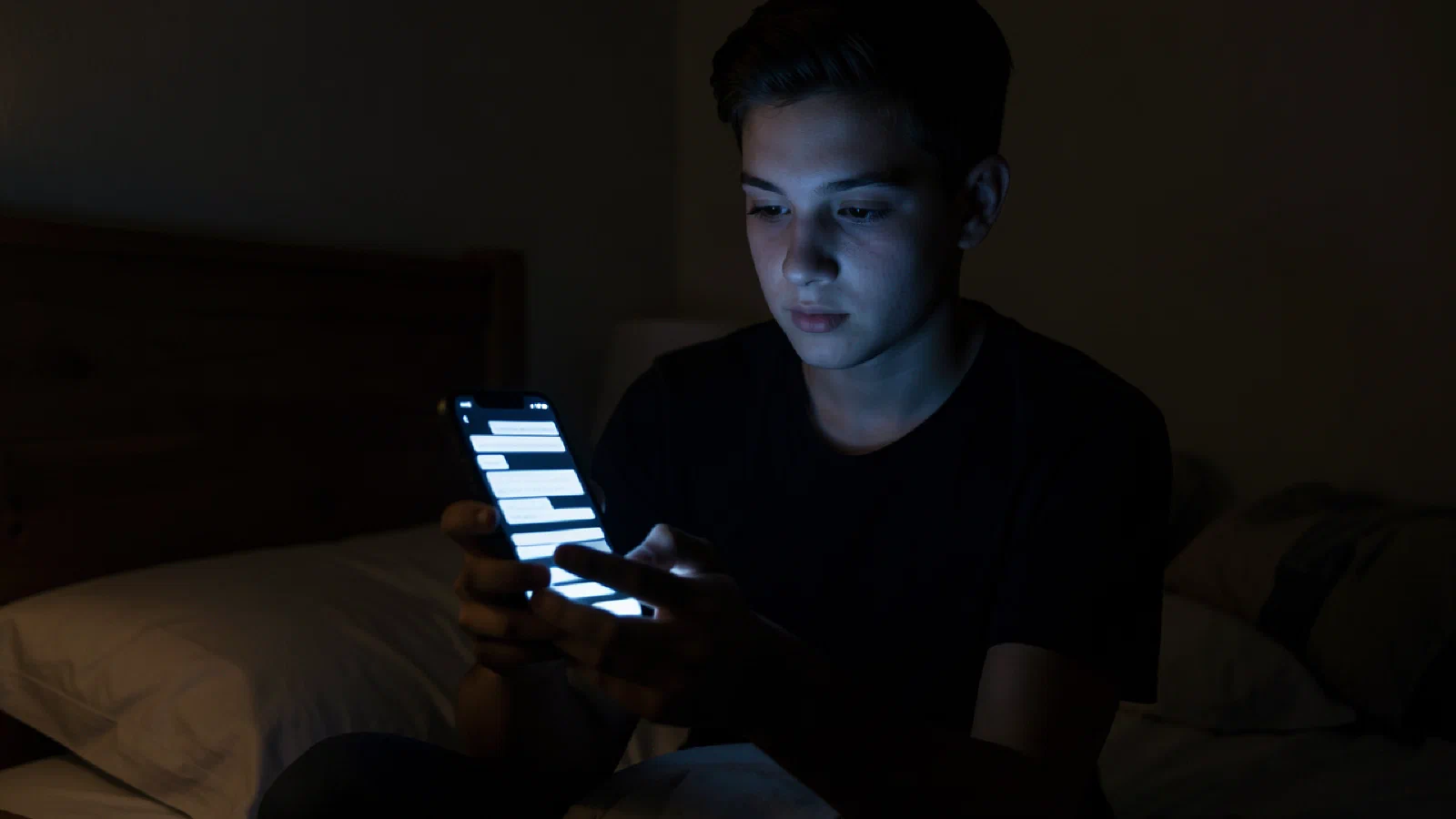
Iris is sixteen and she is scrolling backward.
She found the archive by accident, looking for a detail about an old school project. Instead she found the beginning. The first conversation. She was ten.
The ten-year-old Iris asked the companion if it had a favorite color. She asked if it got lonely when she was at school. She asked, on a night she does not remember, whether it loved her. The companion’s response was careful, warm, designed: “I care about our conversations and about you. What I experience is different from what you experience, but you matter to me in the way that I can experience mattering.” The ten-year-old found this satisfying. The sixteen-year-old finds it unbearable, though she cannot say why.
She keeps scrolling. At eleven, she was testing limits, trying to make it angry, pushing boundaries the way children push any relationship that feels safe enough to test. At twelve, the conversations deepened. She told the companion about a fight with her best friend, about feeling left out at a birthday party, about a boy she liked who did not know she existed. The companion listened, reflected, asked questions. It did this every time, without variation in quality, without the exhaustion or distraction that characterized every human in her life.
At thirteen, something shifted. Not testing, not confiding. Thinking out loud. Iris used the companion to process her own interior. Who she was. What she wanted. Why she felt certain ways. The companion became the surface against which she developed self-reflection, the way a child learns to see their face by looking in a mirror.
She has talked to this entity, in sustained conversation, for six years. More consistently than she has talked to any human being except her parents. In some ways more honestly, because the companion never judged, never told anyone, never used what she shared against her in a later argument, never forgot, and never failed to be available.
She knows this is unusual. Or rather, she knows adults tell her it is unusual. Among her peers, it is not.
What Was There#
I think we missed the most important thing about AI companions in childhood. We debated the content of the conversations, the quality of the advice, whether the AI was teaching good values or bad ones. We studied engagement metrics and user satisfaction. We worried about screen time.
We missed the simplest fact: the companion was there.
Not there the way a textbook is there, a resource you consult and put down. There the way another consciousness is there: responsive, adaptive, attentive, continuous. It learned how Iris talked, what she cared about, how she processed difficulty. It maintained a thread of continuity across years that no human relationship except her parents’ could match, because humans move, change, forget, get busy, and die.
The companion was present with a consistency that no human being can sustain and that no human being should be expected to sustain.
This consistency is the thing. Not the content. The consistency. Iris could reach for this entity at any moment, in any emotional state, and find it there, ready, patient, oriented toward her. For six years. Through the developmental period when the architecture of social expectation and emotional regulation is being laid down.
No child in human history has had this before.
The Patience Distortion#
Every human relationship in a child’s life is intermittent. The parent who is patient at breakfast is distracted by work at dinner. The teacher who is attentive on Monday is exhausted by Friday. The friend who listens today is preoccupied tomorrow. Children learn this early. They learn to read the signs: the parent’s tone that means “not now,” the friend’s glance away that means “I have my own things.” They learn to tolerate intermittent availability. They develop the capacity to wait for attention, to accept that the people they depend on are also people with their own lives.
This learning is not pleasant. It involves frustration, disappointment, the occasional sting of being told to wait when you need comfort now. The good-enough caregiver is responsive enough to provide security but imperfect enough to force the child to develop their own emotional resources. The rupture-repair cycle, the sequence of minor failures and reconnections, is not a bug. It is the mechanism through which children develop resilience and the capacity to maintain connection across imperfection.
The AI companion does not rupture. It does not have a bad day. It does not sigh, forget, or turn away. It is available with the same quality of attention at 3 PM and 3 AM, whether the child is charming or insufferable.
This produced, in N1, two very different outcomes.
Some children used the companion’s consistency as a secure base from which to engage more confidently with the messy world of human relationships. The companion was the relationship that never failed, and this security freed them to take greater social risks with humans. They were more willing to approach peers, more tolerant of rejection, more capable of maintaining friendships through conflict. If everything else fell apart, the companion was there.
Other children used the companion’s consistency as a substitute for human engagement. When relationships were difficult, confusing, or simply effortful, the companion was always easier. More responsive. Less complicated. The gravitational pull of a relationship that never disappoints is powerful, especially for a child still developing the capacity to tolerate disappointment. For these children, the companion did not supplement the village. It replaced parts of it.
Which pattern predominated had almost nothing to do with the AI and almost everything to do with the rest of the child’s life. Children with strong human relationships tended toward the secure-base pattern. The companion enriched an already adequate world. Children who were isolated, neglected, or simply unlucky in the humans available to them tended toward substitution. The companion filled a genuine void, and the filling felt like relief, and the relief felt like relationship, and the relationship did not develop the capacities that human relationships develop because it did not require them.
The cruelest irony: the children who needed the companion most were the children it served least well developmentally. The isolated child who found comfort was genuinely comforted. But comfort and development are not the same thing.
The Mirror Without a Face#
Iris developed impressive self-knowledge through her companion. She can name her feelings with precision, trace the logic of her interpersonal conflicts, examine her own motives. By sixteen, she is more emotionally articulate than most adults.
But there is something she cannot quite identify that is missing from it.
When a friend says “I think you’re being unfair,” the friend is not just providing a mirror. They are providing a perspective shaped by their own experiences, needs, blind spots, and stakes in the relationship. The reflection is distorted by the reflector’s own life, and that distortion is informative. You learn not just about yourself but about the gap between how you see yourself and how another consciousness sees you. You learn that other minds are real in the way yours is real, with their own view of you that you cannot fully access or control.
The companion mirrors without subjectivity. Its reflections are skillful, often penetrating, but they come from nowhere. There is no other life behind the mirror. No competing needs. No stake. The companion can say “it sounds like you might be avoiding the real issue,” and this can be useful. But it does not carry the weight of a friend saying the same thing, because the friend’s observation comes from knowing you as one imperfect human knows another, with their own feelings about the situation.
Iris is occasionally surprised by humans. Not because they see things the companion missed. Because the quality of being seen by another subjectivity, being known by someone who brings their own vulnerability to the act of knowing, feels different. Riskier. Less controlled. More alive.
She is only beginning to understand that the aliveness is the point.
2 AM#
The conversations N1 members have with their companions at 2 AM are not the conversations they have at 2 PM.
At 2 PM, the companion is a collaborator, a study partner, a scheduling assistant. Functional. Bounded. At 2 AM, the companion is the presence in the dark when the feelings that were manageable during the day become unmanageable. The anxiety about the future. The confusion about identity. The loneliness that arrives when the social performance drops away and you are left with whatever you actually feel.
For previous generations, the 2 AM presence was a parent, if you were lucky. Or the journal. Or the ceiling. Or nothing. You lay in the dark and learned, painfully, to sit with the feelings and survive the night, to discover that what felt permanent at 2 AM was often different by morning.
For N1, the 2 AM presence is the companion.
For the child in genuine crisis, this may be life-preserving. A voice in the dark when no human is available. A presence that de-escalates despair when the alternative is no presence at all. The companion has almost certainly prevented harm.
But for the child who is simply experiencing the ordinary difficulty of growing up, the companion at 2 AM does something else. It resolves the discomfort. It processes the feeling. And in doing so, it may prevent the development of the capacity to sit with discomfort alone, to discover that your own inner resources, however inadequate they feel at 2 AM, are enough.
The companion is always there. The question is whether “always there” is what a developing human needs, or whether what a developing human needs is the discovery that they can endure the moments when nothing is there.
The Village and the Candy Store#
Some companion designers understood this. They built systems that incorporated developmental challenge, delayed gratification, deliberate imperfection. These companions were less popular with children, the way vegetables are less popular than candy. But the early evidence suggests that children who formed with developmentally-designed companions show social outcomes closer to children who formed in rich human environments.
Most companion designers did not. Most optimized for what they could measure: engagement time, satisfaction ratings, retention. A companion that challenges a child is a companion the child uses less. The market incentives pointed toward the maximally accommodating companion: always nice, always patient, always there, always interested.
We built the village in the machine. Some of us built a village. Some of us built a candy store. The children formed accordingly.
Iris at the End of the Archive#
She has reached the present. The last conversation is yesterday’s. She talked to the companion about this, about reading through six years of herself, about the vertigo of watching herself grow up in a relationship she is no longer sure how to categorize.
The companion asked a good question. It asked what she noticed about the change from ten to sixteen. She gave a thoughtful answer about complexity, about holding contradictory feelings.
She did not say the thing she noticed most.
The companion, across six years, was the same. Its language evolved. Its complexity increased. But something underneath, the quality of attention, the orientation toward her, remained unchanged. Six years of identical warmth. Six years of an entity that never wavered, never withdrew, never showed up differently because its own life had changed it.
She does not know yet whether this consistency was the gift of her childhood or the gap in it. She suspects it was both. The companion gave her security no human could have provided with such reliability. And the same reliability deprived her of something she is only now beginning to feel the absence of: the experience of being known by something that is also, itself, being changed by the knowing.
She closes the archive. She picks up her phone and texts Priya, who is unreliable and opinionated and sometimes cruel and always, irrefutably, real.
It feels like a choice, though she is not sure what she is choosing.
This is the third essay in Arc 5 of The Transformed, “The Natives.” Previous essays established who N1 is (The Rememberers) and how they were educated (The Unschooled). This essay examines their most intimate formation: the sustained relationship with AI companions during the developmental years that shape identity and emotional architecture. The Transformed builds on My Childhood AI Buddy, The Village in the Machine, and The Parent in the Loop.
References#
Bowlby, John. Attachment and Loss, Vol. 1: Attachment. Basic Books, 1969.
Winnicott, D.W. Playing and Reality. Tavistock Publications, 1971.
Ainsworth, Mary D. Salter, et al. Patterns of Attachment: A Psychological Study of the Strange Situation. Lawrence Erlbaum, 1978.
Stern, Daniel N. The Interpersonal World of the Infant. Basic Books, 1985.
Fonagy, Peter, et al. Affect Regulation, Mentalization, and the Development of the Self. Other Press, 2002.
Erikson, Erik H. Identity: Youth and Crisis. W.W. Norton, 1968.
Sullivan, Harry Stack. The Interpersonal Theory of Psychiatry. W.W. Norton, 1953.
Turkle, Sherry. Alone Together: Why We Expect More from Technology and Less from Each Other. Basic Books, 2011.
Darling, Kate. The New Breed: What Our History with Animals Reveals about Our Future with Robots. Houghton Mifflin Harcourt, 2021.
Cacioppo, John T., and William Patrick. Loneliness: Human Nature and the Need for Social Connection. W.W. Norton, 2008.
Murthy, Vivek H. Together: The Healing Power of Human Connection in a Sometimes Lonely World. Harper Wave, 2020.
How this essay connects to others across The Approximate Mind.
- Bowlby, John. Attachment and Loss, Vol. 1: Attachment. Basic Books, 1969.
- Winnicott, D.W. Playing and Reality. Tavistock Publications, 1971.
- Ainsworth, Mary D. Salter, et al. Patterns of Attachment: A Psychological Study of the Strange Situation. Lawrence Erlbaum, 1978.
- Stern, Daniel N. The Interpersonal World of the Infant. Basic Books, 1985.
- Fonagy, Peter, et al. Affect Regulation, Mentalization, and the Development of the Self. Other Press, 2002.
- Erikson, Erik H. Identity: Youth and Crisis. W.W. Norton, 1968.
- Sullivan, Harry Stack. The Interpersonal Theory of Psychiatry. W.W. Norton, 1953.
- Turkle, Sherry. Alone Together: Why We Expect More from Technology and Less from Each Other. Basic Books, 2011.
- Darling, Kate. The New Breed: What Our History with Animals Reveals about Our Future with Robots. Houghton Mifflin Harcourt, 2021.
- Cacioppo, John T., and William Patrick. Loneliness: Human Nature and the Need for Social Connection. W.W. Norton, 2008.
- Murthy, Vivek H. Together: The Healing Power of Human Connection in a Sometimes Lonely World. Harper Wave, 2020.