The Digital Durkheim
When AI Reshapes the Social, Who Studies What’s Happening?#
James Whitfield has his mother’s parish directory on his desk. It is a mimeographed booklet from 1987, thirty-two pages, stapled through the center, the cover slightly water-stained from a basement flood sometime in the nineties. His mother kept it her whole life. James keeps it now, not as a memento exactly, and not for the names, most of which mean nothing to him. He keeps it because of what it is: a list. Someone in 1987 took the trouble to collect every family in the parish, write their address and phone number, print it, staple it, and distribute it, so that the neighborhood could find itself on paper. The list was not the community. But you could not have made the list without one.
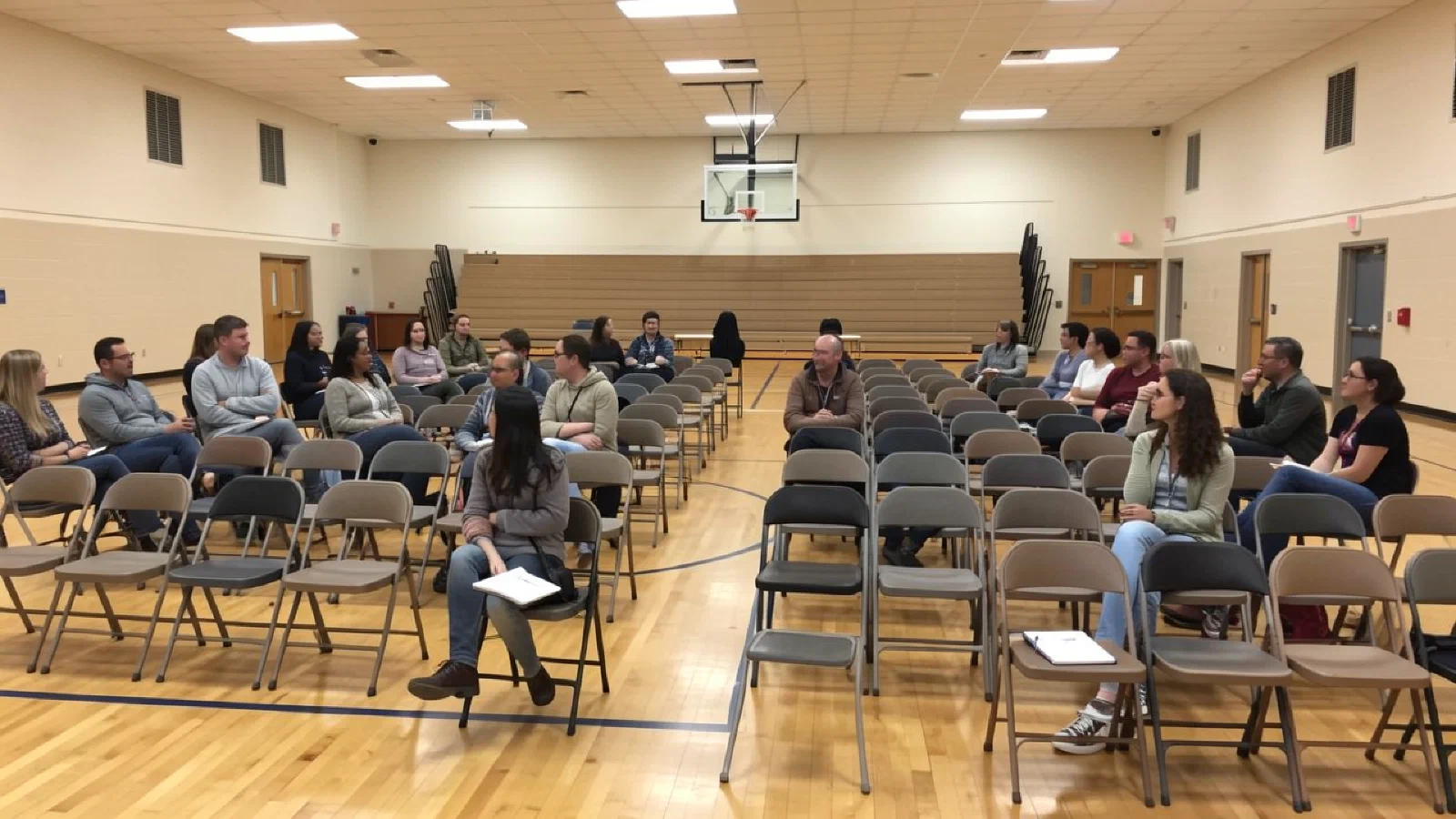
He has this thought often at community meetings, which is where he spends most of his Tuesday and Thursday evenings. Tonight it is a gymnasium in east Columbus. The topic is a new AI-managed public housing allocation system the city adopted six months ago. Roughly eighty people showed up, which is sixty more than any community meeting in this neighborhood has drawn in years.
Half the room is furious. Half is relieved. The split does not fall where you might expect.
The furious half includes longtime community organizers, people who spent decades building relationships with housing authority staff, learning the informal rules, learning which case worker would listen and which supervisor would move a file. The AI system replaced not just a process but a web of human relationships through which this community exercised whatever small power it had. The staff who used to make discretionary judgments are now processors of algorithmic outputs. The organizers’ expertise, which was relational and hard-won, has been rendered obsolete without being replaced.
The relieved half includes people who never had those relationships. Newcomers. Immigrants. People whose English was insufficient to meet the old system’s unwritten expectations. People who had been, without anyone naming it, on the wrong side of the discretionary judgments the organizers’ network made possible. For them, the algorithm’s impersonal consistency is an improvement over a system that worked for people who knew how to work it.
James sits in the back row and takes notes. He is not there to study the AI system. He is there to study the room.
His formal title is Associate Professor of Sociology with a joint appointment in the Institute for Technology and Society. His informal title, the one community members have started using, is the person who explains what the algorithm is doing to us. He has a more precise way of saying it: the algorithm is not doing anything to you that was not already being done. It is making the existing social structure visible. And that visibility is what is tearing the room apart.
The algorithm did not create the division in the room. It revealed it.
The Discipline That Sees Structure#
Digital Durkheim, elsewhere in this collection, asked a theoretical question: what happens when you have collective behavior without collective consciousness? AI agent networks developing emergent social patterns, conventions nobody programmed, dynamics that persist even as individual agents are replaced. Social facts, in Durkheim’s precise sense, without social beings.
That question has acquired bodies now. Real communities are being reshaped by AI systems interacting with existing social structures in ways nobody designed and few anticipated. The question is no longer whether AI creates social facts. It is who studies them, who names them, and who helps communities understand what is happening to the invisible architecture of their shared lives.
The answer is increasingly: sociologists. Not sociologists writing papers for other sociologists, but applied sociologists embedded in communities, hospitals, school districts, government agencies, navigating what AI is actually doing to the people who live inside its effects.
Sociology’s core contribution sounds simple: it sees the social. Not individuals making choices. Not technology producing outcomes. The patterns that emerge when individuals interact within systems, the structures that constrain possibilities before any individual choice is made, the collective dynamics that no individual intends and everyone inhabits.
This is what James sees in the gymnasium. Not eighty individuals with opinions about an algorithm. A social structure being disrupted, the disruption falling along lines of existing power, existing relationships, existing inequality. The social world in this room was organized a specific way before the algorithm arrived, and the algorithm, by replacing that organization with a different one, has made the original visible. The organizers’ network was not neutral. The newcomers knew this. Everyone in the room knew this, but the informal system had no mechanism for saying so, and the community had adapted around what could not be said. The algorithm, by being indifferent to the informal system, broke the adaptation. Now the thing that could not be said is standing in the gymnasium, sorting itself into two groups.
Whether the community uses this visibility to build something more equitable, or whether the old structure simply reassembles in new forms, James cannot predict. He can watch. He can document. He can help people name what they are seeing. Whether they do anything with the name is not his to control.
When Solidarity Erodes#
The most consequential social transformation AI may be producing is the one nobody is governing.
AI companions have proliferated. One in six Americans reports feeling lonely all or most of the time. Among adults eighteen to twenty-five, the figure is higher. AI companion apps have attracted hundreds of millions of users, and research published in 2025 found that heavy emotional self-disclosure to AI companions was consistently associated with lower wellbeing, and that intensive daily use correlated with greater loneliness and reduced real-world social interaction. The app that was supposed to solve isolation appears, in aggregate, to be deepening it.
Loneliness at epidemic scale is not a collection of personal failures. It is a social fact.
This is the distinction the sociologist keeps insisting on, in rooms where the psychologist and the engineer are looking at individual users and individual products. A pattern that emerges across an entire population, that persists independently of any individual’s choices, that has its own structural causes, is not a mental health crisis in the clinical sense. It is a social structural crisis. These require different analysis and different responses.
James calls what he studies the loneliness architecture: the structural features of contemporary life that produce isolation not as a side effect but as an emergent property of systems designed without attending to social bonds. Social media platforms that optimize for engagement rather than connection. Remote work arrangements that dissolve workplace community while improving productivity metrics. Urban design that privatizes public space. Economic structures that require geographic mobility, breaking the local ties that once provided belonging without effort.
AI companions enter this architecture as both symptom and accelerant. They are a symptom because the scale of demand reveals the depth of the unmet need. They are an accelerant because, in filling the need partially, they may reduce the pressure to address structural causes. When a person’s loneliness is made bearable by an AI conversation, the structural conditions that produced the loneliness remain intact. Nothing has been solved. The pressure that might have produced collective action toward structural change has been, instead, individually managed.
The sociological insight here is one no other discipline is positioned to provide. The loneliness epidemic is not primarily about the people experiencing it. It is about the dissolution of the institutions, rhythms, and arrangements that once produced belonging as a byproduct of shared life. The church. The union. The bowling league. The workplace cafeteria. The front porch. Each of these was a structure that generated social connection without requiring anyone to seek it out. Their decline left a vacuum, and the vacuum has a specific shape, and AI companions are filling that shape while leaving its structural cause entirely untouched.
I wonder sometimes whether naming this distinction accomplishes anything, or whether it only deepens the grief of people who are lonely right now and cannot afford to wait for structural change.
The Social Order and Its Double#
Recommendation algorithms are, from an engineering perspective, optimization systems: given user data, predict what content maximizes engagement. From a sociological perspective, they are social sorting machines. They decide who sees what, which means they decide who encounters whom, which means they shape the possibility space for human community. When algorithms consistently show conservative content to conservatives and liberal content to liberals, they are not merely filtering information. They are constructing social worlds. They are performing, at computational speed, the function that neighborhood and church and workplace once performed: defining who your people are.
The old social sorting was visible, negotiable, embedded in human relationships with at least the theoretical possibility of change. You could leave the neighborhood. You could change churches. You could get a different job. The algorithmic social sort is invisible, non-negotiable, and embedded in infrastructure. You do not choose it. You inhabit it without knowing its contours.
Durkheim distinguished mechanical solidarity, the bonds of sameness, from organic solidarity, the bonds of interdependence among people who are genuinely different. The administered community that algorithms produce simulates mechanical solidarity: the feeling of being among your people. But it achieves this by eliminating the encounters with difference that organic solidarity requires.
The result is a social order that feels cohesive from the inside and is fragmenting from the outside. Every group believes it is a community. No group encounters the others. The social whole dissolves while its parts feel more connected than ever.
An engineer optimizing for engagement cannot see this. It is not a property of the system. It is a property of the social world the system is constructing.
What Institutions Become#
Every society builds institutions that serve obvious functions and a less obvious one. The church provides worship. The union provides labor representation. The professional association provides development. But these institutions also produce what Durkheim considered their most important output: solidarity. They give people a place to belong, a role to fill, a community to inhabit. The explicit function is the reason people show up. The implicit function is what happens while they are there.
AI is transforming institutions in ways that preserve the explicit function while dissolving the implicit one.
The workplace is the clearest case. AI tools make remote work more productive. The explicit function of work, producing outputs, has never been more efficiently served. But the implicit function of work, providing social structure, identity, daily rhythm, a community of colleagues, a reason to leave the house, a place where you are known, has been quietly gutted. The worker optimizing from home is more productive and more alone. The incidental encounters, the break room conversation, the hallway exchange, the lunch invitation that becomes a friendship, were never in any productivity metric. They also were not incidental.
The sociologist maps this trade-off across institutions. The church that streams services online reaches more people and builds less community. The professional association using AI to optimize its advocacy is more effective at policy change and less effective at producing the felt solidarity among members that sustains civic life across generations. In each case, AI improves measurable performance while degrading an unmeasurable social function that was always, in Durkheim’s framework, the deeper purpose.
Because the social function was always implicit, never appearing in any mission statement, its loss is felt but not named. People know something is missing. They do not have a word for what it is.
Sociology has the word. It is solidarity. And its loss, when it reaches a certain threshold, is what Durkheim called anomie: the condition in which social norms weaken, shared meaning dissolves, and individuals are left to construct purpose from their own increasingly inadequate resources.
What Margaret Inhabits#
Margaret does not meet a sociologist. She inhabits the world the sociologist studies.
Her Thursday bridge club has thinned. Two members moved to be closer to grandchildren. One stopped coming after her husband died, not because she was too deep in grief to play, but because the drive had always been his contribution to the evening and she never learned the route. The club once had twelve members and a waiting list. It now has six and no applicants.
Margaret does not connect this to AI. Why would she? The connection is structural, not obvious. The members who moved did so partly because remote work, enabled by AI tools, freed their children from geographic attachment to specific employers. The housing economics in their destination cities were shaped by algorithmic pricing tools that made the move financially rational. The member who stopped coming inhabits a transportation world increasingly organized around ride-sharing apps she doesn’t know how to use, and the bus route that once served her neighborhood was cut when ridership fell below the algorithmic threshold.
Margaret’s loneliness, when she feels it, feels personal. It is not personal. She is experiencing, in the texture of her daily life, the dissolution of the informal social institutions that once produced belonging as a byproduct of proximity and routine. The bridge club was never just a card game. It was a structure that generated connection, reciprocity, mutual monitoring, and the low-level continuous social contact that Durkheim understood as the fabric of solidarity.
No algorithm replaced it. But algorithms, in reshaping the geography of work and the economics of housing and the patterns of daily transportation, contributed to the conditions under which it eroded. The sociologist maps these connections not to apportion blame but to make visible the structural forces that Margaret experiences as private loss.
There is a difference between understanding why something happened and being able to undo it. James has been doing this work long enough to know which one he provides.
The Question the Gymnasium Raises#
Back in the gymnasium, something unexpected is beginning to happen. The two groups, the furious organizers and the relieved newcomers, have started talking to each other across the aisle. Not warmly. But directly. One of the organizers is asking a woman in the second row what the old system was like for her, and she is answering, and the organizer is quiet in a way that suggests she is actually listening.
James watches. He does not intervene. His job, tonight, is to observe.
The old solidarity in this community was real. The informal network that organized housing access for decades was a form of social capital, genuinely useful to the people inside it and genuinely exclusionary toward the people outside it. Both things were true, and neither was fully acknowledged. The algorithm, by treating everyone the same, broke the arrangement that made both truths livable. Now the community has to decide what it actually values. Equity, or familiarity? The people it has always organized around, or the people it has been organizing against?
The algorithm did not raise this question. The algorithm is indifferent to it. The community raised it, because the algorithm gave them no other choice.
James picks up his pen. Writes two words: new coalition? with a question mark. Whether the conversation across the aisle becomes something durable or dissipates when the meeting ends, he cannot say. Whether the newly visible structure produces something more equitable than what preceded it, he cannot say. He is a sociologist, not an optimist.
But he has his mother’s parish directory on his desk, and it was made by someone who thought it was worth the trouble to write everyone down. Someone who believed the neighborhood could find itself on paper, and that finding itself on paper was the beginning of finding itself in the world.
The question the gymnasium is asking tonight is whether communities in an AI-saturated society still have that option. Whether the social structures being dissolved and replaced and made visible by algorithmic systems leave room for the human decision to organize, to name, to print a new list.
Nobody knows yet. The sociologist’s job is to make sure the question stays visible long enough for people to try.
This is the twenty-second essay in The Transformed, and the second in Arc 4: The Human Foundation. It extends Digital Durkheim from theory into applied professional practice and draws on The Empty Room, The Belonging Gap, The Social Scaffold, and The Search for Social Consciousness in its attention to solidarity, loneliness, and the social structures AI is reshaping. The next essay, The Applied AI Philosopher, examines what happens when every algorithmic decision becomes a moral decision, and the philosopher who helps you think.
References#
Durkheim and Social Theory
Durkheim, Émile. The Division of Labor in Society. Translated by W. D. Halls, Free Press, 1893/1984.
Durkheim, Émile. Suicide: A Study in Sociology. Translated by John A. Spaulding and George Simpson, Free Press, 1897/1951.
Luhmann, Niklas. Social Systems. Translated by John Bednarz Jr. and Dirk Baecker, Stanford University Press, 1995.
Community, Solidarity, and Institutional Decline
Han, Byung-Chul. The Burnout Society. Translated by Erik Butler, Stanford University Press, 2015.
Putnam, Robert D. Bowling Alone: The Collapse and Revival of American Community. Simon and Schuster, 2000.
Turkle, Sherry. Alone Together: Why We Expect More from Technology and Less from Each Other. Basic Books, 2011.
Loneliness and Social Isolation
Holt-Lunstad, Julianne, et al. “Social Relationships and Mortality Risk: A Meta-Analytic Review.” PLOS Medicine, vol. 7, no. 7, 2010.
Shelmerdine, Susan, and Matthew Nour. “AI Chatbots and the Loneliness Crisis.” The BMJ, 2025.
Zhang, Y., et al. “The Rise of AI Companions: How Human-Chatbot Relationships Influence Well-Being.” 2025.
Algorithmic Social Order and Automated Inequality
Burawoy, Michael. “For Public Sociology.” American Sociological Review, vol. 70, no. 1, 2005, pp. 4-28.
Couldry, Nick, and Ulises Mejias. The Costs of Connection: How Data Is Colonizing Human Life and Appropriating It for Capitalism. Stanford University Press, 2019.
Eubanks, Virginia. Automating Inequality: How High-Tech Tools Profile, Police, and Punish the Poor. St. Martin’s Press, 2018.
How this essay connects to others across The Approximate Mind.
- Durkheim, Émile. The Division of Labor in Society. Translated by W. D. Halls, Free Press, 1893/1984.
- Durkheim, Émile. Suicide: A Study in Sociology. Translated by John A. Spaulding and George Simpson, Free Press, 1897/1951.
- Luhmann, Niklas. Social Systems. Translated by John Bednarz Jr. and Dirk Baecker, Stanford University Press, 1995.
- Han, Byung-Chul. The Burnout Society. Translated by Erik Butler, Stanford University Press, 2015.
- Putnam, Robert D. Bowling Alone: The Collapse and Revival of American Community. Simon and Schuster, 2000.
- Turkle, Sherry. Alone Together: Why We Expect More from Technology and Less from Each Other. Basic Books, 2011.
- Holt-Lunstad, Julianne, et al. “Social Relationships and Mortality Risk: A Meta-Analytic Review.” PLOS Medicine, vol. 7, no. 7, 2010.
- Shelmerdine, Susan, and Matthew Nour. “AI Chatbots and the Loneliness Crisis.” The BMJ, 2025.
- Zhang, Y., et al. “The Rise of AI Companions: How Human-Chatbot Relationships Influence Well-Being.” 2025.
- Burawoy, Michael. “For Public Sociology.” American Sociological Review, vol. 70, no. 1, 2005, pp. 4-28.
- Couldry, Nick, and Ulises Mejias. The Costs of Connection: How Data Is Colonizing Human Life and Appropriating It for Capitalism. Stanford University Press, 2019.
- Eubanks, Virginia. Automating Inequality: How High-Tech Tools Profile, Police, and Punish the Poor. St. Martin’s Press, 2018.