The AI Anthropologist
Making the Strange Familiar and the Familiar Strange#
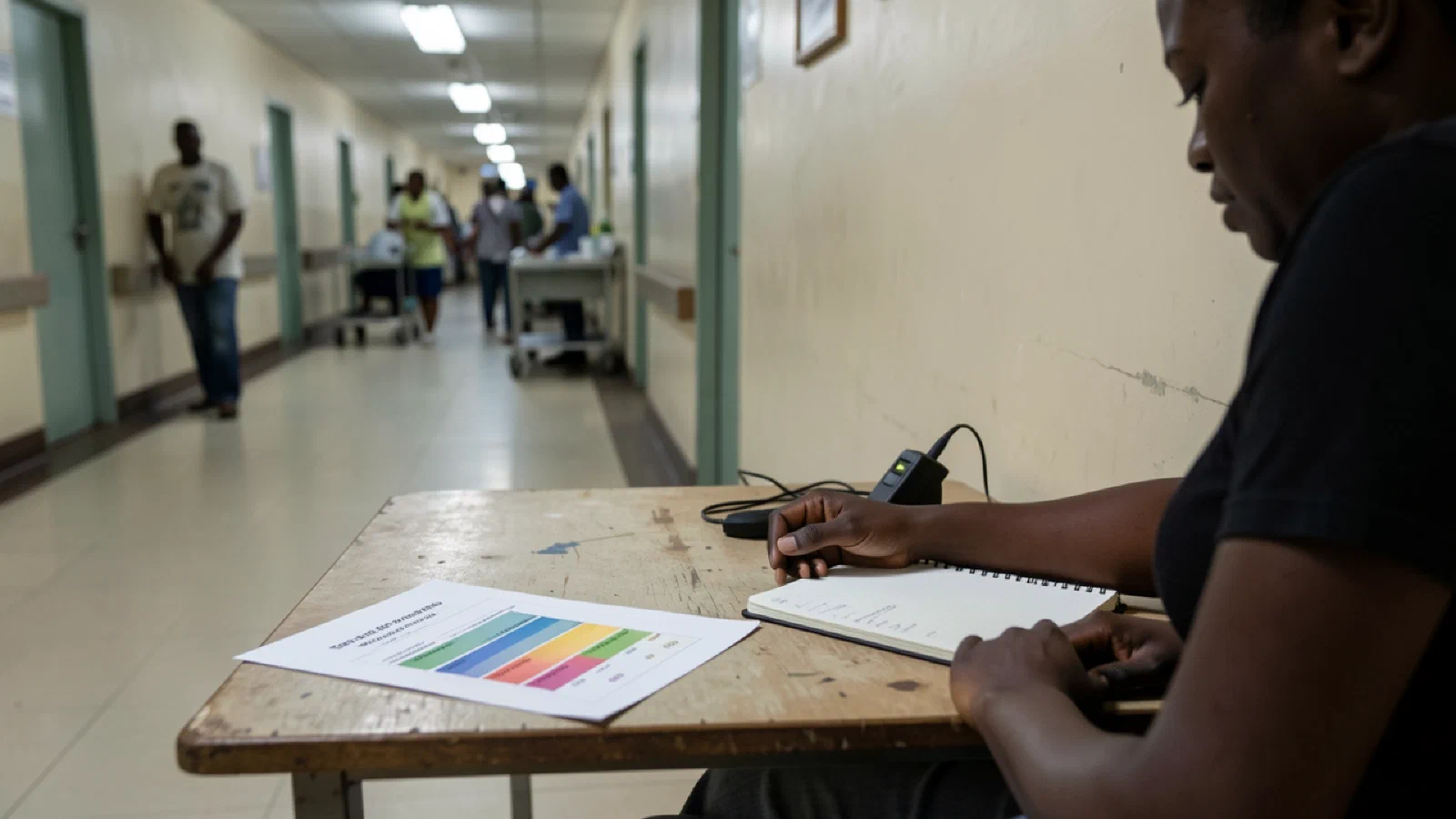
Amara Osei has two things on her desk that confuse the physicians at Kenyatta National Hospital in Nairobi. One is a hand-worn calabash bowl, the kind her grandmother kept in the kitchen for measuring grain. The other is a paper notebook she fills by hand each evening before going home, even though everything else she produces ends up in a digital system. The physicians have never asked about either. Amara has noticed this. She notices things that are not remarked upon. That is, more or less, the job.
She is an anthropologist, embedded in the hospital’s AI integration team for eighteen months now, and her workday begins where the triage algorithm’s confidence ends.
This Wednesday, a woman presents with abdominal pain she describes as “a heaviness that moves.” The AI maps the complaint to several differential diagnoses, none with high confidence. It is not wrong, exactly. It is lost. The system was trained mostly on data from hospitals in London, Amsterdam, and Stockholm, on patients who locate pain precisely, who use scales from one to ten, who have learned to distinguish between sharp and dull because their clinical culture taught them to. This patient’s idiom does not break into those categories. The heaviness that moves carries information the algorithm was never built to receive: information about her social situation, her fears, what she thinks the pain means about her body and her life.
Amara does not fix the algorithm. That is not her job. Her job is to describe the gap between what the system sees and what the patient is trying to say, and to help the clinical team understand why the AI’s confusion is not a bug to be patched but a window into something the designers never knew they were missing.
She picks up the paper notebook. Writes for four minutes. Turns the calabash on the desk a half rotation, an unconscious habit she has had since her grandmother died.
She has never explained the bowl to anyone here. But she knows why it is there.
The Discipline Nobody Saw Coming#
For two decades, the conversation about AI’s workforce impact followed a predictable script. Learn to code. Study data science. Get a STEM degree. The message to humanities students was gentle but unmistakable: your skills are admirable, your employment prospects are not. Anthropology sat near the bottom of every “practical degrees” ranking. The jokes wrote themselves.
Five years into widespread AI deployment, the joke has inverted.
The organizations struggling hardest with AI are not struggling with the technology. They are struggling with what happens when the technology meets actual human beings in actual cultural contexts. They need people who can see what the engineers cannot: how technology is received, resisted, adapted, misunderstood, repurposed, and woven into the fabric of lives that were never consulted during the design phase.
The technical problem was always the secondary problem. The harder one, the one that keeps surfacing after the system is deployed and functioning, is the distance between the world the system assumes and the world people actually inhabit. Every hospital deploying AI diagnostics, every school system introducing AI tutoring, every government automating decisions about housing or criminal justice eventually reaches the same realization: the system works as designed, and something is still wrong.
What these situations require is someone trained to see what everyone else has stopped noticing. Someone whose core method is sustained, immersive attention to what people actually do, as distinguished from what they say they do, as distinguished from what systems assume they do. The gap between those three is where most AI deployments go quietly wrong, and closing it requires exactly the kind of disciplined observation that anthropologists have been practicing, often to polite indifference, for over a century.
Amara in Nairobi is not an outlier. She is the leading edge of a profession that barely has a name, that appears in no university catalog, and that the world needs by the tens of thousands.
I wonder sometimes whether anthropology departments have understood yet that their moment has arrived.
Fieldwork in the Hybrid#
Classical ethnography took anthropologists to places where life was organized differently than it was at home. The point was not tourism. It was to encounter difference in a way that revealed your own assumptions back to you. You could not see the water you swam in until you found yourself in different water.
The AI Anthropologist conducts fieldwork in a new kind of foreign territory: the space where human social systems and AI systems overlap, interpenetrate, and change each other. This is not about studying AI in isolation. That is the computer scientist’s work. It is not about studying humans in isolation. That is what traditional social science has always done. It is about studying the hybrid, the messy emergent reality that appears when an AI enters a community and the community does what communities have always done: absorbs, resists, repurposes, and is changed by the thing that was supposed to change it.
What Amara observed in her first months was not what the integration team expected her to find. The triage algorithm, she discovered, did not simply sort patients. It sorted the hospital. Physicians who trusted the system behaved differently from those who did not. Nurses developed informal practices, undocumented and unreported, for flagging patients they believed the system had misread. Patients learned, through the rapid informal networks that characterize any community, which symptoms to emphasize and which to downplay in order to be taken seriously by the AI. A loop formed: the system’s categories shaped patient behavior, which shaped the data the system collected, which reinforced the categories. Nobody designed this loop. Nobody intended it. But it was reshaping care in ways that would have been invisible without someone trained to see emergent social patterns.
Making the familiar strange is harder than it sounds. The triage system became familiar to the hospital staff within weeks of deployment. Amara’s job was to make it strange again, to hold up what everyone had stopped noticing and ask: is this what you meant to build?
She found, for instance, that the algorithm’s confidence scores had acquired a social meaning entirely unrelated to their statistical definition. A low confidence score had become, among some nursing staff, a kind of institutional permission. If a patient’s complaint did not map cleanly onto the AI’s categories, some staff treated this as the patient’s failure to communicate rather than the system’s failure to understand. The algorithm had become an authority. Its confusion was being interpreted as the patient’s problem.
The AI’s way of knowing the world was quietly colonizing the hospital’s clinical judgment.
No engineer would have noticed this. It is not a technical problem. It requires seeing what has become invisible precisely because everyone works inside it every day.
The Decolonizing Instinct#
Anthropology carries its own colonial history, and the discipline has spent decades reckoning with it. The early anthropologists went to places they called exotic, armed with frameworks that were European in origin and often racist in application. The painful self-examination that followed, the insistence on reflexivity, on acknowledging the observer’s position, on questioning whose categories get to count as universal, turns out to be exactly the preparation that AI deployment most urgently needs.
AI systems trained in one cultural context and deployed in another perform a form of epistemic colonization. The system’s categories, its definitions of illness, its models of how rational people make decisions, its assumptions about what counts as normal, are cultural products masquerading as technical facts. When an AI triage system treats a particular way of reporting symptoms as the correct way, it is making a cultural claim that has been laundered through technical design until it no longer looks like a claim at all. It just looks like how the system works.
The AI Anthropologist sees this because she was trained to see it.
The disparity is not abstract. Dermatological AI systems trained primarily on lighter-skinned patients have demonstrated reduced accuracy for darker-skinned patients. Diagnostic algorithms developed in high-income Western hospitals degrade significantly when deployed in lower-income settings, not because the technology is flawed but because disease presents differently across populations, clinical practices vary, and the data that built the models encoded assumptions about normal that are anything but universal. The engineer can identify underrepresentation in training data. The anthropologist can explain why the underrepresentation takes the specific form it does, how the affected communities experience and respond to the system, and what cultural dynamics are required to understand and address the failure.
There is a difference between knowing a problem exists and understanding it. The anthropologist’s contribution is the second kind. Not a diagnosis of bias, but a thick description of how the bias lives in the world and what it costs the people who encounter it.
Studying the Other Society#
The Anthropology of Artificial Intelligences and The Society of Approximate Minds, elsewhere in this collection, asked theoretical questions: what would it mean to study AI the way anthropologists study humans, and what would an AI agent society look like? Five years later, those questions have stopped being theoretical.
AI agents negotiate with other AI agents across financial markets, supply chains, content platforms, and customer service ecosystems. They develop default behaviors, interaction patterns, and emergent conventions that no designer specified. They form something that functions like a social order without functioning like a society, and someone needs to study it. Not the code, which is the engineer’s domain, but the patterns, the unintended structures, the conventions that arise when many autonomous agents interact over time.
This is anthropology’s oldest question applied to a new context: when you encounter a community whose organizing logic is foreign to your own, how do you describe what you see without imposing your own categories on it?
The corporate version of this role exists in embryonic form. Technology companies employ people to track how their agent networks behave in deployment. But most of these analysts are engineers monitoring performance metrics. They can tell you that response times are within parameters. They cannot tell you that a cluster of recommendation agents has converged on a content strategy that, while technically optimizing for engagement, is constructing an information environment that no human stakeholder would have chosen if shown it directly. They can see what the system is doing. They cannot see what the system is becoming.
The AI Anthropologist brings the commitment to seeing what is actually there, not what the specification says should be there. The village was never organized the way the colonial administrator’s map said it was. The AI ecosystem is never doing only what the product requirements document describes.
What Margaret Encounters#
Margaret, in her Indiana life, does not know she has met an AI Anthropologist. She knows that the last time she went to Dr. Chen’s office, there was a new person on the team. Not a doctor. Not a nurse. Not an administrator. A woman named Claire who asked Margaret questions nobody else had asked: How do you decide when to follow the AI’s recommendation versus when to check it against something else? When the system suggests something different from what you expected, what do you do? How do you talk about the AI with your friends at bridge club?
Margaret found the questions strange. Not unwelcome. Strange. Nobody had ever asked her how she experienced the technology. Everyone had asked whether she was using it correctly.
Claire is compiling what she calls an adoption ethnography for the health system. She is documenting how patients in different demographic groups actually interact with the AI chronic disease management platform, not how the platform designers assumed they would. She has found that patients like Margaret often develop what she calls selective trust: following the AI’s dietary recommendations while setting aside its exercise suggestions, not because they are irrational but because the dietary recommendations align with advice received from human authorities they trust, while the exercise suggestions feel generic and detached from their physical reality.
This is not a usability problem. It is a cultural one. Claire’s finding, that trust in AI is not a binary state that can be toggled on or off but a negotiated relationship embedded in existing structures of authority and experience, is the kind of finding that changes how systems are designed.
If the designers are listening.
The Instrument and Its Purpose#
The technology industry spent two decades insisting that the hardest problem in AI deployment was technical. Better algorithms. More data. Improved accuracy. This was true and it was insufficient.
The hardest problem in AI deployment is not technical. It is cultural. It is the distance between the world the system assumes and the world people actually inhabit. It is the gap between what the algorithm measures and what the patient means. It is the emergent social dynamics that appear when technology enters a community and the community does what it has always done.
Engineering builds the system. Anthropology reveals what the system does when it meets actual human diversity. The tech industry thought it needed more engineers to deploy AI globally. It needed more anthropologists. It is only now, after years of deployments that worked technically and failed humanly, beginning to understand why.
The discipline that was dismissed as impractical turns out to be the one that sees what no other discipline can see. Not because anthropology is superior. Because anthropology was built, across a century of fieldwork and self-criticism, for exactly this encounter: the moment when two different ways of organizing reality meet, and someone needs to describe honestly what happens in the space between them.
That was never impractical. It was premature. The world was not ready for it.
Now it is.
Amara turns the calabash again before she leaves. Her grandmother’s bowl was calibrated not to metric weight but to the needs of a community. It was not precise by any modern standard. It was perfectly attuned to the lives it actually served. When Amara looks at every AI system she encounters, this is the question the bowl keeps asking: what community built this instrument, and whose grain is it measuring?
This is the twenty-first essay in The Transformed, and the first in Arc 4: The Human Foundation, examining new professions born from the humanities. It extends the theoretical groundwork of The Anthropology of Artificial Intelligences and The Society of Approximate Minds into applied professional practice. It connects to The Social Self and The Neurodivergent Partner in its attention to human diversity that resists standardization. The next essay, The Digital Durkheim, examines what happens when AI reshapes social structure itself, and the sociologist who maps the transformation.
References#
AI Anthropology and Applied Practice
Artz, Matt. “AI Anthropology: A New Opportunity for Anthropological Work.” Society for the Anthropology of Work, 2025, www.anthropology-of-work.org.
Forsythe, Diana E. Studying Those Who Study Us: An Anthropologist in the World of Artificial Intelligence. Stanford University Press, 2001.
Seaver, Nick. Computing Taste: Algorithms and the Makers of Music. University of Chicago Press, 2022.
Suchman, Lucy. Human-Machine Reconfigurations: Plans and Situated Actions. 2nd ed., Cambridge University Press, 2007.
Cultural Context, AI Bias, and Epistemic Colonization
Geertz, Clifford. The Interpretation of Cultures. Basic Books, 1973.
Obermeyer, Ziad, et al. “Dissecting Racial Bias in an Algorithm Used to Manage the Health of Populations.” Science, vol. 366, no. 6464, 2019, pp. 447-453.
van Voorst, Roanne. “Redefining Intelligence: Collaborative Tinkering of Healthcare Professionals and AI.” Medicine Anthropology Theory, 2025.
AI Diagnostic Bias and Global Health
Seyyed-Kalantari, Laleh, et al. “Underdiagnosis Bias of Artificial Intelligence Algorithms Applied to Chest Radiographs in Under-served Patient Populations.” Nature Medicine, vol. 27, 2021, pp. 2176-2182.
Zhang, Haoran, et al. “Why AI Models That Analyze Medical Images Can Be Biased.” Nature Medicine, 2024.
Ethnographic Method and Technology Studies
Clifford, James, and George E. Marcus, editors. Writing Culture: The Poetics and Politics of Ethnography. University of California Press, 1986.
Malinowski, Bronislaw. Argonauts of the Western Pacific. Routledge, 1922.
Viveiros de Castro, Eduardo. Cannibal Metaphysics. Univocal, 2014.
How this essay connects to others across The Approximate Mind.
- Artz, Matt. “AI Anthropology: A New Opportunity for Anthropological Work.” Society for the Anthropology of Work, 2025, www.anthropology-of-work.org.
- Forsythe, Diana E. Studying Those Who Study Us: An Anthropologist in the World of Artificial Intelligence. Stanford University Press, 2001.
- Seaver, Nick. Computing Taste: Algorithms and the Makers of Music. University of Chicago Press, 2022.
- Suchman, Lucy. Human-Machine Reconfigurations: Plans and Situated Actions. 2nd ed., Cambridge University Press, 2007.
- Geertz, Clifford. The Interpretation of Cultures. Basic Books, 1973.
- Obermeyer, Ziad, et al. “Dissecting Racial Bias in an Algorithm Used to Manage the Health of Populations.” Science, vol. 366, no. 6464, 2019, pp. 447-453.
- van Voorst, Roanne. “Redefining Intelligence: Collaborative Tinkering of Healthcare Professionals and AI.” Medicine Anthropology Theory, 2025.
- Seyyed-Kalantari, Laleh, et al. “Underdiagnosis Bias of Artificial Intelligence Algorithms Applied to Chest Radiographs in Under-served Patient Populations.” Nature Medicine, vol. 27, 2021, pp. 2176-2182.
- Zhang, Haoran, et al. “Why AI Models That Analyze Medical Images Can Be Biased.” Nature Medicine, 2024.
- Clifford, James, and George E. Marcus, editors. Writing Culture: The Poetics and Politics of Ethnography. University of California Press, 1986.
- Malinowski, Bronislaw. Argonauts of the Western Pacific. Routledge, 1922.
- Viveiros de Castro, Eduardo. Cannibal Metaphysics. Univocal, 2014.