The Identity Transition
Who Are You When You’re Not What You Do?#
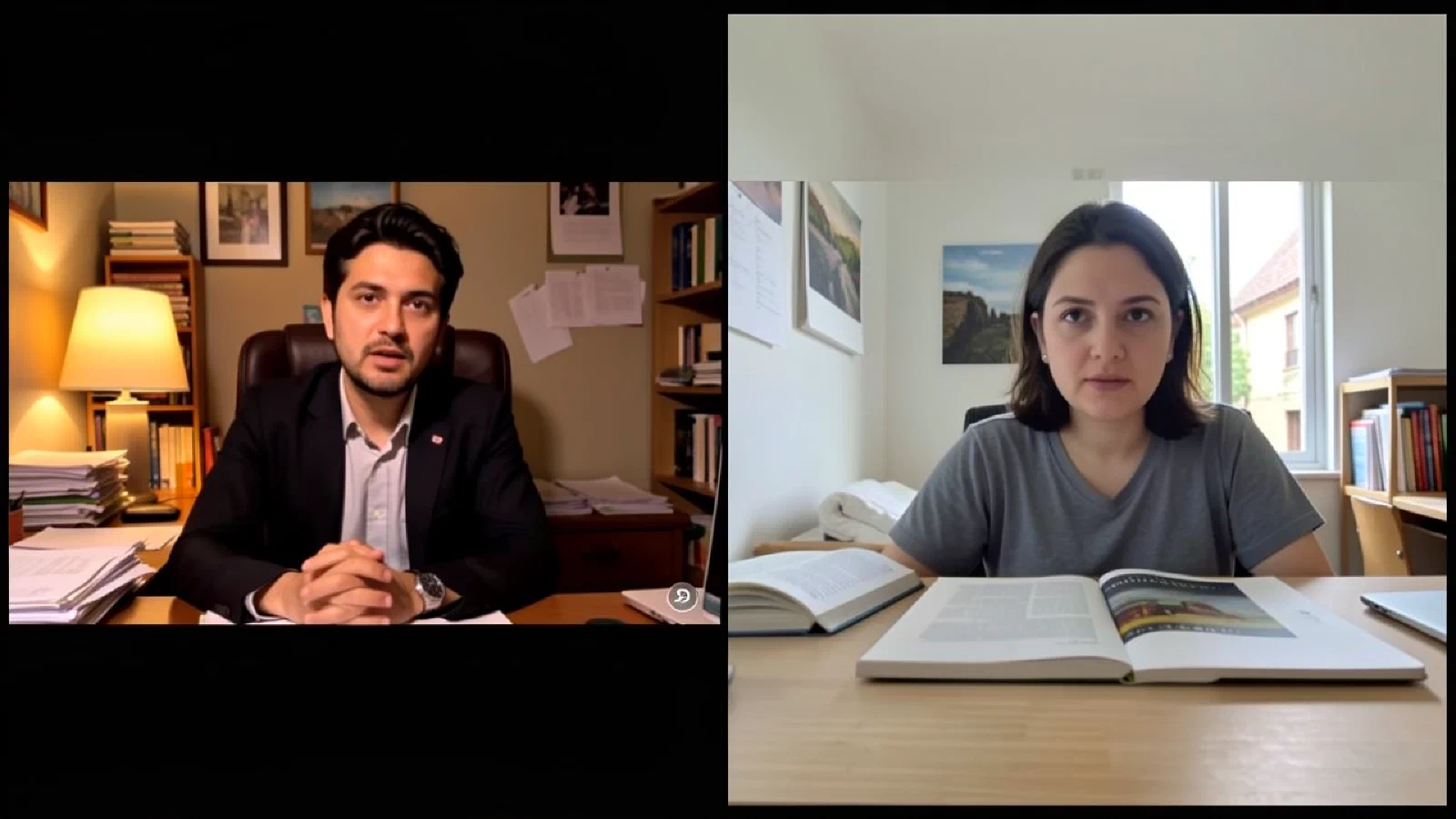
My son and I are on a video call. He is at Purdue. I am in Hyderabad. We talk most weeks, and the conversations wander the way they always have, from his coursework to my projects to the thing neither of us planned to discuss, which is usually the thing that matters.
Tonight he is describing a class that does not fit any of his four declared areas of study, which is why he is taking it. This is familiar. I was the same way. I finished my undergraduate degree at IIT Madras at twenty because formal systems moved too slowly and I wanted to get to the interesting part, which was everything that happened outside the systems. Twenty-nine years later, last October, I finished an MPH at Brown, because the question I needed to answer had finally caught up with the credential. I have never had a linear career. I have had a practice of following what interested me and trusting that the coherence would become visible later.
So when people assume I mourn the old professional order, they get me wrong. I was always uncomfortable inside it. I am atypical for my generation. Most of my peers built identity through professional titles and career trajectories. I built mine through problems I cared about, across industries and continents, and the million miles I logged were not a ladder. They were restlessness with a frequent flyer number.
But I notice something when Yagn talks about his future. He is building a credential the market has not named yet, for a profession that does not exist yet, in a world where the credentials might not matter the way they used to. He is not anxious about this. He is energized. And here is the thing I did not expect: even though I share his comfort with ambiguity, I feel something watching him navigate a world without the structures I chafed against. Not grief exactly. More like the recognition that the structures I resisted were still there, that I could push against them because they were solid enough to push against, and that pushing against something is different from standing in open space where there is nothing to push against at all.
The structures were a wall I climbed over. For Yagn, there is no wall. This should be better. I am not sure it is.
The First Question#
“What do you do?”
It is the first question at every social gathering, the handshake of adult identity in industrialized societies. The question is not really about employment. It is about placement. Where do you fit? What are you worth? What kind of person are you? The answer provides a name, a status, a community, a narrative. “I am a doctor” locates you in a social order more precisely than almost any other sentence you could speak.
Professional identity provides what Erik Erikson called a sense of continuity: the feeling that you are the same person across time, that your past leads coherently to your present, that you are going somewhere. The career was the narrative thread. You trained. You entered. You advanced. You arrived. Each stage confirmed the story. The story confirmed you.
AI does not just change what you do. It disrupts the narrative through which you understand who you are. James from The Empty Ledger, sitting at his desk, employed and unnecessary. The ledger of contribution empty. The meaning wound, which Case and Deaton documented in communities where traditional employment collapsed, is not about income. It is about the severing of the connection between effort and identity, between doing and mattering.
You can give someone a new paycheck. You cannot give them a new answer to the question of who they are.
Two Crises#
Here is what I did not fully see until Arc 5 made it visible.
The identity crisis is not one crisis. It is two, happening at the same time, in the same families, and they look completely different from each other.
The first is grief. Marco at the dinner table, furious about the insurance portal but furious about something deeper: the world no longer recognizes his competence. The uncle who asks Amara “what are you going to do?” because he does not have another question. The fifty-year-old whose title changed and whose pride did not survive the change. These are people who built a self around a professional identity and are watching it dissolve. The building took decades. The dissolution takes years. The gap between the two timelines is where the grief lives.
The second is vertigo. N1 never had the professional identity to lose. They arrived at adulthood without the narrative structure that told every previous generation what a life was supposed to look like. The career ladder was gone before they could climb it. The credential system was dissolving before they could earn the credentials. Amara’s inability to answer her uncle’s question is not a failure of ambition. It is the accurate perception that the question no longer has the kind of answer it used to have.
Grief and vertigo require different things. The grieving need their loss acknowledged, their competence recognized as real even if the context that gave it meaning has changed. The vertiginous need structures that provide direction without the rigidity of the old professional path: ways to mark progress, accumulate reputation, belong to something that persists.
Neither generation can help the other, because neither can fully feel what the other is going through. Marco cannot feel Amara’s vertigo because he has too much structure, even in its dissolution. Amara cannot feel Marco’s grief because she has never had the thing he is losing.
The Boy on the Porch#
Davi can feel both.
I keep returning to him because his position, between his father’s fury and his sister’s incomprehension, is the clearest lens on the identity transition. He carries enough memory of the old world to understand why his father’s competence mattered. He carries enough fluency in the new world to understand why his sister cannot see the loss. He translates between them at the dinner table, and the translation costs him something that neither of them fully appreciates.
The bridge generation’s double vision is the identity transition made visible. Davi knows what professional identity provided because he watched it organize his father’s life. He knows what its absence feels like because he is living without it. He is not grieving and he is not vertiginous. He is both, and the both is its own condition, the condition of seeing two operating systems from inside neither.
I think this position, uncomfortable as it is, may be the only one from which the next identity structures can be built. The grieving generation knows what the old identity provided but cannot imagine new forms. The vertiginous generation can imagine new forms but does not know what the old identity provided. The bridge generation knows both, and the knowing is painful, and the pain may be what makes the building possible.
What Might Replace It#
I do not know what replaces professional identity. But I can see people trying.
Identity organized around problems rather than domains. Not “I am a doctor” but “I work on the intersection of AI and pediatric care.” Amara’s pattern. Less legible, potentially more honest. The problem can change. The orientation persists.
Identity built on creative practice. The handmade premium from Arc 3 extends to all human creation. When AI produces competent work across every domain, the fact that a human made something, that a specific person with a specific history and specific limitations chose to invest their finite time in this particular act of creation, becomes the value. You are not what the market calls you. You are what you make with your hands and your attention.
Identity rooted in care. What you give rather than what you produce. The teacher, the mentor, the parent, the person who shows up when the showing up is hard. Arc 3 showed that AI cannot replace conscious presence. The identity built on providing that presence, on being the person who accompanies others through difficulty, may be the most durable identity available in the post-professional world.
Identity as translation. Davi’s discovery that his position between two worlds is not just a psychological condition but a vocation. The bridge generation member who realizes that the ability to honor both worlds, to carry the old world’s values into the new world’s forms, is itself a contribution that nobody else can make.
These are not consolation prizes. They are genuinely valuable sources of meaning. But they require a cultural transition from “you are what you do” to something else, and that something else has not yet stabilized. We are in the gap. The gap may last a generation.
I wonder whether the transition ever fully completes, or whether every generation from now on will have to build identity without the professional scaffolding that used to do half the work. Whether the question “who are you?” becomes permanently harder, not because people are lost but because the easy answers are gone and the honest answers require more courage.
The Third Voice#
I had a conversation last month, not with Yagn, that I have not been able to stop thinking about. A friend’s daughter, sixteen, was visiting. She is N1 in every sense: formed inside AI, fluent in the new world, carrying fragments of the old one. She had been listening to me talk about this project, about the generational divide, about Marco and Amara and the question that organizes this essay.
She was quiet for a long time. Then she said something precise. She said the way I talk about professional identity sounds like a house people built room by room. She said the way Yagn talks about his future sounds like a city he is exploring without a map. She said she feels like she is standing in the doorway of the house, looking out at the city, and she cannot tell whether the right move is to stay inside or to walk out.
It is, I think, the most honest description of the identity transition I have heard from anyone.
The question “what will I do for work?” was always really the question “who will I be?” We conflated the two for so long that the conflation felt natural. AI pries them apart. The hardest part of the transition is not finding new work. It is finding new answers to the identity question that work used to answer for us.
She is standing in the doorway. So are we all. The house is familiar and the city is vast and nobody has a map.
She will figure it out. So will Yagn. So, in a different way, will I.
I never loved the house. I spent most of my career climbing out windows. But I notice, now that the walls are coming down, that I always knew where the walls were. I could orient by them even when I was on the other side. Yagn does not have walls to orient by. Neither does she. Whether that makes them freer or more lost depends on something I cannot yet see.
It was probably both. Most structures are.
This is the fourth essay in Arc 6 of The Transformed, “The Grand Convergence.” Previous essays examined the dissolution of the profession, the apprenticeship crisis, and the equity dimension. This essay examines the identity question: who are you when you are not what you do, and how two generations answer it from opposite sides. The Transformed builds on The Empty Ledger, What Remains, The Plural Self, The Unbounded, and The Translators.
References#
Erikson, Erik H. Identity and the Life Cycle. W.W. Norton, 1980.
Jahoda, Marie. Employment and Unemployment: A Social-Psychological Analysis. Cambridge University Press, 1982.
Sennett, Richard. The Corrosion of Character: The Personal Consequences of Work in the New Capitalism. W.W. Norton, 1998.
Arendt, Hannah. The Human Condition. University of Chicago Press, 1958.
Taylor, Charles. Sources of the Self: The Making of the Modern Identity. Harvard University Press, 1989.
Case, Anne, and Angus Deaton. Deaths of Despair and the Future of Capitalism. Princeton University Press, 2020.
Frankl, Viktor E. Man’s Search for Meaning. Beacon Press, 1946.
Mannheim, Karl. “The Problem of Generations.” Essays on the Sociology of Knowledge, edited by Paul Kecskemeti, Routledge and Kegan Paul, 1952, pp. 276-322.
How this essay connects to others across The Approximate Mind.
- Erikson, Erik H. Identity and the Life Cycle. W.W. Norton, 1980.
- Jahoda, Marie. Employment and Unemployment: A Social-Psychological Analysis. Cambridge University Press, 1982.
- Sennett, Richard. The Corrosion of Character: The Personal Consequences of Work in the New Capitalism. W.W. Norton, 1998.
- Arendt, Hannah. The Human Condition. University of Chicago Press, 1958.
- Taylor, Charles. Sources of the Self: The Making of the Modern Identity. Harvard University Press, 1989.
- Case, Anne, and Angus Deaton. Deaths of Despair and the Future of Capitalism. Princeton University Press, 2020.
- Frankl, Viktor E. Man’s Search for Meaning. Beacon Press, 1946.
- Mannheim, Karl. “The Problem of Generations.” Essays on the Sociology of Knowledge, edited by Paul Kecskemeti, Routledge and Kegan Paul, 1952, pp. 276-322.