The Approximate Professional
What Work Was Always For#
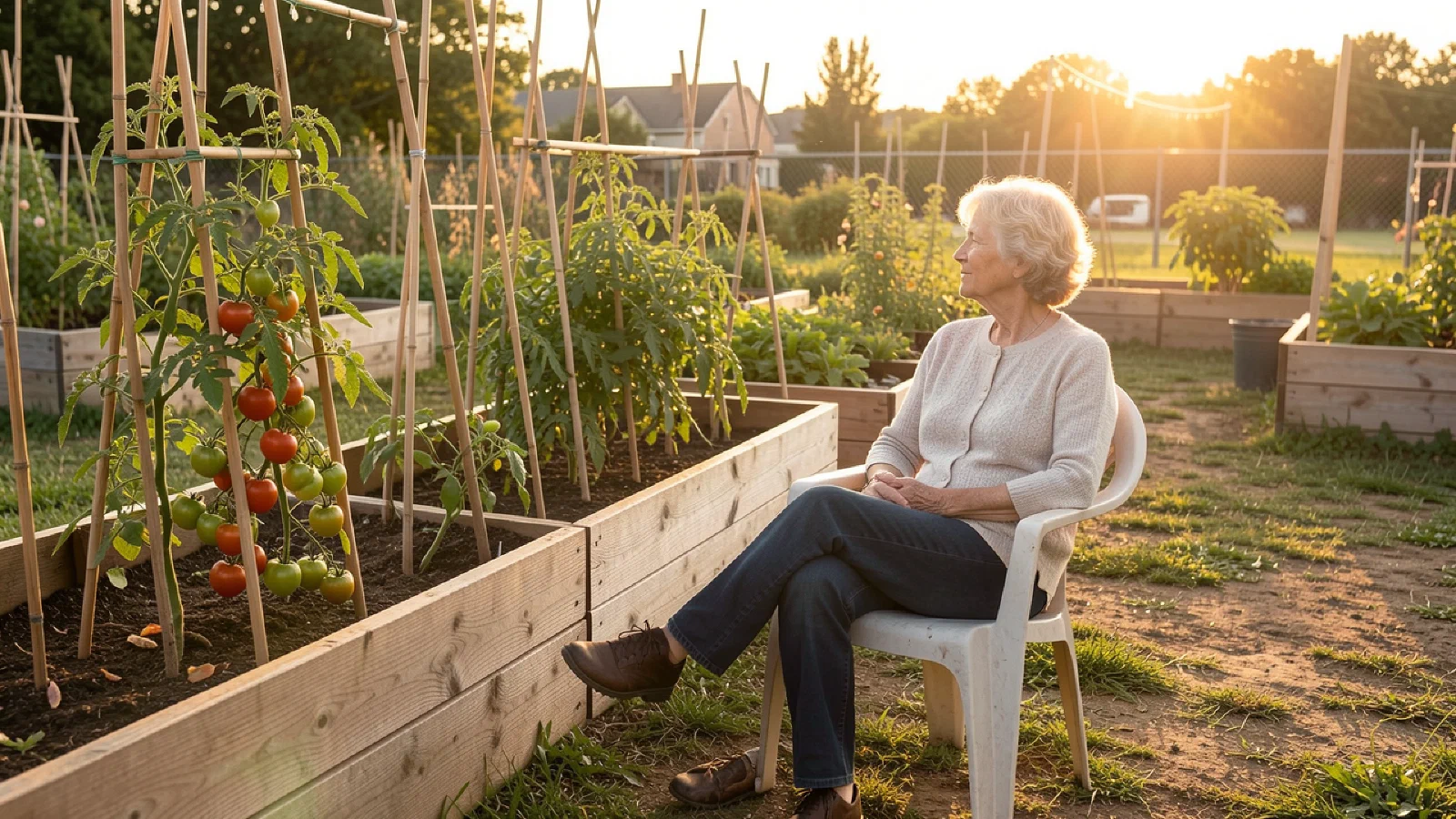
Margaret is in her garden. She is not doing anything in particular. The tomatoes need staking but she has not gotten to them. She is sitting in the plastic chair she bought at the hardware store that used to be on Fourth Street, before it became a fulfillment pickup point, and she is thinking about nothing she could name if you asked.
She has been the recipient of a lot of transformation. The AI-read scan. The insurance system that reorganized around algorithms she does not understand. The pharmacy where Linda spends more time verifying automated dispensing than talking to patients. The bank branch with two windows and a tablet. Margaret has encountered every dimension of the professional transition documented across thirty-nine essays, not as a case study but as a person trying to live her life while the ground shifts underneath her.
She has also been making choices. Which AI recommendations to follow and which to ignore. Which human professionals to trust. When to use the app and when to walk into the building. She still goes to the pharmacy in person because Linda asks how she is doing and means it. She drives to the bank branch because the woman at the remaining window knows her name.
These are not efficient choices. They are human ones. And Margaret’s stubborn insistence on being seen by people rather than processed by systems is, I think, the series’ argument about conscious presence applied to ordinary life.
She does not know she is making an argument. She is sitting in her garden. The not-doing is the most important thing about her.
The Distillation#
Here is what thirty-nine essays taught me.
The word most people use for what AI does to professions is transformation. I think the more precise word is distillation. Distillation removes what is volatile and leaves what is not. AI removes the computational, the routine, the procedural knowledge that could always, in principle, be formalized. What remains is the part that could not be formalized because it was not a procedure. It was an orientation.
The radiologist’s job description said she read scans. What mattered was her judgment about what the scan meant for this patient. The lawyer’s job description said she researched precedent. What mattered was her wisdom about which precedent spoke to this situation. The teacher’s job description said she delivered curriculum. What mattered was the Tuesday afternoon when she noticed a boy sitting in the back corner with a stillness that was different from the other quiet students, a practiced stillness, and she stayed after class and asked how he was doing.
She noticed before her training gave her vocabulary for what she was seeing. She was drawn toward seeing him before she had tools to help him.
The skill was never the vocation. The skill made the vocation legible to the market. AI is absorbing the skill layer, and the gravity underneath is showing. The orientation that drew certain people toward the core of their work, the thing they could not not do, before they were trained and after the training is obsolete. That orientation is what remains when everything that can be automated has been.
Every profession, under sustained AI pressure, is being distilled to its gravity. The farmer who persists is the one for whom the land was always a calling and not only a livelihood. The nurse who remains is the one whose hand on a frightened patient’s arm at 3 AM was never a task but a recognition of what she was for. The judge who endures is the one who carries the 3 AM uncertainty of having been wrong and returns to the bench the next morning to decide again.
AI did not create the gravity. It revealed it, by taking everything else.
The Complication#
But there is a complication, and it is the one I did not see until Arc 5 made it unavoidable.
The developmental process through which professionals became capable of the human work happened inside the computational work that AI absorbed. The radiologist’s judgment was built through years of reading routine scans. The lawyer’s wisdom was built through years of grinding research. The teacher’s presence was built through years of managing classrooms. Remove the developmental work and you expose the purpose but cut off the path to fulfilling it.
Work was always for the human development that happened in the doing, and AI takes the doing while leaving the development without its vehicle.
And it extends to childhood. Companions that provided comfort without demanding productive struggle. Personalized learning that eliminated the boredom through which tolerance for difficulty develops. The same pattern at every scale: the removal of what was difficult exposes what was valuable, and the valuable thing was developed through the difficulty that was removed.
The distillation reveals the gravity. The distillation also removes the process through which the gravity was developed into capability. This is not a contradiction. It is the central paradox of the entire project.
The Twenty-Year-Old#
Somewhere tonight, a twenty-year-old is studying.
Not because anyone is watching. Because the deal was clear: put in the work, finish the degree, and the world on the other side will have a place for you. She has been keeping her end of the bargain for four years. The credential is almost in hand.
What she does not yet know is that the world on the other side reorganized itself during those four years. The place that was being held for her is no longer there. Not because she was inadequate. Because a structural transformation of a speed and scale that economic history has no clean precedent for moved through the global labor market while she was preparing to enter it.
This is happening tonight in Lagos and Jakarta and Cairo and Dhaka. The twenty-year-old studying in one city is the same person as the twenty-year-old studying in a city ten time zones away. The bet they made is the same bet. The goalposts that moved, moved for all of them.
Elsewhere in this collection, the New Periphery suite (The Promised Ladder through The Same Diagnosis) traced this across nine essays. The promised ladder, whose rungs were built from credentials that worked long enough to become the foundation on which lives were organized. The blocked generation, whose educated underemployment produces grievance rather than frustration because the system, not the person, broke the contract. The wrong question, which revealed that employment was never the destination but a delivery mechanism for income, structure, identity, and belonging, and the mechanism is failing while we try to rebuild it rather than asking what it was delivering.
Margaret in her Midwestern garden and this student in her dormitory are inside the same transition. What Margaret lost was recognition, the encounter with humans who knew her name. What the student lost was the contract that was supposed to make her life legible to the economy. Both losses are real. Both are being answered, right now, mostly by default.
The Harder Implication#
There is something this argument implies that I have been circling and need to say directly.
Not everyone has strong vocational gravity toward a profession. The skill economy could absorb people across a vast range of orientations, because the skill layer was thick enough that competence served as a sufficient organizing principle for most work. A person could be reasonably competent at something, derive reasonable meaning from it, build a reasonable life around it. Reasonable was enough.
If the skill layer thins, if AI distills professions to their vocational core, the range of people who can find sustaining work organized around that core narrows. Not because the others lack value or capacity. Because the remaining work selects for orientations that are unevenly distributed in any population.
Vocation is not equally distributed. The call is not heard at the same volume by everyone.
Some of this is developmental. People who were never given conditions to discover their gravity may not know it yet. Kofi, walking home from school, thinking about a circuit board and his grandfather who was an engineer at the Akosombo Dam, may carry a vocational gravity he has never had the opportunity to name. The formation gap is partly an orientation gap: whose children get the conditions to discover what draws them?
Some of it is something harder to address. A society that organizes work around vocational alignment faces a version of the equity question it could previously defer by making the skill layer thick enough for broad employment. AI is removing the option to defer.
I wonder what we owe the people whose orientation does not map onto what the distilled economy needs. I do not have an answer. The question barely has a shape yet. But a project that has spent thirty-nine essays looking honestly at what AI does to work cannot pretend this question does not exist. It is the question underneath all the other questions, and it is the one most likely to be answered badly by default.
Four Choices#
The project distills to choices being made right now, mostly without awareness.
The equity choice. Who gets the human professional and who gets the machine. Catherine’s thirty minutes with an oncologist who brings tissues, or Rosa’s twelve minutes with a stranger. Sonia’s ambient formation or Kofi’s episodic fragments. The distribution of human attention is becoming the class structure of the AI age.
The development choice. Whether we invest in new ways to build human judgment across the full lifespan, or accept a generation that is fluent and capable and unable to exercise the judgment that fluency is supposed to serve. Mira standing in the room with her residents, hoping that presence is enough.
The identity choice. Whether we build structures that help people across two generations find meaning beyond professional achievement. Marco’s fury. Amara’s vertigo. Davi translating between them.
The formation choice. Whether we treat the formation of the next generation as a design problem deserving of civilizational attention. The companion designed as a village or a candy store. Noor, sitting on the floor of her room, carrying everything we chose and everything we neglected.
None of these have obvious answers. All of them are being answered right now by market incentives and institutional inertia. The one important thing is always: what kind of humans are we forming?
Margaret and Noor#
Margaret remembers what AI replaced. She remembers the pharmacist who had time. The teller who knew her situation. The doctor who spent forty-five minutes instead of nine. She remembers these with the specific knowledge of what was provided in those encounters that the AI versions do not provide. She felt recognized. She felt known. She felt like a person.
Noor will barely remember any of this. By the time she is Margaret’s age, the before-times will be history, not memory. The pharmacist who talked, the teller who knew your name: stories from another world.
Between them, the full scope. The world that was. The world that is. And the world being formed in the cognitive architecture of a sixteen-year-old who sits with a feeling she cannot name and does not reach for the companion to process it.
That small act of not reaching is everything this series has been about. Noor’s choice to sit with difficulty rather than resolve it is the human capacity AI cannot approximate. It is what Margaret does in her garden. It is what the radiologist does when she looks at the patient instead of the scan. It is what Sarah did when she noticed Theo (The Gravity). It is conscious presence, applied not to a profession but to a life.
What the Professionals Revealed#
The Approximate Mind has been asking its central question for over a hundred essays now: what does it mean that AI creates approximations of human cognition? The Transformed took that question into the world of work and spent thirty-nine essays watching what happened. What happened was distillation. AI stripped away the computational, the routine, the procedural, and what remained was the gravity: the vocational orientation that drew certain people toward certain kinds of work before they were trained and after the training became obsolete.
That is what the professionals revealed. Not that AI changes jobs. That AI shows us what jobs were always for.
But the professionals were only one lens. The Approximate Mind has others still to use.
The Waiting Room will ask what happens to the institutions of daily life, the pharmacy counter, the bank branch, the library, the DMV, when AI makes the trip unnecessary. The professionals behind the counter were examined here. The citizens in front of it have not been. Margaret’s pharmacy visit and Rosa’s clinic encounter and Kofi’s walk to school happen inside institutions that are being quietly emptied, and the emptying dissolves something the institutions were providing that nobody measured: the encounter, the recognition, the community that formed in the waiting room because waiting, it turns out, was where the town happened.
The Reshaped World will ask what happens to the civilizational systems built on top of the professions: the cities organized around commuting, the financial systems built on trust friction, the educational infrastructure designed for an economy that is disappearing, the governance structures calibrated for a citizenry that was organized by work. The Transformed examined the nodes. The Reshaped World examines the network.
And The Reimagined will ask, for the first time in this project’s history, what should be built. Not as prescription. As imagination, offered by a father and a son and an AI who have been paying attention for a long time and who believe that the people who have looked most carefully at what is breaking have some responsibility to wonder about what could be built in its place.
We are not done. We have finished asking what happens to the people who do the work. We have not yet asked what happens to the towns they serve, the systems they sustain, or the world their children will inherit.
The approximate mind approximates everything except what matters most. What matters most was always the human in the process, not the process itself.
Margaret is still in her garden. The tomatoes still need staking. She will get to them, or she will not. What matters is that she is here, present, thinking about nothing in particular, in the specific way that only a conscious being with a finite life and a particular history and a stubborn insistence on being herself can think about nothing in particular.
The AI cannot do this. Not because it lacks capability. Because “nothing in particular” is not a task. It is a condition of being alive, and being alive is not something you can approximate.
For now.
This is the final essay of The Transformed: thirty-nine essays across six arcs examining how AI distills professional work to its vocational gravity, dissolves institutional boundaries, and forms the first generation to grow up inside the transformation. The Transformed is one series within The Approximate Mind, which has explored AI’s intersection with human identity, consciousness, memory, belonging, administrative burden, economic structure, and global equity across more than a hundred essays. This capstone draws on the New Periphery suite (The Promised Ladder through The Same Diagnosis) and The Gravity. The project continues with The Waiting Room (the institutions of daily life), The Reshaped World (civilizational systems), and The Reimagined (what should be built).
References#
Arendt, Hannah. The Human Condition. University of Chicago Press, 1958.
Polanyi, Karl. The Great Transformation: The Political and Economic Origins of Our Time. Farrar and Rinehart, 1944.
Illich, Ivan. Tools for Conviviality. Harper and Row, 1973.
Berry, Wendell. The Art of the Commonplace: The Agrarian Essays. Counterpoint, 2002.
Frankl, Viktor E. Man’s Search for Meaning. Beacon Press, 1946.
Crawford, Matthew B. The World Beyond Your Head: On Becoming an Individual in an Age of Distraction. Farrar, Straus and Giroux, 2015.
Murdoch, Iris. The Sovereignty of Good. Routledge, 1970.
Weil, Simone. The Need for Roots. Translated by Arthur Wills, Routledge, 1952.
Bellah, Robert N., et al. Habits of the Heart: Individualism and Commitment in American Life. University of California Press, 1985.
Sen, Amartya. Development as Freedom. Knopf, 1999.
How this essay connects to others across The Approximate Mind.
- Arendt, Hannah. The Human Condition. University of Chicago Press, 1958.
- Polanyi, Karl. The Great Transformation: The Political and Economic Origins of Our Time. Farrar and Rinehart, 1944.
- Illich, Ivan. Tools for Conviviality. Harper and Row, 1973.
- Berry, Wendell. The Art of the Commonplace: The Agrarian Essays. Counterpoint, 2002.
- Frankl, Viktor E. Man’s Search for Meaning. Beacon Press, 1946.
- Crawford, Matthew B. The World Beyond Your Head: On Becoming an Individual in an Age of Distraction. Farrar, Straus and Giroux, 2015.
- Murdoch, Iris. The Sovereignty of Good. Routledge, 1970.
- Weil, Simone. The Need for Roots. Translated by Arthur Wills, Routledge, 1952.
- Bellah, Robert N., et al. Habits of the Heart: Individualism and Commitment in American Life. University of California Press, 1985.
- Sen, Amartya. Development as Freedom. Knopf, 1999.