The Physical Builders
When Robots Lay the Bricks, What Was Craft For?#
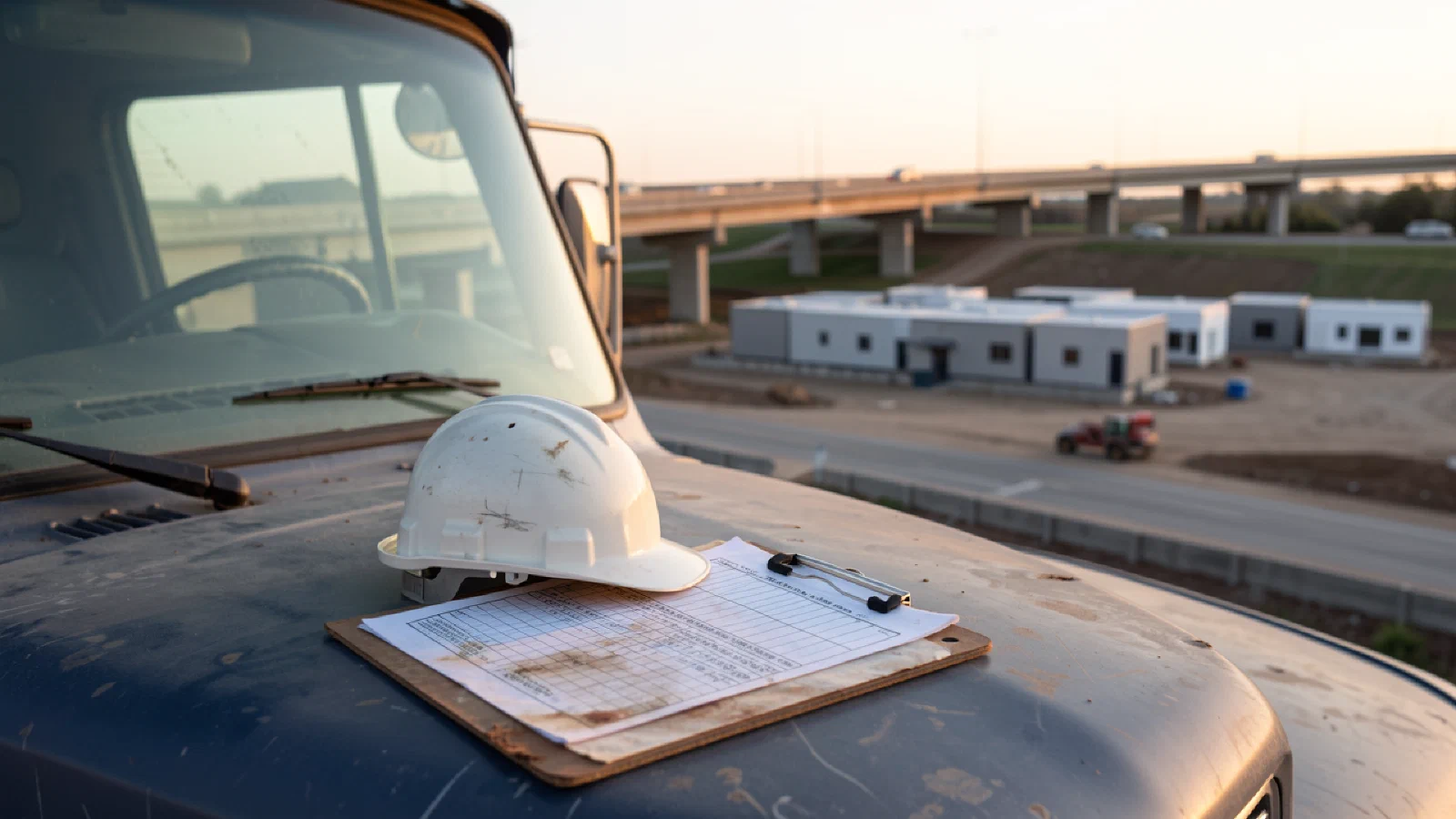
From the overpass on Interstate 71, south of Columbus, you can see both sites at once.
On the left, a housing development going up the way housing developments have gone up for decades. Workers in hard hats. The choreography of excavators, concrete trucks, framing crews. A foreman named Tom Kaminski walks the site with a clipboard, checking progress against a schedule he keeps partly on paper and partly in his head. He has been building houses for twenty-six years. He knows by the sound of a nail gun whether the framing crew is working green lumber. He knows by the way soil behaves after rain whether the drainage will hold. He knows things he cannot explain and makes decisions all day that he could not fully justify if asked to write them down.
On the right, a site that looks nothing like a construction site. Almost no humans. A fleet of autonomous units works through the night, coordinated by a system that optimizes sequencing in real time. Robotic arms assemble prefabricated wall panels with millimeter precision. A 3D concrete printer lays foundation elements in continuous loops. Drones survey the site every twenty minutes, feeding dimensional data back to the coordination system, which adjusts the next phase accordingly. The site is quieter than Tom’s. It is also faster. The first house on the right will be finished before the first house on the left has its roof.
Tom watches the robotic site sometimes, on his way home. He is not afraid of it exactly. He is something harder to name. The work his body knows, the work that gave him a middle-class life and a sense of himself as someone who builds things, is being done by machines that do not know what building means. His paycheck, for now, is the same. His identity is not.
What the Hands Know#
Michael Polanyi wrote that we know more than we can tell. He meant it as an epistemological claim: certain kinds of knowledge resist articulation. You cannot explain how to ride a bicycle by describing the physics of balance. You cannot teach someone to throw a pot by writing instructions. The knowledge is in the body, in the feedback loop between hand and material, in the accumulated adjustments of ten thousand repetitions.
Construction is full of this knowledge. A master carpenter reads wood grain by running her thumb across the surface, feeling the direction of the fibers, the density, the moisture content, adjusting her cut accordingly without conscious calculation. A bricklayer knows mortar consistency by the way it resists the trowel. Too wet and it slumps. Too dry and it will not bond. Right, and it has a quality he describes as buttery, a word that conveys nothing to someone who has not felt it. A welder listens to the arc. The sound tells her whether the heat is penetrating properly, whether the shielding gas is flowing correctly, whether the joint will hold.
Richard Sennett argued in The Craftsman that this embodied knowledge is not a primitive form of understanding that science will eventually replace. It is a distinct epistemological mode, a way of knowing the world through physical engagement with it that produces insights unavailable to purely abstract reasoning. The carpenter who feels the grain knows something about that piece of wood that a moisture meter does not capture. The knowledge is not less precise for being embodied. It is differently precise.
Matthew Crawford extended this in Shop Class as Soulcraft, arguing that manual work engages cognitive capacities that knowledge work often does not. The mechanic diagnosing an engine problem is doing something intellectually demanding: integrating sensory data, testing hypotheses, reasoning about causation in a physical system that talks back. The machine does not care about your theory. It either runs or it does not. This feedback loop, the material world’s refusal to be fooled, is a form of intellectual discipline increasingly rare in work that deals only with symbols and screens.
AI-coordinated construction does not replicate this knowledge. It routes around it. The robotic system does not feel the wood grain. It scans it with sensors that produce measurements more precise than any human thumb. It does not know mortar consistency by feel. It mixes to specification, monitored by chemical sensors that detect deviation in real time. It does not hear the weld. It monitors the arc with instruments that detect thermal irregularities invisible to the human ear.
The outputs are comparable or superior. The knowledge is categorically different. What is lost when the embodied mode disappears is not accuracy. It is a way of being in relationship with the material world that craft traditions cultivated across millennia.
Whether that loss matters depends on what you think craft was for.
The Swarm Replaces the Crew#
Traditional construction is sequential and human-paced. The foundation crew finishes, the framing crew arrives, the plumbers and electricians rough in, the drywall goes up, the finish work begins. Delays cascade. A framing crew slowed by rain delays the plumbing, which delays the electrical, which delays the inspection. Tom spends much of his day managing these dependencies, juggling schedules, making decisions about sequencing that are part logistics and part intuition he accumulated over decades.
Swarm robotics reorganizes this entirely. Autonomous units work in parallel, coordinated by a system that replans in real time as conditions change. While one set of units assembles wall panels, another prepares the site for the next phase, another fabricates custom components on site from digital plans. The system does not wait for framing to finish before preparing for plumbing. It interleaves tasks in patterns no human foreman would attempt, because no human can hold that many dependencies in mind at once.
Tom’s role, in this new arrangement, is exception handling. When a sensor reads something anomalous, when the soil behaves in a way the model did not predict, when a prefabricated component does not fit and the system cannot determine why, a human is called in. Tom is good at this. His twenty-six years make him very good at it. But the work feels different. He used to build. Now he supervises building and intervenes when things go wrong. His hands are clean at the end of the day.
He is not sure how he feels about that.
The Class Question#
The professions elsewhere in this arc involve educated, well-compensated people with transferable skills and financial cushions. Radiologists, financial analysts, software developers. They are being disrupted, but they have options. They can retrain, pivot, adapt. The disruption is real, but it lands on people with resources to absorb it.
Construction workers, manufacturing workers, tradespeople: these are working-class professions. Often union professions. Often the pathway to middle-class life for people without college degrees. The electrician who completed an apprenticeship. The welder who learned on the job. The heavy equipment operator who supports a family on a skill that took years to develop and does not transfer easily to a desk.
Some workers will move into swarm supervision, like Tom. Their embodied knowledge becomes the judgment that exception-handling requires. This is a real transition, but it is available to experienced workers whose judgment is worth augmenting, not to the apprentice who was still developing that judgment when the routine work disappeared.
Some will move into maintenance. AI-driven smart infrastructure creates genuine demand for skilled technicians who can install, diagnose, and repair physical systems. The plumber dispatched by an AI diagnostic system, arriving with the right parts already in her truck, guided by overlays showing the exact location of the problem, is still a plumber. But she diagnoses less and executes more. Whether she experiences this as liberation or deskilling depends on what she valued about the work.
Some workers will simply be displaced. This is the honest part. Not every construction worker will find a place in the new system. The gap between the promise of workforce transition and the reality of it is one of the persistent dishonesties of technological optimism. Retraining programs help some people. They do not help everyone. You cannot tell a forty-five-year-old roofer to learn to code. That was always a cruel suggestion, and it is crueler now that coding itself is being reorganized.
The demand-supply picture is real but partial. Construction labor shortages in developed economies are severe. Young people are not entering the trades at replacement rates. Robotic construction is partly addressing a shortage that was already leaving millions without adequate housing. Globally, UN-Habitat estimates 1.6 billion people live in inadequate shelter. The scale of building needed exceeds the capacity of the existing construction workforce by orders of magnitude.
But who benefits? If robotic construction builds luxury apartments in Manhattan and affordable housing in Lagos, the transformation serves humanity. If it builds luxury apartments in Manhattan and nothing in Lagos because the economics favor wealthy markets, it serves capital. The technology permits either. The politics determines which.
Margaret’s Kitchen#
Bring the transformation down to a single room. Margaret needs her kitchen renovated. The countertops are cracked, the cabinets are warping, the plumbing under the sink leaks intermittently.
Three years ago, this would have meant weeks of disruption. A contractor, subcontractors, scheduling conflicts, unexpected discoveries behind the walls, cost overruns, the particular chaos that makes homeowners swear they will never renovate again.
In 2031, the renovation arrives as a kit. Prefabricated cabinets manufactured to the exact dimensions of Margaret’s kitchen, scanned by robots that mapped the room in twenty minutes. Countertops cut from digital measurements. Plumbing components pre-assembled for her specific pipe configuration. An installation crew of autonomous units working four hours on a Tuesday while Margaret visits her daughter Sarah.
She comes home to a new kitchen. Clean. Precise. Better work, by every objective measure, than a human crew would have done, because the tolerances are tighter and the joints more consistent.
Margaret runs her hand along the new countertop. It is smooth. It is correct. It is also, in some way she cannot articulate, less hers than the old kitchen was, the one that Tom’s crew built twenty years ago. The corner cabinet was slightly off, because Tony the trim carpenter had to work around a pipe nobody expected, and the workaround became a feature: a little shelf where Margaret kept her tea tin. The new kitchen has no workarounds. It has no stories in the joints.
This is not only nostalgia. It is a genuine question about what we want from the built environment. The market will sort it out, and the sorting will have class dimensions: handcraft for those who can afford it, robotic precision for everyone else. A new luxury will emerge, the luxury of human-made, and it will be available to the people who need it least.
What Craft Was Always For#
The unbundling here follows the pattern of the whole arc, but with a weight the other professions did not carry. In diagnostics, the unbundling separated pattern recognition from judgment and both parties were well-compensated professionals whose identities could absorb the shift. In software, it separated coding from intent and the people affected were adaptable knowledge workers. Here, the unbundling separates physical execution from embodied judgment, and the people affected are working-class communities whose economic stability and sense of themselves are inseparable from the physical doing.
The transformation reveals that craft was always two things: the physical doing and the knowing that guided the doing. Tom’s hands built houses. Tom’s judgment decided how to build them, when to deviate from the plan, where the material demanded something the blueprint did not anticipate. The hands and the judgment developed together, through the same years of practice, and separating them feels like separating a person from their shadow.
But the separation is happening. The physical doing moves to machines. The knowing remains human, at least for now. Whether the knowing can survive without the doing, whether judgment can be maintained when the hands are clean, whether a new form of embodied knowledge emerges from directing autonomous systems rather than wielding tools, these are open questions. Nobody knows the answer yet.
Sennett wrote that craft is the desire to do a job well for its own sake. If that holds, then craft survives the transformation, because the desire does not depend on whether the work is done by hands or by systems that hands direct. The foreman who takes pride in a well-coordinated swarm, who feels satisfaction when the autonomous systems produce something he judges to be right, may be practicing craft in a form Sennett would recognize.
Or he may not. Tom is not sure.
He watches the robotic site from the overpass, coffee in hand, and what he feels is not fear and not excitement but something in between. The knowledge in his hands is real. The machines do not have it. Whether they need it, whether the world needs it, whether it survives in any form when the last generation that learned it has retired, he does not know.
The question is not whether robots can build. They can. The question is what happens to the dignity that lived in the building. And whether it is possible that the new form of craft, directing autonomous systems with the judgment that only experience produces, develops its own dignity. Its own tacit dimension that we cannot yet name because it is too new to have names.
The Transformed is a series within The Approximate Mind examining how AI reshapes professional work across six arcs. The previous essays found that AI unbundles computation from judgment in medicine, prediction from interpretation in uncertainty professions, and coding from intent in software. This essay finds the same unbundling in physical work, but with a different human weight: the people affected are working-class communities whose identities and livelihoods are inseparable from the physical doing. The series builds on What Will AI Feel, The New Work, Democratized Cognition, and The Paperwork of Being Alive.
References#
Embodied Knowledge and Craft
Crawford, Matthew B. Shop Class as Soulcraft: An Inquiry into the Value of Work. Penguin, 2009.
Ingold, Tim. Making: Anthropology, Archaeology, Art and Architecture. Routledge, 2013.
Pirsig, Robert M. Zen and the Art of Motorcycle Maintenance. William Morrow, 1974.
Polanyi, Michael. The Tacit Dimension. Doubleday, 1966.
Sennett, Richard. The Craftsman. Yale University Press, 2008.
Construction Automation and Robotics
Bock, Thomas, and Thomas Linner. Robot-Oriented Design: Design and Management Tools for the Deployment of Automation and Robotics in Construction. Cambridge University Press, 2015.
Melenbrink, Nathan, et al. “On-Site Autonomous Construction Robots: Towards Unsupervised Building.” Automation in Construction, vol. 119, 2020, article 103312.
Global Housing and Labor
International Labour Organization. The Future of Work in the Construction Industry. ILO, 2023.
UN-Habitat. World Cities Report 2022: Envisaging the Future of Cities. United Nations, 2022.
Work, Class, and Technological Change
Autor, David H. “Work of the Past, Work of the Future.” AEA Papers and Proceedings, vol. 109, 2019, pp. 1-32.
Braverman, Harry. Labor and Monopoly Capital: The Degradation of Work in the Twentieth Century. Monthly Review Press, 1974.
Standing, Guy. The Precariat: The New Dangerous Class. Bloomsbury, 2011.
How this essay connects to others across The Approximate Mind.
- Crawford, Matthew B. Shop Class as Soulcraft: An Inquiry into the Value of Work. Penguin, 2009.
- Ingold, Tim. Making: Anthropology, Archaeology, Art and Architecture. Routledge, 2013.
- Pirsig, Robert M. Zen and the Art of Motorcycle Maintenance. William Morrow, 1974.
- Polanyi, Michael. The Tacit Dimension. Doubleday, 1966.
- Sennett, Richard. The Craftsman. Yale University Press, 2008.
- Bock, Thomas, and Thomas Linner. Robot-Oriented Design: Design and Management Tools for the Deployment of Automation and Robotics in Construction. Cambridge University Press, 2015.
- Melenbrink, Nathan, et al. “On-Site Autonomous Construction Robots: Towards Unsupervised Building.” Automation in Construction, vol. 119, 2020, article 103312.
- International Labour Organization. The Future of Work in the Construction Industry. ILO, 2023.
- UN-Habitat. World Cities Report 2022: Envisaging the Future of Cities. United Nations, 2022.
- Autor, David H. “Work of the Past, Work of the Future.” AEA Papers and Proceedings, vol. 109, 2019, pp. 1-32.
- Braverman, Harry. Labor and Monopoly Capital: The Degradation of Work in the Twentieth Century. Monthly Review Press, 1974.
- Standing, Guy. The Precariat: The New Dangerous Class. Bloomsbury, 2011.