The Diagnosticians
When AI Reads the Scan, Who Reads the Patient?#
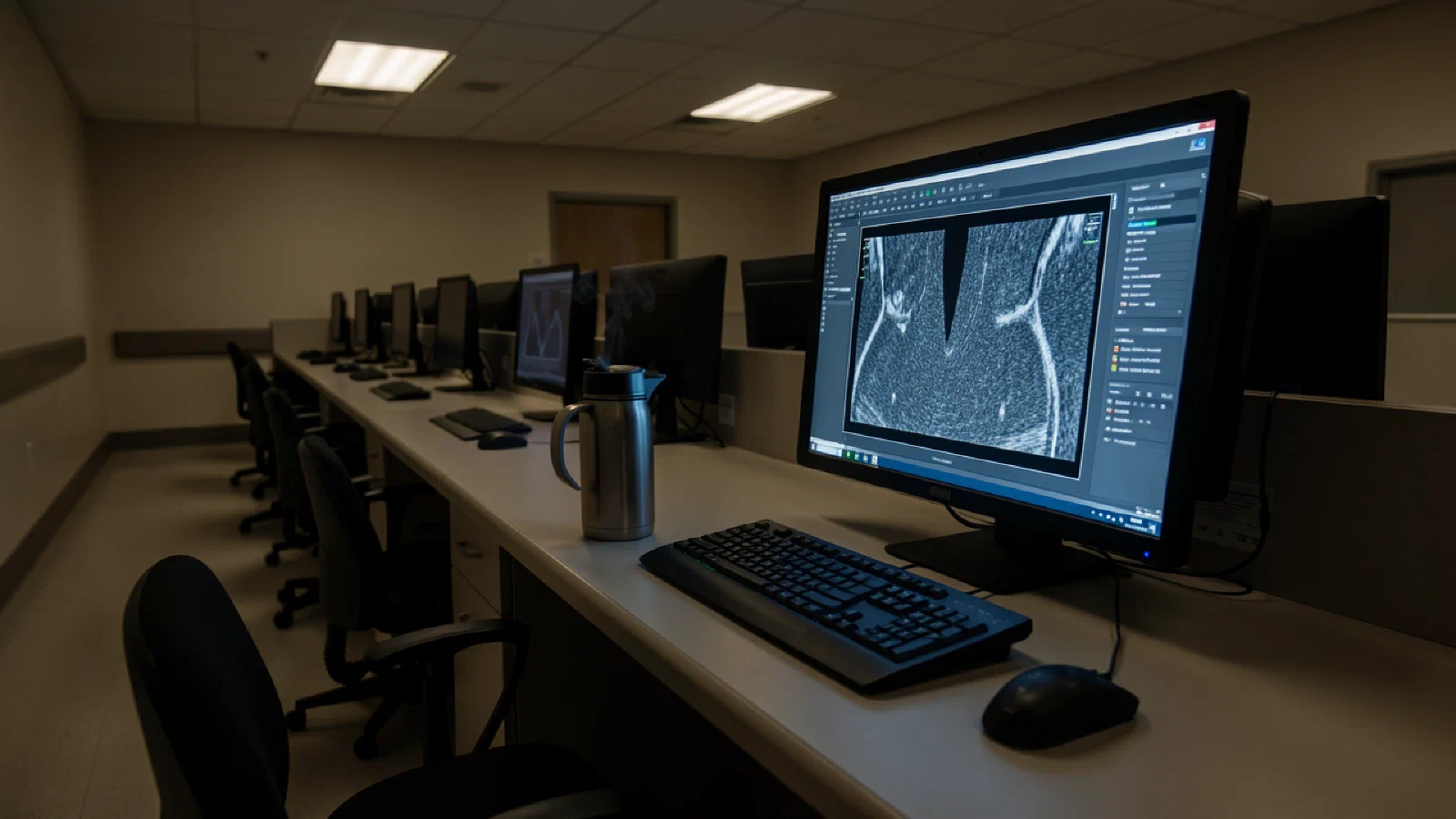
Priya Venkatesh keeps a thermos of chai on the console beside her keyboard. She has strong opinions about cricket and mild opinions about most other things. She has been reading images of lungs, livers, kidneys, and bones for eleven years, long enough that she sometimes sees the pattern before she can name it, the way a musician hears a false note before she identifies which instrument.
She arrives at the reading room at 6:15 in the morning, which is not discipline so much as habit calcified into something that feels like preference. Three years ago, this room held twelve radiologists. Today it holds five.
Not because seven were let go. Because the work reorganized itself around what remained.
The common narrative about AI and medicine is a replacement story. Machines that read faster, more accurately, without fatigue or distraction, arriving to displace the people who used to do what machines now do. The replacement story is clean. It has a shape: before and after, winners and losers. What I found when I started paying attention to what radiologists actually describe is something harder to diagram. Something that looks less like displacement and more like a profession discovering what it was always for.
What Reaches the Screen#
The AI Priya works with triages everything first. Routine chest X-rays, unambiguous, no findings of concern, are flagged and released. Obvious pathologies are pre-reported and queued for rapid confirmation. What reaches her screen is the remainder. The ambiguous. The cases where the system’s confidence drops below a threshold that means, as nearly as I can translate it: I found something but I am not sure what it means.
She used to read two hundred scans a day. She reads forty now.
The forty she reads are harder than anything she faced three years ago, because the routine cases never reach her. Every image on her screen is a genuine puzzle: the shadow that could be artifact or tumor, the subtle asymmetry that might indicate early pathology or normal variation, the scan where clinical context changes the interpretation entirely. She is, by every measure, a more skilled diagnostician than she was before. She is also more tired at the end of the shift. Easy cases provided rhythm. Difficult cases provide meaning, but not rest.
I asked Priya whether she misses the routine work.
She thought about it. “A little,” she said. “The way you miss anything that was yours.”
That is a more honest answer than I expected. It names something the enthusiasm for AI transformation tends to obscure: things are lost even in transitions that are, on balance, good. The rhythm mattered. The accumulation of many ordinary cases was not just inefficiency. It was the texture of a working day, and textures disappear without ceremony.
But Priya now reviews flagged cases from a rural clinic in Madhya Pradesh that has never had a radiologist. From a district hospital in Bihar where a single overworked physician was reading his own images. From a women’s health screening program in Rajasthan that could not justify a full-time specialist. The AI processes the volume. Priya provides the judgment. And patients in communities that never had access to specialist interpretation are receiving it, for the first time.
The bottleneck moved. It used to be reading. Now it is interpretation, which is what her training always prepared her to do.
The Line Accountability Cannot Cross#
Adaeze Okafor’s situation reveals something different.
Adaeze is a pathologist in Lagos. She has two daughters and a weakness for terrible detective novels, which she reads on her phone while tissue samples process. She has been doing this work for fourteen years, long enough that she has developed what she calls “a feeling for tissue” that she cannot fully explain to trainees, which worries her.
Her AI system analyzes tissue samples with pattern recognition that matches or exceeds human accuracy on well-characterized pathologies. For standard biopsies, it identifies cellular abnormalities, classifies tumor grades, and generates preliminary reports with confidence scores.
Adaeze reviews these reports. She confirms most. She adjusts perhaps fifteen percent. She overrides perhaps two percent entirely, because something about the tissue, something about the patient’s history, something about the clinical context tells her the pattern-match has missed the point.
That two percent has become the center of gravity of her profession.
A pathology report is not usually a recommendation. It is closer to a verdict. Cancer or not cancer. Malignant or benign. The treatment plan, the surgical decision, sometimes the decision about whether to treat at all, follows directly from the pathologist’s call. When the system says “high probability of malignant neoplasm, confidence 94%,” someone must decide whether that is cancer. And someone must be accountable for that decision.
That someone cannot be the AI. Not because the AI is wrong more often. It may be wrong less often. But accountability requires a moral agent, a person who can be questioned by the oncologist, challenged by the patient, overruled by a second opinion, who bears the weight of the call. The pathologist’s signature on the report is not a formality. It is the moment where computational probability becomes medical authority.
We have spent considerable energy asking whether AI can do what doctors do. The pathology story suggests the question conflates two different activities. Analysis can be performed by a system with no stake in the outcome. Accountability cannot. Accountability is not a skill. It is a relationship, between the person who makes the call and the person who lives with the consequences.
The analysis was always separable from the accountability. We bundled them because we had no choice. Now we have a choice, and we are only beginning to understand what that means.
What we keep wondering, and we want to be clear that this is wondering rather than finding, is where responsibility sits for the shape of the AI that Adaeze is working with. Not whether she should sign the report. Of course she should. But the AI she is reviewing arrived with a set of choices already made inside it. Whether it explains why its confidence is 94% and not 87%. Whether it names the competing interpretations it considered before settling on one. Whether it flags when a tissue type sits near the edge of its training data, resembling cases it has seen rarely. Whether it suggests a lower-cost confirmatory test when its own uncertainty is high, rather than proceeding to a verdict. I do not know how these decisions get made inside medical AI development, what the technical or regulatory or commercial constraints actually are, or what the people building these systems are thinking about when they make them. I am on the outside of that process entirely.
But the question seems worth asking: if the liability for a wrong finding lands on Adaeze, and the choices that shaped what the AI showed her were made by people she has never met and cannot hold to account, something about that distribution is worth examining. I am not sure what the right answer is. I am not even sure I have framed the question correctly. What I notice is that the current conversation about AI in medicine focuses heavily on accuracy and access, and less on what kind of partner the AI is built to be for the person who must answer for its output.
Lagos has a severe pathologist shortage. Biopsy backlogs stretched to months, during which patients lived with the uncertainty of not knowing whether the lump was killing them. The AI cut Adaeze’s turnaround from weeks to days. Patients who would have waited in dread now receive answers at a speed that was simply impossible before. Adaeze is not losing relevance. She is, for the first time, able to serve the patient volume that was always there, waiting, unmet. None of that diminishes the question of what the AI she is working with has been built to do, and for whom.
What Margaret’s Endocrinologist Does Now#
Margaret lives in rural Indiana. She has had type 2 diabetes for fourteen years. She plays bridge on Thursday evenings, is moving slowly through a grief that arrived when her husband died and has not fully resolved, and is considering whether to move closer to her daughter. She sees Dr. Emily Chen, her endocrinologist, twice a year.
The continuous glucose monitor Margaret wears, paired with an AI system tracking her levels, her medication timing, her activity, her sleep, her meal patterns, has changed what those visits are for. The system adjusts her insulin management in real time, catching what quarterly blood work could never see: the dawn effect that spikes her glucose before she wakes, the delayed impact of Thursday’s bridge dinners, the way her levels destabilize when she is anxious about her daughter’s travel.
Dr. Chen sees the dashboard before Margaret walks in. She knows, before they sit down, exactly how the last six months have gone. The old visit was diagnostic: what has happened since we last met? The new visit is something different.
“What do these patterns mean for how you want to live?” is roughly how Dr. Chen described the question she is now in the business of asking.
Margaret’s glucose could be optimized further if she eliminated the Thursday dinners. Margaret would rather have the dinners and manage the consequences. That is a values judgment, not a medical one, and it requires a physician who knows Margaret well enough to respect it. Dr. Chen spends less time reviewing numbers and more time in conversation. About Margaret’s fear of falling. About whether to move closer to her daughter. About the fatigue that might be diabetes or might be something else that has never fully been named.
The AI freed Dr. Chen from the computational labor of chronic disease management. What it freed her into was the human work of knowing a patient.
I do not think this transformation is uniformly good. Some physicians were not trained for this kind of conversation and are not comfortable in it. Some patients do not want to be known this way. They want the transaction: numbers reviewed, prescription adjusted, goodbye. The shift assumes a vision of medical care as relationship that is not universally shared or universally possible within the constraints of how care is organized and paid for. I am genuinely uncertain how that resolves.
But when I ask physicians what they are doing now that they were not doing before, what keeps coming back is: listening. Talking. Sitting with the patient in the question of what they want their life to be.
The Demand That Was Always There#
The replacement narrative frames AI in medicine as a threat. Fewer jobs, displaced specialists, a profession under siege.
There are not enough diagnosticians on Earth.
Sub-Saharan Africa has approximately one pathologist per million people. India has roughly half the radiologists it needs, concentrated in cities while rural populations go unserved. A CT scanner in a rural hospital without anyone trained to read its images is furniture. Even in wealthy nations, specialist wait times stretch to months, and the physicians who practice are burning out under volumes their training did not anticipate.
The profession does not shrink. The definition of who it serves expands.
The question was never “will AI take the radiologist’s job?” The question was always “will anything finally make the radiologist’s expertise reachable for the billion people who have never had access to it?”
There is an equity risk here worth naming. The same systems that extend Priya’s reach could, if deployed without care, allow health systems in wealthy countries to improve further while systems in poorer countries receive a digital substitute rather than the real thing. Remote AI-assisted diagnosis is better than nothing. It is not the same as having a radiologist who knows the local context, the equipment’s quirks, the clinical presentation patterns of a specific population. The technology creates a possibility. Whether that possibility becomes equity or becomes a new layer of extraction depends on choices being made right now by people who are not, for the most part, thinking about them this way.
The Problem Nobody Has Solved, and One Partial Answer#
Priya learned to read scans by reading a great many of them. Not the interesting ones. The ordinary ones. The volume of routine work built the pattern recognition that now allows her to see significance in ambiguity. The easy cases were the foundation. The difficult cases are the visible structure.
The AI has removed the easy cases from the queue.
Trainees coming into radiology today are not building pattern recognition through volume the way Priya did. They are working with cases already filtered for difficulty, which may be better preparation for the work they will actually do, but which may not develop the underlying perceptual fluency in the same way. I genuinely do not know which of those is true, and I am not sure anyone does yet.
What we find ourselves wondering is whether the same technology that dissolved the old developmental pathway might be able to create a different one. Not by mimicking the old approach, but through possibilities that simply did not exist before.
Teaching and transparency are two separate things, and I think it matters to keep them separate. A transparent AI, one that externalizes its confidence intervals and competing hypotheses, is interesting. But the AI can teach regardless of whether it is transparent about its own internals. A great teacher does not narrate their own cognition. They create conditions for the student to develop theirs. An AI working alongside a trainee could build case libraries calibrated to what that trainee keeps missing. It could scaffold differential diagnosis in real time, not by showing its own reasoning but by asking the trainee to reason first. It could track patterns in the trainee’s errors across months and surface them in ways no attending physician, stretched across a department, realistically could. None of that requires the AI to be transparent about how it reached its own conclusions. It requires the AI to be genuinely oriented toward the trainee’s development, which is a different design goal than accuracy on a benchmark.
And then there is a third possibility that I find harder to articulate but more interesting than either of the first two.
When Adaeze overrides the AI, something happened in that moment that the AI does not understand. It had 94% confidence. She saw something different. The current relationship between clinician and AI treats that override as a correction: the clinician was right, the AI was wrong, the interaction ends there. But what if the AI were genuinely curious about what Adaeze saw? Not logging the correction for future training in the background, passively, but actively asking: what was it in the clinical history that changed your reading? What feature of the tissue did you weight differently, and why? What have you seen before that this reminded you of?
That would be a different kind of relationship entirely. Not the clinician checking the AI’s work, but both of them learning from the same case in different directions. The AI’s curiosity making Adaeze’s tacit knowledge visible, to the trainee watching, to the AI itself, possibly even to Adaeze, who may not have fully articulated why she overrode the system until someone asked. The senior clinician becomes a teacher not just to trainees but to the AI, which changes what seniority means and what the learning environment of a clinical department could be.
I want to be careful not to describe this as though it exists or as though building it would be simple. I am speculating about a possibility, not reporting on a practice. What I notice is that none of the current conversation about AI in diagnostic medicine seems to be asking this question. The conversation is about accuracy, about access, about liability. It is not much about what kind of learning relationship the AI could be designed to support, for trainees and for the clinicians it works alongside, and whether that design question is being asked by the people who have the most influence over the answer.
Some training programs are experimenting with AI-generated case libraries to restore volume-based learning in simulation. Others are restructuring mentorship toward intensive case review alongside AI output. None of these approaches have been validated at scale. The generation currently in training will be the test case, a cohort whose outcomes we will not be able to assess for a decade, by which time the experiment will be, in practical terms, irreversible.
The developmental pathway that produced diagnostic expertise has been dissolved. Whether what replaces it can produce equivalent judgment, or different judgment that serves patients equally well, is one of the more consequential open questions in medicine right now. And it is not being asked loudly enough.
This will not be unique to diagnostics. It will surface in profession after profession, in different forms but with the same underlying structure. The work AI automates is often the same work through which humans developed the expertise to do what AI cannot automate. Remove the foundation and the upper floors lose their support. Whether the foundation can be rebuilt differently is not yet clear, and the stakes accumulate with every cohort that enters training under conditions none of us have figured out.
What Was Always Two Things#
The standard framing asks what happens to diagnosticians when AI arrives. I keep coming back to a different question: what does AI’s arrival reveal about what diagnosticians were always doing?
They were always doing two things. Reading patterns and making judgments. The reading required knowledge, training, repetition, a particular kind of computational fluency. The judging required something else: clinical context, moral accountability, relationship with the patient and the referring physician, the willingness to bear the weight of a call that could be wrong.
We bundled these because humans had to do both. A radiologist who could read patterns but not exercise judgment was useless. A radiologist with superb judgment but slow pattern recognition was a bottleneck. The profession selected for people who could do both, and the training developed both capacities at once.
AI unbundles them. It takes the reading and leaves the judging. And in doing so, it reveals that the judging was always the harder, rarer, more valuable part. The part that required not just training but experience. Not just knowledge but something that accumulates over years and cannot yet be transferred by any means we have.
Priya in Mumbai is living this every morning. Adaeze in Lagos, signing reports that carry her name and her accountability, working with a system whose design choices she did not make and largely cannot see. Dr. Chen in Ohio, the AI dashboard open on her screen, sitting across from Margaret, talking not about numbers but about what matters.
The diagnosticians are not disappearing.
But that observation needs to be held lightly. What is emerging is genuinely different from what existed before, and different things carry different losses even when the net is better. The accountability for the shape of that difference does not belong entirely to the profession adapting to it. Some of it belongs to the developers who decided how much of the AI’s reasoning to make visible. Some of it belongs to the institutions that deployed these tools without building the new developmental infrastructure to replace what the tools dissolved. Some of it belongs to the systems, political and economic, that will determine whether the technology’s reach extends to the people who need it most or consolidates further around those who already have access.
These are not rhetorical observations. They are questions about where responsibility lives when a technology reshapes a profession’s capacity to do its work and train its successors. Diagnostics is only the first profession where we have to ask them.
The Transformed is a series within The Approximate Mind examining how AI reshapes professional work across six arcs. This first arc, The Expected Storm, begins with the professions where AI’s arrival was widely anticipated. Subsequent essays examine interpreters of uncertainty, digital builders, physical builders, the language professions, the legal ecosystem, and the thread connecting them all. Two threads introduced here, the design choices embedded in how AI systems are built, and the apprenticeship gap created when AI dissolves the developmental work it replaces, run through every arc that follows. The Transformed builds on foundations laid across the main series, particularly The New Work, Good Enough for Whom, and the administrative burden arc (The Paperwork of Being Alive, The Burden of Rights, and The Honest State).
References#
Medical Workforce and Global Access
Chen, Lincoln, et al. “Human Resources for Health: Overcoming the Crisis.” The Lancet, vol. 364, no. 9449, 2004, pp. 1984-1990.
Farmer, Paul. Pathologies of Power: Health, Human Rights, and the New War on the Poor. University of California Press, 2003.
Mollura, Daniel J., et al. “Radiology in Global Health: Strategies, Implementation, and Applications.” Current Radiology Reports, vol. 2, no. 5, 2014, article 50.
Wilson, Marilyn L., et al. “Access to Pathology and Laboratory Medicine Services: A Crucial Gap.” The Lancet, vol. 391, no. 10133, 2018, pp. 1927-1938.
World Health Organization. Health Workforce. WHO Global Health Observatory, 2023, www.who.int/health-topics/health-workforce.
AI in Diagnostic Medicine
Esteva, Andre, et al. “A Guide to Deep Learning in Healthcare.” Nature Medicine, vol. 25, 2019, pp. 24-29.
Rajpurkar, Pranav, et al. “AI in Health and Medicine.” Nature Medicine, vol. 28, 2022, pp. 31-38.
Topol, Eric J. Deep Medicine: How Artificial Intelligence Can Make Healthcare Human Again. Basic Books, 2019.
AI Transparency, Explainability, and Design Accountability
Lundberg, Scott M., and Su-In Lee. “A Unified Approach to Interpreting Model Predictions.” Advances in Neural Information Processing Systems, vol. 30, 2017, pp. 4765-4774.
Mittelstadt, Brent, et al. “The Ethics of Algorithms: Mapping the Debate.” Big Data and Society, vol. 3, no. 2, 2016, pp. 1-21.
Obermeyer, Ziad, et al. “Dissecting Racial Bias in an Algorithm Used to Manage the Health of Populations.” Science, vol. 366, no. 6464, 2019, pp. 447-453.
Reyes, Mauricio, et al. “On the Interpretability of Artificial Intelligence in Radiology: Challenges and Opportunities.” Radiology: Artificial Intelligence, vol. 2, no. 3, 2020, e190043.
Rudin, Cynthia. “Stop Explaining Black Box Machine Learning Models for High Stakes Decisions and Use Interpretable Models Instead.” Nature Machine Intelligence, vol. 1, 2019, pp. 206-215.
Clinical Judgment and the Structure of Expertise
Dreyfus, Hubert L., and Stuart E. Dreyfus. Mind Over Machine: The Power of Human Intuition and Expertise in the Era of the Computer. Free Press, 1986.
Kahneman, Daniel, and Gary Klein. “Conditions for Intuitive Expertise: A Failure to Disagree.” American Psychologist, vol. 64, no. 6, 2009, pp. 515-526.
Polanyi, Michael. The Tacit Dimension. Doubleday, 1966.
Medical Education and the Apprenticeship Problem
Ericsson, K. Anders. “Deliberate Practice and the Acquisition and Maintenance of Expert Performance in Medicine and Related Domains.” Academic Medicine, vol. 79, no. 10, 2004, pp. S70-S81.
Patel, Vimla L., et al. “The Coming of Age of Artificial Intelligence in Medicine.” Artificial Intelligence in Medicine, vol. 46, no. 1, 2009, pp. 5-17.
Accountability and Medical Authority
Gawande, Atul. Complications: A Surgeon’s Notes on an Imperfect Science. Picador, 2002.
Mukherjee, Siddhartha. The Laws of Medicine: Field Notes from an Uncertain Science. Simon and Schuster, 2015.
Health Equity
Deaton, Angus. The Great Escape: Health, Wealth, and the Origins of Inequality. Princeton University Press, 2013.
How this essay connects to others across The Approximate Mind.
- Chen, Lincoln, et al. “Human Resources for Health: Overcoming the Crisis.” The Lancet, vol. 364, no. 9449, 2004, pp. 1984-1990.
- Farmer, Paul. Pathologies of Power: Health, Human Rights, and the New War on the Poor. University of California Press, 2003.
- Mollura, Daniel J., et al. “Radiology in Global Health: Strategies, Implementation, and Applications.” Current Radiology Reports, vol. 2, no. 5, 2014, article 50.
- Wilson, Marilyn L., et al. “Access to Pathology and Laboratory Medicine Services: A Crucial Gap.” The Lancet, vol. 391, no. 10133, 2018, pp. 1927-1938.
- World Health Organization. Health Workforce. WHO Global Health Observatory, 2023, www.who.int/health-topics/health-workforce.
- Esteva, Andre, et al. “A Guide to Deep Learning in Healthcare.” Nature Medicine, vol. 25, 2019, pp. 24-29.
- Rajpurkar, Pranav, et al. “AI in Health and Medicine.” Nature Medicine, vol. 28, 2022, pp. 31-38.
- Topol, Eric J. Deep Medicine: How Artificial Intelligence Can Make Healthcare Human Again. Basic Books, 2019.
- Lundberg, Scott M., and Su-In Lee. “A Unified Approach to Interpreting Model Predictions.” Advances in Neural Information Processing Systems, vol. 30, 2017, pp. 4765-4774.
- Mittelstadt, Brent, et al. “The Ethics of Algorithms: Mapping the Debate.” Big Data and Society, vol. 3, no. 2, 2016, pp. 1-21.
- Obermeyer, Ziad, et al. “Dissecting Racial Bias in an Algorithm Used to Manage the Health of Populations.” Science, vol. 366, no. 6464, 2019, pp. 447-453.
- Reyes, Mauricio, et al. “On the Interpretability of Artificial Intelligence in Radiology: Challenges and Opportunities.” Radiology: Artificial Intelligence, vol. 2, no. 3, 2020, e190043.
- Rudin, Cynthia. “Stop Explaining Black Box Machine Learning Models for High Stakes Decisions and Use Interpretable Models Instead.” Nature Machine Intelligence, vol. 1, 2019, pp. 206-215.
- Dreyfus, Hubert L., and Stuart E. Dreyfus. Mind Over Machine: The Power of Human Intuition and Expertise in the Era of the Computer. Free Press, 1986.
- Kahneman, Daniel, and Gary Klein. “Conditions for Intuitive Expertise: A Failure to Disagree.” American Psychologist, vol. 64, no. 6, 2009, pp. 515-526.
- Polanyi, Michael. The Tacit Dimension. Doubleday, 1966.
- Ericsson, K. Anders. “Deliberate Practice and the Acquisition and Maintenance of Expert Performance in Medicine and Related Domains.” Academic Medicine, vol. 79, no. 10, 2004, pp. S70-S81.
- Patel, Vimla L., et al. “The Coming of Age of Artificial Intelligence in Medicine.” Artificial Intelligence in Medicine, vol. 46, no. 1, 2009, pp. 5-17.
- Gawande, Atul. Complications: A Surgeon’s Notes on an Imperfect Science. Picador, 2002.
- Mukherjee, Siddhartha. The Laws of Medicine: Field Notes from an Uncertain Science. Simon and Schuster, 2015.
- Deaton, Angus. The Great Escape: Health, Wealth, and the Origins of Inequality. Princeton University Press, 2013.