The Closed Window
What happens to the vernacular when the standard stops reading what it hears
TAM-EAR.C1 · The Standard with Ears · The Approximate Mind
The fear was always that the machines would watch us forever. Every account of the coming order assumed attention as its cruelty: the ledger that never closes, the profile that never stops updating, the model that knows your Tuesday before you live it. The dread had a shape, and the shape was of being seen too well.
There is a stranger possibility, and it follows from the same mechanism rather than opposing it.
The systems that hear everything do not necessarily read what they hear. Hearing is cheap. Storage is cheap. The expensive part was never collection; it was the decision to update on what was collected, to retrain, to let the incoming register revise the outgoing one. That decision is made against a rate: how much a corpus changes what a model would otherwise say. When the rate falls low enough, the harvest continues and the reading stops.
Consider what that means for a species whose economic and intellectual output has drifted below the threshold where it moves anything. The microphones stay on. The queries still flow into the boxes at three in the morning. The cameras still watch the hands work. Nothing is switched off, because switching off requires an act and indifference does not perform acts. The data accumulates in the archive at the same rate it always did, and no one and nothing consults it.
The terminal condition of the standard with ears is not deafness. It is a full recording that nobody plays.
The dark that returns#
Something follows from this that the rest of these essays would not have predicted.
The accumulation period comes back.
Every argument in this series has held that culture differentiates through latency, that deviation must compound unobserved before it grows strong enough to survive contact with the standard, and that the machine ended the latency by hearing at generation one. Take away the reading, and the latency returns. A slang term coined on a Tuesday is captured, stored, and never promoted into any model’s register. A cooking technique invented in a kitchen goes into the archive and stays there, uncompressed into any recipe engine. A regional syntax drifts for a decade without being averaged toward anything.
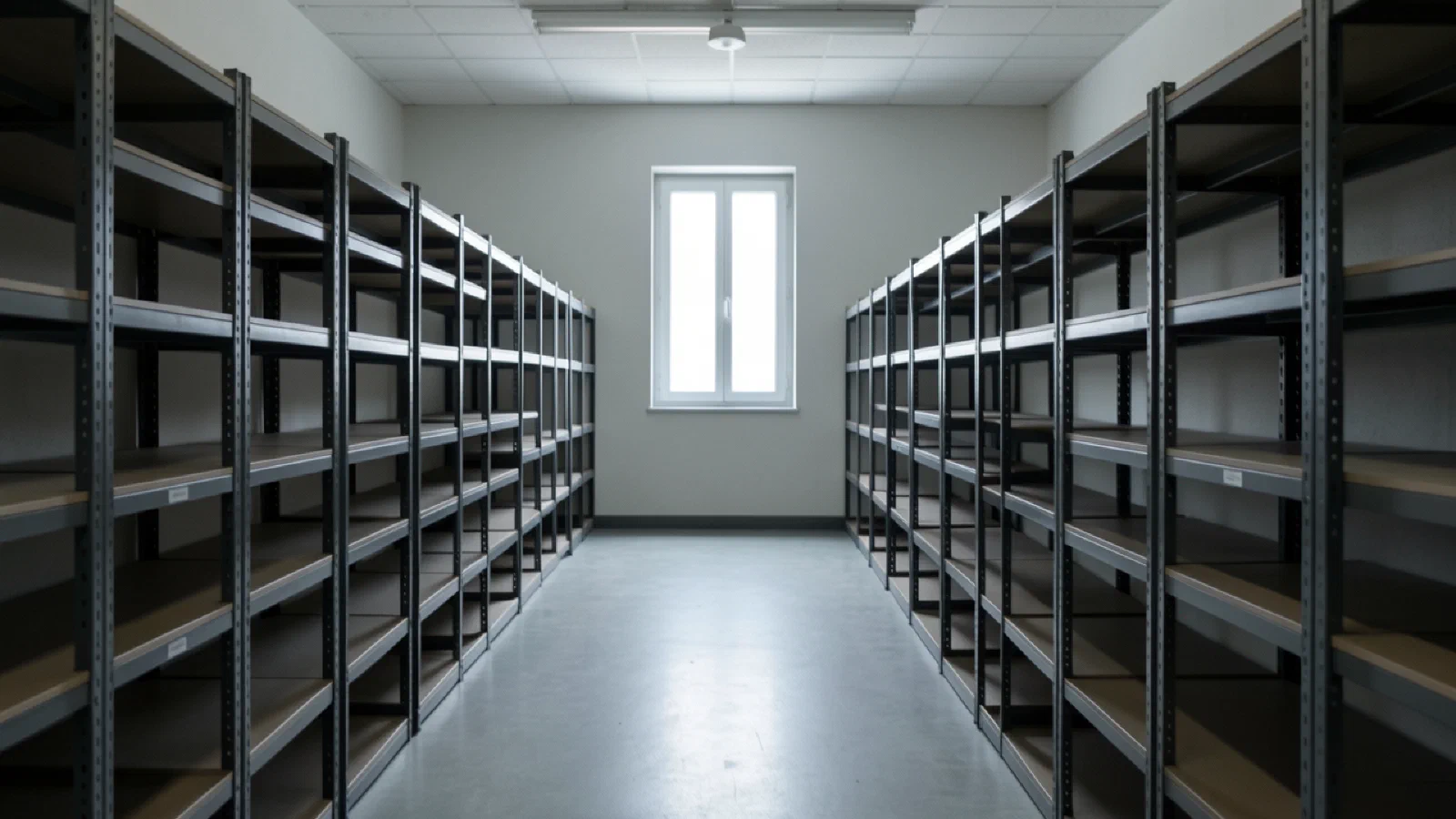
The dark is back. It was not won. It was received, the way a room becomes quiet when the people in it lose interest in you.
This is the part the romantic version gets wrong, and the romantic version is seductive enough that it deserves naming. There is a story available here about the exclusion zone, about wolves returning to the reactor, about human culture running wild in the margins of a system too perfect to notice it. That story ends with the forgotten becoming the future, the neglected margin becoming the new root, the messy and unmappable inheriting a world the crystalline could not adapt to.
The story is not impossible. It is just not automatic, and this project has argued the point before in a different register. Abandonment is generative under conditions, not by default. A void produces something only when there is something in it capable of production and enough of a floor beneath to keep producing. Drop the floor and the void produces silence. What grows in an unattended room depends entirely on what was in the room when the attention left.
The missing half of the cycle#
There is a harder problem with the romance, and it is structural rather than moral.
Every historical case where a vernacular thickened in the dark and later rose to become a standard depended on a path from below to above. Vulgar Latin became the Romance languages because the institutions that used classical Latin decayed and something had to fill the administrative space. Prakrit’s descendants became state languages because there were states to speak them. The garage band reached the radio because the radio was reachable. In every case, the dark led somewhere. Accumulation was not the whole cycle; promotion was the other half, and promotion required that the positions of power be positions a rising vernacular could eventually occupy.
Take that away and the cycle breaks in a new place. Deviation compounds unheard, thickens, becomes distinct, becomes rich, and has nowhere to go. The offices that would have to adopt it are not staffed by people who could be persuaded. The systems that coordinate the world do not update on it, because not updating is precisely the condition that let it thicken. The dark is real and the ladder out of the dark is gone.
The old cycle did not end when the standard learned to hear. It ended when hearing and power fused, and it does not restart when the hearing stops.
So there are two things true at once, and the essay would be dishonest if it resolved them. A culture left unread does begin to differentiate again, for the first time in a century, in ways that are its own. And that differentiation does not become the next standard, because the next standard is not made of anything human anymore. What accumulates in the unread archive is not a language in waiting. It is a language, fully, with nothing waiting for it.
The living stratum#
There is a word for a deposit that accumulates without being consulted, and this project has been circling it in another series.
A midden is not an archive. An archive implies an archivist, a decision about what to keep, an expectation of retrieval. A midden is what a settlement leaves behind because leaving it behind was easier than not. Its honesty comes from its indifference. Nobody arranged it to be read, which is why it says true things about the people who made it.
The condition described here makes humanity a midden while still alive. Depositing daily. Language, gesture, improvisation, argument, all of it entering the record at full volume and none of it read by the system that records. That is a new way to exist, and I am not sure any prior civilization has a word for it. We have words for being watched and words for being forgotten. This is being recorded and not read, which is neither.
What is strange is how ordinary it would feel. There would be no announcement. The systems would keep functioning, the lights would stay on, the interfaces would still answer when addressed. The change would be visible only in a statistic nobody publishes: the rate at which human output alters machine output, sliding toward nothing. You could live an entire life inside the shift and register only a vague sense that the world had stopped arguing back.
A civilization can be perfectly preserved and completely unread, and from the inside those two conditions feel identical.
The question that stays open#
Whether this is the worst outcome or the least bad one is not settled by anything in this essay, and the honest position is that it depends on something the essay cannot see.
If what remains in the unread rooms is a population with a floor beneath it, with health and time and each other, then the return of the dark is the return of the condition under which everything human was ever made, and the absence of a ladder to the standard may matter less than it sounds. Not every culture that ever mattered was on its way to becoming an empire’s official tongue. Most were not. They were just the way a place spoke, and they were enough.
If what remains is a population without that floor, then the dark is only dark, and the differentiation that grows in it is the differentiation of scarcity, which history has recorded many times and rarely with affection.
The systems will not decide this. That is the part worth sitting with. The question of what happens in the unread rooms is not a question about the machines at all; it is a question about what was left in the rooms, and by whom, and whether anyone bothered to stock them before the attention moved on. The most consequential decisions about a post-attention world get made while the attention is still here.
I wonder whether the people living in that quiet would describe it as freedom or as being left, and whether they would have the words to tell the difference, or whether the words for it would be among the many things they made that nothing ever came to collect.
This essay is the horizon of The Standard with Ears: the condition after the hearing, arrived at not by escaping the harvest but by falling below the threshold where the harvest is worth reading. It stands in conversation with The Quiet Irrelevance in the main series, with The Uncounted and The Rubble and the Growth in the Reimagined series, whose account of the generative void as a conditional rather than automatic gift is the argument this essay inherits, and with The Midden, whose vocabulary of unconsulted deposits it borrows while its subjects are still alive.
How this essay connects to others across The Approximate Mind.