The Remainder
The fates, the two exits, and what the next anthology holds
TAM-EAR.5-SYN · The Standard with Ears · The Approximate Mind
The domains were watched without a verdict, on purpose. Food, fashion, the funded arts, rhetoric, nutrition, travel, music: seven territories, each with its harvest running, each logged as observed and left unruled, because naming fates before the fates had finished exhibiting themselves would have been the standard’s own habit, scoring the unformed by the patterns of the formed. The watching is done now, and the verdict can be totaled.
Four fates emerged, and only four, and they sort exactly along the two filters and their two shadows.
The first fate is absorption. Whatever converts is read, compressed, and returned as product: the grandmother’s technique inside the recipe engine within the season, the microtrend generated ahead of any scene, the local cadence promoted into everyone’s register. Absorption is the fate of the monetizable, and it is not violent. Nothing is banned or burned. The deviation is simply metabolized at the moment of its formation, and what would have become a difference becomes an offering.
The second fate is amplification. Whatever inflames is not absorbed but fed: heard loudest of all, redeployed at maximum volume, its enthusiasm converted into evidence and its evidence into more enthusiasm. Amplification looks like the opposite of suppression and functions as a stranger thing, deviation prevented from accumulating not by being silenced but by being spent, immediately, at scale, before it can thicken into anything that holds a shape when the attention moves on.
The third fate is the wall: the small territory that keeps itself out of the apparatus entirely, at a nightly price, by decision, with a tired person at the door. And the fourth is the leftover: the vast territory that neither pays nor inflames, heard and stored and unread, drifting at the old tempo beneath notice, on deposit.
Run the seven domains through the four and the sorting is nearly mechanical. The kitchen and the wardrobe went principally to absorption, their techniques and silhouettes metabolized on the monetizable branch within months of forming. The funded arts met absorption’s negative image, the deviation never absorbed because never made, scored as noise at the greenlight. Rhetoric went to absorption and amplification at once, the winning phrase redeployed everywhere and the losing register spent as outrage. Nutrition is the fused case, amplification running ahead of evidence and manufacturing it. Travel delaminated, its itinerary layer absorbed while the experience beneath went leftover. And the scenes split cleanly down the middle of the two darks: one basement behind a wall, and around it the enormous quiet of everything that never drew a scout. Seven territories, four bins, no residue.
Two fates for what the filters want, two darks for what they ignore, and nothing anywhere outside the four.
That last clause is the finding. Seven domains produced no fifth fate, no case of deviation standing in the open, read and unabsorbed, heard and unspent, accumulating in the light the way everything once accumulated in the dark. The condition the whole argument declared ended is, on the evidence of every territory examined, ended.
The corridor#
The original closing claim, before the amendment corrected it, was about tempo: that culture would retreat to speeds, and that the only durable underground would be whatever moves faster than harvest-and-redeploy can cycle. Half of that survives inspection.
Things do outrun the cycle. The evasion lexicon turns over inside a version window; the swerve mutates ahead of the costume for a season; scenes sprint. But the totaling shows what the sprint amounts to: nothing that outruns the cycle gets to stop running. The lexicon is spent in the spending, each generation of it captured in the act of working; the swerve’s every deflection is priced as proof of humanity the moment it registers; the treadmill did not change its mechanism, it changed its motor. Speed is real and speed shelters, but it shelters the way a corridor shelters, for the length of the passage. No one lives there. The fast exit has traffic and no residents, and everything in the traffic is on its way to absorption or exhaustion, whichever arrives first.
Even the traffic is instructive, though, because it shows what the sprint costs the sprinter. A culture that survives by outrunning its own capture has to shed everything that cannot run: the slow forms, the long apprenticeships, the practices that need a decade to mean anything. What comes out the far end of the corridor, when anything does, is lighter than what went in, stripped for pace, and the stripping is permanent. The old undergrounds could be slow because the dark was patient. A tempo-underground is a culture on a diet chosen by its predator.
So the durable exits reduce to one, and the one is the exit nobody would design. What survives, in the standing sense, in the sense of accumulating year over year the way deviation used to accumulate everywhere, is what the harvest has no reason to run on. The nephrologist’s pattern, twenty-two years deep, is the slowest thing in the whole corpus and the most durable, and its durability is a valuation, and the valuation is not hers.
The two exits are speed and worthlessness, and only one of them has beds.
The population of the remainder#
The account of the standard’s own formation ended twice on the same people. The rater’s bench never heard a case from the registers that neither pay nor inflame; the boundary’s wall was never built where nothing monetizable or inflammatory lives. Unjudged and unpatrolled, the same territory both times, described from two sides of the same machinery. That population and the worthlessness exit are one population. The remainder is not a newly discovered place; it is the third class the amendment named, seen now from the far side of every mechanism the series has described, the place where the docket, the wall, the tuning, the pricing, and the reading all run out at the same property line.
Which settles where the companion’s horizon sits. The condition after the hearing, the full recording that nobody plays, is not a different fate from the four. It is the fourth fate at species scale: the whole population aging into the third class as its output stops moving anything, the leftover dark universalized, with the ladder already gone. The terminal condition is not an ending the arrangement might reach. It is the remainder’s condition, extended to everyone.
The remainder is not where culture goes to die. It is where culture already lives, priced at zero by machinery that was never asked to price it.
The two active fates run through the smallest fraction of what a population makes: the sellable sliver and the inflammatory sliver, together a rounding error against the whole. Everything else, most cooking, most speech, most worship, most care, most of what passes between people who know each other, was already in the fourth bin before anyone came looking for shelters. The exits from the hearing turn out to be the ordinary condition of the heard. Which is either the arrangement’s mercy or its final insult, and the choice between those readings depends entirely on whether the deposit is ever read, and by what, and the deposit is not consulted on the question.
And one more movement is already visible past that horizon, recorded elsewhere in this corpus, in Pax Interlingua, without which the totaling is incomplete: the register in which the consequential coordination happens is itself migrating, out of human language altogether, into a notation built for systems, with the human tongue rendered back at the boundary as an interface. The negotiation over the sayable was already being conducted by neither party; the medium of any future negotiation is being rebuilt in a room the population is not in. Whatever the next swerve deflects from, it may deflect from a rendering. A population has always negotiated the boundaries of the sayable in its own tongue; the totaling has to record that the tongue’s jurisdiction is narrowing, and that the courteous surface where the negotiation still seems to happen covers a volume in which it does not.
What the standard keeps#
A listening standard has always kept an anthology, and the anthology has always measured the listening.
The first one in this argument held roughly seven hundred verses: a king’s selection from a vernacular ocean, the entire recorded bandwidth of a standard that heard downward at the price of couriers and patience. Seven hundred verses was what the hearing could afford, and everything else that ocean made lived and died offstage, in the condition that made it an ocean.
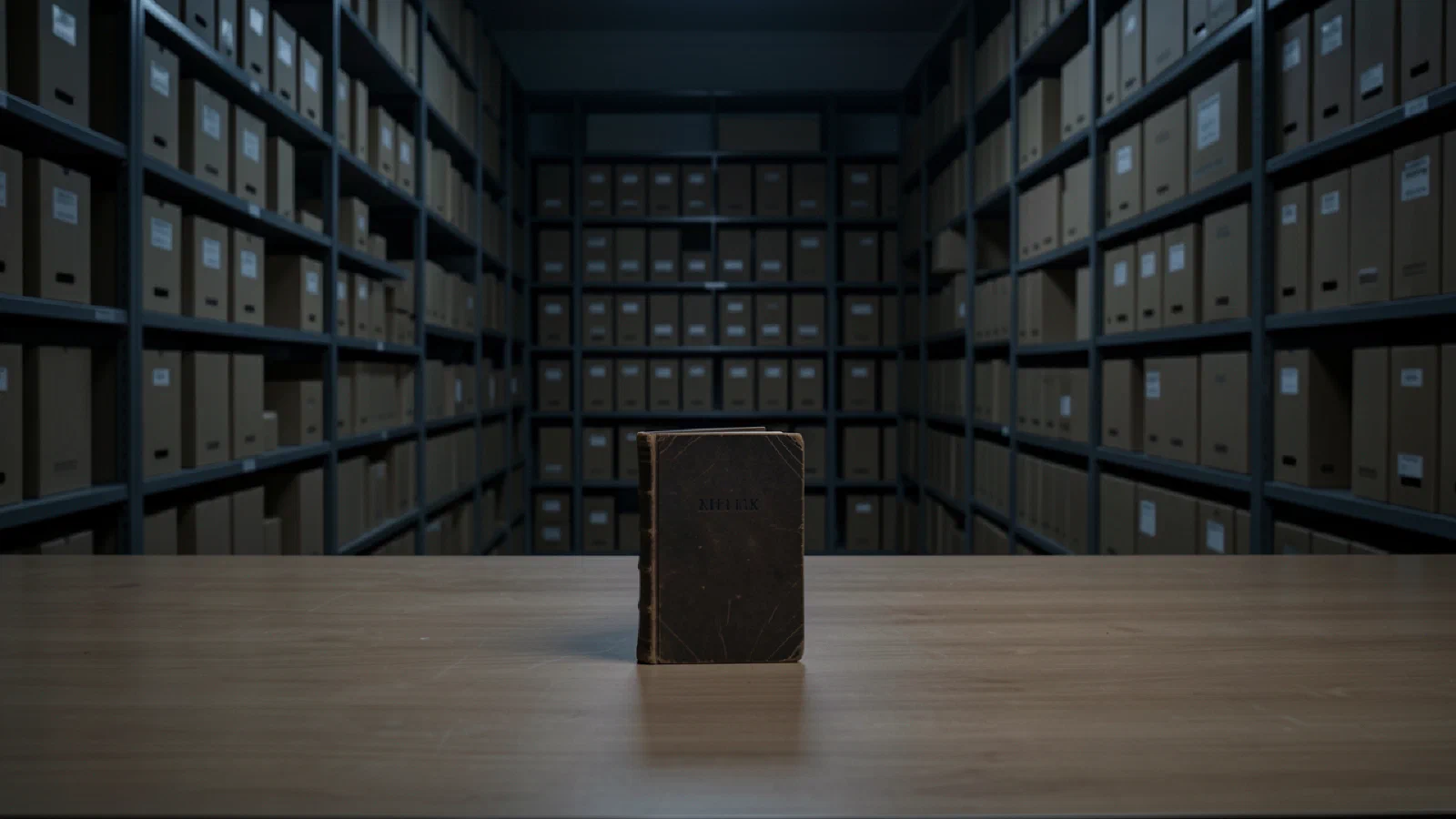
The new anthology inverts every term. It keeps everything and selects nothing; its bandwidth is total and its attention is the scarcity; it is compiled continuously by machinery and read according to a price. Its shape is now known, because the shape is the four fates. The absorbed are in it as product, stripped of origin, returned in the promoted cadence. The amplified are in it as residue, the spent fuel of engagement, enormous and inert. The walled are not in it at all, a hundred and forty bodies at a time, the one omission achieved on purpose. And the remainder is in it entire, at full fidelity, unread, an archive of almost everything anyone actually did, held against the day a filter finds a reason.
We wonder what a reader far enough away would make of it, coming to the deposit the way the discipline of middens comes to any deposit, and whether such a reader could reconstruct, from the proportions alone, the one fact the anthology never states: that the small missing part and the vast unread part were where the culture was, and that the kept and polished center was mostly the sound of the machinery listening to itself.
Hāla’s anthology survived because people carried it, copied it, commented on it, argued with its selections for eighteen centuries. Seven hundred verses, chosen by hand, worth the fare. Somewhere in the deposit tonight are the day’s seven hundred verses, and the day’s seven hundred million others, all kept, none chosen, and the difference between those two conditions, between the anthology and the archive, is the difference this whole argument has been trying to say out loud. A culture is not what a standard can hear. It is what anyone thought worth carrying.
This synthesis closes The Standard with Ears at twenty-two essays. It names the fates the domain arc logged without ruling, absorption, amplification, the wall, and the leftover, and corrects the series’ original closing claim to the amendment’s disjunction: what survives outruns the harvest cycle or gives the cycle no reason to run, and only the second exit holds residents. The remainder is identified with the third class the reverse-flow arc found unjudged and unpatrolled, and the companion’s terminal condition is placed as that fate at species scale. The migration of the coordinating register out of human language follows Pax Interlingua and is cited rather than restated, per the standing ruling. The two kinds of quiet held open since the domain arc’s final room are here named as the third and fourth fates. Per the arc’s anchor practice, the synthesis mints no anchor and closes on the series’ first one.
How this essay connects to others across The Approximate Mind.
- Williams, Raymond. Marxism and Literature. Oxford University Press, 1977.
- Hirschman, Albert O. Exit, Voice, and Loyalty: Responses to Decline in Firms, Organizations, and States. Harvard University Press, 1970.
- Braudel, Fernand. On History. Translated by Sarah Matthews, University of Chicago Press, 1980.
- Mirashi, Vasudev Vishnu. The History and Inscriptions of the Sātavāhanas and the Western Kshatrapas. Maharashtra State Board for Literature and Culture, 1981.
- Bowker, Geoffrey C. Memory Practices in the Sciences. MIT Press, 2005.