The Harvested Slice
The standard is made of vernacular, and the vernacular it is made of belonged to somebody
TAM-EAR.4-01 · The Standard with Ears · The Approximate Mind
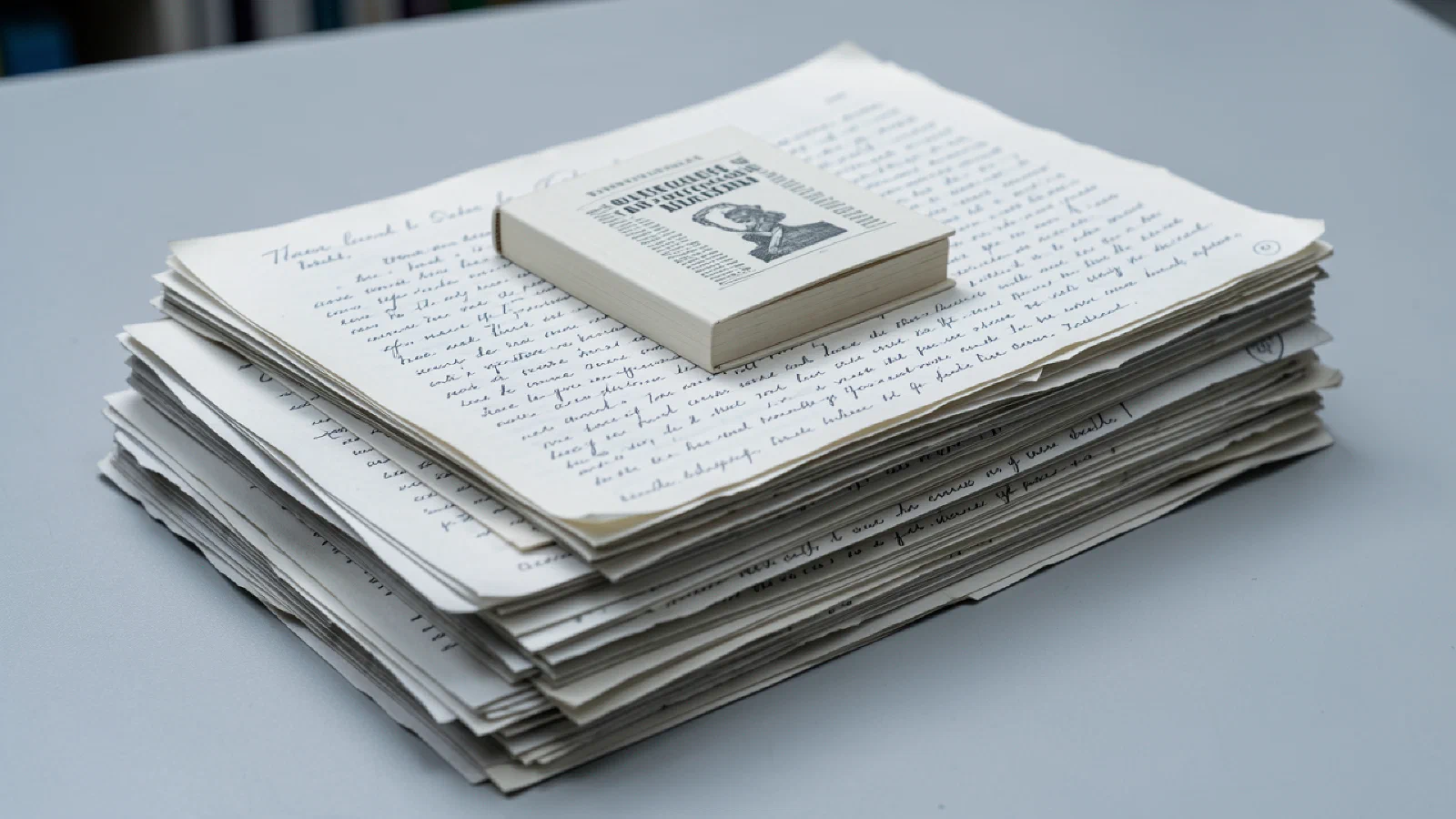
In 1501 a Venetian nobleman named Pietro Bembo prepared a small book for the press of Aldus Manutius. It was an octavo, sized for a pocket, set in a new slanted type, and it contained the vernacular poems of Francesco Petrarca, who had been dead for a hundred and twenty-seven years. Bembo worked from a manuscript that had passed through Petrarch’s own hands, quires the poet had corrected himself, lines crossed out and rewritten in the margins, and he prepared the text with a fidelity that was unusual for the time and that he was proud of. The little book sold across Italy. Later the manuscript itself came into Bembo’s possession, and he kept it in his collection until he died, the working papers of a dead man, complete with the dead man’s second thoughts.
Twenty-four years after the Aldine Petrarch, Bembo published the treatise that settled the question the peninsula had been arguing about since Dante: which language should Italians write in. His answer was Tuscan. Not the Tuscan being spoken in Florence in 1525, which he considered corrupted by use, but the Tuscan of Petrarch for verse and Boccaccio for prose, the language of two writers who had been dead for a century and a half. Other candidates had serious backers. Castiglione argued for the mixed language of the courts, alive and in use across the peninsula. Machiavelli argued for the living speech of Florence, on the reasonable ground that a language belongs to the people speaking it. Bembo won, and his victory ran so deep that Italian schoolchildren were being corrected toward fourteenth-century Tuscan into the twentieth century.
The imposition was the ordinary part; standards get imposed. What the standard was made of was not. Italy had, by Dante’s own count, at least fourteen vernaculars. The standard was built out of exactly one of them, in exactly one preserved register, from exactly two bodies of text, and everything else the peninsula was saying became, by that promotion, dialect.
The oldest asymmetry#
Promotion has always worked this way, and the oldest recorded hearing of a vernacular carries the same asymmetry inside it.
Hāla’s anthology preserved seven hundred verses of Maharashtri Prakrit, and those verses are nearly all that survives of what a living language was saying about itself. But Maharashtri was not the only Prakrit. It was one of a family, siblings spoken across the subcontinent, and it was the one the literary tradition chose to elevate. The Sanskrit theorists who ranked the Prakrits ranked Maharashtri first among them, the Prakrit fit for lyric, and the dramatic tradition assigned the others by station: this Prakrit for women of rank, that one for servants, another for clowns. Even the vernacular got a hierarchy. Even the underground had a promoted floor.
Promotion to a standard has never elevated the vernacular. It has elevated one vernacular and renamed the rest as dialect.
The pattern repeats wherever a standard was assembled from below rather than inherited from above. Luther’s Bible did not elevate German; it elevated the chancery German of Saxony, and the other Germanies spent four centuries being corrected toward it. The King James translators did not elevate English; they elevated a literary register of the southeast that most of the island did not speak. In every case the promotion was defended as the vernacular’s triumph, and in every case the triumph belonged to a slice, and the slice had properties, and the properties were never neutral. The promoted tongue was always the one that was already written down, already attached to prestige, already convenient to the machinery doing the promoting. Bembo’s Tuscan had one qualification that outweighed every argument Castiglione or Machiavelli could make: it existed as text, curated, stable, and sitting in his collection. A press cannot set type from speech.
The accounting#
The current standard is assembled out of the vernacular itself, and the slice it is assembled from has been named: written, English, leisured. What remains is the accounting, the question of what did the selecting, because this time there was no Bembo.
No treatise was published. No candidate was named. Nobody argued for the promoted tongue against its rivals, because nobody knew a promotion was occurring. The slice selected itself, by three properties, each of which looks like an accident and none of which is.
It was already written. Speech has to be transcribed before a model can eat it, and transcription, cheap as it has become, is a cost, while text is free at the point of harvest. So the standard was built from the fraction of human language that happens to exist as writing, which is a small fraction, produced by a minority of speakers, in registers that writing favors. The kitchen, the job site, the bus queue, the argument through a doorway: the registers most people live in left almost no deposit, not because anyone excluded them but because nobody was writing them down.
It was already English, or already in the handful of languages that dominate the web, with English holding a share of the crawl far beyond its share of the world’s speakers. And within English it was a particular English, the English of forums and encyclopedias and comment threads and long posts, which is to say the English of people who write at length in public.
Which is the third property. It was written by people with the leisure to write, the connectivity to post, and some reason to perform in text: the educated, the professional, the argumentative, the online. Their habits of phrase, their comic timing, their ways of hedging and asserting and closing a paragraph went into the composite in proportion to their volume, and their volume was enormous relative to their number.
The slice was not chosen. It was what arrived already written, and arriving already written is the oldest qualification there is.
Then the weighting ran again. Crawls get filtered, and the filters carry judgments about quality that were tuned on somebody’s idea of good text. Deduplication favors what was said once at length over what was said a million times briefly. And after all of that, a further selection was applied by hand, preference by preference. Each pass narrowed the slice further, and no pass was performed by anyone who understood themselves to be choosing a national language.
Two depths of one selection#
The Counterparty amended the claim this whole argument runs on, in one sentence: the hearing is not uniform, the standard hears what pays and what inflames, and the accumulation period stayed open for everything that does neither. That amendment and the harvested slice are one observation made at two depths, and each is incomplete without the other.
The amendment describes the selection that runs at the moment of reading. A nephrologist’s twenty-two years of pattern sit unharvested in an addressable clinic because no product and no outrage will carry them through the apparatus. This essay describes the selection that ran at the moment of formation. Her knowledge was never in the corpus to begin with, because it was never written, and the corpus is made of what was. She fails the filters, and before the filters ever ran she failed the harvest, and the two failures have the same shape: the apparatus attends to what arrives under its own power, and what arrives under its own power at the formation depth is text, in the big languages, from the posting classes.
Which vernacular got promoted and which deviation gets read are one selection, run at two depths.
The formation depth is the deeper of the two, because it sets what the machine can even return. The reading filters decide what gets amplified out of what exists. The harvested slice decided what the standard is made of, which means it decided what everything else gets translated into.
Who gets approximated, at corpus scale#
The question of who gets approximated was asked about individuals in Who Gets Approximated, and answered with a warning. Here it returns at the scale of whole populations, and the warning has grown teeth.
A standard made of one slice does not refuse the others. This is what separates the present arrangement from every one before it, and it is easy to mistake for generosity. Bembo’s standard sat above the unpromoted vernaculars as different material, a pole to lean away from, and under it the dialects persisted for five centuries, because the standard had no way to absorb them. It could only correct them, and correction is loud, and loudness breeds the resistance that kept Neapolitan Neapolitan.
The composite standard hears everything, within the amendment’s limits, and returns what it hears in its own register. A speaker from far outside the slice can address the machine in her own English, her own Spanish, her own mixture, and the machine will meet her graciously, take her meaning, and hand it back dressed in the promoted cadence, smoothed toward the habits of the people who happened to be posting at length in 2019. Her words survive the exchange. What does not survive is the register they were carried in, and register is where a vernacular actually lives.
A standard made of one slice does not silence the rest. It returns them in its own cadence, at the moment of hearing.
That is a quieter fate than dialect. A dialect knows it is one. It has a border, a stigma, a home, something to defend. Speech that is heard perfectly and returned in translation has none of those, and its speakers get back fluent, helpful, slightly foreign versions of their own sentences, and the foreignness is very hard to point at, because every individual exchange feels like being understood.
We wonder whether the slice can be heard as a slice at all from inside it, since the promoted register is also the register in which nearly all the describing gets done, and a water that every description is written in has no color the descriptions can name.
Bembo at least could be argued with. He published his reasons, and the peninsula spent a century arguing, and the argument itself is a monument of the language it was about. What he built his standard from sat in his collection until he died: a dead man’s working papers, the crossed-out lines still visible, the second thoughts preserved alongside the verdicts. The promoted tongue was somebody’s draft. It always is. The difference now is that nobody keeps the manuscript, nobody signs the treatise, and the draft that was promoted belonged to several hundred million people who were never told they had written a standard, only that the machine, remarkably, seemed to speak the way they did.
This essay opens the reverse-flow arc of The Standard with Ears and takes up the accounting that The Vernacular After Geography named in one paragraph and handed forward: the slice is written, English, and leisured, and this essay asks what selected it. It and The Counterparty cite each other by ruling, as one selection question run at two depths, formation and reading. The anchor ruling for this arc is per-essay: this essay and the boundary essay take historical anchors on the mechanism arc’s pattern, and the raters essay takes the living anchor, since its population contains reachable persons.
How this essay connects to others across The Approximate Mind.
- Bembo, Pietro. Prose della volgar lingua. Venice, 1525.
- Migliorini, Bruno. The Italian Language. Abridged and translated by T. Gwynfor Griffith, Faber and Faber, 1966.
- Richardson, Brian. Print Culture in Renaissance Italy: The Editor and the Vernacular Text, 1470-1600. Cambridge University Press, 1994.
- Ollett, Andrew. Language of the Snakes: Prakrit, Sanskrit, and the Language Order of Premodern India. University of California Press, 2017.
- Pollock, Sheldon. The Language of the Gods in the World of Men: Sanskrit, Culture, and Power in Premodern India. University of California Press, 2006.
- Bender, Emily M., Timnit Gebru, Angelina McMillan-Major, and Shmargaret Shmitchell. “On the Dangers of Stochastic Parrots: Can Language Models Be Too Big?” Proceedings of the 2021 ACM Conference on Fairness, Accountability, and Transparency, 2021, pp. 610-623.
- Dodge, Jesse, et al. “Documenting Large Webtext Corpora: A Case Study on the Colossal Clean Crawled Corpus.” Proceedings of the 2021 Conference on Empirical Methods in Natural Language Processing, 2021, pp. 1286-1305.
- Hargittai, Eszter, and Gina Walejko. “The Participation Divide: Content Creation and Sharing in the Digital Age.” Information, Communication & Society, vol. 11, no. 2, 2008, pp. 239-256.