The Kitchen at Generation Zero
Regional cooking as what flavor did while the kitchens could not hear each other
TAM-EAR.3-01 · The Standard with Ears · The Approximate Mind
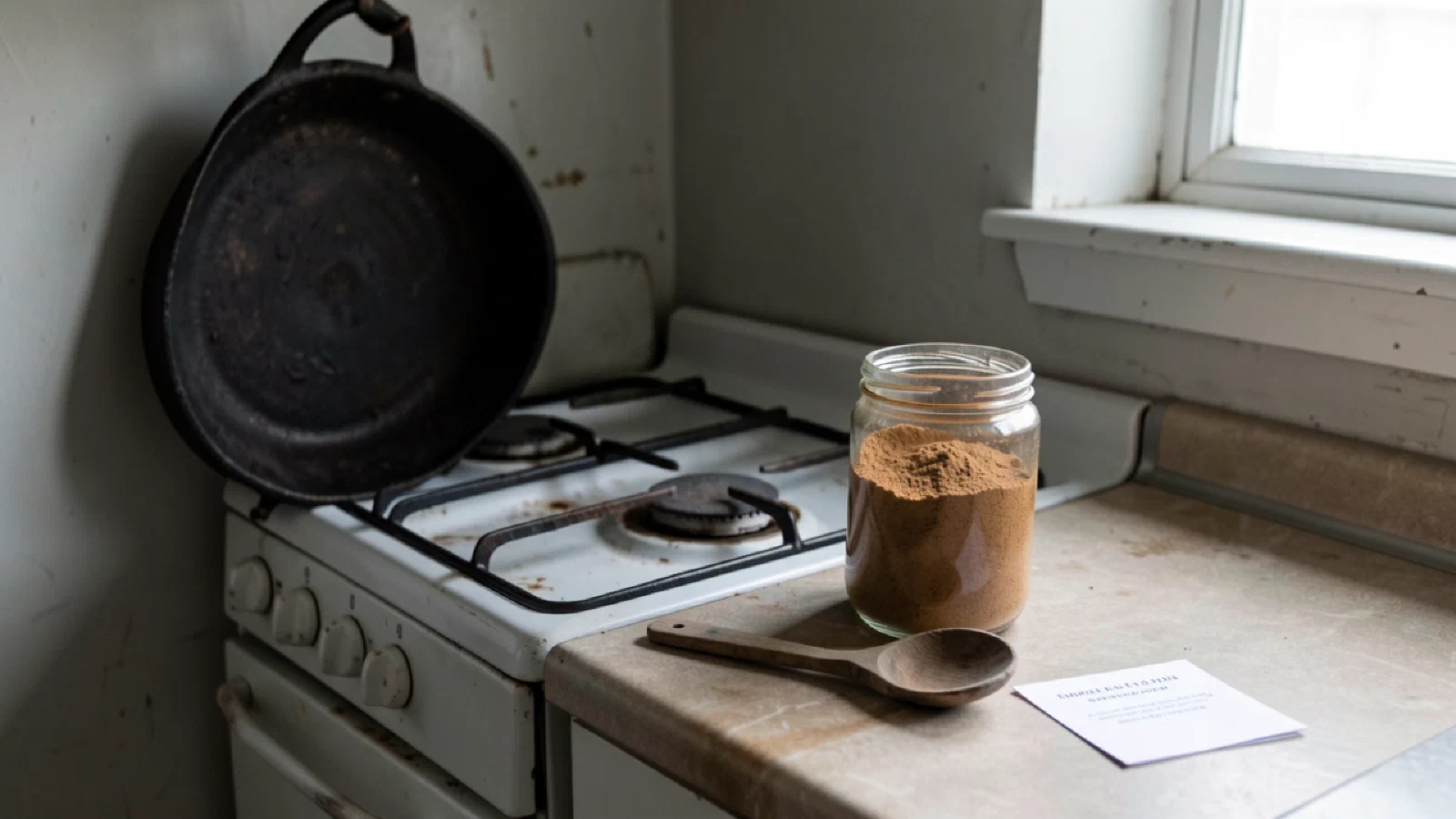
Meenakshi is seventy-four and has made podi, the roasted lentil and chili powder of her part of Tamil Nadu, roughly every third week for sixty years. She learned it standing next to her mother, who measured nothing, and she measures nothing either, because the recipe is not a set of quantities. It is a sequence of corrections. The dal darkens a shade past where the books say to stop, because her mother’s did. The chilies go in later than her neighbor two streets over puts them in, and the difference is audible in the finished powder if you grew up on one of them. She owns a spice box, a round brass one with seven cups, that her mother carried into her marriage, and one of the cups has a dent she works around without noticing.
In March her granddaughter filmed her. Forty seconds, hands only, phone propped against the rice tin: the dal going in, the shade of the darkening, the late chilies. The granddaughter posted it because the hands were beautiful. By June, versions of the phrasing the family uses for the late-chili step were appearing in generated recipes, in English, attached to dishes from three states away, offered to strangers who asked a system what to do with red chilies and dal. Nobody stole anything. Nothing that happened was against a rule. The forty seconds went where forty seconds go, and what the hands knew entered the reading.
The distance the flavors needed#
Regional cuisine exists for one reason, and it is not soil.
Soil matters, and climate matters, and what grows locally sets the pantry. But two villages with the same pantry cook differently, and the difference is the cuisine, and the difference exists because for the whole history of cooking a kitchen could not hear another kitchen. A technique traveled at the speed of a marriage. A correction, the small ones Meenakshi makes without naming, traveled only inside a household, mother to daughter, hand to hand, at a bandwidth of one stove and twenty years. Every kitchen was an accumulation chamber. Deviations piled up privately, compounded across generations, hardened into a style, and only then, thickened and load-bearing, did they meet other styles at a wedding or a market town and survive the meeting.
The accumulation period, which the opening of this argument located in language, had its plainest form in food. Prakrit had grammarians to escape; a kitchen had only distance, and distance was enough. What we call a regional cuisine is the archaeological record of kitchens that were out of earshot of each other for long enough to become themselves.
A cuisine is the residue of kitchens that could not hear each other, and the kitchens can hear each other now.
The hearing did not begin with the machine. Cookbooks were the first collectors, and they behaved exactly like the folklorists: few, slow, pointed by a patron’s theory of what counted. The colonial compilations recorded the dishes of the households the compilers could enter. The national cookbooks of the twentieth century, assembling a standard cuisine out of a subcontinent of vernaculars, promoted some kitchens and passed over most, and the passing over was not neutral, because a printed recipe is a standard the way a grammar is. Television compressed the lag from a generation to a season. The food video compressed it to a week. At each step the beam widened and the delay shortened, and at each step something recognizable still held: a human had to notice the kitchen, decide it was worth the trip, and carry the technique out by hand.
Which kitchens get read#
What reads Meenakshi’s forty seconds is not a person, and it was not pointed at her.
Her granddaughter’s video entered the harvest the way everything enters it, unfetched, and what happened next ran on the two filters the title essay, The Standard with Ears, named. The technique was read because a recipe converts into a product. There is a machine on the other end that answers cooking questions for money, directly or through the attention it holds, and regional technique is exactly the raw material that keeps its answers fresh. This is the monetizable branch of the selective hearing, and this essay should be plain that it is describing that branch and not the whole mechanism. The Counterparty, in the main series, named this case in advance: the grandmother’s technique is harvested because someone can sell the recipe.
The inflammatory branch runs through food too, in the diet wars and the purity fights, and The Evidence That Followed takes that loop on its own terms. And the third class, the deviation that neither sells nor inflames, exists in every cuisine: the funeral dishes, the food of fasts nobody outside keeps, the household preparations too specific to convert. Those sit in the footage and go unread, held the way the unread text corpus is held. The hearing of kitchens is exactly as uneven as the hearing of everything else.
But the read branch is enormous, because food converts more readily than almost any vernacular. Every technique is a potential product. Every regional pantry is a catalogue waiting for distribution. The reading of the world’s kitchens is not a possible future. It is a commercial buildout in progress, and it has already reached below the recipe, into the hands themselves: the record of hands managing objects has a spot price now, because machines being built for kitchens need footage of kitchens, and the layer of cooking that could never be written down is being purchased as data. The Body in the Data established that withdrawal, and this is its domain: the grandmother’s hands entered the harvest the day a machine needed kitchens, and the machines need kitchens now.
Fusion without accumulation#
What comes out the other side is not theft, and calling it theft misses what is actually new.
Cooks have always borrowed. Fusion is not a modern invention; it is what happens every time thickened styles meet, and the meetings made most of what anyone now defends as tradition. The chili itself crossed an ocean to reach Meenakshi’s family. What is new is the tempo and the direction. The old borrowing ran between kitchens that had each spent generations becoming distinct, so the fusion was a meeting of accumulated things, and the accumulation continued afterward, in private, out of earshot, replenishing the differences the borrowing spent.
The new arrangement reads the deviation at generation zero. The improvisation Meenakshi’s mother made in the 1960s had thirty years in one kitchen before it met the world. The improvisation Meenakshi makes this winter, if the phone is propped against the rice tin, has a season. It enters the composite before it has become anything, one correction among millions, averaged into a competent everywhere-style that answers every question about dal fluently and comes from no street. The generated recipe is not wrong. It is early. It harvests the variation before the variation has compounded into a difference, which means the next generation of regional difference is being spent as seasoning for the standard at the moment of its formation.
The old cookbook took the finished dish and left the kitchen its privacy. This takes the drift itself.
The child in the kitchen still exists, and this arc will keep saying so wherever it is true. Meenakshi’s granddaughter is acquiring the podi the old way, by standing there, at the old bandwidth, and what she acquires is bound to that dented cup and that stove in a way no composite is. Two transmissions now run in parallel from the same pair of hands, the slow one through proximity and the fast one through the harvest, and they carry different things even when they carry the same technique. What nobody knows yet is what the slow one is for, culturally, when the fast one has already delivered the surface of it to everyone.
We wonder whether a dish can still be from somewhere once its second generation grows up everywhere, and whether anyone standing in a kitchen in thirty years will be able to taste the difference between a style and its average.
The video is still up. It has done whatever it will do. Meenakshi has not seen the generated recipes and would not recognize her step in them, because the step was never hers alone; it was the street’s, and the street got it from streets before that, and the composite has folded it into a version that belongs to no street at all, which is a thing that has never existed in the history of cooking and now exists for nearly everything.
She made podi again last week. The dal went a shade past where the books say to stop. The seventh cup has the dent, and she worked around it, the way her mother did, for reasons that are not in any footage, because the reasons are not in her hands. They are in whose hands the box was.
This essay opens the domain arc of The Standard with Ears and settles the arc’s anchoring instrument: a contemporary person in the pattern of the nephrologist of The Counterparty, alive inside the essay with something at stake, carrying the object discipline of the mechanism arc, where the anchors were historical and dead. The essay instantiates the monetizable filter of The Standard with Ears and says so, per the amendment; the case is named in advance in The Counterparty. The harvest of the hands builds on the withdrawal performed in The Body in the Data rather than restating it. The unread remainder of every cuisine is left where the title essay left the third class. The arc observes; if fates cluster across its seven domains, the synthesis names them.
How this essay connects to others across The Approximate Mind.
- Achaya, K. T. Indian Food: A Historical Companion. Oxford University Press, 1994.
- Appadurai, Arjun. “How to Make a National Cuisine: Cookbooks in Contemporary India.” Comparative Studies in Society and History, vol. 30, no. 1, 1988, pp. 3-24.
- Ray, Krishnendu. The Ethnic Restaurateur. Bloomsbury Academic, 2016.
- Polanyi, Michael. The Tacit Dimension. University of Chicago Press, 1966.
- Sutton, David E. Remembrance of Repasts: An Anthropology of Food and Memory. Berg, 2001.
- Ha, David, and Jürgen Schmidhuber. “World Models.” arXiv preprint, arXiv:1803.10122, 2018.
- Zuboff, Shoshana. The Age of Surveillance Capitalism. PublicAffairs, 2019.