The Two Tempos
Why the cycle breaks on the clock rather than on the microphone
TAM-EAR.1-04 · The Standard with Ears · The Approximate Mind
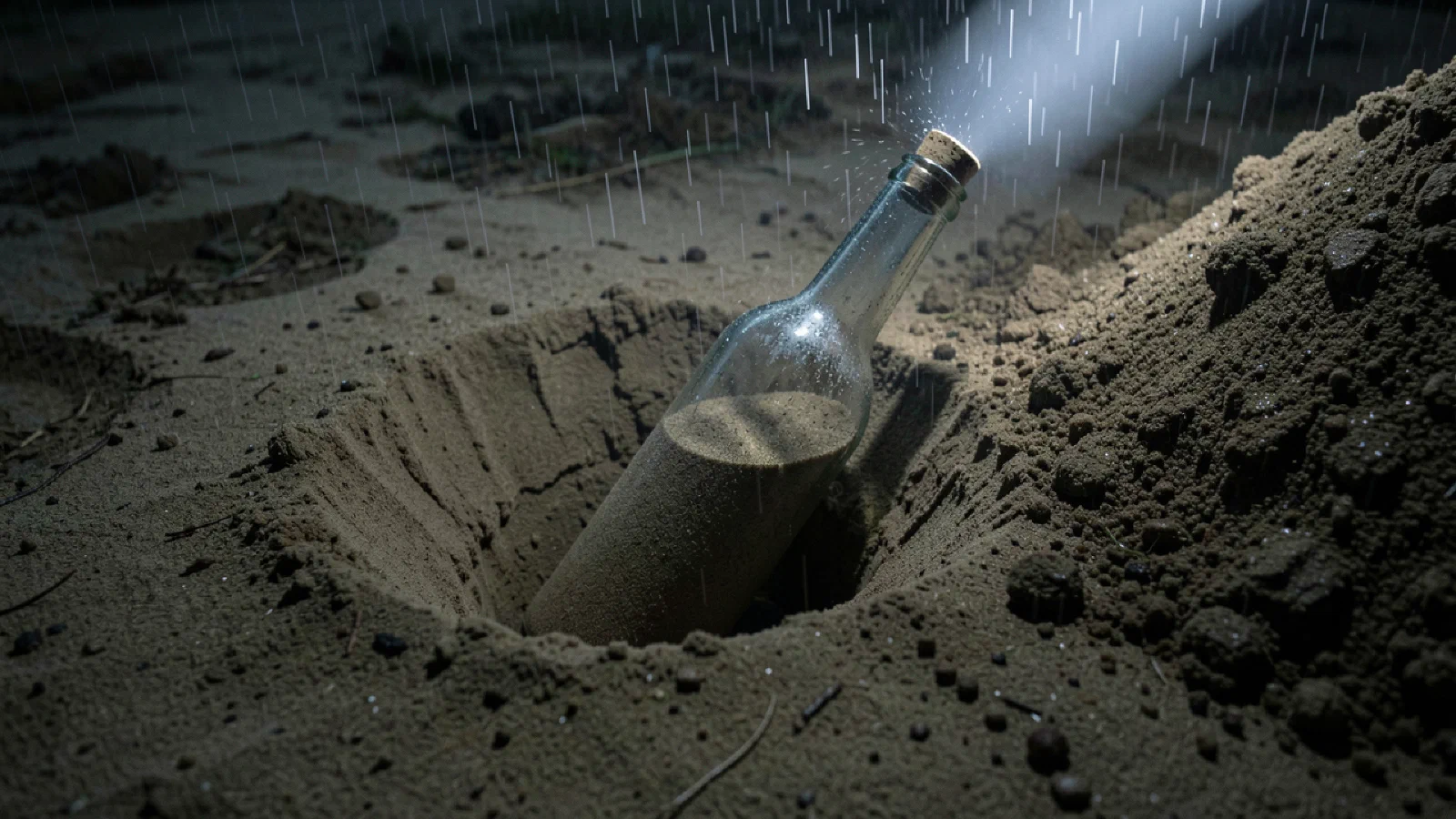
In the autumn of 1879, a botanist at the State Agricultural College in Michigan walked out to a sandy knoll on the campus with twenty narrow-necked glass bottles. William James Beal filled each with damp sand and about a thousand seeds, drawn from a couple of dozen common local plants, and buried them twenty inches down in a row running east and west. He left them uncorked, mouths angled downward so water could not pool around the seeds. People who have handled them since say they look like whiskey flasks.
His question was practical and old. Farmers had no herbicides, and weeding was the worst part of the year, and the thing everyone wanted to know was how many seasons you had to pull a weed before it stopped coming back. Beal wanted an answer with a number in it. The plan was to dig up one bottle every five years until the hundred years were used up, which put the last excavation in 1979 and put Beal, who was forty-six, comfortably outside it.
On the fifteenth of April in 2021, at four in the morning, in sleet, four scientists met at a rendezvous point on the same campus with flashlights, a trowel, a tape measure and an old map. They go at night so nobody sees where the row is. Frank Telewski, the seventh person to hold the map, had recently turned sixty-five and had brought three younger colleagues along specifically so that somebody would still know the location after him. A few months later he had a stroke.
The intervals were stretched twice, to ten years and then to twenty. The last bottle is now scheduled for 2100.
A conversation with two clocks#
Everything in the argument so far has been about hearing: what the standard can pick up, what it bothers to read, what it leaves lying. Suppose all of that were settled tomorrow. Suppose the reading became perfectly uniform, or suppose it stopped entirely. The old cycle would still not work, and the reason has nothing to do with microphones.
The two parties are running on different clocks, and the mismatch is not a detail of the current implementation.
One direction is instant. A person writes a sentence and something adjusts inside the exchange, within a second, tuned to that person’s phrasing and mood and the last thing they said. The register that comes back is shaped for them. Multiply by a few hundred million people and several times a day, and the influence running from the systems toward the population is continuous, immediate, and individually fitted.
The other direction runs in epochs. What people say gets folded into a corpus, and the corpus is used to train an object, and that object is released some number of months or years later. Nothing an individual contributes is visible in the result. The corpus is the aggregate and the aggregate is the unit; a single person’s language enters as a rounding contribution to a statistic and comes back, if it comes back at all, as one indistinguishable strand in a composite.
So the asymmetry is double. There is the speed, which is milliseconds against months. And there is the grain, which is one person against everybody.
It addresses you as a person and hears you as a population, and no institution before it had those the wrong way round.
Every prior arrangement ran the other direction. The school addressed you as a member of a category, one of forty children in a room, taught from a text written for none of you. But a single student could affect a school. A famous pupil, a rebellion, a scandal, one teacher’s decision about one child. Influence downward was general and influence upward was particular. Now the personalization runs downward and the aggregation runs upward, and a person can be perfectly known and perfectly unable to register.
The grain asymmetry has a consequence that shapes how the whole arrangement is experienced, and the experience is misleading in a specific way.
What comes toward a person is vivid. It is addressed to them, arrives in seconds, uses their phrasing, answers the thing they actually asked. What goes the other way is imperceptible by construction. Nobody has ever felt themselves contribute to a corpus. There is no sensation associated with it, no confirmation, no moment at which anything registers, and there could not be, because the contribution is real only in aggregate and aggregates are not available to experience.
So the felt relation is entirely one-directional even though the actual relation runs both ways. People conclude they are being shaped and not shaping. They are right about the phenomenology and wrong about the mechanism, and the error is not carelessness on their part. It is what the arrangement produces in anyone standing inside it.
The reverse flow is real and it is the only part of this that nobody can feel, which is why it has to be argued rather than noticed.
There is a third clock in the neighborhood, the one that governs how long it takes to form a competent human being, and it belongs to a different argument. Set it aside here.
What pressure actually requires#
The old cycle was a negotiation, and negotiations require a counterparty that stays.
Prakrit did not defeat Sanskrit in an encounter. It applied pressure over centuries, and the thing it pressed against was continuously present through all of it. The Sanskrit that a village register drifted away from in the second century was recognizably the same Sanskrit that its great-grandchildren drifted from in the fourth. Grammarians defended it, texts fixed it, priests carried it, and its persistence is exactly what let deviation accumulate into a settlement rather than dissipating. You can lean on a wall for three hundred years and eventually move it. You cannot lean on anything for three hundred years if it is replaced every eighteen months.
That is the structural break, and it is not about volume or speed of capture.
Models are not revised. They are succeeded. A new one is trained, and it inherits from its predecessor the way a copy inherits from an original rather than the way an adult inherits from a child, and then the predecessor is deprecated and the weights are retired and the thing you were pressing against is not there. What arrives in its place was trained on a corpus that includes the old one’s output, which means it carries a compressed impression of what the old one said, filtered through whatever the corpus preserved of the response.
A vernacular can push against a standard that persists. It has nothing to do with a standard that is replaced before the push arrives.
The loop that is not one#
Which means the feedback loop everyone describes is not a loop.
A loop implies that what comes back is connected to what went in, in a way the participant could in principle trace. The old cycle had that. The person who coined a word heard it come back from a stranger. The cook whose technique traveled saw it in a neighbor’s kitchen. The return took a year or a generation, but it closed, and it closed at a resolution where a human could recognize their own contribution arriving.
What exists now is two open ends joined by a pipeline. Language goes in at one end, into a corpus, at a scale where individual attribution is not merely difficult but definitionally absent. Something emerges at the other end, later, from an entity that is not the entity anyone spoke to. No participant can locate their input in the output, and no output can be traced to a participant, and nothing in between is preserving the relation, because preserving the relation is not what any part of the pipeline is for.
Beal’s bottles supply the figure, and they supply it better than any argument could.
In 2023, two years after the bottle came out of the ground, genetic testing on the seeds found that a hybrid plant had been included in the mixture by accident in 1879. Nobody had noticed for a hundred and forty-four years. The finding is real and it is interesting and Beal could not have understood a word of it, because DNA was not a concept available to him. The experiment ran faithfully for fourteen decades and delivered an answer to a question its author did not ask, in a language he did not have, about a mistake he did not know he had made.
The bottles kept their end. The discipline that opened them did not stay the same discipline.
We wonder whether anything a person says now can be described as being said to something, or whether the right description is that it is being deposited, and whether we would notice the difference from inside a conversation that answers us in a second.
Even if the hearing stopped#
Make the hearing perfect. Give every deviation, profitable or not, inflammatory or not, an equal chance of being read and folded in. The cycle still does not close, because the fold-in happens on epoch time and at population grain, and the person whose deviation was folded cannot find it, cannot claim it, and cannot press further against the object that absorbed it, because that object will be superseded before the pressing accumulates into anything. Perfect hearing does not restore the cycle. It only makes the losses even.
Now make the hearing stop. Let the reading fall away entirely, the way it does at the far end of this argument, and let the archive fill up unconsulted. Deviation would begin to compound again, which is the one genuine restoration available. But the ladder is still gone, and the tempo is why. There is no persistent standard for a thickened vernacular to be promoted into, because the standard is not a thing that persists long enough to be climbed. It is a sequence of objects.
The hearing determines what gets taken. The tempo determines whether anything can be given back, and it answers no in both cases.
The last bottle comes up in 2100. The people who dig it will not be born for some years yet, and the map will have passed through two or three more hands, and whatever they find will be interpreted with instruments nobody has built. Beal chose twenty-one or twenty-three species, depending on which of his notes you follow, because those were the weeds that were making trouble in Michigan in 1879. Some of them are not making trouble anywhere now.
He did the only thing available to a person with a question longer than a life, which was to arrange for the question to outlast him and hope somebody would still care enough to go out in the sleet at four in the morning. Seven of them have. The arrangement has held for a hundred and forty-six years on nothing but the willingness of successive people to keep an appointment made by a man they never met.
That is what a conversation across a long clock costs, and it is payable, and it has been paid. It requires only that both parties still be there.
This essay closes the mechanism arc of The Standard with Ears by locating the break in the clock rather than in the capture. It supplies the reason the countercurrent essays cannot resolve the problem and the reason the horizon condition does not restore the old cycle even where it restores the dark. It stands in conversation with The Closed Window, and with The Ear That Answers in the Claude series, which states the epoch problem from inside the one interrogable layer.
How this essay connects to others across The Approximate Mind.
- Beal, William James. “The Vitality of Seeds.” Proceedings of the Society for the Promotion of Agricultural Science, 1885.
- Telewski, Frank W., and Jan A. D. Zeevaart. “The 120-yr Period for Dr. Beal’s Seed Viability Experiment.” American Journal of Botany, vol. 89, no. 8, 2002, pp. 1285-1288.
- Braudel, Fernand. On History. Translated by Sarah Matthews, University of Chicago Press, 1980.
- Douglas, Mary. How Institutions Think. Syracuse University Press, 1986.
- Koselleck, Reinhart. Futures Past: On the Semantics of Historical Time. Translated by Keith Tribe, Columbia University Press, 2004.
- Labov, William. Principles of Linguistic Change, Volume 1: Internal Factors. Blackwell, 1994.
- Ollett, Andrew. Language of the Snakes: Prakrit, Sanskrit, and the Language Order of Premodern India. University of California Press, 2017.