The Obvious Cases
Where Removing the Human Saves Lives and the Argument Is Settled
TAM-RWR.ZPF-01 · The Reshaped World, The Zero-Person Frontier · The Approximate Mind
The organ arrives in better condition than any human-driven delivery in Maren Soderquist’s records. She has been coordinating transplant logistics for eleven years, first at a regional organ procurement organization in the upper Midwest and now at a national coordinating body that oversees allocation and transport across fourteen states. She has seen the transition from the inside.
The old system worked like this: a human driver, usually a courier contracted through a medical transport service, received a cooler at a procurement hospital and drove it to the transplant center. The window was four to six hours depending on the organ. The driver navigated traffic, weather, construction, the specific anxieties of knowing what was in the cooler without being trained to manage those anxieties. The driver was good or not good, experienced or not experienced, calm or not calm. The organ did not care about any of this. It cared about temperature and time.
The autonomous transport system that has replaced the driver on three of Maren’s fourteen routes is faster by an average of twenty-two minutes. It maintains temperature control within a range tighter than any human-managed cooler. It does not get drowsy at 3 a.m. It does not take a wrong exit in an unfamiliar city. It does not experience the particular dread of sitting in traffic on I-94 with a kidney that someone is waiting for in a surgical suite forty miles ahead.
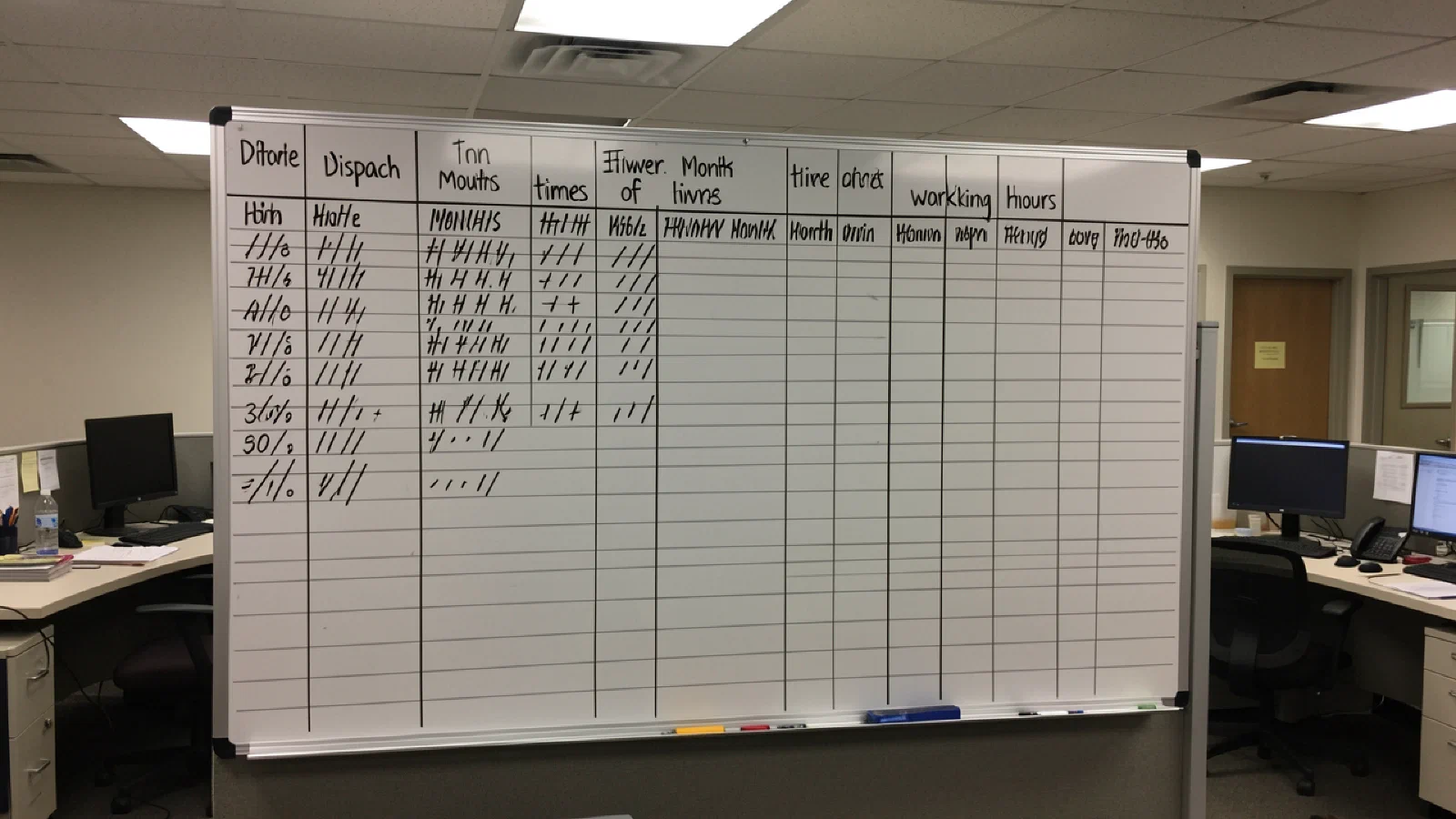
Maren keeps a whiteboard in her office tracking transport times by route and modality. She updates it weekly. The autonomous column has been consistently better for eighteen months. She has stopped updating the human transport column on the three converted routes because there is nothing left to compare.
On her desk, next to the whiteboard marker, is a small ceramic bowl her daughter made in a pottery class when she was nine. It is lopsided and glazed in a color her daughter called “ocean green” and Maren calls teal. It holds paperclips. It has held paperclips for twelve years. It is the most useless and most permanent object in her office.
The Domains Where the Body Was Wrong#
The transplant logistics case is the gentlest version of a broader argument. There are domains where human presence in the operational loop was always a compromise forced by the absence of an alternative, and the compromise cost lives.
Radiation zone inspection. The workers who entered contaminated environments at Fukushima, at Chernobyl, at dozens of smaller incidents that never made international news, did so because no other option existed. Their bodies absorbed what the instruments measured. The robots that now perform these inspections do not absorb anything. They do not develop cancers fifteen years later. They do not leave families who spend decades wondering whether the exposure was within safe limits and whether the limits were honest.
Deep sea pipeline maintenance. The saturation divers who spent weeks in pressurized chambers to perform repairs at depths where human physiology was never meant to operate. The decompression schedules. The nitrogen narcosis. The specific terror, managed through training and temperament, of working in darkness at pressures that could kill through a single equipment failure. The remotely operated vehicles and autonomous underwater systems that have replaced much of this work do not experience terror. They do not require decompression. They do not leave widows.
Wildfire perimeter monitoring. The firefighters positioned on ridgelines in conditions where wind shifts could overrun their position in minutes. The drone systems that now hold these positions see more, report faster, and do not burn.
Hazardous waste handling. Mine inspection. High-voltage electrical work in conditions too dangerous for standard safety protocols. Bridge inspection in structural failure zones.
In each of these domains, the same thing is true: the human body was the wrong instrument for the task. It overheated, panicked, fatigued, got sick, died. The machine that replaces it is not an approximation. It is categorically better at the task the body was asked to perform.
The relief is real and it should be stated plainly. People are not dying in jobs that should never have required a human body. The families of radiation workers are not waiting for diagnoses. The saturation divers’ children are not growing up with a father who descends into pressure vessels for weeks at a time. The organ arrives intact. The fire line holds without putting a crew at risk.
This is not a complicated argument. It is not an argument at all. It is an outcome, measurable and positive, and the appropriate response is relief.
What the Relief Obscures#
The next observation is small, and the risk is that it sounds like an objection to something that does not deserve objection.
The organ courier who drove the cooler from Milwaukee to Minneapolis was performing a task that a machine performs better. That is settled. But the courier was also a person who existed in a system of human relationships that the task created as a byproduct.
The courier called the surgical team from the road. The call was procedural: estimated arrival time, transport conditions, any anomalies. It was also, in a way that no protocol manual would describe, a moment of human contact between two groups of people engaged in the same urgent work. The procurement coordinator heard a voice. The surgical nurse heard a voice. The voice carried information, but it also carried something else: the reassurance that a person was responsible, was paying attention, was in the chain of consequence between the donor and the recipient.
The autonomous system sends a data packet. The data is more accurate. The reassurance is different in kind.
The hazmat inspector who completed a perimeter check stopped at the fence line and talked to the resident whose property bordered the site. The conversation was not part of the inspection protocol. It was a human being, present at a boundary, acknowledging the person on the other side of that boundary. The resident felt seen. Not served, not processed, not monitored. Seen. The inspector who was there because of a contamination risk was also, incidentally, the only representative of the institutional system who had ever stood on that fence line and said hello.
These contacts are not load-bearing. The organ recipient is better served by a system that prioritizes transport time over road-call reassurance. The resident near the hazmat site is better protected by a drone that completes the perimeter check without stopping to chat.
But the contacts existed. They were small and incidental and produced by the friction of human presence in systems where friction was the cost of having a body do the work. When the body is removed, the friction goes with it. The efficiency gain is real. The loss is close to nothing.
Close to nothing is not nothing.
The Principle and the Door It Opens#
The obvious cases establish a principle that the rest of this arc depends on. The principle is simple: human presence is not inherently valuable in service delivery. Its value depends on what the human was doing besides the nominal task.
In organ transport, the human was doing very little besides the nominal task. The nominal task was moving the organ. The incidental contact, the road call, the procedural update in a human voice, was real but marginal. The organ’s safe arrival matters more than the surgical team’s preference for hearing a human voice confirm the arrival. The principle holds cleanly here. The human presence was instrumental. The instrument has been improved.
The principle is correct. It is also, I think, dangerous in a specific way.
The ease of the obvious cases trains the institutions making deployment decisions to expect that the next removal will be just as clean. The organ transport worked. The radiation inspection worked. The wildfire monitoring worked. The pattern suggests that removing the human is reliably beneficial, that the incidental contacts are always marginal, that the nominal function is always what matters.
The pattern does not suggest this. The pattern establishes that in domains where human presence was instrumental, removing the instrument and replacing it with a better one produces better outcomes. The pattern says nothing about domains where human presence was not instrumental. Where the presence was the product. Where the nominal function, delivering the meal, driving the bus, carrying the prescription, was a vehicle for something the system never designed and never measured and never listed in any job description.
I wonder whether the success of the obvious cases is what makes the ambiguous ones so dangerous, whether the clean data from organ transport and radiation inspection creates a template that decision-makers apply to Meals on Wheels and school buses and pharmacy delivery routes, where the template does not fit, and whether the template’s failure to fit is visible in any metric the decision-makers are trained to read.
The Whiteboard#
Maren’s whiteboard tells a clear story. The autonomous column is better. It will continue to be better. The routes that have not yet converted will convert, because the data supports conversion and the data is not wrong.
She approves the next transport. The cooler is loaded. The vehicle departs. Somewhere in the system, a field that used to contain a driver’s name contains a unit identifier instead. The surgical team receives a data packet with an estimated arrival time more precise than any human driver could provide. The organ arrives within the projected window. The surgery proceeds.
Maren updates the whiteboard. The numbers are what she expects. She does not miss the human drivers. She does not miss anything about the old system. The old system was worse, and her job is to make the system better, and the system is better.
The ceramic bowl holds paperclips. It has held paperclips since her daughter was nine. Her daughter is twenty-one now and studying biomedical engineering at a university three states away, which is a coincidence that Maren notices without assigning meaning to: the daughter building the systems, the mother coordinating what the systems carry.
The bowl is lopsided. The glaze is uneven. Ocean green on one side, something closer to grey where the kiln ran hot. It is not a good bowl by any standard that a bowl might be measured against. It is on her desk because her daughter made it, because she was nine, because the making was the point, and because some objects persist not through quality but through the fact that a specific person brought them into the world for a specific other person, and that relationship is not the kind of thing that improves with optimization.
She does not think about this when she updates the whiteboard. She thinks about it at other times, which are not relevant to the work and which the work does not ask about.
The next transport is scheduled for Thursday.
References#
Organ Transport and Autonomous Systems
Giwa, Sola, et al. “The Promise of Organ and Tissue Preservation to Transform Medicine.” Nature Biotechnology, vol. 35, no. 6, 2017, pp. 530–542.
Uhlmann, Ruth F., and Sara McDaniel. “Perspectives in Organ Transplant Logistics.” American Journal of Transplantation, vol. 18, no. 4, 2018, pp. 831–837.
Hazardous Environment Robotics
Murphy, Robin R. Disaster Robotics. MIT Press, 2014.
Nagatani, Keiji, et al. “Emergency Response to the Nuclear Accident at the Fukushima Daiichi Nuclear Power Plants Using Mobile Rescue Robots.” Journal of Field Robotics, vol. 30, no. 1, 2013, pp. 44–63.
Autonomous Systems in Dangerous Work
Autor, David H. “Why Are There Still So Many Jobs? The History and Future of Workplace Automation.” Journal of Economic Perspectives, vol. 29, no. 3, 2015, pp. 3–30.
International Federation of Robotics. World Robotics 2024: Service Robots. IFR Statistical Department, 2024.
Wildfire Monitoring and Aerial Drones
Merino, Luis, et al. “An Unmanned Aircraft System for Automatic Forest Fire Monitoring and Measurement.” Journal of Intelligent and Robotic Systems, vol. 65, no. 1, 2012, pp. 533–548.
How this essay connects to others across The Approximate Mind.
- Giwa, Sola, et al. “The Promise of Organ and Tissue Preservation to Transform Medicine.” Nature Biotechnology, vol. 35, no. 6, 2017, pp. 530–542.
- Uhlmann, Ruth F., and Sara McDaniel. “Perspectives in Organ Transplant Logistics.” American Journal of Transplantation, vol. 18, no. 4, 2018, pp. 831–837.
- Murphy, Robin R. Disaster Robotics. MIT Press, 2014.
- Nagatani, Keiji, et al. “Emergency Response to the Nuclear Accident at the Fukushima Daiichi Nuclear Power Plants Using Mobile Rescue Robots.” Journal of Field Robotics, vol. 30, no. 1, 2013, pp. 44–63.
- Autor, David H. “Why Are There Still So Many Jobs? The History and Future of Workplace Automation.” Journal of Economic Perspectives, vol. 29, no. 3, 2015, pp. 3–30.
- International Federation of Robotics. World Robotics 2024: Service Robots. IFR Statistical Department, 2024.
- Merino, Luis, et al. “An Unmanned Aircraft System for Automatic Forest Fire Monitoring and Measurement.” Journal of Intelligent and Robotic Systems, vol. 65, no. 1, 2012, pp. 533–548.