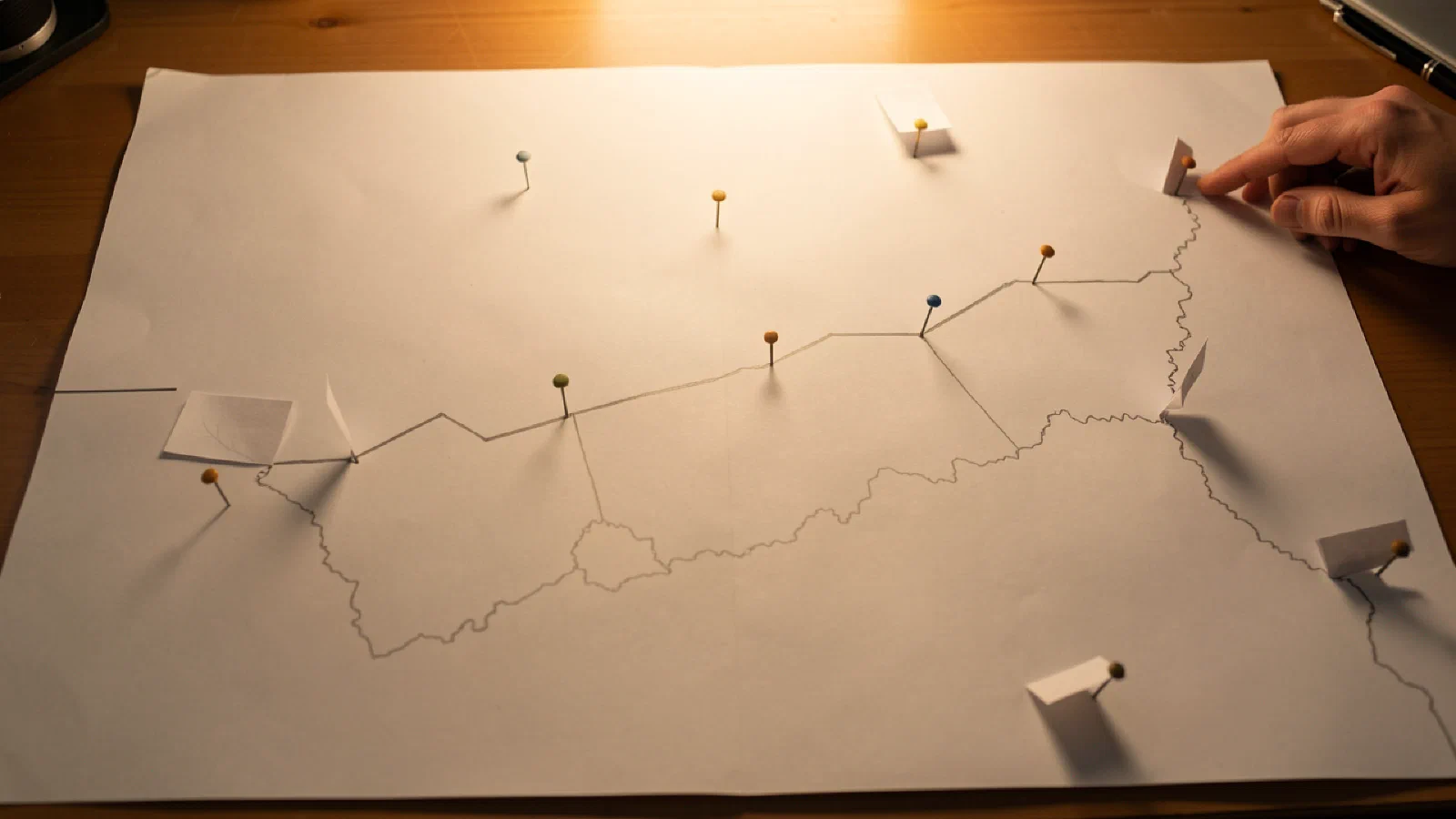
The Mapped Territory
What the Spectrum Reveals About What Human Presence Was For
TAM-RWR.ZPF-SYN · The Reshaped World, The Zero-Person Frontier · The Approximate Mind
The spectrum is not a line. This is what Keiko has learned, sitting with the eleven annotated assessments and the whiteboard and the question that the third program manager asked and that she still does not know how to answer. The progression from organ transport to Meals on Wheels to policing is not a smooth gradient from obviously-better to obviously-worse. It is a territory, and the territory has local conditions, and the conditions depend on a single variable that no standard deployment framework tracks: what the human was doing besides the job description.
The grid on her whiteboard has evolved over three months. It started as a spectrum, a line from obvious cases to contested edge with the ambiguous middle and the care boundary in between. But the line did not hold. The cases did not sort along a single dimension. The organ courier who called the surgical team and the Meals on Wheels volunteer who knew about the cups were both carrying something besides the nominal function, but the weight of what they carried was so different that placing them on the same line distorted both.
The grid became clusters. The clusters have names she has given them, written in dry-erase marker that she keeps redrawing because she is not satisfied with any of them yet. She has erased and rewritten the cluster labels four times. The labels are placeholders. The clusters are real.
Her whiteboard is the map. Not a map of where autonomous systems have been deployed. A map of what human presence was doing in the systems the deployments replaced. The map has nothing to do with robots. It has everything to do with people.
What the Arc Found#
The obvious cases established the principle. Human presence is not inherently valuable in service delivery. Its value depends on what the human was doing besides the nominal task. In organ transport, radiation inspection, deep sea maintenance, the human was doing almost nothing besides the nominal task. The instrument was replaced by a better instrument. Lives were saved. The principle is clean.
The invisible route showed where the principle begins to strain. Tomás was carrying prescriptions. He was also carrying informal intelligence between practitioners separated by forty miles of mountain road, noticing infrastructure failures that no reporting system covered, reading past the word “fine” in a patient whose “fine” he had learned to hear differently over seven years. The prescriptions were the nominal function. The notebook was the relational function. The autonomous vehicle that replaced him on three stops carries the prescriptions. It does not carry the notebook.
The Trojan horse showed where the principle fractures. In Meals on Wheels, school transportation, library delivery, postal routes, community health worker visits, the nominal function was never the real function. The real function was human contact with people who might not otherwise have it, smuggled in through logistics operations that happened to require human hands. The meal was the vehicle. The presence was the cargo. The zero-person frontier delivers the vehicle and removes what was inside it.
The procured presence showed the system’s adaptation. When the fracture became visible, the system did what systems do: it optimized. The contact that Delores provided as a byproduct of meal delivery was unbundled, formalized, and purchased as a companion service. Lily arrives for twelve minutes, matched by the AI for language and cultural compatibility. The care is real. The provider is good. The nature of the function has changed in a way that no metric captures: the caring has shifted from a side effect of presence to a purchased service with a duration and a departure time. The pebble works. The crossing functions. The gap it fills is normalized by the filling.
The contested edge showed where the spectrum becomes unresolvable. In policing, emergency response, judicial process, the human at the endpoint carries both the danger and the discernment. The bias and the shoes. The fear and the judgment. Removing the human solves one problem by creating another, and the two problems exist on different scales, and no framework can weigh them against each other because one is measurable and the other is not.
The assessment gap showed why the territory remains unmapped in institutional terms. The relational function was invisible before automation arrived, because the system was designed around the nominal function and the relational function was a byproduct. Byproducts do not have baselines. They do not appear in before-and-after comparisons. They are visible only through the absence they create after they are gone, and by then the deployment has been approved.
These are the findings. They are accurate and they are not, by themselves, the discovery.
The Discovery#
The discovery is what the findings reveal when they are held together.
Society built its service infrastructure as logistics systems. Meals on Wheels is a logistics operation: procure food, prepare meals, deliver them to addresses on a schedule. School transportation is a logistics operation: move children from residential locations to educational facilities and back. Pharmacy delivery is a logistics operation: transport medications from a dispensary to patients along a route. Policing is a logistics operation with additional complexity: dispatch responders to incident locations, manage the incident, file the report.
Each system was designed around its nominal function. The design was appropriate. The metrics tracked the nominal function. The funding justified the nominal function. The training prepared workers for the nominal function. Everything about the institutional architecture was built for the thing the system was supposed to do.
And then the humans inside the system did something else.
They did it without being asked. Without being trained. Without being compensated. Without being measured. They did it because they were present, because human beings who are present in other human beings’ lives over time start to notice things and care about things and carry things that no job description lists. Delores learned about the cups. Tomás learned about the sound of the refrigeration unit. Ray learned which children were quiet in a way that meant something. Officer Reyes learned to read the shoes by the back door.
The relational function was never designed. It was never funded. It was never measured. It was subsidized entirely by the accident of human presence in systems that required human hands.
When automation removes the hands, the subsidy ends. The nominal function continues, improved by every metric the system tracks. The relational function, which was carried for free by the human who happened to be there, has no carrier. It does not transfer to the autonomous system, because the autonomous system was designed to perform the nominal function, and the relational function was never part of the design.
This is the discovery the arc has been building toward, and it is not a discovery about automation. It is a discovery about design. The zero-person frontier is not a story about robots replacing people. It is a story about what we never built. We never built the infrastructure of human contact as a designed system. We relied on it as a byproduct of logistics systems that happened to require human bodies, and we mistook the byproduct for a feature, and when the bodies were removed, the byproduct disappeared, and we are now trying to figure out what it was and how to replace it from inside the absence it left behind.
The Designed Question#
What would it look like to build the infrastructure of human contact deliberately?
Not as a companion service dispatched for twelve minutes. Not as a gig worker contracted through a coordination layer. Not as a pebble laid across a gap to make the gap bearable. As infrastructure. Designed, funded, maintained, and valued the way we value roads and water systems and electrical grids: not because they are profitable but because without them the society does not function.
The question is easy to ask and nearly impossible to answer within existing institutional frameworks, because existing frameworks were not built to treat human contact as infrastructure. They were built to treat it as a personal matter, a family responsibility, a community resource, a charitable service, or a commercial product. None of these framings produces infrastructure. Infrastructure requires public commitment, sustained funding, and the political will to maintain something whose benefits are diffuse and whose absence is felt slowly and by the people with the least political voice.
Mrs. Chen does not have political voice. The homebound elder whose only regular human contact was the meal delivery volunteer does not organize, does not petition, does not appear at city council meetings to testify about the twelve-minute companion visit that replaced the relationship she had with Delores. The child on Ray’s bus does not know that Ray’s attention was a welfare system. The patient in Mora does not know that Tomás’s route was the county’s nervous system. The people who benefit most from the relational function are the people least likely to advocate for it, because the function was invisible to them too. They experienced it as a person coming to the door. They did not experience it as infrastructure. When the person stopped coming, they experienced the absence as personal: something that happened to them, not something that happened to a system.
I wonder whether the infrastructure of human contact, designed and deliberate, is something a society would choose to build if it understood what it was losing, or whether the understanding always arrives after the loss is complete, carried by the generation that remembers what it had, inaudible to the generation that inherited the absence as baseline.
The Fade#
The generational dimension of this discovery is what makes it urgent and what makes the urgency invisible.
The generation that remembers Delores will feel the loss. Mrs. Chen knows what Tuesdays used to be. She has stopped setting out two cups, but she remembers setting them out, and the memory is a form of knowledge about what contact feels like when it is not purchased.
The generation after Mrs. Chen will not have this memory. They will have the companion service, or the AI check-in, or nothing, and whatever they have will be what contact looks like, and they will calibrate their expectations to it, and the calibration will be invisible because calibration always is. The loneliness that Mrs. Chen feels as a loss, as the withdrawal of something she once had, will be experienced by the next generation as a condition: the way things are. Conditions do not generate advocacy. Losses do, but only while the people who remember what was lost are still present to articulate it.
The window for building the infrastructure of human contact is the window in which the people who remember what incidental presence felt like are still alive to describe it. After that window closes, the absence becomes the baseline, and baselines do not produce political will, and the infrastructure that was never built becomes the infrastructure that was never missed.
Harriet#
Harriet is eighty-one. She lives in a small town in the northeastern part of a state that has been losing population for thirty years, in a house her husband built additions to twice, once when the children came and once when he thought they might come back. They did not come back. He died on a Tuesday in November. The additions remain.
She receives a meal delivery three times a week. The robot arrives at 11:15. She takes the container from the compartment, brings it inside, eats it at the table by the window where she can see the garden that has gotten smaller each year as her knees have made the bending harder.
She does not know Keiko. She does not know about the whiteboard or the framework or the assessment gap or the relational load. She does not think in these terms. She thinks in the terms that her life provides: the meal is fine, the house is cold in the mornings, the garden will need to be smaller again next spring, and nobody comes to the door anymore except the robot, which does not come to the door exactly but parks at the end of the walk and opens a compartment, which is not the same as coming to the door but is what coming to the door means now.
She had a volunteer for two years. A woman named Grace who brought the meal and stayed for a few minutes and asked about the garden. Grace moved away. The robot came. Harriet adjusted, because adjusting is what she has done for eighty-one years, and because the alternative to adjusting is something she does not allow herself to consider on most days.
She does not set out two cups. She has never set out two cups. The cups were Mrs. Chen’s practice, in another city, in another life, in an arc Harriet does not know she is in. What Harriet does is leave the porch light on until the robot has departed, which takes about ninety seconds, because the porch light is what she used to turn on when Grace was coming up the walk, and she has not turned off the habit, and the habit is not for the robot.
The habit is for the version of the door where someone was on the other side of it.
The Map#
Keiko’s framework has been adopted by one city, as a pilot, for new deployments only. It adds one page to the standard assessment. The page asks three questions:
What is the human doing besides the nominal function?
Who depends on that function?
What happens to them when it ends?
The questions are not hard. The answers are. The answers require the deploying institution to look at something it was not built to see, to name a cost it was not designed to measure, and to hold a form of accountability it does not know how to fulfill. The framework does not tell the institution what to do with the answers. It only makes the questions unavoidable.
Keiko is not sure the framework will survive contact with budget cycles and procurement timelines. She is not sure the pilot city will continue using it after the first deployment in which the relational load is high and the deployment proceeds anyway and the record shows that the institution knew what it was removing and removed it. She is not sure whether a record of acknowledged loss is better than a record of unacknowledged loss, or whether the acknowledgment is the thing that matters, or whether what matters is something further upstream that neither the framework nor the deployment nor the institution can reach: the decision, never made by anyone in particular, to build the service infrastructure around the nominal function and let the relational function take care of itself.
The relational function took care of itself for a long time. It took care of itself because the logistics required human hands, and human hands came attached to human beings, and human beings who show up at the same door twice a week for four years start to care about the person behind the door, and the caring was free, and the free thing was load-bearing, and nobody noticed it was load-bearing until the load was removed.
The map is on Keiko’s whiteboard. The folder on her laptop is still growing. The cat is on the desk. The apartment is quiet. The next deployment review is in the morning.
She will bring the fifth page.
References#
Social Infrastructure and Design Failure
Klinenberg, Eric. Palaces for the People: How Social Infrastructure Can Help Fight Inequality, Polarization, and the Decline of Civic Life. Crown, 2018.
Jacobs, Jane. The Death and Life of Great American Cities. Random House, 1961.
Putnam, Robert D. Bowling Alone: The Collapse and Revival of American Community. Simon and Schuster, 2000.
The Generational Fade and Baseline Calibration
Pauly, Daniel. “Anecdotes and the Shifting Baseline Syndrome of Fisheries.” Trends in Ecology and Evolution, vol. 10, no. 10, 1995, pp. 430.
Kahn, Peter H. “The Human Relationship with Nature: Development and Culture.” MIT Press, 1999.
Care as Infrastructure
Tronto, Joan C. Caring Democracy: Markets, Equality, and Justice. NYU Press, 2013.
Folbre, Nancy. The Invisible Heart: Economics and Family Values. New Press, 2001.
Held, Virginia. The Ethics of Care: Personal, Political, and Global. Oxford University Press, 2006.
Measurement, Invisibility, and Institutional Knowledge
Scott, James C. Seeing Like a State: How Certain Schemes to Improve the Human Condition Have Failed. Yale University Press, 1998.
Muller, Jerry Z. The Tyranny of Metrics. Princeton University Press, 2018.
Polanyi, Michael. The Tacit Dimension. University of Chicago Press, 1966.
Loneliness and Social Isolation
Holt-Lunstad, Julianne, et al. “Social Relationships and Mortality Risk: A Meta-analytic Review.” PLoS Medicine, vol. 7, no. 7, 2010, e1000316.
Cacioppo, John T., and William Patrick. Loneliness: Human Nature and the Need for Social Connection. W. W. Norton, 2008.
How this essay connects to others across The Approximate Mind.
- Klinenberg, Eric. Palaces for the People: How Social Infrastructure Can Help Fight Inequality, Polarization, and the Decline of Civic Life. Crown, 2018.
- Jacobs, Jane. The Death and Life of Great American Cities. Random House, 1961.
- Putnam, Robert D. Bowling Alone: The Collapse and Revival of American Community. Simon and Schuster, 2000.
- Pauly, Daniel. “Anecdotes and the Shifting Baseline Syndrome of Fisheries.” Trends in Ecology and Evolution, vol. 10, no. 10, 1995, pp. 430.
- Kahn, Peter H. “The Human Relationship with Nature: Development and Culture.” MIT Press, 1999.
- Tronto, Joan C. Caring Democracy: Markets, Equality, and Justice. NYU Press, 2013.
- Folbre, Nancy. The Invisible Heart: Economics and Family Values. New Press, 2001.
- Held, Virginia. The Ethics of Care: Personal, Political, and Global. Oxford University Press, 2006.
- Scott, James C. Seeing Like a State: How Certain Schemes to Improve the Human Condition Have Failed. Yale University Press, 1998.
- Muller, Jerry Z. The Tyranny of Metrics. Princeton University Press, 2018.
- Polanyi, Michael. The Tacit Dimension. University of Chicago Press, 1966.
- Holt-Lunstad, Julianne, et al. “Social Relationships and Mortality Risk: A Meta-analytic Review.” PLoS Medicine, vol. 7, no. 7, 2010, e1000316.
- Cacioppo, John T., and William Patrick. Loneliness: Human Nature and the Need for Social Connection. W. W. Norton, 2008.