The Invisible Route
What the Human Was Carrying Besides the Package
TAM-RWR.ZPF-02 · The Reshaped World, The Zero-Person Frontier · The Approximate Mind
Tomás Herrera has been driving the pharmacy delivery route in northern New Mexico for eleven years. The route covers 140 miles round trip through three valleys and touches nine communities, seven of which have no pharmacy, no clinic, and in two cases no reliable cell coverage. He drives a white pickup with a lockbox in the bed that holds the prescriptions, sorted by stop in the order he learned to run the route in his first month and has not changed since, because the order accounts for road conditions and clinic schedules and the fact that Mrs. Gallegos in Mora needs her insulin before noon or she will skip lunch rather than eat without taking it first.
The route takes between five and seven hours depending on weather, road construction, and how many stops require more than a handoff. Most days, three or four stops require more than a handoff.
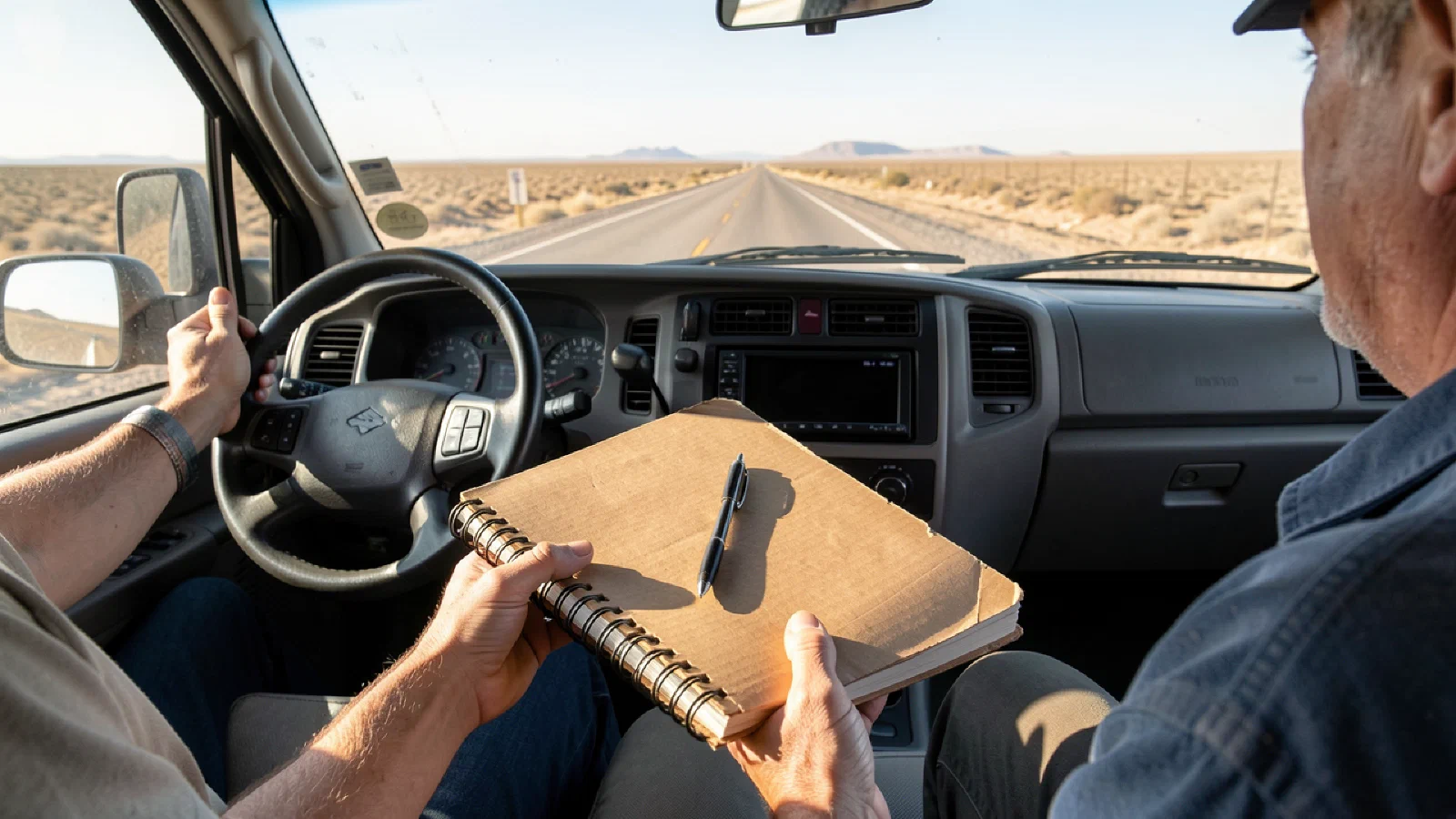
In his truck’s center console, next to a thermos of coffee his wife fills each morning and a packet of green chile jerky from a woman in Peñasco who makes it in her kitchen and sells it at the Saturday market, there is a spiral notebook. The notebook is not a log. It is not part of his job description. Nobody asked him to keep it, and nobody at the pharmacy that employs him has ever asked to see it.
The notebook is a nervous system for a county that does not have one.
What the Notebook Contains#
The entries are short and written in a handwriting that has developed, over eleven years, the specific compression of someone who writes while parked on the shoulder of a state highway with the engine running.
“Peñasco fridge humming high again. Third time. Told Rosario.”
“Mora patient, new inhaler, says it tastes different. Check with Espanola.”
“Truchas NP wants to know about the Chama road closure, how long.”
“Chama: dog at the Velarde place looks thin. Not the usual thin.”
“Dixon clinic closed Tuesdays now. Nobody told the pharmacy.”
These are not clinical observations. They are not infrastructure reports. They are not welfare checks. They are something for which there is no institutional category: the incidental intelligence gathered by a person who moves through a fragmented system on a regular schedule and notices things that no monitoring system is positioned to notice, because no monitoring system travels the route.
Tomás carries prescriptions. He also carries information between practitioners who are separated by forty miles of mountain road and connected by no shared electronic health record, no communication protocol, and no institutional relationship other than the fact that their patients sometimes overlap and the overlap is visible only to the person who delivers to both.
The nurse practitioner in Truchas does not know that the clinic in Dixon has changed its Tuesday schedule. The pharmacist in Espanola does not know that the patient in Mora is experiencing something different with the new inhaler, because the patient reported to the pharmacist that the medication was “fine,” which is what the patient reports about everything, and Tomás knows to listen past the word “fine” because he has been delivering to this patient for seven years and has learned what “fine” sounds like when it is true and what it sounds like when it is not.
The route is not a delivery service. It is a circulatory system for a county too dispersed to have one.
What the System Sees#
The pharmacy that employs Tomás tracks delivery times, prescription accuracy, and compliance with controlled substance handling protocols. These metrics are appropriate. They measure what a pharmacy delivery service should measure. By these metrics, Tomás is good at his job: reliable, accurate, no compliance violations in eleven years.
The metrics do not track the notebook. They do not track the information Tomás carries between clinics. They do not track the number of times he has told a nurse practitioner something she did not know about a patient they share. They do not track the refrigeration unit in Peñasco that he has flagged three times and that has not yet been fixed and that, when it fails, will spoil vaccines worth more than his annual salary.
The autonomous delivery system that has been proposed for three of his nine stops would, by the metrics the pharmacy tracks, perform better. The vehicle does not require breaks. It does not take longer at some stops than others. It operates in conditions, snow on the mountain passes, unpaved roads after rain, that sometimes keep Tomás home, which means the patients at those stops go without their prescriptions until the roads clear.
The proposal is sensible. The three stops selected for the pilot are the ones with the best road access: paved state highways, sufficient infrastructure for autonomous vehicle navigation, reliable GPS coverage. These are also, not coincidentally, the stops where Tomás spends the least time beyond the handoff. The pilot targets the easy conversions first, which is standard deployment practice and which makes sense from the perspective of the system that is deploying it.
From the perspective of the route as a circulatory system, the three easy stops are also the three points where the route connects the isolated clinics to the highway network. Removing Tomás from those stops does not just remove the delivery. It removes the last regular human link between the mountain communities and the valley, a link whose existence is invisible in the deployment assessment because the deployment assessment measures prescription delivery, not information circulation.
The County’s Other Nervous System#
The official channels exist. Tomás would be the first to say this. The county health department has a reporting structure. The clinics have phone lines. The nurse practitioner in Truchas can call the pharmacist in Espanola directly. The patient in Mora can call her prescriber if the inhaler tastes different.
The official channels are also, in practice, rarely used for the kind of information Tomás carries. The nurse practitioner does not call the pharmacist because the question is not clinical enough to justify the call. The patient does not call her prescriber because the inhaler is “fine” and calling about something that is “fine” feels like making a fuss. The refrigeration concern in Peñasco has been reported through official channels once, by Rosario, who manages the clinic. The report went into a maintenance queue. Tomás has mentioned it three times because he notices the sound each time he delivers and the sound has not changed, which means the report has not been acted on, which he finds concerning in a way that does not fit any reporting category he has access to.
The official channels carry formal information: diagnoses, prescriptions, referrals, reports. The notebook carries informal information: impressions, patterns, the soft data that accumulates when a person sees the same people and places every week for eleven years and develops an intuitive model of what normal looks like, so that deviation from normal registers before it becomes a clinical event or an infrastructure failure.
The formal channels and the informal channels are not substitutes for each other. They are complementary systems, and the informal one is invisible because it was never designed. It emerged from the fact that a human being drove the route, and human beings, when they are present in a system over time, begin to notice things. The noticing is not a feature of the delivery service. It is a feature of the person.
What Tears Silently#
When the autonomous vehicle takes over three of Tomás’s nine stops, the prescriptions will arrive. The delivery times will improve. The weather-related gaps will close. The pharmacy’s metrics will show improvement. The pilot will be judged a success, because by every measure the system tracks, it will be a success.
The information Tomás carried on those three segments of the route will stop flowing. The nurse practitioner in Truchas will no longer learn about the road closure from someone who drove through it two hours ago. The refrigeration concern in Peñasco will no longer be mentioned by someone who hears the compressor each week. The patient in Mora will report that the inhaler is “fine,” and no one who has spent seven years learning what her “fine” sounds like will be present to hear the difference.
The connective tissue will tear. It will tear silently, because the tissue was never mapped. The consequences will arrive later: the vaccine spoilage when the refrigeration unit finally fails, the medication problem that escalates because the early signal was missed, the patient whose decline was visible to Tomás and invisible to everyone else because everyone else sees the patient through a clinical encounter and Tomás saw her through a door.
I wonder whether anyone will notice the connective tissue is gone before the consequences arrive, or whether the consequences, when they come, will be attributed to something else entirely: to the rural health workforce shortage, to the infrastructure maintenance backlog, to the patient’s failure to report the symptom through the proper channel. Each attribution will be accurate. None will identify the cause: a circulatory system that worked because a person drove through it, and that stopped working when the person was replaced by a vehicle that carried the prescription but not the notebook.
The Green Chile Jerky#
Tomás has been told the pilot will start in the spring. Three stops, the highway stops, autonomous vehicles with lockboxes programmed to the patients’ access codes. He will continue to drive the remaining six stops. His route will be shorter by about forty miles. His day will be shorter by about two hours.
He does not argue with the decision. The decision is above him, and the people making it have data he does not have, and the data says what it says. He has one question that he asks the program manager during the briefing, a question that comes from the notebook rather than from the job description.
“Who tells the Truchas NP about the Chama road closure?”
The program manager looks at him. The question is not hostile. It is not rhetorical. It is a question from a person who has been the answer to it for eleven years and wants to know who the answer will be when he is no longer on the route.
The program manager does not have an answer. The question does not fit any field in the deployment assessment. It is not the kind of question the deployment assessment was built to hold.
Tomás drives home. The thermos is empty. The jerky is half gone. He will stop in Peñasco on the way and listen to the refrigeration unit, not because anyone asked him to but because he will be there and the unit is there and the listening costs nothing and takes four seconds and might matter.
The notebook is in the console. It is almost full. He will start a new one next month. He has not thought about what happens to the notebooks when he is done with them. They sit in a box in his garage, eleven years of observations that belong to no system and inform no database and constitute, in aggregate, something like a medical record for a county too dispersed to keep one, written by a man whose job title is pharmacy delivery driver and whose actual function has never been described in any document that anyone with authority over his route has ever read.
The green chile jerky is from Rosa Medina in Peñasco. She has been making it for thirty years. Tomás has been buying it for eleven. She gives him a discount because he tells her about her grandchildren in Mora, whom she does not see often enough because the drive takes two hours and her truck is unreliable and the road is bad after rain.
He carries the prescriptions. He carries the information. He carries the jerky. He carries the news about the grandchildren.
The vehicle that replaces him will carry the prescriptions.
References#
Rural Health Infrastructure and Service Delivery
Rosenblatt, Roger A., and L. Gary Hart. “Physicians and Rural America.” Western Journal of Medicine, vol. 173, no. 5, 2000, pp. 348–351.
Douthit, Nathaniel, et al. “Exposing Some Important Barriers to Health Care Access in the Rural USA.” Public Health, vol. 129, no. 6, 2015, pp. 611–620.
National Rural Health Association. About Rural Health Care. NRHA Policy Briefs, 2023.
Informal Knowledge Networks in Fragmented Systems
Granovetter, Mark S. “The Strength of Weak Ties.” American Journal of Sociology, vol. 78, no. 6, 1973, pp. 1360–1380.
Wenger, Etienne. Communities of Practice: Learning, Meaning, and Identity. Cambridge University Press, 1998.
Autonomous Delivery in Rural and Remote Geographies
Nuro, Inc., and Industry Reporting. Trade press coverage of autonomous delivery pilots in low-density service areas, 2023–2025.
Figliozzi, Miguel A. “Carbon Emissions Reductions in Last Mile and Grocery Deliveries Utilizing Air and Ground Autonomous Vehicles.” Transportation Research Part D, vol. 85, 2020, 102443.
Community Health Workers and Connective Functions
Scott, Kerry, et al. “What Do We Know About Community-Based Health Worker Programs? A Systematic Review of Existing Reviews on Community Health Workers.” Human Resources for Health, vol. 16, no. 1, 2018, p. 39.
How this essay connects to others across The Approximate Mind.
- Rosenblatt, Roger A., and L. Gary Hart. “Physicians and Rural America.” Western Journal of Medicine, vol. 173, no. 5, 2000, pp. 348–351.
- Douthit, Nathaniel, et al. “Exposing Some Important Barriers to Health Care Access in the Rural USA.” Public Health, vol. 129, no. 6, 2015, pp. 611–620.
- National Rural Health Association. About Rural Health Care. NRHA Policy Briefs, 2023.
- Granovetter, Mark S. “The Strength of Weak Ties.” American Journal of Sociology, vol. 78, no. 6, 1973, pp. 1360–1380.
- Wenger, Etienne. Communities of Practice: Learning, Meaning, and Identity. Cambridge University Press, 1998.
- Nuro, Inc., and Industry Reporting. Trade press coverage of autonomous delivery pilots in low-density service areas, 2023–2025.
- Figliozzi, Miguel A. “Carbon Emissions Reductions in Last Mile and Grocery Deliveries Utilizing Air and Ground Autonomous Vehicles.” Transportation Research Part D, vol. 85, 2020, 102443.
- Scott, Kerry, et al. “What Do We Know About Community-Based Health Worker Programs? A Systematic Review of Existing Reviews on Community Health Workers.” Human Resources for Health, vol. 16, no. 1, 2018, p. 39.