The Post-Work Church
What Happens to Institutions That Bundled Six Things When the Bundle Unravels
TAM-RWR.3-03 · The Reshaped World, Arc 3: The Rewoven Fabric · The Approximate Mind
Pastor David Hensley has been watching his congregation shrink for twelve years. When he arrived at First Methodist in a mid-sized Ohio city, the Sunday attendance was 340. It is now 187. He has tried most of what there is to try. A contemporary service at 9 AM alongside the traditional service at 11. A community dinner on Wednesday evenings. A youth program with a budget he cannot justify to the finance committee but that he defends because the seven teenagers who attend are the only young people who cross the building’s threshold. A podcast that his daughter helped him set up and that has forty-three subscribers, most of whom, he suspects, are members who listen instead of attending.
He has hired a younger associate who understands social media. He has renovated the fellowship hall. He has adjusted the service time, twice. The congregation is smaller than when he started the improvements.
He has arrived, reluctantly and against his professional training, at a suspicion he does not say aloud in committee meetings: the decline is not about what he is doing. It is about what the congregation was for, and whether the institutional form can still provide it.
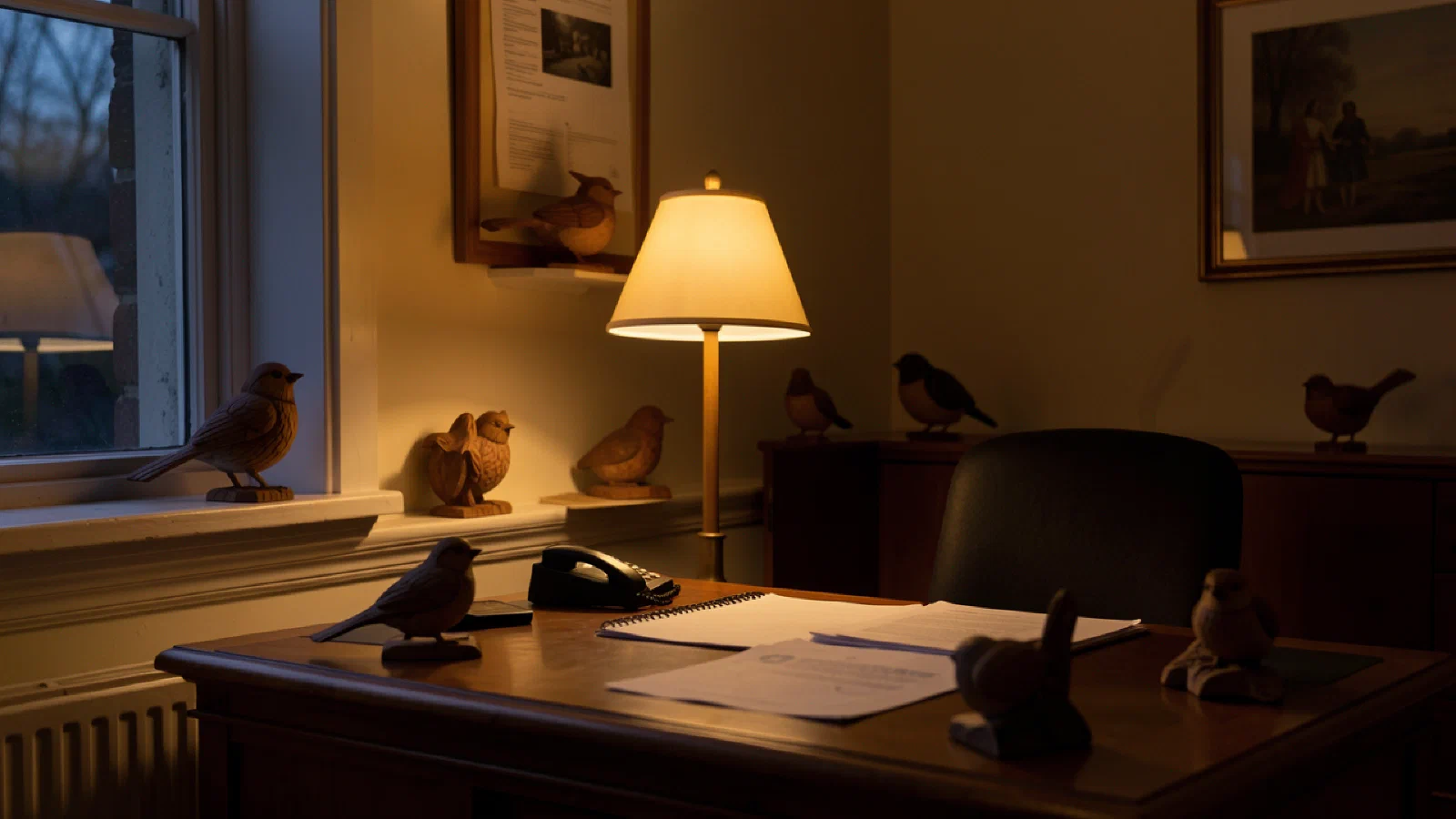
He carves wooden birds. Small ones, palm-sized, from scraps of wood he collects on walks along the river behind the church. His office has eleven of them on various surfaces, mantels, windowsills, the corner of his desk where the phone used to sit before the phone became his pocket. He cannot explain why birds. When asked, which is rarely, he says they are the right size.
The Bundle#
The religious institution in America was never only about God. The theological function, the provision of spiritual practice, moral framework, and encounter with the transcendent, was the institution’s stated purpose and its public justification. It was also the smallest part of what the institution actually provided.
First Methodist, in the decades when it served 340 people on a Sunday, was providing at least six things at once, bundled into a single institutional container the way employment bundled income, structure, identity, and belonging into a single mechanism.
It provided spiritual practice: the weekly encounter with texts, rituals, and questions about meaning that most people do not otherwise address in structured form. It provided community: the reliable, repeated gathering of the same people, in the same room, organized around something larger than any individual’s preference. It provided temporal structure: the week organized around Sunday, the year organized around the liturgical calendar, the lifetime organized around the rituals of baptism, confirmation, marriage, and burial. It provided mutual aid: the casserole delivered to the family whose mother was in the hospital, the rides to appointments, the quiet envelope of cash at Christmas, the knowledge that if your house burned down, forty people would be at your door by morning. It provided life-cycle witnessing: the marking of transitions, birth to death, in the presence of people who had been there for the whole story. And it provided childcare, in the specific form of Sunday school and youth programming, which served at once as religious education, social formation, and the two hours of peace that parents needed on Sunday morning.
The bundle worked because the bundling was invisible. People did not come to First Methodist for six things. They came for church. “Church” was the word that contained the bundle without requiring anyone to disaggregate it. The word was load-bearing. It carried the six functions the way a roof carries weight: distributed, invisible, noticed only when it fails.
The Unbundling#
Each function, taken individually, now has an alternative that is more convenient, more tailored, and less demanding than the institutional form.
Spiritual practice can happen privately. Meditation apps provide guided practice at any hour. Podcasts deliver sermons from speakers more compelling than most local pastors, David included, without requiring the listener to get dressed and drive to a building at a specific time. The spiritual seeker who wants access to theological reflection has more access than any prior generation, delivered to any device, in any tradition, with no institutional obligation.
Community can be organized through digital platforms. The neighborhood group chat, the online forum, the interest-based community: each provides a form of connection that is interest-matched rather than geographically constrained, available on demand rather than on Sunday, and free of the social obligations that institutional membership entails. The digital community does not require you to serve on the building maintenance committee.
Mutual aid has been partially replaced by the welfare state (food stamps, Medicaid, unemployment insurance) and partially by crowdfunding (GoFundMe, community fundraising platforms). The quiet envelope of cash at Christmas still happens, but the institutional channel through which it happened, the deacon board that knew who was struggling and organized the response, is thinner than it was. The information that the deacon board held, who needs help and what kind, is distributed now across social media, text messages, and the caseworker’s file.
Temporal structure is provided by work for those who have it and is absent for those who don’t, which is the argument the previous essay traced. The liturgical calendar’s temporal function, organizing the year around a cycle of meaning rather than a cycle of productivity, has been replaced by the commercial calendar: back-to-school, Black Friday, the January reset. The replacement is not spiritual. It is structural. It organizes the year. It does not sanctify it.
Childcare is available through commercial and public providers that are often higher quality, more professionally staffed, and more developmentally sophisticated than the Sunday school classroom. The Sunday school teacher was a volunteer. The childcare center has credentialed staff, a curriculum, and a facility designed for children rather than repurposed from a fellowship hall.
Each alternative is better at the specific function it addresses than the institutional bundle was. This is the pattern of unbundling across every domain the project has examined: the individual components, freed from the bundle, improve. The question is whether something was being provided by the bundling itself that the individual components, however improved, do not replicate.
What the Bundling Provided#
David has spent twelve years trying to name it. He is closer now than he was when he started, though the naming has not helped his attendance numbers.
The bundling provided obligation. You came to church because you were supposed to. Not because you felt like it. Not because Sunday morning’s offering competed successfully against sleeping in and brunch. Because the community expected you, and the expectation was felt, and the feeling was the mechanism. The obligation was not incidental to the benefit. It was the benefit’s delivery system.
You showed up because you were obligated, and because you showed up, you encountered the person whose marriage was failing and the person whose child was sick and the person who was quietly running out of money, and the encounters produced the mutual aid and the community and the witnessing that the institution officially provided through formal programs but actually provided through the accidental proximity of people who had agreed, by obligation rather than preference, to be in the same room at the same time.
Voluntary association does not replicate this. The meetup group, the book club, the recreational league: each requires continuous re-enrollment. Each time you attend, you are making a choice. The choice introduces optionality, and optionality is the enemy of the obligation that made the encountering reliable. The person whose marriage is failing does not go to the meetup group, because the meetup group is optional and going out when your marriage is failing is hard. The person whose marriage is failing goes to church, because church is obligatory, and the obligation overrides the inclination to stay home, and the overriding is what produces the encounter, and the encounter is what produces the support.
David has watched the obligation erode. The members who attend irregularly are not less committed to the values. They are less obligated by the social structure. The norm has shifted from “you go every Sunday because that is what people like us do” to “you go when you feel called, when the schedule permits, when nothing else competes.” The shift sounds like liberation. It is, in a specific structural sense, the dissolution of the mechanism that made the community reliable.
The Witnessing Function#
David has arrived, after twelve years of trying everything, at the one thing he still has that nothing else provides.
It is not the sermon, which a podcast delivers better. It is not the community, which a neighborhood group provides more conveniently. It is not the mutual aid, which GoFundMe handles more efficiently. It is not the temporal structure, which work and the commercial calendar provide for most people.
It is the capacity to witness. To be present, across a lifetime, at the moments when a person needs someone who holds the whole story. The birth. The coming of age. The marriage. The illness. The death. The moments when the individual needs not just someone present but someone who was there for the preceding chapters, who remembers what the marriage was like before the illness, who held the child at the baptism and will hold the family at the funeral.
This is the accompaniment argument from The Transformed, applied to the institution rather than the profession. The Irreducible argued that certain professions provide something beyond their product: a conscious being, mortal and invested, present at a threshold moment with another conscious being. The church provided this at the institutional level. The pastor who has been there for twelve years, who baptized the grandchildren and officiated the fiftieth anniversary and who will stand at the casket and say the name, is providing accompaniment at a scale no individual relationship can sustain.
AI can provide information. It can provide comfort, of a kind. It can even provide a form of companionship that is patient and available and adaptive. It cannot witness. Witnessing requires a conscious being who has been present across time, who carries the accumulated knowledge of the story, and whose presence at the threshold moment says: I was here. I saw. I remember. You are not alone in the history of yourself.
I wonder whether secular society will build institutions capable of this, or whether the religious institution’s decline leaves a gap that no secular form has yet filled. The civic organization, the community center, the social club: none of these provide witnessing at the lifecycle level, because none of them organize themselves around the assumption that the same people will be present across decades, marking the transitions together. The witnessing function requires institutional persistence and relational continuity at a timescale that voluntary association, with its optionality and its turnover, has not demonstrated the capacity to sustain.
The Funeral#
David is preparing a funeral. Mrs. Henderson died on Thursday at eighty-seven. She had been a member for forty-one years. Her husband preceded her by six. Her daughter, who lives in Charlotte, is flying in tomorrow. Her son is in town and has been at the church three times in the past decade.
David knows the family. He baptized the granddaughter. He officiated the fiftieth wedding anniversary, where Mr. Henderson cried during the vows and Mrs. Henderson did not because Mrs. Henderson did not cry in public, which was one of the things David knew about her that the obituary would not contain.
He is the person in the room who holds the whole story. Not the medical story. Not the financial story. The story of who she was when she was not a patient or a policyholder or a client but a person in a room with other people, known across time, carried through the transitions by an institution that, for all its declining attendance and all its unbundled functions, did the one thing nothing else in her life was organized to do: it stayed.
He carves a bird on the evening before the funeral. He does not know why. He started the habit years ago, a bird before each funeral, and the habit persists without explanation, the way certain rituals persist after the theology that justified them has thinned. The bird is small. It is the right size. He will finish it by morning.
The funeral is at eleven. The pews will not be full. Some of the people who come will not have been to the church in years. They will come because Mrs. Henderson was the reason they came when they came, and the coming is the last obligation, and the obligation, even now, overrides the inclination to stay away.
David will say her name. He will say it in a room where people remember what the name meant, not to the world, which did not know her, but to the room, which did. The room is the institution’s last irreducible function: a space where someone who held the whole story speaks the name to people who remember the life the name carried.
The bird is almost done. The knife is sharp. The wood curls away from the blade in spirals that fall on the desk and that he does not clean up until morning.
This is the third essay in Arc 3 of The Reshaped World. The arc traces what employment and its companion institutions were carrying beyond their stated functions. This essay examines the religious institution as a function bundle being unbundled and identifies the witnessing function, the capacity to be present across a lifetime at the moments that mark transitions, as the one function the unbundled alternatives cannot replicate. The capstone essay that follows, The Participation Economy, asks what determines whether communities hold together when the institutional fabric thins.
References#
Religious Institutions as Function Bundles
Putnam, Robert D., and David E. Campbell. American Grace: How Religion Divides and Unites Us. Simon and Schuster, 2010.
Chaves, Mark. American Religion: Contemporary Trends. Princeton University Press, 2011.
Wuthnow, Robert. After the Baby Boomers: How Twenty- and Thirty-Somethings Are Shaping the Future of American Religion. Princeton University Press, 2007.
Obligation, Voluntary Association, and Social Cohesion
Durkheim, Émile. The Elementary Forms of Religious Life. 1912. Translated by Karen E. Fields, Free Press, 1995.
Bellah, Robert N., et al. Habits of the Heart: Individualism and Commitment in American Life. University of California Press, 1985.
Accompaniment and Witnessing
Nouwen, Henri J.M. The Wounded Healer: Ministry in Contemporary Society. Doubleday, 1972.
Kalanithi, Paul. When Breath Becomes Air. Random House, 2016.
Secular Community and Its Limitations
Klinenberg, Eric. Palaces for the People: How Social Infrastructure Can Help Fight Inequality, Polarization, and the Decline of Civic Life. Crown, 2018.
Oldenburg, Ray. The Great Good Place: Cafes, Coffee Shops, Bookstores, Bars, Hair Salons, and Other Hangouts at the Heart of a Community. Paragon House, 1989.
How this essay connects to others across The Approximate Mind.
- Putnam, Robert D., and David E. Campbell. American Grace: How Religion Divides and Unites Us. Simon and Schuster, 2010.
- Chaves, Mark. American Religion: Contemporary Trends. Princeton University Press, 2011.
- Wuthnow, Robert. After the Baby Boomers: How Twenty- and Thirty-Somethings Are Shaping the Future of American Religion. Princeton University Press, 2007.
- Durkheim, Émile. The Elementary Forms of Religious Life. 1912. Translated by Karen E. Fields, Free Press, 1995.
- Bellah, Robert N., et al. Habits of the Heart: Individualism and Commitment in American Life. University of California Press, 1985.
- Nouwen, Henri J.M. The Wounded Healer: Ministry in Contemporary Society. Doubleday, 1972.
- Kalanithi, Paul. When Breath Becomes Air. Random House, 2016.
- Klinenberg, Eric. Palaces for the People: How Social Infrastructure Can Help Fight Inequality, Polarization, and the Decline of Civic Life. Crown, 2018.
- Oldenburg, Ray. The Great Good Place: Cafes, Coffee Shops, Bookstores, Bars, Hair Salons, and Other Hangouts at the Heart of a Community. Paragon House, 1989.