Margaret's World
TAM-RWR.6-03 · The Reshaped World, Arc 6: The New Operating System · The Approximate Mind
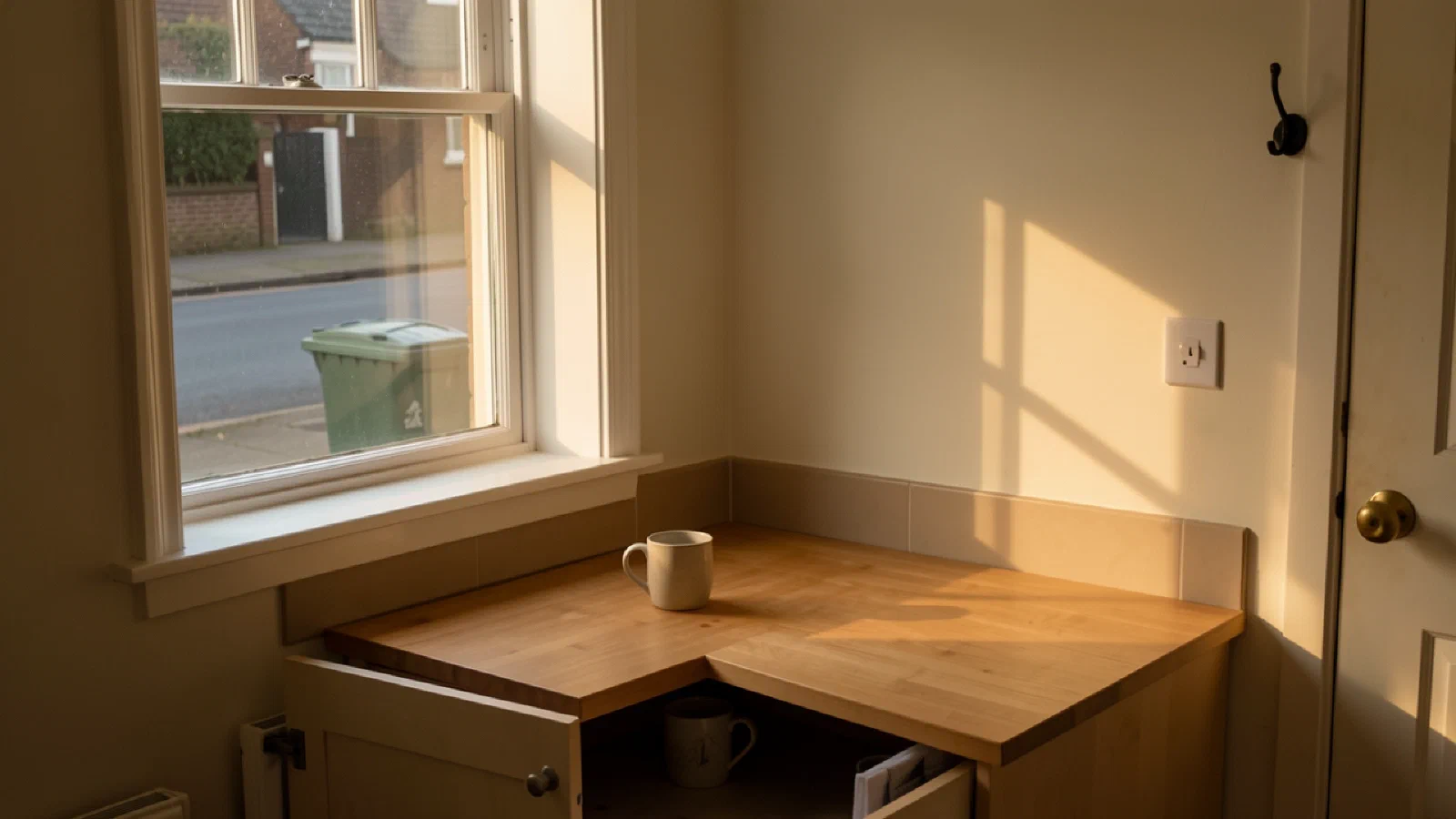
Margaret is seventy-eight. She is in the kitchen. It is Wednesday morning, which she knows because the recycling goes out on Wednesday and the blue bin is at the curb. This is one of the ways she keeps time now: by which bin is out. The other ways are the pharmacy’s automated refill notification on her phone, the calendar her daughter set up with the appointments marked in green, and the light in the east window, which she has been watching move across the kitchen floor for eleven years, since David died, and which arrives at the corner of the table at approximately 8:15 in late May.
The corner of the table is where she sits for her first cup of coffee.
David’s mug is in the cabinet. She does not use it. She does not move it. It sits behind her own mug, which she reaches past every morning, the back of her hand grazing the ceramic. The reaching-past is not avoidance. It is proximity. The mug is where David left it, and leaving it where he left it is a form of keeping him in the house that does not require her to explain to anyone what she is doing or why.
She sits down with her coffee. The light is at the corner of the table. It is 8:15, approximately. She was right.
The refill notification arrived last night: her blood pressure medication has been processed and will be delivered Thursday. She did not call in the refill. The pharmacy’s system called it in automatically, based on the days-supply remaining, the same as it has for two years. She has not been inside the pharmacy since the automatic system started. She has not needed to be. She thinks sometimes about the pharmacist she used to see there, a woman whose name she cannot remember now, who once told her, without being asked, that the combination of medications she was on could make her dizzy if she stood up quickly. Margaret still thinks of that when she stands up quickly. She does not know if the pharmacist is still there.
The coffee is the right temperature. She has been making coffee in the same percolator for nineteen years. David bought it. It makes more coffee than she drinks and she has never considered replacing it.
Her daughter called on Tuesday, as she does most Tuesdays. The call lasted forty minutes. They talked about her older grandchild, who is twelve and whose school has a new program using AI to teach math in a way that adjusts to each student, identifying exactly where their understanding stops and building from there. Her daughter says it has made a difference. Margaret does not doubt this. She also has a younger grandchild, nine, in a different school that has been using AI to cover classroom time when there are not enough teachers, which there have not been for three years. From the outside she cannot tell whether the two children are receiving the same thing or something categorically different. She suspects there is a difference. She cannot see it from where she sits.
The light has moved off the table and onto the floor near the radiator.
She has an appointment at 10:30, a telehealth visit with her cardiologist for the quarterly check. She will sit at the kitchen table with her phone propped against the sugar bowl and speak to him for twelve minutes. He will review the readings from the monitoring device she wears on her wrist and ask her about her energy levels and whether she has had any episodes of the feeling she described last October, which she has not, and he will tell her the medication adjustment from February appears to be working and she should continue as is. She has met this cardiologist in person once, three years ago, when she was first referred. He is competent. She trusts him. She does not know anything about him that is not relevant to her heart.
She used to see her previous cardiologist in person every three months. He had a photograph of his family on his desk that she never asked about but noted across twelve years, the children growing up in the margins of their appointments. She does not know what happened to him. She moved to this practice when her insurance changed two years ago. The continuity of care transferred; the continuity of the person did not.
She rinses her cup and sets it in the drying rack, which David installed on the left side of the sink because he was left-handed and she is right-handed and they argued about it, pleasantly, for years. The drying rack is on the left. She has adapted.
The house is the same house they bought in 1978. The neighborhood around it has changed in the way that neighborhoods change over a generation: some of the families she knew are still here, grown children, the originals mostly gone or moved away. The drugstore on the corner that was there when they moved in closed in 2019. The coffee shop that replaced it closed in 2022. There is a nail salon there now. She has no use for a nail salon but she is glad something is in the building. The hardware store two blocks east is still there, run by the son of the man who ran it when they arrived. She went in last month to ask about a leaky faucet. He fixed it himself, that afternoon, in twenty minutes, and charged her forty dollars, and she felt, while he was working under her sink, something she could not quite name: the specific comfort of being in the presence of someone who knew what they were doing and was doing it in her house.
The telehealth appointment goes as she expected. Twelve minutes. The cardiologist is satisfied with the readings. She should continue as is. He will see her again in three months, which means her phone will show the appointment in green and she will sit at the kitchen table with the phone propped against the sugar bowl.
She hangs up and stands in the kitchen for a moment. The light has moved to the west side of the room. It is nearly noon.
The Medicare letter arrived last week. She has read it three times and understood it imperfectly. The supplemental insurance covers, as best she can determine, most of what the Medicare covers less, except for certain things listed in a paragraph she has read four times and still cannot parse. She called the supplemental insurance’s customer service line. She was connected to an automated system that answered her question by directing her to the website. The website directed her to a PDF. The PDF was seventeen pages. She printed it and read it and found a passage she thinks answers her question, though she is not certain the question she had is the same question the passage is answering. She has decided to assume that it is. If she is wrong she will find out when the bill arrives.
Her neighbor Edie comes by at noon, as she sometimes does, with tomatoes from her garden. The tomatoes are not ready yet, it is too early in the season, but Edie comes by anyway, with a cutting from a plant she is propagating, and they stand in Margaret’s kitchen for twenty minutes talking about the tomatoes they will have later and the ones they had last year and the summer when David was still alive and the tomatoes were so good that summer, she remembers, better than usual. Edie remembers too. They stand in the kitchen with the cutting on the counter and they talk about tomatoes and the summer eleven years ago and Edie does not stay for lunch because she has somewhere to be, but she was here, for twenty minutes, standing in the kitchen, and this is what Margaret has in the place of what the pharmacist’s name used to occupy in the space of being known.
The afternoon is slow. She reads. She calls her friend Dorothy, who lives in a different city and who is seventy-eight and whose health is more complicated than Margaret’s. They talk for thirty-five minutes. Dorothy’s church changed its service time and she has been going less often. Margaret’s church has not changed its service time but the minister who came after her minister left has a different manner, not worse, she would not say worse, but different in a way she has not yet adjusted to or decided she will not adjust to. She still goes. She goes because she has been going since 1983 and because the people there have been the same people across those years, older now, some of them gone, but the ones who remain are the ones who were there for the funeral in 2020 and held her, physically held her, in the receiving line, and she has not yet found the reason to stop going to the place where the people who held her are still going.
She does not think of this as loyalty. She thinks of it as being where you are from.
Her property tax bill is on the desk in the living room. She has looked at it twice. She can still afford it. Her neighbor two houses down, a woman her age who has lived there longer than Margaret has, cannot afford it anymore, and is in the process of determining what to do about this, which appears to mean moving somewhere less expensive, which means leaving the house she has been in for forty years, which means leaving the neighborhood, which means that soon there will be one fewer person on this street who was here when David was alive and who therefore constitutes, without either of them having discussed this, evidence that her life with David was real and not only memory.
She does not know how to explain this to the property tax assessor. She suspects this is not the assessor’s problem to solve.
The light is in the west window now. The day has followed its path across the floor. She has been watching this light for eleven years and it still surprises her sometimes, the reliability of it, the way it arrives at the corner of the table at approximately 8:15 in late May, every late May, indifferent to everything that has changed in the house below it.
She makes dinner for one, which she has been doing for eleven years and which she has not become used to in the sense of forgetting it. She has become used to it in the sense of doing it every evening without it requiring a decision. There is a difference between those two things.
After dinner she sits on the porch. The street is quieter than it used to be. She has noticed this without having decided what to conclude from it. Fewer people walk by than used to. The children who used to ride bikes in the early evening are somewhere else now, or there are fewer of them, or they are inside. She does not analyze this. She holds it the way a person holds a familiar weight: without examining it, without naming it, without deciding what it means.
The blue bin is at the curb. Tomorrow the truck will come. She will bring the bin back up to the side of the house. Saturday the green bin goes out. She keeps time.
David’s mug is in the cabinet.
The civilization that built her house and educated her children and insured her health and organized her neighborhood and employed the pharmacist who noticed she might get dizzy and maintained the hardware store where someone will come fix your faucet in twenty minutes, the civilization that transmitted, across her lifetime, the implicit answer to what it means to be a person in this society, is reshaping itself around her in ways she can feel and cannot name.
She does not need to name it. She is not the one who needs to understand the operating system. She is the one who lives inside it. The question this series has been asking, across six arcs and twenty-six essays, is whether the people who are reshaping the system understand what it feels like from inside Margaret’s kitchen, and whether that understanding, if they had it, would change what they build.
The light is in the west window. It will be there again tomorrow. She goes inside.
This is the final essay of The Reshaped World. The series began with a city planner and a map of a city that no longer exists in the form the map describes. It ends with Margaret and a kitchen in a civilization that no longer operates in the form she understood. Both the map and the kitchen are still there. Both the city and the civilization are still being lived in. The gap between what was built for and what now is: this has been the series’ territory. The gap is not closing. It is being inhabited, by people who did not choose it and cannot exit it and are doing their best with what they have. That is the series’ last argument. It is also Margaret’s Wednesday. Both are true. Neither is sufficient. The inhabiting continues anyway.
References#
On the Experience of Aging and Social Change
Angell, Marcia. The Truth about the Drug Companies: How They Deceive Us and What to Do about It. Random House, 2004.
Carstensen, Laura L. A Long Bright Future: An Action Plan for a Lifetime of Happiness, Health, and Financial Security. Crown Publishers, 2009.
Gawande, Atul. Being Mortal: Medicine and What Matters in the End. Metropolitan Books, 2014.
Medicare, Insurance, and Administrative Burden
Bhattacharya, Jay, et al. “Medicare at 50.” New England Journal of Medicine, vol. 373, no. 10, 2015, pp. 901–903.
Sommers, Benjamin D., et al. “Understanding Participation Rates in Medicaid: Implications for the Affordable Care Act.” ASPE Research Brief, U.S. Department of Health and Human Services, 2012.
The Built Environment and Aging in Place
AARP Public Policy Institute. “Livable Communities: An Evaluation Guide.” AARP, 2005. aarp.org.
Pew Research Center. “What Unites and Divides Urban, Suburban and Rural Communities.” Pew Research Center, 2018. pewresearch.org.
Education, AI, and the Two Schools
Reich, Justin. Failure to Disrupt: Why Technology Alone Can’t Transform Education. Harvard University Press, 2020.
Selwyn, Neil. Should Robots Replace Teachers? AI and the Future of Education. Polity Press, 2019.
Community, Continuity, and the Social Fabric
Klinenberg, Eric. Palaces for the People: How Social Infrastructure Can Help Fight Inequality, Polarization, and the Decline of Civic Life. Crown Publishers, 2018.
Putnam, Robert D. Bowling Alone: The Collapse and Revival of American Community. Simon and Schuster, 2000.
Oldenburg, Ray. The Great Good Place: Cafés, Coffee Shops, Community Centers, Beauty Parlors, General Stores, Bars, Hangouts, and How They Get You Through the Day. Paragon House, 1989.
How this essay connects to others across The Approximate Mind.
- Angell, Marcia. The Truth about the Drug Companies: How They Deceive Us and What to Do about It. Random House, 2004.
- Carstensen, Laura L. A Long Bright Future: An Action Plan for a Lifetime of Happiness, Health, and Financial Security. Crown Publishers, 2009.
- Gawande, Atul. Being Mortal: Medicine and What Matters in the End. Metropolitan Books, 2014.
- Bhattacharya, Jay, et al. “Medicare at 50.” New England Journal of Medicine, vol. 373, no. 10, 2015, pp. 901–903.
- Sommers, Benjamin D., et al. “Understanding Participation Rates in Medicaid: Implications for the Affordable Care Act.” ASPE Research Brief, U.S. Department of Health and Human Services, 2012.
- AARP Public Policy Institute. “Livable Communities: An Evaluation Guide.” AARP, 2005. aarp.org.
- Pew Research Center. “What Unites and Divides Urban, Suburban and Rural Communities.” Pew Research Center, 2018. pewresearch.org.
- Reich, Justin. Failure to Disrupt: Why Technology Alone Can’t Transform Education. Harvard University Press, 2020.
- Selwyn, Neil. Should Robots Replace Teachers? AI and the Future of Education. Polity Press, 2019.
- Klinenberg, Eric. Palaces for the People: How Social Infrastructure Can Help Fight Inequality, Polarization, and the Decline of Civic Life. Crown Publishers, 2018.
- Putnam, Robert D. Bowling Alone: The Collapse and Revival of American Community. Simon and Schuster, 2000.
- Oldenburg, Ray. The Great Good Place: Cafés, Coffee Shops, Community Centers, Beauty Parlors, General Stores, Bars, Hangouts, and How They Get You Through the Day. Paragon House, 1989.