The Two Curricula
Who Gets Thoughtful Augmentation and Who Gets Emergency Content Delivery
TAM-RWR.5-03 · The Reshaped World, Arc 5: The Distilled Institution · The Approximate Mind
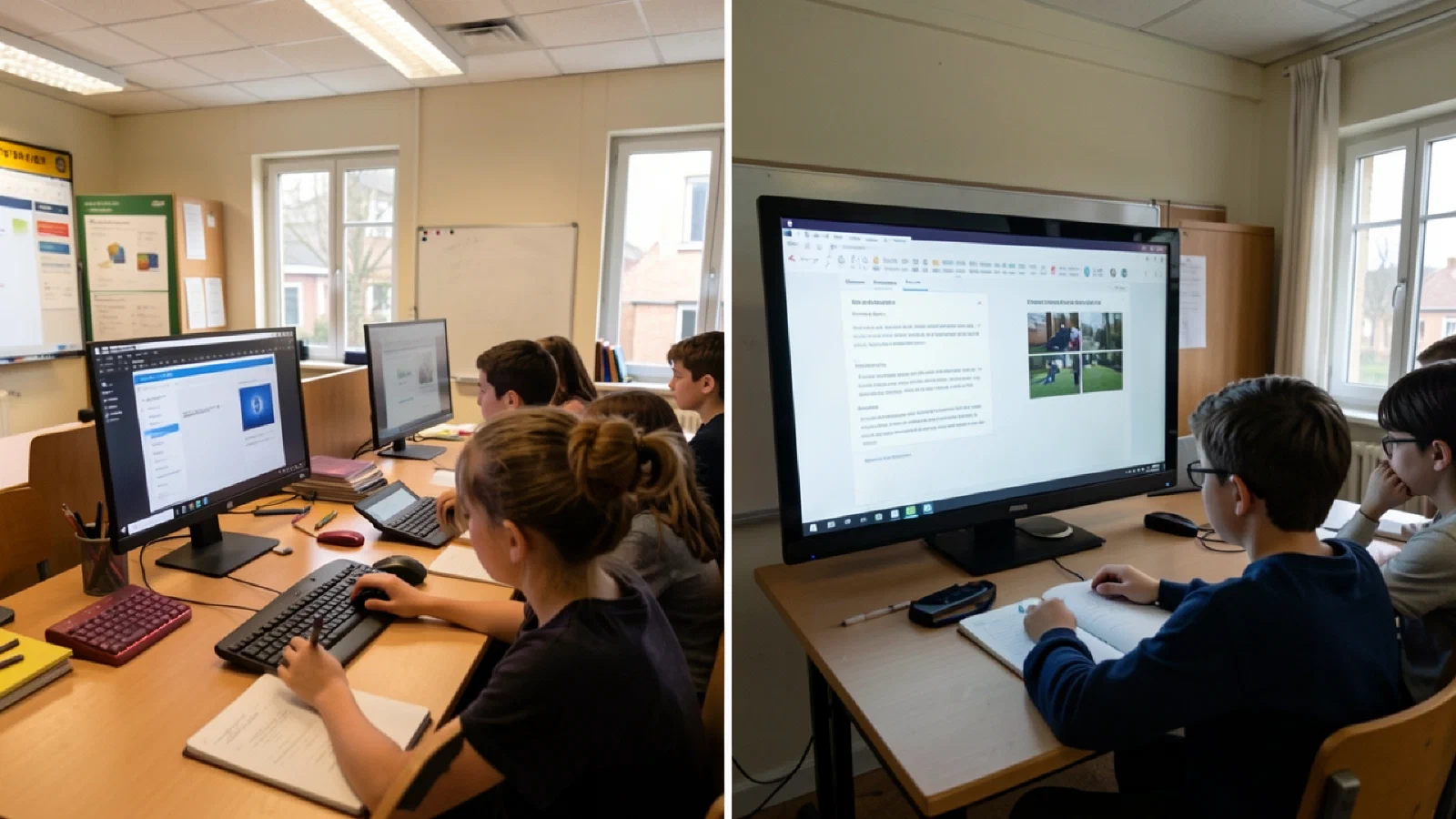
Two teachers are preparing for Monday. They have never met. They will never meet. They are both doing the best they can.
Marisol Vasquez teaches ninth-grade biology at a school in a wealthy suburb of Dallas. The school spent eighteen months developing its AI integration framework. There were committees. There was professional development. There was a consultant, whose fee Marisol does not know but suspects was significant. The framework distinguishes between “product tasks” and “process tasks,” a distinction Marisol finds useful. Product tasks are the ones where the output matters: write a lab report, compile research findings, generate a data visualization. For these, AI assistance is permitted and taught explicitly, because the professional world will use these tools and students should learn to use them well. Process tasks are the ones where the struggle matters: work through a genetics problem, construct an argument from conflicting evidence, design an experiment to test a hypothesis. For these, AI is restricted, and the restriction is enforced through in-class work, oral examination, and the kinds of assignments that cannot be completed by handing a prompt to a chatbot.
Marisol has a coffee mug from a teaching conference she attended in Austin two years ago. It says “Assessment Is a Conversation” in a font that she finds slightly embarrassing but that she has not replaced because the mug is the right size and the sentiment, stripped of the font, is something she believes.
James Okonkwo teaches ninth-grade biology in a school in rural East Texas, ninety miles from Marisol’s. His school lost its only other science teacher in October to a hospital laboratory that pays forty percent more. The district cannot fill the position. James now teaches four sections of biology, two sections of environmental science, and a section of physical science that he is not certified to teach but that the principal has asked him to cover because the alternative is a permanent substitute who has not been found.
He is using an AI tutoring platform for the environmental science sections. Not because he chose to. Because the students would otherwise have no instruction in the subject. The platform delivers content, generates questions, provides feedback on written responses, and adapts its difficulty level to each student’s demonstrated performance. It is, by every available metric, better than a permanent substitute who has not been found. It is not a teacher.
James does not have a coffee mug from a conference. He has not attended a conference in three years. The professional development budget was cut when the district’s property tax revenue declined after the largest local employer automated its warehouse operations.
The Divergence#
The two curricula are not a metaphor. They are a description of what is already happening in American education, and the divergence between them is compounding in ways that will be visible in the capacities of the students they produce before those students finish secondary school.
Marisol’s students are learning to use AI as a cognitive tool within a framework designed to protect the developmental experiences that produce judgment. They are learning when AI assistance helps and when it substitutes for the struggle the learning requires. They are practicing the distinction between product and process in real time, with a teacher who has the training, the class size, and the institutional support to enforce the distinction thoughtfully. They are developing judgment about AI itself: when to trust it, when to question it, when to set it aside and do the work themselves.
James’s students in the AI-tutored sections are receiving content. The content is accurate. The platform is patient. The adaptive difficulty is well-calibrated to performance metrics. What the students are not receiving is the calibrated human judgment that the previous essay described: the teacher who watches a student struggle and decides whether to intervene. The teacher who knows that this student needs to sit with the confusion a little longer and that student has crossed from productive failure into genuine distress. The teacher who asks the question that the student did not know they needed to be asked.
The divergence is not between good schools and bad schools. It is between schools that can afford to use AI thoughtfully and schools that must use AI as a substitute for what they cannot afford.
Both uses are rational. Marisol’s school made a deliberate investment in an AI framework because it had the resources, the stability, and the institutional capacity to do so. James’s school adopted AI tutoring because the alternative was no instruction at all. Neither decision is wrong. Both are responses to the conditions each school actually faces. The problem is not the decisions. The problem is that the conditions differ, and the difference compounds.
What Compounds#
The compounding is the part of this argument that is hardest to hear and most important to sit with.
A student who spends four years developing judgment, calibrated difficulty tolerance, and the capacity for sustained attention alongside AI tools will use AI differently at twenty-two than a student who spent four years receiving AI-delivered content. The first student will treat AI as a tool subordinate to their own judgment. The second student will treat AI as a source of answers. The difference is not about intelligence or motivation. It is about the developmental experiences each student had access to, which were determined by the resources of the institutions they attended, which were determined by the property tax base of the neighborhoods they grew up in.
This is the invisible tiers argument from The Invisible Tiers, applied to education. The interface is the same. Every student has access to the same AI tools. The experience behind the interface is not the same, because the experience depends on what the institution surrounding the tool provides, and the institutions provide radically different things depending on what they can afford.
The compounding operates across generations. A parent who developed judgment uses AI as a tool and models that use for their children. A parent who received AI-delivered content uses AI as a source and models that use. The child inherits not the knowledge, which is freely available to everyone, but the relationship to AI, which is transmitted through the developmental environment and is not freely available at all.
The knowledge gap is closing. The judgment gap is opening. And the judgment gap compounds in ways the knowledge gap never did, because judgment determines what you do with the knowledge, and what you do with it determines everything downstream.
The Global Dimension#
The divergence within wealthy nations is a preview. The global version is larger.
Across the developing world, AI is arriving in educational systems that face genuine emergencies: teacher shortages, geographic isolation, language barriers, infrastructure limitations that make conventional schooling impossible for millions of children. In these contexts, AI-delivered content is not a degraded substitute for something better. It is the first instruction many children have ever received. The improvement is real. A child in rural Rajasthan who receives AI-delivered mathematics instruction, in her own language, calibrated to her pace, is receiving something she would otherwise not have received at all. The comparison is not between AI instruction and a well-resourced classroom. It is between AI instruction and nothing.
This is important to hold. The global south’s use of AI in education is meeting a real crisis, and meeting it with a tool that is, for many purposes, better than the status quo. Content delivery at scale, in local languages, adapted to individual pace: these are achievements. They matter. They reach children who were previously unreached.
And they do not develop judgment.
The wealthy nations that are investing in AI-augmented education, the schools like Marisol’s, are building the capacity to distinguish between product and process, to protect the developmental experiences that judgment requires, to use AI as a cognitive tool within a framework of human calibration. The developing nations that are deploying AI to meet educational emergencies are, understandably, focused on the emergency: getting content to children who have none.
The divergence compounds across a generation. The children in wealthy contexts who develop judgment alongside AI will enter the global economy as the people who direct AI systems. The children in developing contexts who receive AI-delivered content will enter the global economy as the people who use AI systems within parameters set by others. The hierarchy this produces is not a hierarchy of intelligence. It is a hierarchy of formation, and the formation divergence begins in childhood, in the gap between a school that can afford to be thoughtful and a school that is grateful to have anything at all.
I wonder whether the organizations funding AI education in the developing world have considered this. Not whether AI content delivery is better than no instruction. It is. Whether AI content delivery, deployed at scale without the human calibration layer that wealthy nations are building, produces a generation whose relationship to AI is fundamentally different from the generation being formed in wealthy contexts. And whether that difference, compounding across the decades when these children enter adulthood, creates a new form of the dependency that development economics has been trying to escape for sixty years.
What Would Be Required#
The honest answer is expensive and specific. Making the augmentation approach available across the resource gap requires not AI systems, which are increasingly available at low cost, but the human infrastructure that makes the augmentation approach work: teachers with the training to distinguish product from process, class sizes that allow individual calibration, institutional stability that permits multi-year framework development, professional development budgets that sustain the teachers’ own formation.
This is the unsexy investment. The AI system is cheap. The teacher who knows how to use it well is expensive. The institution that supports the teacher is more expensive. The policy environment that funds the institution is the most expensive of all, and the most resistant to change, because it requires sustained political commitment to a form of investment whose returns are invisible for a generation.
Marisol’s school is not expensive because it bought an AI framework. The framework cost less than the consultant. The school is expensive because it has twenty-two students per class, experienced teachers who stay because the pay is competitive, a principal who protects professional development time, and a community whose property tax base can fund all of this. The AI framework works because the human infrastructure supports it. Without the human infrastructure, the framework is a document in a binder.
The technology is not the constraint. The constraint is the same constraint it has always been: the willingness to invest in the human infrastructure that makes the technology developmental rather than merely convenient.
James knows this. He does not need research to tell him. He can see it in the difference between his biology sections, where he is present, and his environmental science sections, where the AI is present without him. The biology students ask questions the AI would not have prompted. They make connections between the textbook and the field outside the window. They argue with each other about experimental design in ways that produce, occasionally, the kind of confusion that his training tells him is the beginning of understanding.
The environmental science students complete modules. Their scores are adequate. Their questions are addressed. They are not, as best he can tell, being formed by the experience. They are being served by it.
He does not blame the platform. He is grateful for the platform. Without it, those students would have nothing.
He wishes they could have what his biology students have. He is one person. There are not enough of him.
The Mug and the Missing Teacher#
Marisol will go to another conference next year. She will bring back another mug, or a tote bag, or a notebook with a slogan she will find slightly embarrassing and slightly true. She will refine her framework. She will write a paper about her approach to AI integration that will be cited in policy documents that James will not read because he does not have time to read policy documents because he is teaching seven sections across three subjects.
James will keep teaching. The position will remain unfilled. The AI platform will improve. His students in the tutored sections will learn content and not develop judgment, and the students in his sections will develop both, and the difference between the two groups will be invisible on the standardized tests because standardized tests measure content, not judgment, and the systems that fund and evaluate schools measure what standardized tests measure.
The divergence will not appear in any metric the system currently tracks. It will appear in the students’ lives, years later, in the difference between a person who learned to navigate confusion and a person who learned to avoid it. In the difference between someone who questions the AI’s output and someone who accepts it. In the difference between the person who directs the system and the person the system directs.
Marisol’s mug says assessment is a conversation. James’s assessment is a platform. Both are doing their best. The gap between their bests is the gap the system produces and the system does not see.
This is the third essay in Arc 5 of The Reshaped World. The arc’s examination of education as civilizational system here confronts the divergence already underway: who receives AI as augmentation within a human framework and who receives AI as substitute for one. The divergence compounds across generations and across the global north-south divide. The essay that follows, The Convergent Credential, asks what credential could certify the capacities the learning civilization actually needs, and why no such credential exists.
References#
Educational Inequality and Resource Disparities
Kozol, Jonathan. Savage Inequalities: Children in America’s Schools. Crown, 1991.
Darling-Hammond, Linda. The Flat World and Education: How America’s Commitment to Equity Will Determine Our Future. Teachers College Press, 2010.
Reardon, Sean F. “The Widening Academic Achievement Gap between the Rich and the Poor: New Evidence and Possible Explanations.” Whither Opportunity? Rising Inequality, Schools, and Children’s Life Chances, edited by Greg J. Duncan and Richard J. Murnane, Russell Sage Foundation, 2011, pp. 91-116.
AI in Education and the Global South
Trucano, Michael. AI in Education in Developing Countries: Promising Uses and Potential Risks. World Bank, 2023.
Major, Louis, et al. “A Systematic Review of AI in Education in the Global South.” British Journal of Educational Technology, vol. 54, no. 4, 2023, pp. 922-944.
Teacher Quality, Retention, and Rural Schools
Ingersoll, Richard M. “Teacher Turnover and Teacher Shortages: An Organizational Analysis.” American Educational Research Journal, vol. 38, no. 3, 2001, pp. 499-534.
Podolsky, Anne, et al. Solving the Teacher Shortage: How to Attract and Retain Excellent Educators. Learning Policy Institute, 2016.
Compounding Educational Disadvantage
Heckman, James J. “Skill Formation and the Economics of Investing in Disadvantaged Children.” Science, vol. 312, no. 5782, 2006, pp. 1900-1902.
Lareau, Annette. Unequal Childhoods: Class, Race, and Family Life. University of California Press, 2003.
Sen, Amartya. Development as Freedom. Alfred A. Knopf, 1999.
How this essay connects to others across The Approximate Mind.
- Kozol, Jonathan. Savage Inequalities: Children in America’s Schools. Crown, 1991.
- Darling-Hammond, Linda. The Flat World and Education: How America’s Commitment to Equity Will Determine Our Future. Teachers College Press, 2010.
- Reardon, Sean F. “The Widening Academic Achievement Gap between the Rich and the Poor: New Evidence and Possible Explanations.” Whither Opportunity? Rising Inequality, Schools, and Children’s Life Chances, edited by Greg J. Duncan and Richard J. Murnane, Russell Sage Foundation, 2011, pp. 91-116.
- Trucano, Michael. AI in Education in Developing Countries: Promising Uses and Potential Risks. World Bank, 2023.
- Major, Louis, et al. “A Systematic Review of AI in Education in the Global South.” British Journal of Educational Technology, vol. 54, no. 4, 2023, pp. 922-944.
- Ingersoll, Richard M. “Teacher Turnover and Teacher Shortages: An Organizational Analysis.” American Educational Research Journal, vol. 38, no. 3, 2001, pp. 499-534.
- Podolsky, Anne, et al. Solving the Teacher Shortage: How to Attract and Retain Excellent Educators. Learning Policy Institute, 2016.
- Heckman, James J. “Skill Formation and the Economics of Investing in Disadvantaged Children.” Science, vol. 312, no. 5782, 2006, pp. 1900-1902.
- Lareau, Annette. Unequal Childhoods: Class, Race, and Family Life. University of California Press, 2003.
- Sen, Amartya. Development as Freedom. Alfred A. Knopf, 1999.