The Volume Problem
TAM-RWR.1-01 · The Reshaped World, Arc 1: The Built World After Work · The Approximate Mind
The Reshaped World, Part 1-01 of 7. This essay begins the series’ examination of the built environment after the volume, not merely the geography, of human economic activity reorganizes.
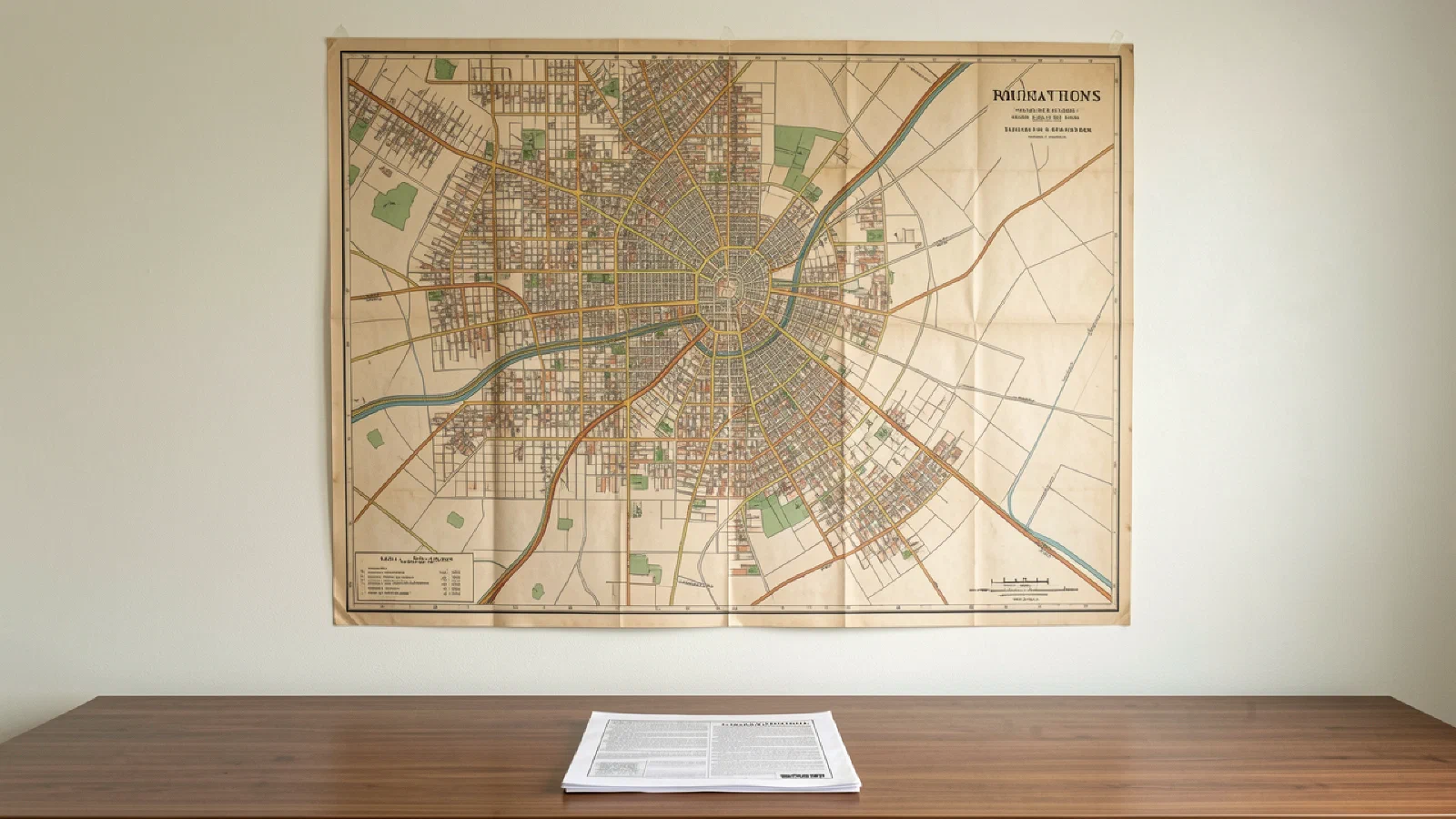
The map on Diane’s wall is from 1965. She put it there when she started as assistant city planner sixteen years ago, and she has not taken it down, partly because it would leave a large pale rectangle on the paint and partly because she finds it useful. Not for reference. For orientation.
The city on the map had 60,000 people. Hers has 31,000.
The buildings from the map are mostly still there.
The Mild Version and the Hard Version#
This is not the story most people are telling about the built environment right now. The dominant version of that story is about downtown office towers half-empty on Tuesdays, about post-pandemic commuting patterns, about companies renegotiating their square footage and developers working out what to do with Class B office space in cities where Class A is still oversubscribed. That version has a solution built into it: conversion. Rezone. Adapt. The office becomes residential, the residential market stays healthy enough to absorb the conversion, and over the course of a decade or two the city’s inventory reshuffles into something appropriate for how people now work.
That version is real. It is also the mild version, affecting the places with options.
The harder version is places like Diane’s, where the economic activity didn’t shift spatially.
It ended.
The distinction matters more than it sounds. When work relocates, the city has an adaptation problem. Workers commute to different nodes. Retail follows population. Offices empty here and fill there. The built environment faces pressure to shift its geography, which is difficult and expensive and sometimes impossible, but it is at least a problem with the right shape for policy intervention: identify the mismatch, design the incentive, wait for the market to respond.
When work disappears, the city has a demand reduction problem.
The demand reduction problem has a different shape. The textile mill that closed in 1987 and then the one that closed in 2003 and then the distribution center that automated in 2018 did not relocate to another zip code. The work left the economy. The supply chain compressed around it. A facility that employed six hundred people at its peak employs forty-one today, and forty-one people do not need the lunch spots and dry cleaners and service providers and school capacity that six hundred needed. The downstream contraction is not incidental. It is arithmetic.
Diane’s city had eighteen restaurants on Main Street in 1988. It has four now. The four that remain are not struggling. They are not in a slump. They are the correct number of restaurants for a downtown serving 31,000 people, roughly half of whom are retired or in school or not eating downtown on a Tuesday. The fourteen that closed were not failures of management or concept. They were a census correction.
The Infrastructure Inheritance#
The built environment, of course, did not shrink with the census.
This is the part that gets expensive. Infrastructure is built for anticipated demand, and the demand it was built for does not un-build it when it leaves. Water systems, road networks, school facilities, civic buildings, the pipes under the streets: these were sized for a city expected to grow or at least hold. They are now maintained, at least partially, by a tax base that is 48 percent of what it was when the sizing decisions were made.
The infrastructure inheritance is not a transition state. It is not a condition between one stable configuration and another. Diane has been doing this job long enough to watch three different city administrations develop three different plans for returning the commercial downtown to vitality. The fourth administration is working on a fourth plan. She helps write them. She does not believe they will work, not because the people writing them are bad planners or naive politicians, but because the plans are trying to solve an adaptation problem that is actually a demand reduction problem, and adaptation plans cannot fix demand reduction.
A city that had sixty thousand people and then lost twenty-nine thousand over sixty years does not have a downtown vitality problem. It has a population arithmetic problem. The arithmetic does not respond to tax increment financing.
The cases like Diane’s are numerous and dispersed: mill towns in the Carolinas and the Piedmont, agricultural service towns whose hinterlands consolidated from three thousand farms into three hundred, regional retail centers that lost their population base to larger metros over thirty years of slow migration, small city downtowns serving shrinking hinterlands in ways that never made the economic news because no single closure was large enough to warrant a story. The closures compounded instead, ten a year for twenty years until the compound became visible to anyone paying attention and invisible to anyone who was not.
They do not appear in most policy conversations about the built environment, which tend to focus on the cities where the argument about adaptation is genuinely interesting and where the solutions, whatever they are, will affect the greatest number of people. I understand the logic of that focus. But I wonder sometimes whether it is also a form of looking away from the places where the argument about volume reduction is most advanced, most legible, and most honest about where the broader story is going.
What Automation Actually Does to the Ecosystem#
The job loss from automation is the visible part. A company installs a system that does the work of two hundred people. One hundred and eighty people lose their jobs. A local newspaper writes about it. This is real and consequential, but it is not the end of the calculation.
The people who still work in the automated facility no longer stop at the gas station on the way in. They no longer buy lunch from the cart outside the front gate. Their children no longer attend the schools built when this facility employed six hundred and the one down the road employed four hundred more. The company’s payroll no longer supports the accountants and insurance brokers and janitorial services and contract logistics providers that a large human-employing facility requires. The automated facility is more economically self-contained than the human facility it replaced. It buys power and bandwidth and the occasional specialized repair service. It does not buy community.
This compression is invisible in most accounts of automation’s effects because it is distributed across every sector of the downstream economy rather than concentrated in any single one. The gas station doesn’t close because of automation. It closes because of a twenty-percent reduction in morning traffic, which nobody attributes to the facility upgrade three miles east, which happened five years before the closure. The cause and the effect are separated by enough time and enough intermediary steps that the connection is easy to miss, especially if you weren’t watching the whole sequence.
The full calculation, run honestly, would show automation’s effect as a multiplier rather than a simple subtraction. Each job eliminated from a human-employing facility removes something closer to two and a half jobs from the surrounding economy, through the downstream compression of every service that job supported. The number is not exact, and it varies by sector and by the density of the local economy’s existing connections. But the direction is not ambiguous: the ecosystem shrinks by more than the facility reports.
Diane’s city has the data, scattered across building permit records and business license renewals and water meter cancellations. She has thought about assembling it into a single number. She has not done it. She suspects the number would be clarifying in ways that would be difficult to present to a city council whose members mostly want to hear about the new business that just opened on the third block of Main.
The Places Being Built Right Now#
The global dimension of this rarely enters the domestic conversation, but Diane keeps a second map on her wall, smaller, a world map she printed from the internet and pinned next to the 1965 map of her city.
She got interested in the global picture three years ago when a delegation from a provincial planning office in Vietnam visited the city, studying American small cities for lessons applicable to their own industrial development plans. She spent two days with the delegation. At the end, over dinner at one of the four Main Street restaurants, she told the lead planner something she hadn’t quite formulated before: that she was not sure American small cities were the right model to study.
The industrial city infrastructure that her city built in the middle of the twentieth century, the infrastructure that allowed it to employ sixty thousand people and support the schools and water systems and road networks that now serve thirty-one thousand, is being built right now in cities across the developing world. Lagos. Dhaka. Provincial cities in Vietnam and Indonesia and Ethiopia whose industrial base is growing because labor costs make it rational and whose planners are drawing on the American mid-century model because it worked, for a while, in the places that pioneered it.
At the same time, in the cities that pioneered the model, that model is becoming obsolete under the pressure of automation. The destination is reorganizing as the travelers are in transit.
I wonder sometimes whether the people designing industrial policy for developing economies have looked at the timeline carefully. Not whether industrialization will reach them. Whether it will reach them before automation makes the economic model it depends on unsustainable. The places currently industrializing are building the infrastructure that, if the American experience is any guide, will serve them for thirty years before automation begins compressing the economic ecosystem that makes that infrastructure financially viable. Thirty years is a real gain. It is also not the foundation that anyone would choose to build on if they could see the whole timeline.
The Vietnamese planner listened carefully at dinner. Then she said: “We understand the risk. We are not aware of a better option.” She was probably right.
The Proposal#
Diane’s most difficult current assignment is a thirty-seven-page proposal she has been meaning to finish reviewing for six weeks. It recommends consolidating three elementary schools into one.
The three buildings that would close were constructed in 1962, when the city’s school-age population was three times its current size. They are solid buildings. The floors do not creak. The roofs are recently repaired. Two of them are named after local figures who are mostly not remembered: a textile mill owner who donated land for a park that was paved over in 1974, a school board member who served for twenty-two years and whose daughter still lives in the city and attends the Methodist church on Harrison Street.
She has delayed the review for two years. She is not sure why. The proposal is sound. The arithmetic is not ambiguous. A city with 31,000 people does not need the school capacity built for 60,000, and the cost of maintaining underutilized facilities compounds annually in ways that will eventually force the decision regardless of what she recommends.
The buildings are not bad buildings. She knows this is part of what makes the review difficult. If the buildings were failing, the decision would be easier. You close what cannot be maintained. You don’t close what is in good repair.
But the case for closing them is not about the buildings. It is about the population they were built for, which is not coming back. The 1965 map is not a record of where the city is going. It is a record of what the city was built for, and the distance between those two things is the city planner’s actual working environment: not the distance between the current city and some imagined future version, but the distance between the built city and the population it now serves.
She has not taken the map down. It is not nostalgia, or not only nostalgia. The map of what the city was built for and the map of what the city is now belong on the same wall. You need both to understand what you are actually managing.
The proposal will be reviewed by the end of the month.
References#
Urban Economics and Demand Reduction
Glaeser, Edward L. Triumph of the City: How Our Greatest Invention Makes Us Richer, Smarter, Greener, Healthier, and Happier. Penguin Press, 2011.
Kline, Patrick, and Enrico Moretti. “Local Economic Development, Agglomeration Economies, and the Big Push: 100 Years of Evidence from the Tennessee Valley Authority.” Quarterly Journal of Economics, vol. 129, no. 1, 2014, pp. 275–331.
Moretti, Enrico. The New Geography of Jobs. Houghton Mifflin Harcourt, 2012.
Deindustrialization and the Built Environment
Bluestone, Barry, and Bennett Harrison. The Deindustrialization of America: Plant Closings, Community Abandonment, and the Dismantling of Basic Industry. Basic Books, 1982.
Clement, Douglas. “Globalization and Deindustrialization.” Region, Federal Reserve Bank of Minneapolis, 2007.
Hollander, Justin B. Sunburnt Cities: The Great Recession, Depopulation, and Urban Planning in the American Sunbelt. Routledge, 2011.
Automation and Downstream Effects
Acemoglu, Daron, and Pascual Restrepo. “Robots and Jobs: Evidence from US Labor Markets.” Journal of Political Economy, vol. 128, no. 6, 2020, pp. 2188–2244.
Autor, David H. “Work of the Past, Work of the Future.” AEA Papers and Proceedings, vol. 109, 2019, pp. 1–32.
Muro, Mark, et al. Automation and Artificial Intelligence: How Machines Are Affecting People and Places. Brookings Institution, 2019.
Infrastructure Maintenance and Shrinking Cities
Mallach, Alan. The Divided City: Poverty and Prosperity in Urban America. Island Press, 2018.
Oswalt, Philipp, editor. Shrinking Cities. Volume 1: International Research. Hatje Cantz, 2005.
Schindler, Seth. “Detroit after Bankruptcy: A Case of Degrowth Machine Politics.” Urban Studies, vol. 53, no. 4, 2016, pp. 818–836.
Global Industrialization and Transition Risk
Rodrik, Dani. “Premature Deindustrialization.” Journal of Economic Growth, vol. 21, no. 1, 2016, pp. 1–33.
World Bank. World Development Report 2019: The Changing Nature of Work. World Bank, 2019.
How this essay connects to others across The Approximate Mind.
- Glaeser, Edward L. Triumph of the City: How Our Greatest Invention Makes Us Richer, Smarter, Greener, Healthier, and Happier. Penguin Press, 2011.
- Kline, Patrick, and Enrico Moretti. “Local Economic Development, Agglomeration Economies, and the Big Push: 100 Years of Evidence from the Tennessee Valley Authority.” Quarterly Journal of Economics, vol. 129, no. 1, 2014, pp. 275–331.
- Moretti, Enrico. The New Geography of Jobs. Houghton Mifflin Harcourt, 2012.
- Bluestone, Barry, and Bennett Harrison. The Deindustrialization of America: Plant Closings, Community Abandonment, and the Dismantling of Basic Industry. Basic Books, 1982.
- Clement, Douglas. “Globalization and Deindustrialization.” Region, Federal Reserve Bank of Minneapolis, 2007.
- Hollander, Justin B. Sunburnt Cities: The Great Recession, Depopulation, and Urban Planning in the American Sunbelt. Routledge, 2011.
- Acemoglu, Daron, and Pascual Restrepo. “Robots and Jobs: Evidence from US Labor Markets.” Journal of Political Economy, vol. 128, no. 6, 2020, pp. 2188–2244.
- Autor, David H. “Work of the Past, Work of the Future.” AEA Papers and Proceedings, vol. 109, 2019, pp. 1–32.
- Muro, Mark, et al. Automation and Artificial Intelligence: How Machines Are Affecting People and Places. Brookings Institution, 2019.
- Mallach, Alan. The Divided City: Poverty and Prosperity in Urban America. Island Press, 2018.
- Oswalt, Philipp, editor. Shrinking Cities. Volume 1: International Research. Hatje Cantz, 2005.
- Schindler, Seth. “Detroit after Bankruptcy: A Case of Degrowth Machine Politics.” Urban Studies, vol. 53, no. 4, 2016, pp. 818–836.
- Rodrik, Dani. “Premature Deindustrialization.” Journal of Economic Growth, vol. 21, no. 1, 2016, pp. 1–33.
- World Bank. World Development Report 2019: The Changing Nature of Work. World Bank, 2019.